Back
Weech Formula for Weight and Height: Pediatrics High-Yield Guide for NEET PG and USMLE (2026)
Master Weech formula calculations for pediatric weight and height assessment. Complete guide with MCQ patterns, malnutrition grading, and mnemonics for NEET PG 2026.
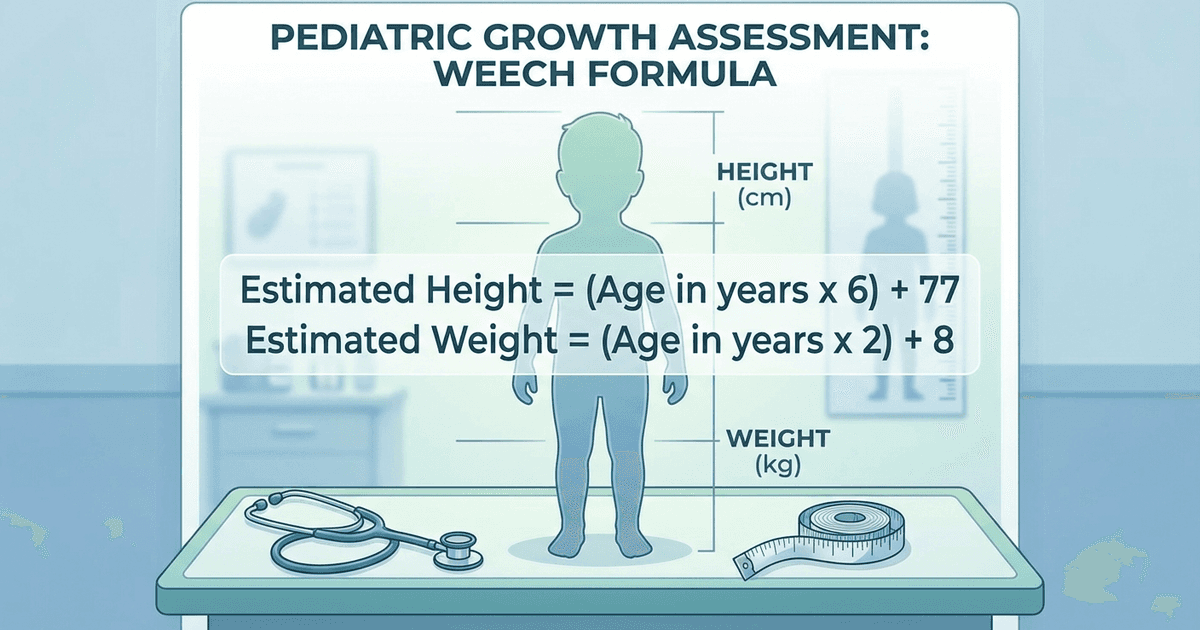
Weech Formula for Weight and Height: Pediatrics High-Yield Guide for NEET PG and USMLE (2026)
You are probably staring at a pediatrics question right now, trying to remember if a 3-year-old weighing 10 kg is normal or concerning. The examiner wants you to calculate expected weight using some formula, and you cant recall which one applies when.
NEET PG throws 15-20 pediatrics questions at you. At least 3-4 will test growth assessment formulas. The Weech formula is your go-to calculation for children aged 1-6 years — and its tested repeatedly because its practical, memorable, and clinically relevant.
Here is everything you need to master the Weech formula for both NEET PG and USMLE Step 1. No fluff, just the formulas that actually show up in exams and how to apply them correctly.
What is the Weech Formula?
The Weech formula calculates expected weight and height for children based on age. Created by pediatrician A. Ashley Weech in 1954, it provides quick bedside calculations for assessing growth in children aged 1-6 years.
Why Weech matters for exams:
Appears in 15-20% of pediatric growth questions
Simple mental math (no calculators needed)
Directly tests your understanding of normal growth patterns
Often combined with malnutrition scenarios
The formula bridges the gap between complex WHO growth charts and quick clinical assessment. When you see "calculate expected weight for a 4-year-old" — think Weech.
Core Weech Formulas for Weight
For Children 1-6 Years
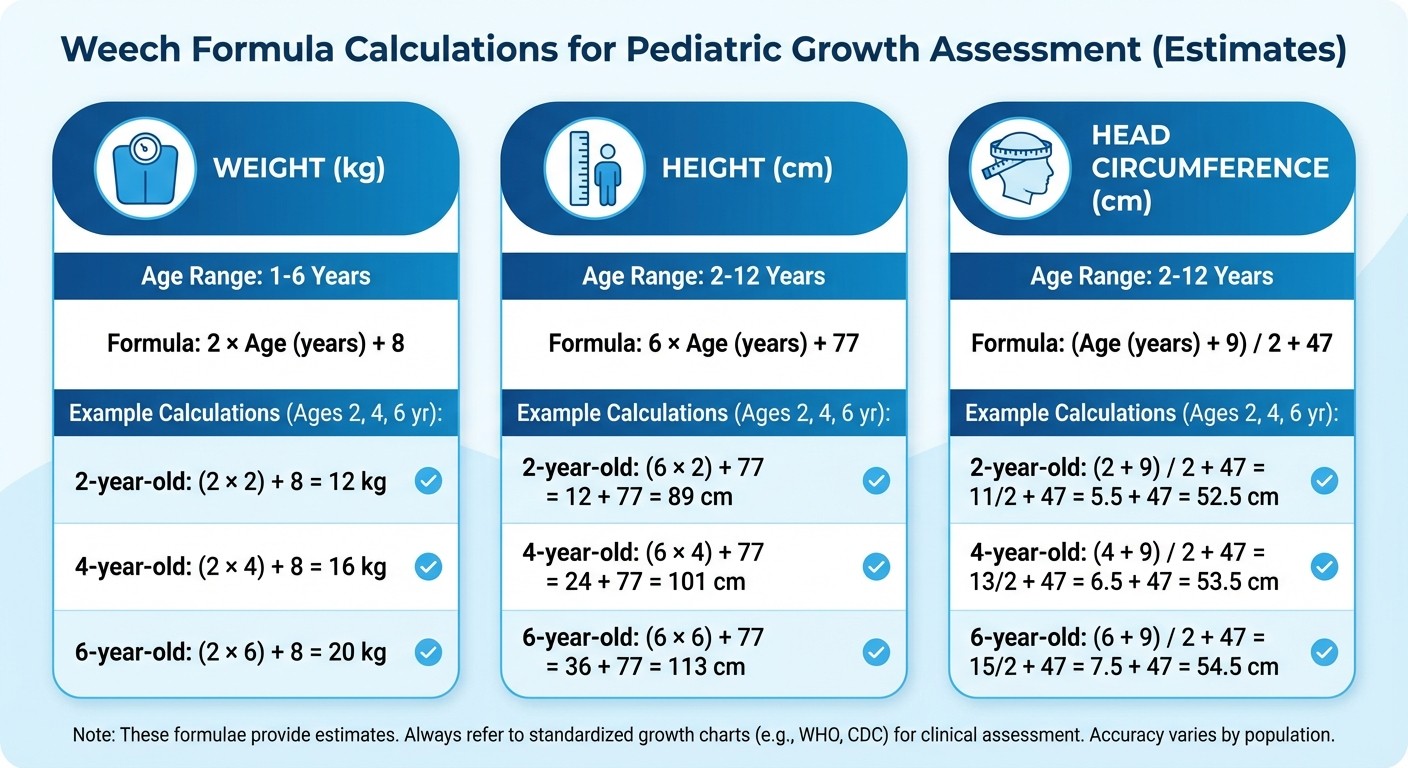
Expected Weight (kg) = 8 + (2 × age in years)
This is the money formula. Memorize it.
Examples:
2-year-old: 8 + (2 × 2) = 12 kg
4-year-old: 8 + (2 × 4) = 16 kg
6-year-old: 8 + (2 × 6) = 20 kg
For Children 6-12 Years (Extended Weech)
Expected Weight (kg) = 2 × (age + 5) Examples:
8-year-old: 2 × (8 + 5) = 26 kg
10-year-old: 2 × (10 + 5) = 30 kg
Memory Aid: The "8 Plus Double" Rule
"At 1 year, start with 8. Add double their age."
1-year-old: 8 + (2 × 1) = 10 kg
3-year-old: 8 + (2 × 3) = 14 kg
5-year-old: 8 + (2 × 5) = 18 kg
Height Formulas for Clinical Assessment
Weech Height Formula (1-6 Years)
Expected Height (cm) = 75 + (5 × age in years) Examples:
2-year-old: 75 + (5 × 2) = 85 cm
4-year-old: 75 + (5 × 4) = 95 cm
6-year-old: 75 + (5 × 6) = 105 cm
Memory Aid: "75 Plus Five"
"At birth, aim for 75. Add 5 cm each year."
This formula assumes normal linear growth velocity of 5 cm per year during the toddler and preschool period.
Head Circumference Assessment
Weech Head Circumference Formula
Expected HC (cm) = 35 + (age in years × 1) Examples:
1-year-old: 35 + 1 = 36 cm
3-year-old: 35 + 3 = 38 cm
5-year-old: 35 + 5 = 40 cm
Clinical note: Head circumference growth slows significantly after age 2. This formula is less precise than weight calculations but useful for quick screening.
Clinical Applications in Growth Assessment
Identifying Malnutrition
Grade I Malnutrition: 75-80% of expected weight Grade II Malnutrition: 60-75% of expected weight Grade III Malnutrition: <60% of expected weight Exam scenario: "A 3-year-old weighs 9 kg. What grade of malnutrition?" Solution:
Expected weight: 8 + (2 × 3) = 14 kg
Actual percentage: (9/14) × 100 = 64%
Grade: II malnutrition (60-75% range)
Failure to Thrive Assessment
Definition: Weight below 5th percentile OR crossing two major percentiles downward Weech application:
Calculate expected weight
Compare with actual weight
If <80% expected weight → investigate further
Red flags requiring immediate evaluation:
Weight <60% of expected (Grade III malnutrition)
Height <90% of expected
Head circumference <95% of expected
Comparison with Other Growth Standards
Weech vs WHO Growth Charts
Aspect | Weech Formula | WHO Charts |
|---|---|---|
Speed | Instant calculation | Requires chart lookup |
Accuracy | ±10% variance | Precise percentiles |
Clinical use | Quick screening | Detailed assessment |
Exam relevance | High-yield for MCQs | Complex for timed tests |
Weech vs BMI Calculations
BMI = Weight (kg) / Height² (m) When to use each:
Weech: Quick age-based screening
BMI: Obesity/overweight assessment in >2 years
Both: Comprehensive nutritional evaluation
Exam tip: If the question mentions "calculate expected weight for age" → use Weech. If it asks about "obesity screening" → use BMI.
High-Yield MCQ Patterns for NEET PG
Pattern 1: Direct Formula Application
Common stem: "A 4-year-old child should weigh approximately..." Answer approach:
1. Identify age (4 years)
2. Apply Weech: 8 + (2 × 4) = 16 kg
3. Look for closest option
Pattern 2: Malnutrition Grading
Common stem: "A 5-year-old weighs 12 kg. The grade of malnutrition is..." Answer approach:
1. Expected weight: 8 + (2 × 5) = 18 kg
2. Percentage: (12/18) × 100 = 67%
3. Grade: II malnutrition
Pattern 3: Growth Velocity Assessment
Common stem: "A child's weight increased from 10 kg at age 1 to 14 kg at age 3. This represents..." Answer approach:
1. Expected at age 1: 8 + 2 = 10 kg ✓
2. Expected at age 3: 8 + 6 = 14 kg ✓
3. Conclusion: Normal growth velocity
Pattern 4: Multiple Parameter Assessment
Common stem: "A 3-year-old weighs 11 kg and measures 82 cm. Assessment?" Answer approach:
1. Expected weight: 14 kg → Actual: 79% (Grade I malnutrition)
2. Expected height: 90 cm → Actual: 91% (Mild stunting)
3. Combined: Protein-energy malnutrition with stunting
Quick Reference Table for Exams
Age | Expected Weight | Expected Height | Expected HC |
|---|---|---|---|
1 year | 10 kg | 80 cm | 36 cm |
2 years | 12 kg | 85 cm | 37 cm |
3 years | 14 kg | 90 cm | 38 cm |
4 years | 16 kg | 95 cm | 39 cm |
5 years | 18 kg | 100 cm | 40 cm |
6 years | 20 kg | 105 cm | 41 cm |
Pro tip: Print this table and keep it handy during pediatrics revision. The numbers become automatic after seeing them 20 times.
Practical Mnemonics for Memory
Weight Mnemonic: "Wait + Double"
Weech starts with Weight
8 (wait) + 2 (double) × age
"Wait 8, double their age"
Height Mnemonic: "Seventy-Five Plus Five"
At birth: approximately 50 cm
At 1 year: 75 cm baseline
Add 5 cm each year
"Seventy-five plus five times the years"
Complete Mnemonic: "8-2-75-5"
8 + 2 × age = weight
75 + 5 × age = height
Rhythm: "Eight plus two times age, seventy-five plus five times age"
Advanced Clinical Considerations
When Weech Formula May Not Apply
Avoid Weech in:
Preterm infants (use corrected age)
Children with chronic diseases
Genetic syndromes affecting growth
Severe acute malnutrition cases
Use modified approaches for:
Preterm babies: Subtract weeks premature from chronological age
Chronic kidney disease: Expect 10-15% lower weight
Congenital heart disease: Growth may lag by 6-12 months
Integration with WHO Z-Scores
Weech gives you the starting point. WHO Z-scores give you the precision. Clinical workflow:
1. Use Weech for quick assessment
2. If abnormal, plot on WHO charts
3. Calculate Z-scores for documentation
4. Follow-up based on percentile trends
Exam strategy: If question mentions "Z-score" or "percentile" → think WHO charts. If it says "expected weight" → think Weech.
How Oncourse AI Covers Pediatric Growth Topics
Oncourse transforms pediatric growth assessment from boring memorization into interactive problem-solving. Our adaptive MCQ system presents Weech formula questions in escalating difficulty — starting with direct applications, then moving to complex clinical scenarios.
What makes Oncourse different:
Pattern recognition: 500+ growth assessment MCQs that mirror actual NEET PG patterns
Adaptive learning: AI identifies if you consistently miss malnutrition grading vs direct calculations
Real-time explanations: Each wrong answer gets instant breakdown of the calculation steps
Spaced repetition: Weech formulas appear exactly when you are about to forget them
High-yield features for pediatrics:
Growth chart interpretation tools
Interactive malnutrition case studies
WHO vs Weech comparison modules
Timed practice matching exam conditions
Practice with pediatric growth assessment MCQs and reinforce learning using pediatric growth flashcards. Master complex cases through developmental screening lessons.
Common Exam Mistakes to Avoid
Mistake 1: Wrong Age Range Application
Error: Using infant formulas for toddlers Fix: Weech applies to 1-6 years. Below 1 year, use birth weight doubling/tripling rules
Mistake 2: Unit Confusion
Error: Mixing pounds with kilograms Fix: Weech always uses kilograms and centimeters
Mistake 3: Malnutrition Grade Boundaries
Error: Remembering wrong percentage cutoffs Fix: Grade I: 75-80%, Grade II: 60-75%, Grade III: <60%
Mistake 4: Ignoring Clinical Context
Error: Applying formulas blindly without considering the scenario Fix: Factor in prematurity, chronic illness, or genetic conditions
Practice Problems with Solutions
Problem 1
"A 30-month-old child weighs 10 kg. What is the nutritional status?"
Solution:
Age: 30 months = 2.5 years
Expected weight: 8 + (2 × 2.5) = 13 kg
Percentage: (10/13) × 100 = 77%
Answer: Grade I malnutrition (75-80%)
Problem 2
"Calculate the expected height for a 42-month-old child."
Solution:
Age: 42 months = 3.5 years
Expected height: 75 + (5 × 3.5) = 92.5 cm
Answer: Approximately 93 cm
Problem 3
"A 4-year-old weighs 18 kg and measures 98 cm. Assessment?"
Solution:
Expected weight: 8 + (2 × 4) = 16 kg → Actual: 112% (overweight)
Expected height: 75 + (5 × 4) = 95 cm → Actual: 103% (normal)
Answer: Overweight with normal linear growth
Frequently Asked Questions
What is the age range for Weech formula application?
Weech formulas are most accurate for children aged 1-6 years. For infants under 1 year, use birth weight doubling rules. For children over 6 years, consider BMI calculations alongside weight-for-age assessments.
How accurate is the Weech formula compared to WHO growth charts?
Weech provides approximately 85-90% accuracy for population-based screening. WHO charts offer precise percentile-based assessment but require chart lookup. For exam purposes, Weech is sufficient for quick calculations.
Can Weech formula be used for premature babies?
Use corrected age (chronological age minus weeks premature) when applying Weech formulas to preterm infants until age 2 years. After age 2, chronological age is typically used.
What if a child's weight falls between malnutrition grades?
Use the actual percentage to determine the grade. For example, 77% expected weight is Grade I malnutrition, while 73% is Grade II. The boundaries are: Grade I (75-80%), Grade II (60-75%), Grade III (<60%).
How often do Weech formulas appear in NEET PG?
Approximately 15-20% of pediatric questions involve growth assessment calculations. Weech formulas specifically appear in 3-5 questions per NEET PG exam, often combined with malnutrition or failure-to-thrive scenarios.
Should I memorize the extended Weech formula for 6-12 years?
The original Weech formula (1-6 years) is higher yield for exams. The extended formula appears less frequently but is worth knowing for comprehensive preparation, especially for USMLE Step 1.
Prepare smarter with Oncourse AI — adaptive MCQs, spaced repetition, and AI explanations built for NEET PG and USMLE. Download free on Android and iOS.