Back
USMLE Step 1 Is Pass/Fail Now — Here's What IMGs Actually Need to Do to Match in 2026
Complete IMG strategy for USMLE Step 1 pass/fail era. Step 2 CK targets, research requirements, USCE timeline, and specialty-specific matching advice for 2026.
USMLE Step 1 Is Pass/Fail Now — Here's What IMGs Actually Need to Do to Match in 2026
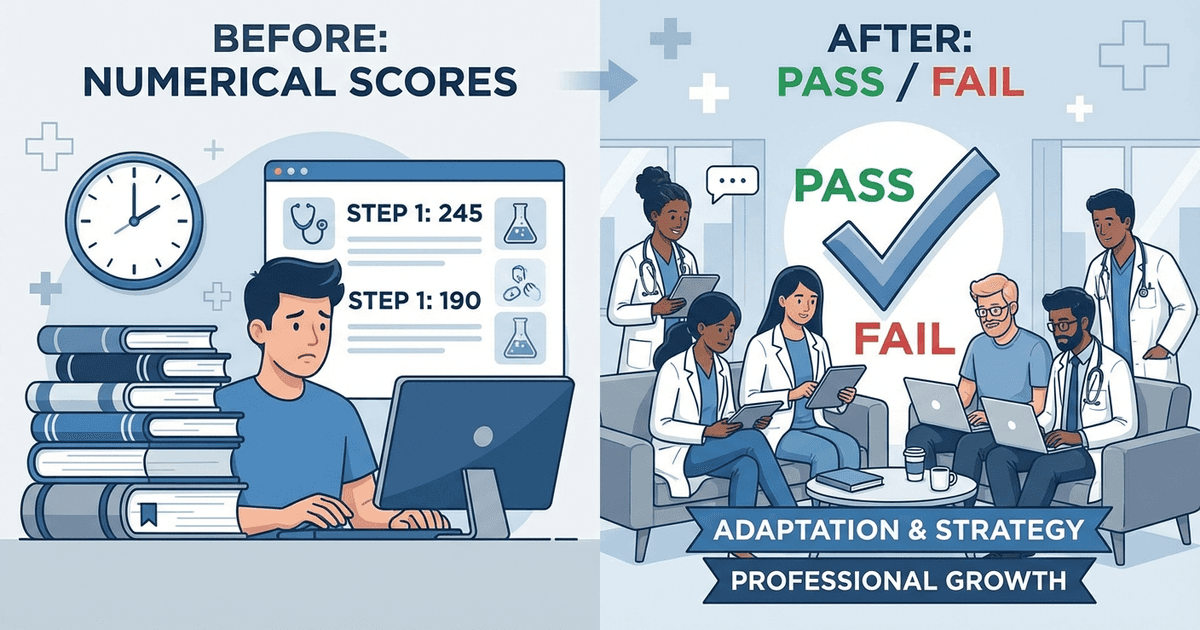
You opened your laptop to check if that 240+ Step 1 score was enough to make you competitive. Then reality hit. Step 1 scores dont exist anymore.
The USMLE Step 1 became pass/fail in January 2022, and if you are an IMG planning to match in 2026, the game has completely changed. No more using a stellar Step 1 score to overcome other application weaknesses. No more clear numerical benchmarks to aim for.
But here's what nobody is telling you: this change actually levels the playing field in ways that smart IMGs can exploit. While everyone panics about losing their score advantage, the successful candidates are quietly adapting their strategy to dominate the new metrics that matter.
Step 2 CK scores now carry 80% more weight. Research publications matter more than ever. And your Step 1 pass timing can make or break your application timeline.
If you have been following the old IMG playbook, this guide will completely rewire your approach to matching in 2026.
The Real Impact: What Changed and What Didnt
What Actually Changed
Step 1 transitioned to pass/fail reporting on January 26, 2022. Every test taken after this date shows only "Pass" or "Fail" on your transcript — no numerical score.
The numbers that matter:
Step 1 pass rate for IMGs: 78% (2024 data)
First-time pass rate: 82%
Repeat takers pass rate: 58%
Timeline impact: Most successful IMGs now take Step 1 within 2 years of graduation, not during medical school. The strategic delay allows better preparation without academic pressure.
What Didnt Change
Step 1 is still required for most residency programs. Failing Step 1 still eliminates you from consideration at 95% of programs. The exam content remains identical.
Critical insight: Programs still use Step 1 as a screening tool — they just cant differentiate between a 230 and 260 anymore. This means passing isnt enough; you need to prove your clinical knowledge through other channels.
Why Step 2 CK Is Now Your Make-or-Break Score
With Step 1 scores gone, Step 2 CK carries unprecedented weight in IMG applications. Program directors now use Step 2 CK as their primary academic filter.
The new Step 2 CK reality:
Target score for competitive specialties: 250+
Target score for IMG-friendly specialties: 240+
Below 220: Severely limits options
Step 2 CK Preparation Strategy for 2026
Timeline: Take Step 2 CK 6-8 months after Step 1 pass. This gives you time to build clinical knowledge without losing momentum. High-yield preparation approach: 1. UWorld Step 2 CK (2 passes minimum): 3,500+ questions with detailed explanations 2. AMBOSS Step 2 CK library: Comprehensive clinical vignettes 3. Practice our USMLE Step 2 CK preparation questions with AI explanations 4. Step 2 CK practice tests: NBMEs 9, 10, 11, 12 plus UWSA1 and UWSA2 Study schedule that works:
Weeks 1-8: UWorld first pass + content review
Weeks 9-12: AMBOSS question bank + weak area focus
Weeks 13-16: UWorld second pass + practice tests
Week 17: Final review and test-taking strategy
Master Step 2 CK with our comprehensive study plan — includes week-by-week schedules and score targets.
The New IMG Application Strategy: Beyond Test Scores
1. Research Publications Are Non-Negotiable
With Step 1 scores eliminated, research experience differentiates competitive candidates. Target these publication types:
High-impact options for IMGs:
Systematic reviews (easier to complete remotely)
Case reports from your home country clinical experience
Meta-analyses using existing data
International collaborations with US institutions
Realistic targets:
Minimum: 3 publications (1 first-author)
Competitive: 5+ publications (2+ first-author)
Timeline: Start research 18 months before application
2. US Clinical Experience (USCE) Strategy
USCE requirements have intensified post-Step 1 pass/fail. Program directors need alternative ways to assess clinical skills.
Essential USCE timeline:
Month 1-2: Observerships at target institutions
Month 3-4: Externships with hands-on patient care
Month 5-6: Sub-internships in your target specialty
How to secure positions:
Email 20-30 programs per month starting 12 months ahead
Use AAMC VSAS for formal applications
Network through IMG Facebook groups and alumni connections
Consider initial positions at community hospitals (easier to obtain)
3. Step 3 Strategic Timing
Taking Step 3 before residency applications is increasingly common among successful IMGs. It demonstrates commitment to US practice and clinical competence.
Step 3 advantages:
Shows long-term US practice commitment
Provides another numerical score for evaluation
Compensates for limited clinical experience
Required for some fellowship applications
Optimal timing: 6 months after Step 2 CK, before ERAS application submission. Review Step 3 format changes for 2026 before planning your attempt.
Specialty-Specific Strategies for IMGs
IMG-Friendly Specialties (High Match Rates)
Internal Medicine, Family Medicine, Psychiatry, Pathology, Pediatrics Step 2 CK target: 230-240 Application strategy:
Apply to 80-120 programs
Focus on community hospitals and state universities
Emphasize primary care interest in personal statement
Target programs with existing IMG residents
Moderately Competitive (Medium Match Rates)
Emergency Medicine, Anesthesiology, Radiology, Physical Medicine & Rehabilitation Step 2 CK target: 240-250 Application strategy:
Apply to 100-150 programs
Secure 2+ months USCE in specialty
Network at specialty conferences
Consider research year for stronger applications
Highly Competitive (Low IMG Match Rates)
Dermatology, Radiology, Ophthalmology, Radiology, Anesthesiology Step 2 CK target: 250+ Application strategy:
Research year almost mandatory
3+ months specialty-specific USCE
5+ publications in specialty
Apply to 150+ programs
Consider less competitive locations
The Hidden Advantages of Pass/Fail Step 1
While most IMGs focus on what they lost, smart candidates exploit what they gained:
1. Reduced Step 1 Stress Allows Better Learning
Without score pressure, you can focus on understanding concepts rather than memorizing for high scores. This builds better clinical reasoning for Step 2 CK.
2. More Time for Application Strengthening
The 2-3 months you would have spent achieving a 250+ Step 1 can now go toward research, USCE, or Step 2 CK preparation.
3. Level Playing Field for Non-Traditional IMGs
Older graduates, career changers, and those with interrupted medical education no longer face the Step 1 score disadvantage.
4. Emphasis on Clinical Skills
Programs now prioritize clinical competence over test-taking ability. This favors IMGs with strong practical experience.
Common Mistakes IMGs Make in the Pass/Fail Era
Mistake 1: Treating Step 1 as "Just Pass"
Even though its pass/fail, Step 1 knowledge directly impacts Step 2 CK performance. Weak Step 1 foundation leads to poor Step 2 CK scores.
Solution: Study Step 1 thoroughly but with Step 2 CK integration in mind.
Mistake 2: Delaying Step 2 CK Too Long
Some IMGs think they have unlimited time to perfect their Step 2 CK score. Delays push back application timelines and create certification gaps.
Solution: Take Step 2 CK within 8 months of Step 1 pass.
Mistake 3: Ignoring Step 3
Many IMGs skip Step 3 thinking it doesnt matter for residency applications. Programs increasingly view Step 3 as commitment proof.
Solution: Take Step 3 before ERAS applications if possible.
Mistake 4: Generic Research Approach
Pursuing low-quality research publications instead of meaningful specialty-specific work.
Solution: Target systematic reviews and case reports in your intended specialty.
How Oncourse AI Adapts to Pass/Fail Reality
Traditional question banks focus on Step 1 score maximization. Our approach emphasizes clinical reasoning that transfers to Step 2 CK success.
Key features for pass/fail preparation:
Integrated Step 1 and Step 2 CK content: Questions that build foundational knowledge while developing clinical reasoning
AI explanations: Understand concepts rather than memorize facts
Spaced repetition algorithms: Retain information longer for Step 2 CK application
Performance analytics: Identify knowledge gaps that impact clinical performance
Start with our USMLE preparation flashcards to build the clinical foundation that matters in the pass/fail era.
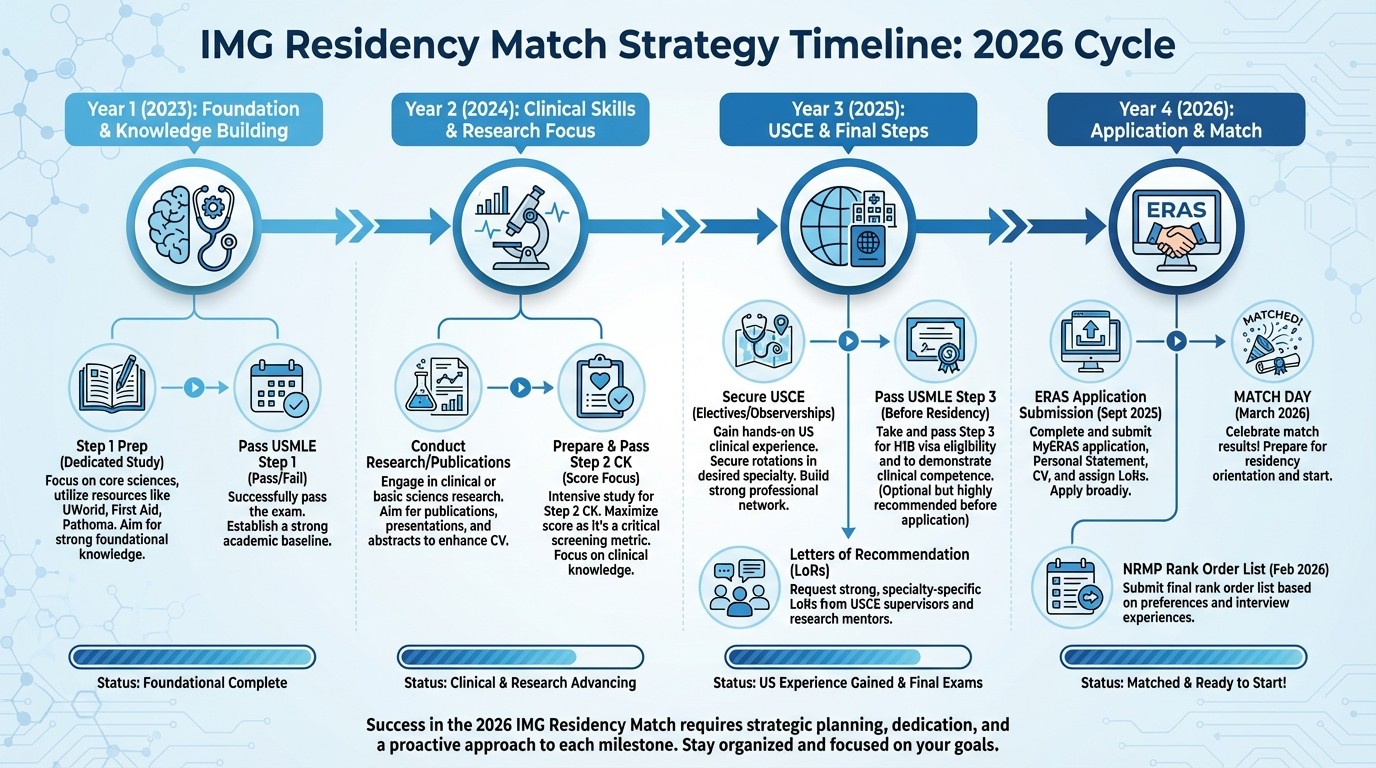
Your 24-Month IMG Match Timeline
Months 1-6: Foundation Building
Complete undergraduate medical education
Begin Step 1 preparation
Start research project identification
Network with US physicians in target specialty
Months 7-12: Step 1 and Research
Take and pass Step 1
Complete first research publication
Begin USCE applications
Start Step 2 CK preparation
Months 13-18: Clinical Experience
Complete 2-3 months USCE
Take Step 2 CK
Submit research publications
Begin Step 3 preparation
Months 19-24: Application and Match
Take Step 3 (if planned)
Submit ERAS applications
Complete interviews
Participate in Match
Get the complete week-by-week Step 1 study schedule to optimize your foundation phase.
The Financial Reality: Budgeting for IMG Applications
Total estimated costs (2026):
Step 1: $1,000 (exam + prep materials)
Step 2 CK: $1,100
Step 3: $900 (if taken before residency)
USCE: $8,000-15,000 (housing, travel, fees)
ERAS applications: $500-2,000 (depending on programs)
Interview travel: $5,000-10,000
Total: $16,500-30,000
Cost optimization strategies:
Share USCE housing with other IMGs
Use virtual interviews when available
Apply for ECFMG scholarships
Consider community hospital USCE (often unpaid but no fees)
Alternative Pathways: If Traditional Match Doesnt Work
Research Year (Preferred Option)
Improves application substantially
Provides US clinical experience
Often leads to home program preference
Timeline: Apply for positions 12-18 months ahead
Preliminary Year Strategy
Internal medicine or surgery preliminary positions
Transition to categorical positions in subsequent matches
Higher match rates for IMGs
Good option for competitive specialties
Observership-to-Position Pipelines
Some community hospitals hire directly from observerships
Less formal than Match but provides pathway
Research these opportunities during USCE
Frequently Asked Questions
Can IMGs still see their Step 1 scores?
No. The USMLE transcript only shows "Pass" or "Fail" for tests taken after January 26, 2022. You receive a private score report immediately after the exam, but this isnt included in official transcripts sent to programs.
How important is Step 1 timing for IMGs now?
Very important. Taking Step 1 immediately after graduation signals strong preparation. Delays raise questions about academic ability or commitment. Ideal timeline: within 12 months of graduation.
Should IMGs retake a low Step 2 CK score?
Depends on the score and specialty. For scores below 220, retaking is usually worthwhile if you can realistically achieve 240+. For scores 220-235, consider your overall application strength and specialty competitiveness.
Do programs still screen by Step 1 pass/fail status?
Yes. Most programs filter out Step 1 failures automatically. However, programs cant filter by Step 1 score ranges anymore, which helps lower-scoring IMGs who would have been screened out previously.
How many programs should IMGs apply to in 2026?
More than before. With increased emphasis on Step 2 CK and research, apply to 80-120 programs for IMG-friendly specialties, 100-150 for moderately competitive, and 150+ for highly competitive specialties.
Is it worth taking Step 3 before residency applications?
Increasingly yes. Step 3 provides another numerical score for evaluation and demonstrates US practice commitment. Take it 6-12 months before applications if your Step 2 CK score is strong.
---
The pass/fail Step 1 change eliminated the easy path to residency matching for IMGs. But it also created opportunities for those who adapt their strategy correctly.
Focus on Step 2 CK excellence. Build meaningful research experience. Secure substantial US clinical exposure. And dont treat Step 1 as just another hurdle — the knowledge matters more than ever for clinical success.
The IMGs matching in 2026 wont be those with the highest Step 1 scores. Theyll be those who understood that the game changed and played by the new rules.
Prepare smarter with Oncourse AI — adaptive MCQs, spaced repetition, and AI explanations built for USMLE. Download free on Android and iOS.