Back
USMLE Step 1 Study Schedule 2026: Complete Week-by-Week Plan for US Medical Students
Complete 8-week USMLE Step 1 study schedule for 2026 with daily templates, question targets, First Aid integration, Anki strategy, and self-assessment milestones for US MD/DO students.

USMLE Step 1 Study Schedule 2026: Complete Week-by-Week Plan for US Medical Students
You probably opened this because your dedicated study period starts in a few weeks (or days), and every time you try to map out your schedule, you end up with either an impossible 16-hour-per-day marathon or a vague "do UWorld and Anki" plan that doesnt actually tell you what Tuesday looks like.
Here's what actually works: 280 Step 1 questions spread across 7 blocks in 8 hours. You get 1.7 minutes per question. No partial credit. Pass/fail since 2022, but competitive residencies still care about your practice scores. And you need a concrete weekly framework that accounts for content review, question practice, spaced repetition, and self-assessments without burning out.
This is your complete week-by-week USMLE Step 1 study schedule for 2026—designed for US MD/DO students in their dedicated study block. No generic advice. Just the exact timeline that consistently produces passing scores.
Before You Start: Your Study Profile
Pick your profile. This determines everything else:
Standard Timeline (8-10 weeks dedicated)
Baseline: Passing school exams, 50-70% UWorld done, NBME 215-230
Goal: Comfortable pass (equivalent to old 230-240 range)
Daily load: 8-10 hours, one rest day weekly
Compressed Timeline (6-8 weeks dedicated)
Baseline: Strong school performance, 70%+ UWorld done, NBME 225+
Goal: Strong pass with margin
Daily load: 10-12 hours, half rest days
Recovery Mode (10-12 weeks dedicated)
Baseline: Struggling with school exams, limited UWorld progress, NBME <215
Goal: First-time pass
Daily load: 8-9 hours with structured breaks
The timeline below assumes Standard Timeline—adjust the intensity and compress/extend as needed.
Core Study Components (Your Daily Building Blocks)
Every day combines these elements in different proportions:
Question Practice (3-4 hours daily)
40 UWorld questions timed + review: 2.5-3 hours
Additional practice questions: 1-1.5 hours
Oncourse's adaptive question bank surfaces high-yield Step 1 questions based on your performance gaps, letting you target weak areas like biochemistry or immunology without manually tracking mistakes across spreadsheets
Active Recall & Spaced Repetition (1.5-2 hours daily)
Anki reviews: 300-500 cards
Flashcard creation: 15-30 minutes
Built-in spaced repetition systems ensure high-yield facts get reviewed at optimal intervals—especially crucial during your final 2 weeks when retention matters more than new learning
Content Review (2-3 hours daily)
First Aid annotation: 45-90 minutes
Video review (Pathoma, Boards & Beyond): 60-90 minutes
Weak topic deep-dives: 30-60 minutes
Performance Tracking (15 minutes daily)
Score analysis by organ system
Next-day schedule adjustments
After each practice session, detailed breakdowns show exactly which USMLE content categories are below passing threshold, enabling data-driven schedule modifications instead of guessing what needs work
Complete Week-by-Week Schedule
Weeks 1-2: Foundation & Assessment
Goals: Establish routine, baseline assessment, identify major gaps Week 1 Daily Template:
8:00-9:30 AM: 40 UWorld questions (timed, random)
9:30-10:00 AM: Break
10:00-12:00 PM: UWorld review + First Aid annotation
12:00-1:00 PM: Lunch
1:00-2:30 PM: Anki reviews (300+ cards)
2:30-4:00 PM: Pathoma or Boards & Beyond (weak topics)
4:00-4:30 PM: Break
4:30-6:00 PM: Additional practice questions (20-30)
6:00-8:00 PM: Dinner + rest
8:00-9:00 PM: First Aid review + planning next day
Key Milestones:
Day 3: First NBME practice exam (baseline)
End of Week 1: Complete First Aid organ systems review schedule
Day 10: Second practice exam to measure early progress
Weeks 3-4: Content Mastery Phase
Goals: Fill knowledge gaps, build question endurance, solidify weak subjects Week 3-4 Daily Intensification:
7:30-9:00 AM: 40 UWorld questions
9:15-11:15 AM: Deep UWorld review + First Aid integration
11:15-12:45 PM: Subject-focused content (rotate: Pharm → Path → Physio → Micro → Biochem)
12:45-1:45 PM: Lunch
1:45-2:45 PM: Anki reviews (400+ cards)
2:45-4:15 PM: Video review (target weak areas from practice exams)
4:15-4:45 PM: Break
4:45-6:15 PM: Timed question blocks (30-40 additional questions)
6:15-8:00 PM: Dinner + exercise
8:00-9:30 PM: Rapid First Aid review + weak topic flashcards
Weekly Structure:
Monday: Cardiovascular focus
Tuesday: Respiratory + Renal
Wednesday: GI + Endocrine
Thursday: Neuro + Psych
Friday: Micro + Immuno + Pharm
Saturday: Mixed practice exam or comprehensive review
Sunday: Rest day or light review
Key Milestones:
Week 3: Complete 70% of total UWorld questions
End of Week 4: Third practice exam—should see 15-20 point improvement from baseline
Weeks 5-6: Peak Performance Phase
Goals: Question accuracy optimization, timing perfection, final content gaps Week 5-6 High-Intensity Template:
7:00-8:30 AM: 40 UWorld questions (simulate exam conditions)
8:30-10:30 AM: Comprehensive UWorld review with First Aid cross-referencing
10:30-12:00 PM: High-yield topic deep dive (based on recent performance data)
12:00-1:00 PM: Lunch
1:00-2:00 PM: Anki reviews (maintain, dont expand)
2:00-3:30 PM: Additional practice questions (40+ questions from weak areas)
3:30-4:00 PM: Break
4:00-5:30 PM: First Aid active recall (closed-book testing)
5:30-7:00 PM: Dinner
7:00-8:30 PM: Video review of complex topics + mnemonics practice
8:30-9:00 PM: Next-day planning + score analysis
Key Adjustments:
Increase question volume to 80+ per day
Focus 70% of study time on identified weak areas
Begin simulating full-length exam timing
Key Milestones:
Week 5: Fourth practice exam (target significant improvement)
End of Week 6: Complete second pass of lowest-scoring UWorld categories
Weeks 7-8: Pre-Exam Sharpening
Goals: Peak confidence, eliminate remaining gaps, perfect exam strategy Week 7-8 Final Phase Template:
6:30-8:00 AM: 40 timed questions (exact exam conditions)
8:00-9:00 AM: Breakfast
9:00-11:30 AM: Detailed review + immediate weak topic reinforcement
11:30-1:00 PM: Rapid First Aid review (active recall method)
1:00-2:00 PM: Lunch
2:00-3:00 PM: Flashcard reviews (retention focus only)
3:00-4:30 PM: Additional questions (target remaining weak areas)
4:30-5:00 PM: Break
5:00-6:30 PM: High-yield fact review + memorization
6:30-8:00 PM: Dinner + light exercise
8:00-9:00 PM: Confidence-building review + relaxation
Week 8 Specific Changes:
Monday-Tuesday: Normal intensity
Wednesday: Reduce to 6-7 hours, light review only
Thursday: Practice exam simulation (4 hours) + light review
Friday: Rest day or very light review (2-3 hours max)
Saturday: Final light review, logistics preparation
Sunday: REST (exam day is Monday)
Key Milestones:
Week 7: Fifth practice exam (should demonstrate readiness)
Final Week: Complete all planned UWorld questions, achieve target practice scores
Daily Schedule Templates by Study Phase
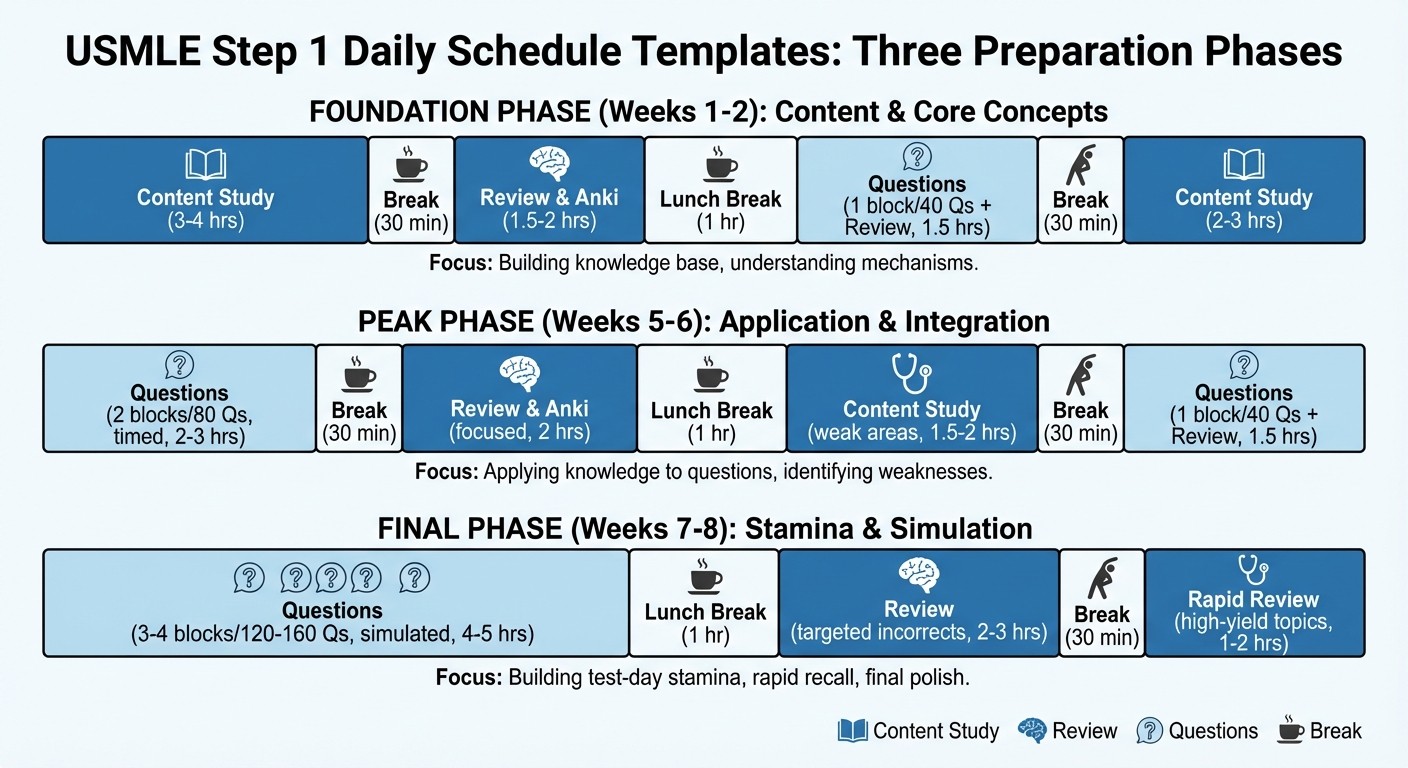
Foundation Phase Template (Weeks 1-2)
Total study time: 8-9 hours
Morning block: 3 hours (questions + review)
Afternoon block: 3 hours (content + Anki)
Evening block: 2-3 hours (additional practice + planning)
Peak Phase Template (Weeks 5-6)
Total study time: 10-11 hours
Morning block: 4 hours (intensive Q&A)
Afternoon block: 4 hours (targeted content + practice)
Evening block: 2-3 hours (retention + strategy)
Final Phase Template (Weeks 7-8)
Total study time: 8-9 hours (tapering)
Morning block: 3 hours (exam simulation)
Afternoon block: 3 hours (weak area elimination)
Evening block: 2-3 hours (confidence building)
Subject-Specific Weekly Rotations
Each week, dedicate focused study blocks to these subjects in rotation:
Week 1-2 Foundation Subjects
Anatomy: 15% of content time
Physiology: 20% of content time
Pathology: 25% of content time
Pharmacology: 20% of content time
Microbiology: 20% of content time
Week 3-4 Clinical Integration
Cardiovascular: 18% of content time
Pulmonary: 15% of content time
GI/Hepatic: 15% of content time
Renal: 12% of content time
Endocrine: 12% of content time
Neuro/Psych: 15% of content time
Hematology/Oncology: 13% of content time
Week 5-8 High-Yield Focus Areas
Prioritize based on your practice exam performance, but typically:
Pathology mechanisms: 30%
Pharmacology MOA: 25%
Clinical correlations: 20%
High-yield facts: 15%
Weak personal areas: 10%
Practice Exam Strategy & Timeline
Practice Exam Schedule
Week 1: Baseline NBME (diagnostic)
Week 3: Second NBME (progress check)
Week 5: Third NBME (readiness assessment)
Week 6: UWorld Self-Assessment
Week 7: Final NBME (confidence confirmation)
Week 8: Light practice or rest
Score Interpretation Guide
Since Step 1 became pass/fail in 2022, use practice scores as readiness indicators:
Practice Score Range | Interpretation | Action |
|---|---|---|
<200 | High risk | Extend dedicated period |
200-215 | Moderate risk | Focus on weak areas, consider delay |
215-230 | Good position | Continue current plan |
230+ | Strong position | Maintain routine, add polish |
|---|
Question Bank Integration Strategy
UWorld Integration (Primary resource):
Weeks 1-4: 40 questions daily, thorough review
Weeks 5-6: 60+ questions daily, focused review
Weeks 7-8: 40 questions daily, confidence building
Additional Resources (Supplement UWorld gaps):
Kaplan Qbank: Biochemistry and basic sciences
AMBOSS: Clinical correlations and complex cases
Use adaptive question targeting to focus on consistently missed topics rather than random subject selection
Question Review Method: 1. Immediate review: Read explanation for every question (right and wrong) 2. First Aid integration: Annotate relevant pages within 24 hours 3. Spaced review: Revisit missed questions after 3-7 days 4. Pattern recognition: Track recurring mistake themes weekly
First Aid Integration Method
First Aid remains central despite being pass/fail. Here's how to use it effectively:
Week-by-Week First Aid Schedule
Weeks 1-2: Complete read-through
6 pages daily with active note-taking
Cross-reference every UWorld explanation
Create personal high-yield summary sheets
Weeks 3-4: Targeted reinforcement
Focus on weak areas from practice exams
Annotate margins with UWorld insights and mnemonics
Create concept maps connecting related topics
Weeks 5-6: Active recall testing
Closed-book testing: Cover text, test recall
Rapid review sessions: 15-20 pages in 30 minutes
Integration practice: Connect concepts across systems
Weeks 7-8: Confidence building
High-yield facts only: Focus on frequently tested items
Pattern recognition: Review common presentation formats
Final gap-filling: Address any remaining weak areas
Smart First Aid Annotation System
Color coding system:
Blue: UWorld explanations and clarifications
Red: Personal weak areas requiring extra attention
Green: High-yield facts and must-know items
Yellow: Mnemonics and memory aids
Anki & Spaced Repetition Strategy
Daily Anki Targets by Week
Study Week | New Cards | Review Cards | Total Time |
|---|---|---|---|
1-2 | 50-75 | 200-300 | 60-90 min |
3-4 | 75-100 | 300-400 | 90-120 min |
5-6 | 25-50 | 400-500 | 60-90 min |
7-8 | 0-25 | 300-400 | 45-60 min |
Optimal Anki Settings for Step 1
New cards/day: 50 (weeks 1-4), 25 (weeks 5-6), 0 (weeks 7-8)
Maximum reviews: 500
Graduation interval: 3 days
Easy interval: 4 days
Learning steps: 1m, 10m, 1d, 3d
Pre-Made vs. Custom Cards
Use pre-made decks for:
Basic science facts
High-yield pathology
Pharmacology mechanisms
Create custom cards for:
Personal weak areas
UWorld explanation pearls
Complex concept connections
Spaced repetition systems integrated with study sessions eliminate deck-management overhead while ensuring optimal review timing—particularly valuable during your final weeks when retention trumps new learning.
Daily Routine Optimization
Optimal Study Environment Setup
Consistent location: Same desk/chair for focus conditioning
Minimal distractions: Phone in different room, social media blockers
Natural lighting: Reduces eye strain during long sessions
Temperature control: 68-72°F for optimal cognitive performance
Energy Management Throughout the Day
Peak performance windows:
Morning (8-11 AM): Most challenging questions and new content
Afternoon (1-4 PM): Content review and active recall
Evening (7-9 PM): Light review and planning
Energy optimization strategies:
Exercise: 30 minutes daily, preferably mid-day
Nutrition: Protein-rich breakfast, light lunch, balanced dinner
Hydration: 2-3 liters water daily, minimal caffeine after 2 PM
Sleep: 7-8 hours nightly, consistent wake/sleep times
Weekly Schedule Structure
Monday-Thursday: High-intensity study days Friday: Medium-intensity with flexibility for catch-up Saturday: Practice exams or comprehensive review Sunday: Rest day or light review (maximum 3-4 hours)
Recovery Day Guidelines
Complete rest: No medical content (crucial for retention)
Light physical activity: Walking, yoga, recreational sports
Social connection: Maintain relationships, reduce isolation
Preparation: Meal prep, laundry, life logistics
Self-Assessment & Progress Tracking
Weekly Performance Metrics to Track
Question Performance:
Overall percentage correct (target: 65-75%+)
Subject-specific accuracy rates
Improvement trends over time
Time per question (target: under 1.5 minutes average)
Content Mastery Indicators:
First Aid page completion rate
Anki card retention percentages
Practice exam score progression
Weak area elimination rate
Weekly Review Questions
Every Sunday, assess:
1. What were my 3 biggest knowledge gaps this week? 2. Which study methods produced the best retention? 3. What schedule adjustments would improve next week? 4. Am I on track for my target exam date?
Warning Signs to Address Immediately
Declining question scores for 2+ consecutive days
Inability to complete daily targets 3+ days running
Severe anxiety or burnout symptoms
Sleep disruption affecting next-day performance
When you notice these, immediately:
Reduce daily targets by 20-30%
Schedule additional rest time
Consider pushing exam date if consistently underperforming
Final 2 Weeks: Peak Preparation Strategy
Week 7: Intensive Final Review
Monday-Wednesday: Full intensity maintenance
Continue 40 questions daily with thorough review
Target remaining content gaps aggressively
Practice full-length exam timing simulations
Maintain all Anki reviews for retention
Thursday-Friday: Intensity reduction begins
Reduce to 6-7 hours total study time
Focus only on high-yield facts and weak areas
Eliminate low-yield content and new learning
Prioritize confidence-building activities
Weekend: Practice exam + light review
Saturday: Full practice exam under exact conditions
Sunday: Light review of exam topics only
Week 8: Pre-Exam Tapering
Monday-Tuesday: Moderate study maintenance
30 questions daily maximum
First Aid high-yield review only
Light Anki maintenance (no new cards)
Focus on retention, not acquisition
Wednesday: Significant reduction
20 questions maximum
3-4 hours total study time
Review only confident subjects
Plan exam day logistics
Thursday: Minimal study
10 questions for confidence
2-3 hours light review
Prepare materials for exam day
Early sleep schedule adjustment
Friday: Rest day
No studying or light review only
Relaxation activities
Social time with family/friends
Final logistics confirmation
Saturday: Final preparation
1-2 hours maximum study time
Review exam day procedures
Pack materials and confirm travel
Early bedtime
Sunday: Complete rest
NO STUDYING
Light activities only
Mental preparation and relaxation
Optimal sleep for Monday exam
Frequently Asked Questions
How Many Hours Should I Study Daily for Step 1?
Plan for 8-10 hours during your dedicated study period. More than 12 hours daily leads to burnout and decreased retention. Quality focused study beats quantity every time.
Should I Use Multiple Question Banks Besides UWorld?
UWorld should be your primary resource—complete it 1.5-2 times during dedicated study. Add supplementary banks (Kaplan, AMBOSS) only for specific weak areas, not comprehensive coverage.
When Should I Take My First Practice Exam?
Take your baseline NBME within the first week of dedicated study. This identifies your starting point and major gaps. Don't delay—you need this data to optimize your remaining weeks.
How Do I Know If I'm Ready to Take Step 1?
You're ready when you're consistently scoring in your target range on practice exams AND can complete 40 questions in the allotted time with confidence. Most students need 2-3 consecutive good practice scores before testing.
What If I'm Not Improving After 4 Weeks of Dedicated Study?
First, analyze your study methods—are you doing active recall or passive reading? Consider extending your dedicated period by 2-4 weeks. Sometimes students need more time to consolidate knowledge, and that's completely normal.
Should I Memorize All of First Aid?
No. Focus on understanding concepts and high-yield facts that appear frequently on practice questions. Use First Aid as a reference and annotation tool, not a memorization target.
---
Ready to optimize your Step 1 preparation with data-driven insights? Prepare smarter with Oncourse AI—adaptive MCQs, spaced repetition, and AI explanations built for USMLE success. Download free on Android and iOS.