Back
Best USMLE Step 1 Resources 2026: Books, Question Banks, and Study Tools That Actually Work
Discover the most effective USMLE Step 1 study resources for 2026. Complete guide to textbooks, question banks, flashcards, and AI-powered study tools that actually improve scores.
Best USMLE Step 1 Resources 2026: Books, Question Banks, and Study Tools That Actually Work
You probably stare at your screen wondering which Step 1 resources are worth your time and which ones will drain your bank account without moving the needle. USMLE Step 1 has 280 questions. You get about 1.5 minutes per question across 7 hours of testing. That means every study hour needs to count.
The truth? Most students collect resources like Pokemon cards, thinking more equals better. But Step 1 success isnt about having every book or subscription. Its about picking the right combination of high-yield materials and using them systematically.
After helping hundreds of students navigate Step 1 prep, here are the resources that actually work — broken down by category so you can build your complete study toolkit without the guesswork.
The Foundation: First Aid for USMLE Step 1
First Aid remains the backbone of Step 1 preparation in 2026. This isnt nostalgia — its practical reality. The book covers exactly what appears on Step 1, organized by organ system, with high-yield facts presented in digestible chunks.
Why First Aid still matters:
Covers 85-90% of testable content in a compact format
Organized exactly how Step 1 thinks about medicine
Perfect for active recall and annotation
Creates a common language among study groups
How to use it effectively:
Start reading First Aid during your first pass through each system, not after. Annotate margins with details from lectures or other resources. During your second pass, focus only on sections you marked as weak. In your final month, read the entire book twice weekly.
The key mistake? Treating First Aid as a reference book instead of an active study tool. Write in it. Highlight it. Make it yours.
High-Yield Visual Learning: Pathoma, Sketchy, and Boards & Beyond
Visual learning platforms transformed Step 1 preparation by making complex concepts memorable through stories and illustrations.
Pathoma for Pathophysiology
Pathoma remains unmatched for understanding disease mechanisms. Dr. Sattar explains pathophysiology in a way that sticks — crucial when Step 1 asks "why" questions rather than pure memorization. Best use strategy:
Watch each video once during your first pass through a system. Take detailed notes. During review periods, focus on the concepts you highlighted as confusing. Pathoma excels at connecting normal physiology to pathological states — exactly what Step 1 tests.
Sketchy for Pharmacology and Microbiology
Sketchy turns abstract drug mechanisms and bacterial characteristics into visual stories. These mnemonics become powerful recall triggers during the exam. Optimization tips:
Dont just watch passively. Draw key elements of each sketch immediately after watching. Create your own associations between the visual elements and the medical facts. Review sketches without audio first, then verify details by rewatching.
Boards & Beyond for Comprehensive Review
Boards & Beyond bridges the gap between medical school lectures and board-style thinking. Dr. Ryan covers topics with the depth you need while maintaining focus on high-yield concepts. Strategic approach:
Use Boards & Beyond during your dedicated study period for comprehensive system review. The videos work best after youve built foundational knowledge through First Aid and other resources. Focus on the question stems and explanations — they mirror actual Step 1 logic.
Mastering Spaced Repetition: Anki and Flashcard Systems
Spaced repetition prevents the forgetting curve from destroying your hard work. Anki remains the gold standard, but success depends on implementation.
Choosing the Right Anki Deck
Popular decks like Anking integrate multiple resources into a single, comprehensive system. These pre-made decks save hundreds of hours compared to creating your own cards.
Anki optimization rules:
Start Anki early — ideally during your first year
Commit to daily reviews without exception
Customize intervals based on your retention rates
Tag cards by system for targeted review
Anki Alternatives for Different Learning Styles
Some students struggle with Anki's interface or overwhelming daily reviews. Modern alternatives like Oncourse use spaced repetition algorithms that automatically adjust to your performance, removing the manual deck management burden while maintaining the memory benefits.
The key insight? Consistent daily exposure beats marathon weekend sessions. Whether you choose Anki or adaptive alternatives, the system only works if you use it consistently.
Question Banks: Building Problem-Solving Skills
Question practice separates Step 1 success from failure. But choosing between available options depends on your study style and timeline.
How Many Questions You Actually Need
Plan for 2,500-4,000 practice questions total. This includes your primary question bank plus NBME practice exams. More questions dont equal better scores — quality and review matter more than quantity.
Question bank selection criteria:
Detailed explanations that teach concepts
Question difficulty matching Step 1 style
Performance tracking by system and topic
Adaptive features that focus on weak areas
Timed Practice vs Learning Mode
Start with learning mode during your first pass through each system. Switch to timed mode 6-8 weeks before your exam date. In the final month, do only timed blocks to build testing stamina.
Review strategy that works:
Read every explanation, even for questions you answered correctly. Create a log of missed questions organized by topic. Review these logs weekly to identify persistent weak areas.
Modern question banks use AI to personalize your practice experience. Oncourse's adaptive question engine adjusts difficulty and topic weighting based on your performance patterns, ensuring you spend time on areas that actually need work rather than grinding through topics you already know.
Practice Exams: NBME and Performance Tracking
NBME practice exams remain the most predictive assessment for Step 1 performance. They use retired Step 1 questions and similar scoring algorithms.
NBME Strategy
Take your first NBME exam 10-12 weeks before Step 1 to establish a baseline. Schedule subsequent exams every 2-3 weeks, saving your final NBME for 1 week before the real exam.
Score interpretation:
12+ weeks out: Focus on content gaps, not scores
6-8 weeks out: Scores should trend upward consistently
2-4 weeks out: Your average NBME score predicts Step 1 performance
Performance Analytics That Matter
Track performance by system and question type, not just overall scores. Analytics dashboards reveal whether you struggle with specific organ systems, question formats, or concept types — letting you redirect study time to highest-impact areas.
Focus on trends over individual exam scores. A student scoring 65%, 68%, 72% shows better trajectory than someone scoring 75%, 74%, 76%.
AI-Powered Study Tools: The 2026 Advantage
AI fundamentally changes how students prepare for Step 1 by personalizing the learning experience and identifying knowledge gaps automatically.
Adaptive Learning Systems
Traditional study plans treat every student identically. AI-powered platforms analyze your performance patterns and adjust content delivery accordingly. If you consistently miss cardiology questions, the system serves more cardiology practice and reduces time spent on topics you've mastered.
This personalization becomes crucial given Step 1's breadth. Rather than following generic timelines, you focus effort where you actually need improvement.
AI Tutoring and Explanation
AI tutors can explain complex concepts using multiple approaches until one resonates. When you miss a pharmacology question about ACE inhibitors, an AI tutor might explain the mechanism through enzyme pathways, clinical scenarios, or visual analogies — adapting to your learning style.
Real-world application:
During question review, AI can identify why you missed a question — whether due to knowledge gaps, misreading stems, or reasoning errors. This pattern recognition helps address root causes rather than symptoms.
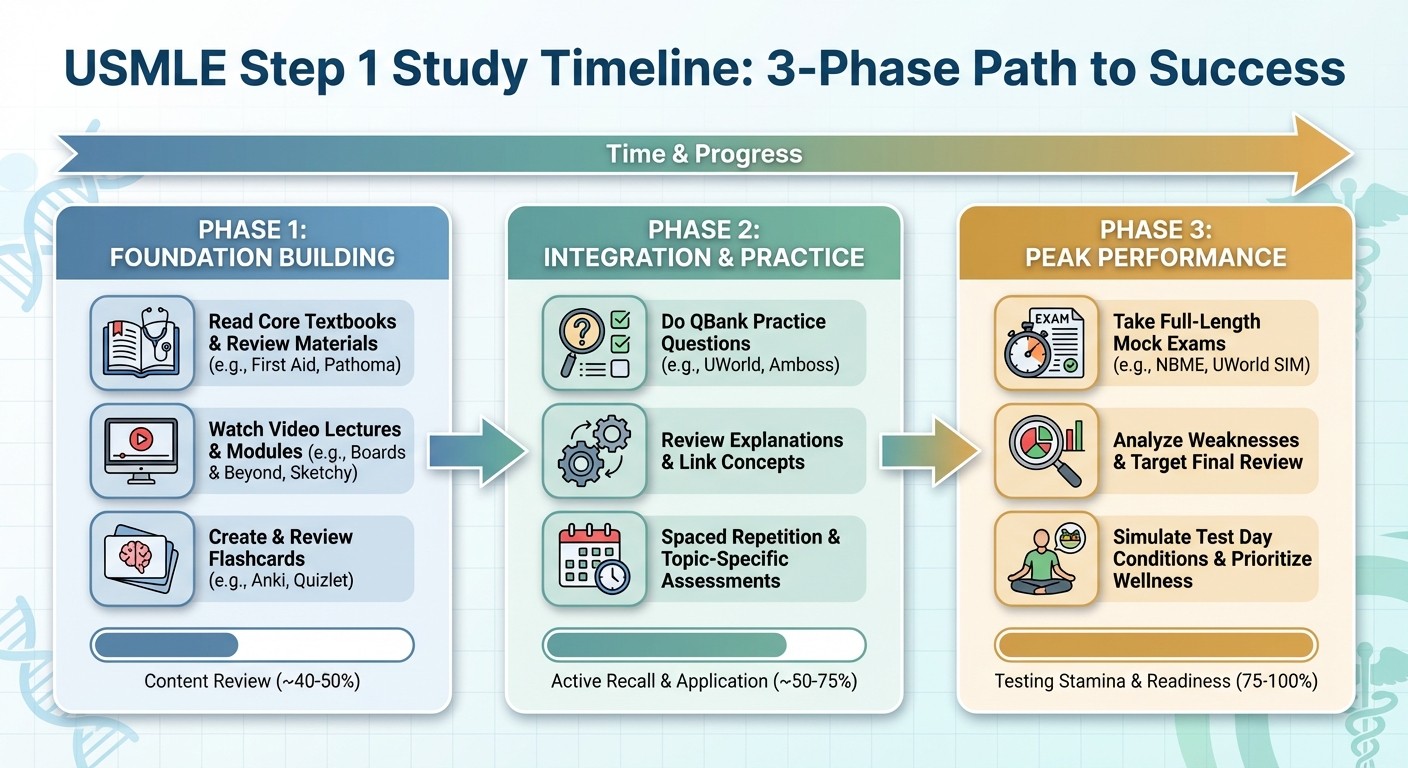
Building Your Complete Study Schedule
The best resources mean nothing without a systematic approach to using them together.
Phase 1: Foundation Building (Months 1-4)
Morning: First Aid + Pathoma for one organ system
Afternoon: Corresponding flashcard reviews
Evening: 20-30 practice questions in learning mode
Focus on understanding concepts during this phase. Speed comes later.
Phase 2: Integration and Practice (Months 5-7)
Morning: System-based question blocks (40 questions, timed)
Afternoon: Weak area targeting using flashcards and videos
Evening: Review missed questions and update notes
Begin connecting systems and practicing clinical reasoning.
Phase 3: Peak Performance (Final 4-6 weeks)
Morning: Full-length question blocks (40 questions)
Afternoon: Targeted review of weak systems only
Evening: Light First Aid reading for confidence
Simulate exam conditions and fine-tune performance.
Resource Budgeting: What Actually Costs What
Step 1 preparation requires significant financial investment. Here's realistic budgeting for core resources:
Essential tier ($200-400):
First Aid: $65
Pathoma: $99/year
Question bank subscription: $200-300
NBME practice exams: $60 each
Enhanced tier ($600-900):
Add Sketchy subscriptions: $200/year
Boards & Beyond: $200/year
Additional question banks: $150-300
Tutoring or prep courses: $500+
Premium tier ($1000+):
Multiple comprehensive subscriptions
Live prep courses
Personal tutoring
Most successful students spend $400-700 total. The sweet spot balances quality resources with financial sustainability.
Common Resource Selection Mistakes
Mistake 1: Resource collecting
Students accumulate every available resource, thinking more options equal better preparation. This creates decision paralysis and prevents deep learning from any single source.
Mistake 2: Switching resources mid-stream
Starting with one question bank, then switching to another halfway through preparation. Each platform has different explanation styles and question patterns — consistency matters more than finding the "perfect" resource.
Mistake 3: Passive consumption
Watching videos or reading without active engagement. Step 1 tests application, not recognition. Every resource interaction should involve active recall or practice.
Mistake 4: Ignoring weak areas
Sticking with comfortable topics while avoiding challenging systems. AI-powered platforms help by automatically identifying and addressing these gaps, but traditional study approaches require conscious effort to tackle weak areas.
Integration Strategies That Work
The Spiral Method
Cover each organ system three times with increasing depth:
1. First pass: Basic concepts (First Aid + videos) 2. Second pass: Question practice + detailed review 3. Third pass: Rapid review + weak area targeting
The Question-First Approach
Start each study session with practice questions, then use other resources to fill knowledge gaps revealed by missed questions. This ensures all study time directly addresses actual deficiencies.
The Mixed Review System
Dedicate 30% of daily study time to reviewing previously covered material. This prevents early learning from fading while you tackle new systems.
Frequently Asked Questions
What are the best resources for USMLE Step 1?
The core combination that works for most students: First Aid as your foundation, Pathoma for pathophysiology concepts, a comprehensive question bank for practice, and spaced repetition flashcards for retention. Add visual learning tools like Sketchy based on your learning style and weak areas.
Is First Aid enough for Step 1?
First Aid covers the breadth needed for Step 1 but lacks the depth for complete understanding. Use it as your central organizing tool while supplementing with videos for concept clarification and question banks for application practice. First Aid alone wont prepare you for Step 1's clinical reasoning requirements.
How many questions should I do for Step 1?
Plan for 3,000-4,000 total practice questions including your primary question bank and NBME exams. Quality matters more than quantity — thorough review of 3,000 questions beats superficial completion of 5,000. Focus on understanding explanations for both correct and incorrect answers.
What is the best question bank for USMLE Step 1?
The best question bank depends on your learning style and timeline. Look for detailed explanations, performance analytics, and question difficulty matching Step 1. Modern adaptive platforms personalize your practice by focusing on weak areas automatically, maximizing study efficiency.
How long should you study for Step 1?
Most students need 6-8 months of dedicated preparation, with 4-6 hours daily during pre-clinical years or 8-10 hours during dedicated study periods. Your timeline depends on your baseline knowledge, target score, and study efficiency. Start early enough to avoid cramming, which compromises retention.
Should I use multiple question banks?
One comprehensive question bank plus NBME exams is sufficient for most students. Using multiple question banks can help if you finish your primary bank early or need additional practice in specific areas. However, thorough review of one excellent question bank beats superficial completion of multiple banks.
Prepare smarter with Oncourse AI — adaptive MCQs, spaced repetition, and AI explanations built for USMLE Step 1. Download free on Android and iOS.