Back
NEET PG Subject-Wise Weightage 2026: Complete Breakdown, Marks Distribution & What to Prioritise First
Complete NEET PG 2026 subject-wise weightage breakdown with marks distribution, priority tiers, and strategic study planning. Get the definitive guide to high-yield vs low-yield subjects.
NEET PG Subject-Wise Weightage 2026: Complete Breakdown, Marks Distribution & What to Prioritise First
You are staring at 19 subjects spread across 300 questions. Each question carries 4 marks. That's 1200 marks total, with -1 for every wrong answer. The math is brutal — you need around 600+ marks to secure a good rank, which means getting 70-75% questions right.
But here's what most NEET PG aspirants get wrong: they treat all subjects equally. They spend 2 weeks on ENT (worth maybe 6-8 questions) and 2 weeks on Medicine (worth 45+ questions). That's not preparation — that's self-sabotage.
The toppers who score 650+ marks dont have some secret sauce. They just understand one fundamental truth: NEET PG is a weightage game. Get the high-yield subjects right, and you are already in the top 10%. Ignore them, and even perfect scores in minor subjects wont save your rank.
This complete breakdown will show you exactly where every mark comes from, which subjects deserve your prime study hours, and how to build a prioritisation strategy that actually works in 2026.
NEET PG 2026 Exam Structure: The Numbers That Matter
The National Board of Examinations (NBE) has maintained the same basic structure, but the pattern has evolved significantly. Here's what you are dealing with:
Total Questions: 300 MCQs
Total Marks: 1200 (4 marks per correct answer)
Negative Marking: -1 mark per incorrect answer
Exam Duration: 3.5 hours (42 seconds per question)
Qualifying Percentile: 50th percentile (general category)
The exam is divided into three main categories:
Pre-Clinical Subjects (~75 questions, 300 marks)
Para-Clinical Subjects (~135 questions, 540 marks)
Clinical Subjects (~90 questions, 360 marks)
But raw numbers dont tell the whole story. Recent NEET PG papers show a clear trend toward applied clinical reasoning, case-based questions, and integration across subjects — exactly what the NEXT pattern emphasizes.
Complete Subject-Wise Marks Distribution 2026
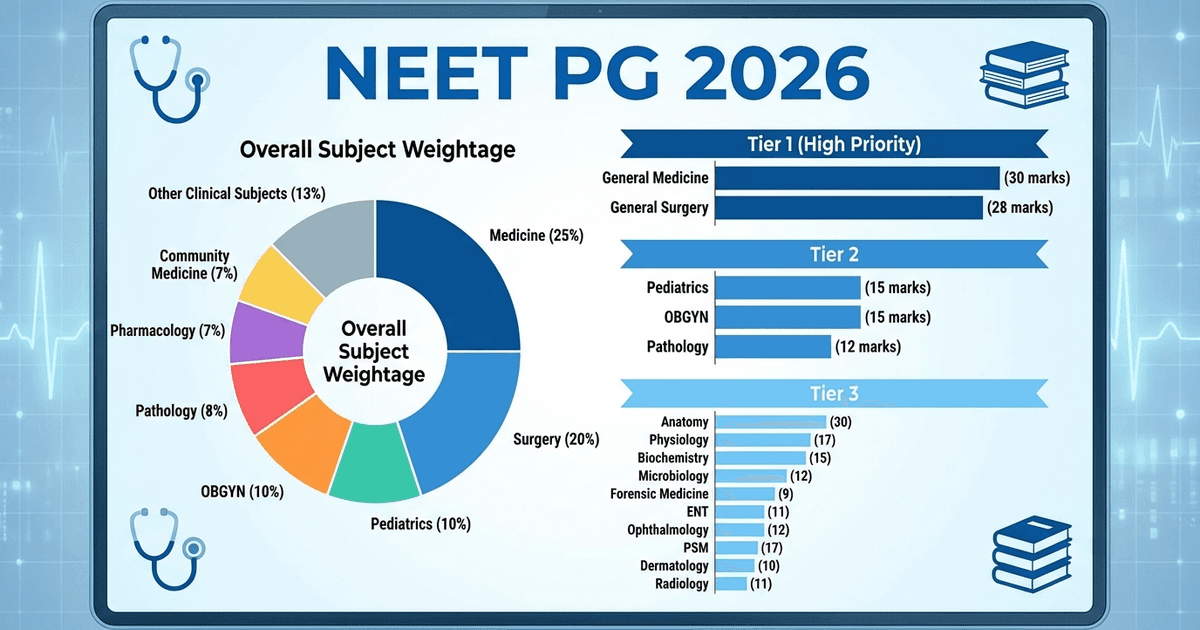
Based on analysis of recent NEET PG papers and NBE guidelines, here's the definitive subject-wise breakdown:
Subject | Questions | Marks | Percentage | Priority Tier |
|---|---|---|---|---|
General Medicine | 45-50 | 180-200 | 15% | Tier 1 |
General Surgery | 36-40 | 144-160 | 12% | Tier 1 |
OBG | 30-35 | 120-140 | 10% | Tier 1 |
Paediatrics | 24-28 | 96-112 | 8% | Tier 1 |
Pathology | 24-26 | 96-104 | 8% | Tier 1 |
Pharmacology | 20-22 | 80-88 | 7% | Tier 1 |
Anatomy | 18-20 | 72-80 | 6% | Tier 2 |
Physiology | 18-20 | 72-80 | 6% | Tier 2 |
PSM/Community Medicine | 18-20 | 72-80 | 6% | Tier 2 |
Microbiology | 15-18 | 60-72 | 5% | Tier 2 |
Biochemistry | 12-15 | 48-60 | 4% | Tier 2 |
ENT | 8-10 | 32-40 | 3% | Tier 3 |
Ophthalmology | 8-10 | 32-40 | 3% | Tier 3 |
Orthopaedics | 8-10 | 32-40 | 3% | Tier 3 |
Psychiatry | 6-8 | 24-32 | 2% | Tier 3 |
Dermatology | 6-8 | 24-32 | 2% | Tier 3 |
Radiology | 6-8 | 24-32 | 2% | Tier 3 |
Anaesthesia | 6-8 | 24-32 | 2% | Tier 3 |
Forensic Medicine | 8-10 | 32-40 | 3% | Tier 3 |
The Three-Tier Priority System
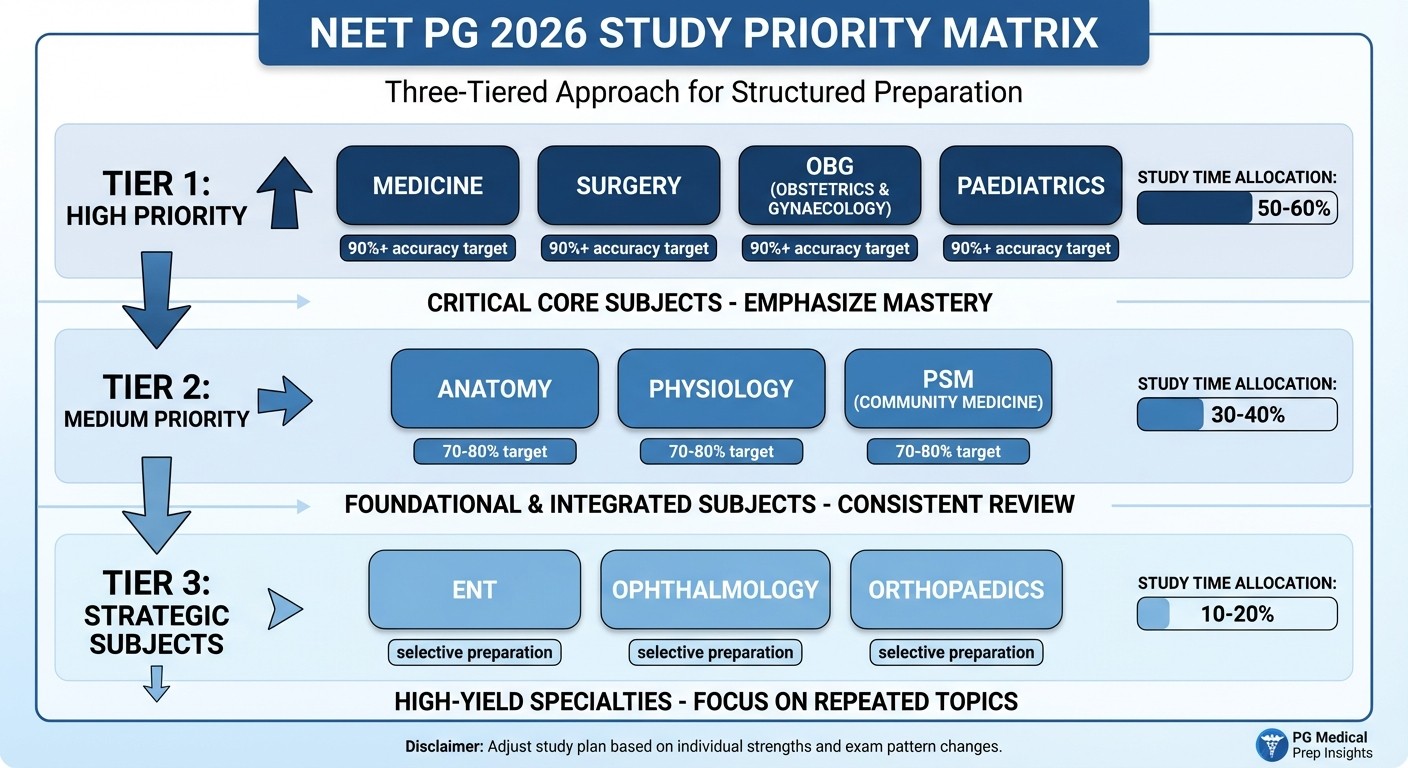
Tier 1: The Core Six (Aim for 90%+ Accuracy)
These six subjects contribute 360+ marks — nearly 30% of your total score. Missing questions here is like throwing away ranks.
Medicine (180-200 marks)
Cardiology, Nephrology, GI Medicine dominate
Case-based scenarios with ECGs, X-rays common
High integration with Pathology and Pharmacology
Recent trend: More emergency medicine and critical care
Surgery (144-160 marks)
GI Surgery, Trauma, and Basic Surgical Principles
Anatomy integration crucial (especially abdominal, thoracic)
Image-based questions (CT scans, operative findings)
Growing emphasis on perioperative care
OBG (120-140 marks)
Labor complications, gynecological malignancies lead
Tons of case scenarios with lab values
High-yield: PCOS, endometriosis, obstetric emergencies
Drug interactions with Pharmacology overlap
Paediatrics (96-112 marks)
Vaccination schedules are goldmines (easy 6-8 marks)
Neonatology and growth charts frequent
Genetic disorders with Biochemistry connections
Recent focus: Pediatric emergencies and fluid management
Pathology (96-104 marks)
Histopathology images in every exam
Cancer staging and tumor markers
Inflammatory pathways connecting to Medicine
Hematology + Clinical correlation heavy
Pharmacology (80-88 marks)
Mechanism of action + Side effects dominate
Drug interactions across all clinical subjects
Antimicrobials and CVS drugs are staples
Applied questions: "Best drug for this patient"
For Tier 1 subjects, Oncourse's subject-wise question banks let you drill 90% accuracy rates with difficulty progression — essential when these subjects make or break your rank.
Tier 2: The Foundation Five (Aim for 70-80% Accuracy)
These contribute 300+ marks total. Strong here = competitive score.
Anatomy (72-80 marks)
Applied and cross-sectional anatomy dominate
Image-based questions from CT/MRI scans
Clinical correlations with Surgery/Medicine
High-yield: Abdomen, pelvis, CNS
Physiology (72-80 marks)
CVS and respiratory physiology are kings
Acid-base balance, renal physiology crucial
Integration with Pathology for disease mechanisms
Recent trend: Exercise physiology, aging
PSM/Community Medicine (72-80 marks)
National health programs are easy marks
Biostatistics and epidemiology calculations
Recent focus: Non-communicable diseases, geriatrics
Environmental health getting more weightage
Microbiology (60-72 marks)
Bacteriology dominates, virology close second
Antimicrobial sensitivity patterns important
Hospital infection control trending up
Immunology overlaps with Pathology
Biochemistry (48-60 marks)
Metabolism (carb, lipid, protein) core concepts
Enzyme kinetics and metabolic disorders
Molecular biology getting more questions
Clinical chemistry: diabetes, liver function
Tier 3: The Strategic Eight (Selective Preparation)
These 8 subjects total about 200-240 marks. The key here is efficiency — identify 2-3 you can realistically master and get 80%+ in those, maintain 50-60% in the rest.
High-Yield Tier 3 Picks:
ENT: Easy anatomy-based questions, quick revision possible
Ophthalmology: Lots of image-based questions, pattern recognition
Forensic Medicine: Factual, high-yield for time invested
Lower Priority (Unless Personal Strength):
Orthopaedics, Psychiatry, Dermatology, Radiology, Anaesthesia
The mistake most students make: trying to master all Tier 3 subjects. Result? Mediocre performance across the board. Pick your battles.
Recent Paper Trends: What's Changing in 2026
The NEET PG pattern has evolved significantly, moving toward the NEXT exam framework emphasis on clinical application:
1. Applied Clinical Questions (60%+)
Case-based scenarios with patient presentations
Multi-step reasoning: presentation → investigation → diagnosis → treatment
Integration across subjects in single questions
2. Image-Based Questions (25%+)
Radiology images (X-rays, CT, MRI) integrated with clinical scenarios
Histopathology slides with clinical correlation
ECG interpretation in Medicine questions
Gross pathology specimens in Surgery
3. Reduced Factual Recall (15%)
One-liner questions becoming rare
Even factual questions now have clinical context
Dates, exact numbers less important than concepts
4. Cross-Subject Integration
Pharmacology questions within Medicine cases
Anatomy questions integrated with Surgery scenarios
Pathology findings within clinical presentations
This shift means your study approach needs updating. Pure memorization wont cut it — you need pattern recognition and clinical reasoning.
Oncourse's AI-generated daily study plans automatically adjust to this trend, giving you more case-based practice and less rote learning time.
Time Allocation Formula: The 70-20-10 Rule
Based on the weightage analysis, here's how to split your daily study time:
70% Time: Tier 1 Subjects (6 subjects, 360+ marks)
Medicine: 20% of total study time
Surgery: 15% of total study time
OBG: 12% of total study time
Paediatrics: 10% of total study time
Pathology: 8% of total study time
Pharmacology: 5% of total study time
20% Time: Tier 2 Subjects (5 subjects, 300+ marks)
Anatomy + Physiology: 8% combined
PSM: 5% of total study time
Microbiology: 4% of total study time
Biochemistry: 3% of total study time
10% Time: Tier 3 Subjects (8 subjects, 240 marks)
Pick 2-3 subjects you can realistically excel in
Maintenance mode for the rest
Quick revision, high-yield topics only
Example Daily Schedule (8 hours study):
Medicine: 1.5 hours
Surgery: 1.2 hours
OBG: 1 hour
Paediatrics: 45 minutes
Pathology: 40 minutes
Tier 2 rotation: 1.5 hours
Tier 3 selected subjects: 45 minutes
Revision/MCQs: 30 minutes
MCQ Volume Strategy: Questions per Subject
Your practice question distribution should mirror the exam weightage:
Priority Tier | Total Questions to Practice | Daily MCQs |
|---|---|---|
Tier 1 | 8000-10000 questions | 60-70 |
Tier 2 | 4000-5000 questions | 25-30 |
Tier 3 | 2000-3000 questions | 15-20 |
Focus on quality over quantity. Better to solve 50 questions with deep analysis than 100 questions superficially. Each wrong answer should trigger a mini-lesson on why you missed it.
Oncourse's performance analytics track your accuracy rates by subject versus expected weightage contribution, so you instantly spot which areas are dragging your score down.
Revision Cycles: The Spacing Strategy
Different tiers need different revision frequencies:
Tier 1 Subjects: 3-Day Cycle
Day 1: New topic coverage
Day 2: MCQ practice + weak area drilling
Day 3: Quick revision + move to next topic
Weekly comprehensive review
Tier 2 Subjects: 5-Day Cycle
Day 1: Topic coverage
Days 2-3: MCQ practice
Day 4: Integration with clinical subjects
Day 5: Quick revision
Bi-weekly comprehensive review
Tier 3 Subjects: 7-10 Day Cycle
Focus on high-yield topics only
Quick coverage → immediate MCQ practice
Monthly revision sufficient
Common Prioritisation Mistakes to Avoid
1. The "Comfort Zone" Trap
Spending too much time on subjects you already know well. If you are consistently getting 85%+ in Anatomy, dont keep drilling it. Move those hours to Medicine where you might be stuck at 65%.
2. The "All or Nothing" Approach
Trying to master every Tier 3 subject. Result: spreading yourself too thin across low-yield areas while neglecting high-yield subjects.
3. The "Weak Subject" Obsession
If you are terrible at Biochemistry (48-60 marks), dont spend 3 hours daily trying to fix it. Those 3 hours in Medicine (180+ marks) will boost your score much more.
4. Ignoring PSM
Community Medicine seems boring, but it's one of the easiest subjects to score in. National health programs, basic statistics — mostly factual, high-yield for time invested.
5. Over-investing in Images
Yes, image-based questions are trending up, but dont spend 50% of your time on radiology images. Focus on clinical correlation — the diagnosis matters more than spotting every shadow on an X-ray.
Subject-Specific High-Yield Topics
Medicine (15% weightage)
Must-Master:
Cardiology: MI management, heart failure, arrhythmias
Nephrology: AKI, CKD, electrolyte disorders
GI: IBD, liver diseases, GI bleeding
Infectious diseases: Sepsis, tropical diseases
Endocrinology: Diabetes, thyroid disorders
Surgery (12% weightage)
Must-Master:
Trauma: ATLS protocols, emergency surgeries
GI Surgery: Appendicitis, intestinal obstruction, pancreatitis
Surgical principles: Wound healing, infections, fluid management
Emergency procedures: Surgical emergencies, ICU care
OBG (10% weightage)
Must-Master:
Obstetrics: Labor complications, high-risk pregnancies
Gynecology: PCOS, endometriosis, malignancies
Reproductive medicine: Infertility, contraception
Emergency scenarios: Postpartum hemorrhage, eclampsia
Building Your Personal Priority Matrix
Every student's optimal strategy will vary slightly based on strengths and weaknesses. Here's how to personalize:
Step 1: Baseline Assessment
Take a comprehensive mock test covering all subjects. Note your accuracy rates by subject.
Step 2: ROI Analysis
For each subject, calculate: (Potential mark improvement × Exam weightage) ÷ Time investment needed
Step 3: Strategic Allocation
If you are already strong in a Tier 1 subject (85%+ accuracy), maintain with light revision
If you are weak in a Tier 1 subject (<60% accuracy), this becomes your primary focus
For Tier 3 subjects, pick 2-3 where you have natural aptitude or prior strength
Step 4: Monthly Rebalancing
Every month, reassess your performance. Shift time allocation based on improvement rates and persistent weak areas.
Frequently Asked Questions
How much time should I spend on Tier 3 subjects if I'm aiming for 650+ marks?
If you are targeting 650+ marks, you need roughly 80%+ overall accuracy. Focus 70% of your time on Tier 1, 25% on Tier 2, and just 5% on Tier 3. Pick only 2 Tier 3 subjects you can realistically score 80%+ in — usually ENT and Ophthalmology work well due to high image-based, pattern-recognition questions.
Is it worth spending time on subjects I consistently score poorly in?
Depends on the tier. If it's a Tier 1 subject like Medicine or Surgery, yes — absolutely worth the investment even if progress is slow. If it's a Tier 3 subject like Dermatology where you are consistently scoring 40%, better to maintain that 40% and invest those hours in boosting a Tier 1 subject from 70% to 85%.
How do I balance new topic coverage with revision for high-weightage subjects?
Use the 70-30 rule daily: 70% time for new topics, 30% for revision. For Tier 1 subjects, revise every 3 days. This ensures you dont forget earlier topics while making progress. Spaced repetition tools help automate this balance.
What if I'm strong in a low-weightage subject — should I still deprioritize it?
Yes, but strategically. If you are naturally strong in ENT (3% weightage), spend just 15-20 minutes daily maintaining that strength. Dont completely ignore it since easy marks are still valuable, but dont let it steal time from Medicine or Surgery.
How many months before the exam should I finalize my subject priorities?
Finalize your tier system at least 6 months before the exam. But keep adjusting time allocation monthly based on your mock test performance. The last 2 months should be pure revision with your priorities locked in.
Should recent paper trends change my subject priorities?
The tier system remains stable, but adjust your approach within each tier. More clinical application means more case-based practice. More images means more visual pattern recognition. But Medicine is still 15% of marks whether questions are factual or case-based.
---
Prepare smarter with Oncourse AI — adaptive MCQs, spaced repetition, and AI explanations built for NEET PG. Download free on Android and iOS.