Back
USMLE Step 1 Physiology: Turn Core Mechanisms Into Daily Recall Practice
Master USMLE Step 1 physiology with mechanism-based daily recall practice. Learn to convert cardiovascular, respiratory, renal, and endocrine pathways into exam-ready knowledge.
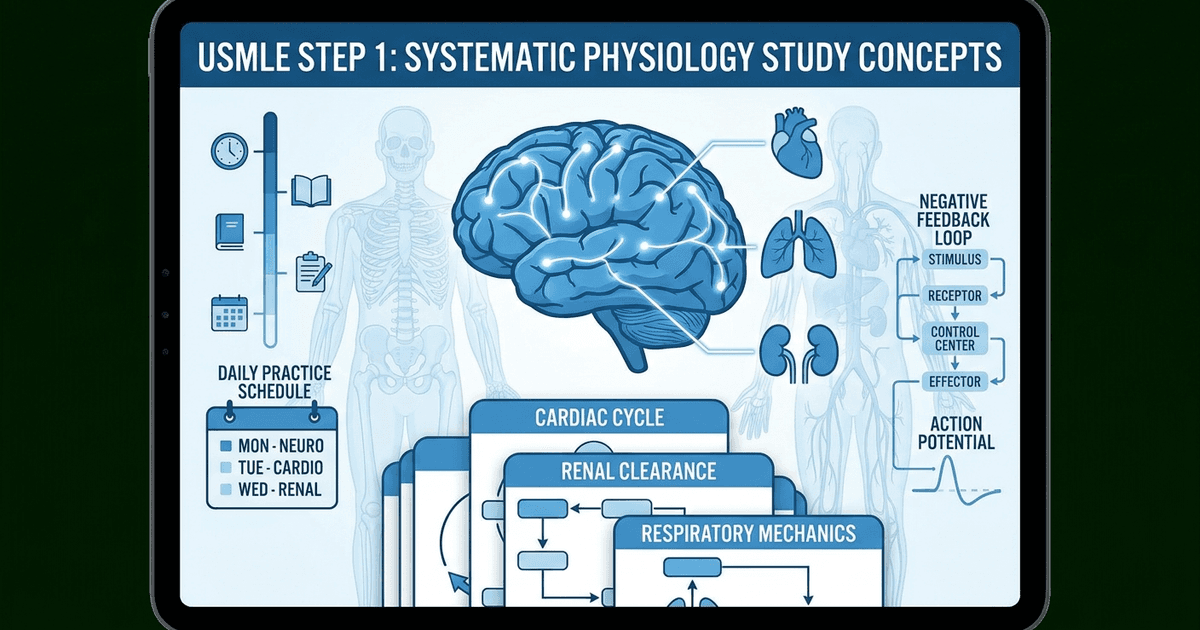
USMLE Step 1 Physiology: Turn Core Mechanisms Into Daily Recall Practice
You probably stare at physiology questions and think "I know this" — then pick the wrong answer. The mechanism is there in your head, but when the vignette hits, it vanishes. You can explain the RAAS pathway backward and forward, but somehow miss a straightforward aldosterone question. Sound familiar?
USMLE Step 1 physiology isn't about memorizing pathways. It's about building recall loops that work under pressure. The difference between students who nail physiology questions and those who don't isn't knowledge depth — it's how quickly they can trace cause-effect chains when a 47-year-old patient walks in with chest pain and elevated BNP.
Here's how to turn your physiology knowledge into exam-ready recall that actually works when it matters.
Why Step 1 Physiology Demands a Different Study Approach
Traditional studying treats physiology like anatomy — read it, memorize it, move on. But Step 1 physiology questions test integration, not recognition. They give you clinical vignettes that require you to connect normal function, dysfunction, compensatory mechanisms, and pharmacological interventions within seconds.
The exam doesn't ask "What does aldosterone do?" It asks: "A 34-year-old man with congestive heart failure is started on lisinopril. Three days later, his serum potassium increases from 3.8 to 5.2 mEq/L. Which of the following best explains this finding?"
Now you need aldosterone, ACE inhibitors, potassium handling, and aldosterone escape — all linked together in a cause-effect chain. That's mechanism recall under pressure.
The Mechanism-First Study Loop That Actually Works
Most students study physiology backward. They read about diseases, then try to remember the underlying mechanisms. Instead, start with the mechanism and build outward to its clinical manifestations.
Step 1: Map the Core Mechanism
Take any physiological process and identify its 3-4 key steps. For the renin-angiotensin system:
Low blood pressure/volume triggers renin release
Angiotensin I converts to angiotensin II via ACE
Angiotensin II causes vasoconstriction and aldosterone release
Aldosterone increases sodium retention and potassium excretion
Step 2: Identify Failure Points
Where can this system break down or get disrupted? RAAS failure points:
ACE inhibitors block conversion (decreasing angiotensin II, increasing bradykinin)
ARBs block angiotensin II receptors
Aldosterone antagonists block mineralocorticoid receptors
Direct renin inhibitors block the initial step
Step 3: Connect to Clinical Scenarios
How does each failure point present clinically?
ACE inhibitor dry cough (bradykinin accumulation)
Hyperkalemia with ACE inhibitors or ARBs (reduced aldosterone effect)
Hypotension in volume-depleted patients on RAAS blockers
Step 4: Practice Reverse Engineering
When you see a clinical vignette, immediately ask: "What mechanism explains this presentation?" Then trace the pathway forward to predict what other findings should be present.
Turn Missed Questions Into Cause-Effect Chains
Every wrong physiology question contains a teaching moment about mechanism-based reasoning. When you miss a question, don't just read the explanation — dissect the thinking process.
The Post-Question Analysis Framework
1. Identify the core mechanism: What physiological process was being tested?
2. Find your break point: Where did your reasoning derail from the correct pathway?
3. Trace the complete chain: Follow the mechanism from trigger to final effect
4. Connect to related scenarios: What other clinical presentations use this same pathway?
For example, if you miss a question about why diabetic patients get hyperkalemia on ACE inhibitors, trace the complete mechanism:
Diabetes → kidney damage → reduced GFR → potassium retention baseline
ACE inhibitor → reduced angiotensin II → reduced aldosterone → less potassium excretion
Combined effect → significant hyperkalemia risk
Now you can answer questions about ACE inhibitors in renal disease, aldosterone antagonists in heart failure, and potassium supplementation guidelines. One mechanism, multiple applications.
Using Oncourse's explanation chat feature, you can interrogate each missed question by asking follow-up questions like "Why wasn't option B correct?" or "What clinical clue should have pointed to this mechanism?" This helps you identify the reasoning gaps that led to the wrong choice.
Daily Recall Practice for High-Yield Physiology Systems
Converting mechanisms into daily recall requires strategic repetition focused on the highest-yield systems. Here's how to structure your daily practice across the core physiology areas.
Cardiovascular Physiology Daily Drills
Morning mechanism check (5 minutes):
Cardiac output equation and its determinants
Frank-Starling relationship under different preload conditions
Baroreceptor reflex response to hypotension and hypertension
Question-based recall (15 minutes):
Practice 5-7 cardiovascular physiology questions focusing on:
Pressure-volume loops and heart failure
Arrhythmia mechanisms and ECG correlations
Shock physiology and compensatory responses
Evening review (10 minutes):
Review any cardiovascular questions you missed, focusing on the mechanism that explains the clinical presentation.
Oncourse's cardiovascular physiology lessons provide comprehensive coverage of these mechanisms, while the cardiovascular question bank offers targeted practice for each concept.
Respiratory Physiology Recall System
Core mechanisms to drill daily:
Oxygen-hemoglobin dissociation curve shifts
Ventilation-perfusion matching and V/Q mismatch patterns
Respiratory compensation in acid-base disorders
High-yield question patterns:
Altitude physiology and compensation
Obstructive vs restrictive disease patterns
Gas exchange abnormalities in various diseases
The key is connecting normal physiology to pathophysiology. When you see decreased DLCO, immediately think: what mechanisms reduce gas exchange? Then trace forward to predict other findings (exercise tolerance, oxygen saturation, compensatory mechanisms).
Renal Physiology and Acid-Base
Daily mechanism review:
Glomerular filtration and clearance concepts
Tubular function and electrolyte handling
Acid-base physiology and compensation patterns
Critical connections to practice:
How different diuretics affect electrolyte balance
Kidney disease effects on drug clearance
Primary vs secondary acid-base disorders
Renal physiology questions often test your ability to predict cascading effects. If GFR drops by 50%, what happens to creatinine, BUN, electrolytes, bone metabolism, and anemia risk? Build these prediction chains through daily practice.
Endocrine System Integration
Core feedback loops to master:
Hypothalamic-pituitary axes (all major hormones)
Glucose homeostasis and insulin resistance
Calcium and phosphate regulation
Daily recall practice:
Review one endocrine axis each day, tracing both normal feedback and pathological disruption. Monday: thyroid axis and hyperthyroidism mechanisms. Tuesday: adrenal axis and stress response. Wednesday: growth hormone and acromegaly.
When studying hormone disorders, always ask: Is this primary, secondary, or tertiary dysfunction? What lab values confirm this? What are the compensatory responses?
Using Rezzy, you can ask questions like "Explain why TSH is low in hyperthyroidism" and get guided explanations that help you trace the feedback mechanism step by step.
GI and Hepatic Physiology
Mechanism-based daily review:
Digestive enzyme function and regulation
Bile acid circulation and fat absorption
Liver synthetic and metabolic functions
High-yield integration points:
How liver disease affects drug metabolism
Malabsorption patterns and nutrient deficiencies
Portal circulation and variceal formation
GI physiology questions often test nutrient absorption and liver function integration. Build daily recall around these connections: which vitamins need bile salts? How does liver disease affect protein synthesis? What happens to ammonia in hepatic encephalopathy?
Using Tutor Mode vs Timed Blocks for Physiology
Your approach to physiology practice should match your learning stage and knowledge gaps.
When to Use Tutor Mode
Best for mechanism building: Use tutor mode when you're still learning core physiological pathways. This allows you to immediately see explanations and build understanding without time pressure. Ideal timing: Early in your preparation (first 8-12 weeks) when you're establishing foundational knowledge. How to maximize: After each question, use the explanation to trace the complete mechanism. Don't just confirm the right answer — understand why wrong answers are physiologically impossible.
When to Switch to Timed Blocks
Test recall under pressure: Once you understand the mechanisms, timed blocks force you to access that knowledge quickly, simulating exam conditions. Pattern recognition: Timed practice helps you recognize question stems faster and predict likely answers before reading all options. Timing strategy: Transition to timed blocks for physiology during your final 6-8 weeks of preparation.
The Hybrid Approach
Combine both methods strategically:
Morning timed blocks (20-30 questions) to assess current recall speed
Afternoon tutor mode for topics where you made errors
Evening review of both timed and tutor questions to reinforce learning
This approach builds both mechanistic understanding and exam performance simultaneously.
2-Week Physiology Reset Plan
If your physiology knowledge feels scattered or you're consistently missing mechanism-based questions, this intensive reset plan will reorganize your understanding around core pathways.
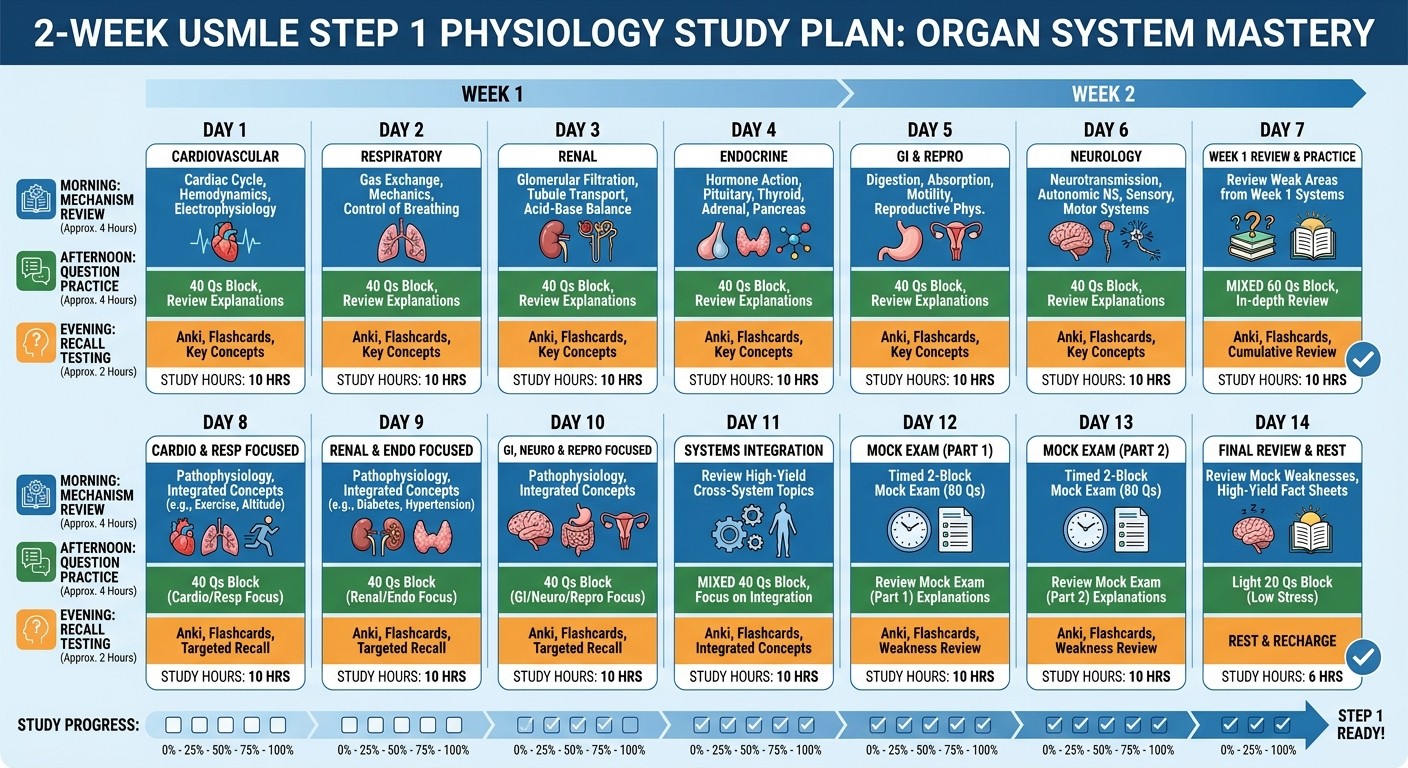
Week 1: Systems Integration
Monday-Tuesday: Cardiovascular
Day 1: Cardiac cycle, pressure-volume relationships, Frank-Starling mechanism
Day 2: Blood pressure regulation, shock physiology, heart failure mechanisms
Daily goal: 40 cardiovascular questions, review all mechanisms behind wrong answers
Wednesday-Thursday: Respiratory
Day 3: Gas exchange, V/Q relationships, oxygen transport
Day 4: Acid-base physiology, respiratory compensation, lung mechanics
Daily goal: 35 respiratory questions, focus on mechanism-based reasoning
Friday-Saturday: Renal
Day 5: GFR, clearance, tubular function
Day 6: Electrolyte balance, diuretic mechanisms, kidney disease progression
Daily goal: 30 renal questions, emphasize cause-effect relationships
Sunday: Review and Integration
Review all flagged questions from the week
Practice integrated scenarios involving multiple systems
Test recall speed with 50 mixed physiology questions
Week 2: Endocrine and Integration
Monday-Tuesday: Endocrine Systems
Day 8: Hypothalamic-pituitary axes, feedback loops
Day 9: Glucose homeostasis, insulin resistance, diabetes mechanisms
Daily goal: 35 endocrine questions, map all feedback disruptions
Wednesday-Thursday: GI and Specialized Systems
Day 10: Digestive physiology, absorption, liver function
Day 11: Neurophysiology, autonomic function, sensory systems
Daily goal: 40 mixed questions across these systems
Friday-Sunday: Speed and Integration
Day 12: Timed blocks only — 60 questions in 90 minutes
Day 13: Review all errors, create mechanism summary sheets
Day 14: Final assessment — 80 mixed physiology questions to test recall
Daily Structure for Maximum Retention
Morning (90 minutes): Mechanism review and concept building
Read/watch content for the day's focus system
Create or review mechanism flowcharts
Identify key integration points with other systems
Afternoon (2 hours): Question practice and analysis
Complete daily question target in tutor mode
Immediately analyze wrong answers using the cause-effect framework
Use Oncourse's spaced repetition system to schedule review of weak areas
Evening (45 minutes): Recall testing and consolidation
Test mechanism recall without notes (use flashcards for structured review)
Review the day's most challenging concepts
Plan tomorrow's focus based on identified gaps
The Oncourse AI platform tracks your performance patterns across these systems, helping you identify which mechanisms need additional reinforcement and adapting your study schedule accordingly.
Common Physiology Mistakes and How to Avoid Them
Understanding typical error patterns helps you develop better reasoning habits and avoid predictable traps.
Mistake 1: Confusing Correlation with Causation
The trap: Seeing two findings together and assuming one causes the other without considering the underlying mechanism. Example: Seeing elevated BUN and creatinine and assuming kidney disease without considering dehydration, heart failure, or medication effects. Solution: Always trace back to the mechanism. What physiological process explains both findings? Are there alternative pathways that could produce the same result?
Mistake 2: Ignoring Compensatory Mechanisms
The trap: Focusing only on the primary pathology while missing secondary effects and body responses. Example: In heart failure, missing that increased sympathetic activation and RAAS activation are compensatory, not primary problems. Solution: For every pathological process, ask: How does the body try to compensate? What are the downstream effects of compensation? When does compensation become harmful?
Mistake 3: Mixing Up Primary and Secondary Effects
The trap: Attributing symptoms to the wrong level of a feedback system. Example: In primary hyperaldosteronism, confusing suppressed renin (secondary effect) with the primary aldosterone excess. Solution: Build a hierarchy for each system. Start with the primary abnormality, then trace secondary effects step by step. Use mnemonics that emphasize the sequence of events.
For complex endocrine disorders, the Synapses feature provides mnemonics that help you remember the sequence of primary and secondary effects, making it easier to distinguish cause from consequence.
Mistake 4: Forgetting Integration Between Systems
The trap: Studying systems in isolation without considering how they interact. Example: Missing that respiratory alkalosis affects calcium binding to albumin, potentially causing symptoms of hypocalcemia despite normal total calcium. Solution: Practice integration scenarios daily. Pick two systems and ask: How does dysfunction in system A affect system B? What are the clinical manifestations of this interaction?
Mistake 5: Speed Reading Clinical Vignettes
The trap: Moving too quickly through the clinical scenario and missing key mechanistic clues. Example: Missing that a patient is taking a diuretic, which explains their electrolyte abnormalities and changes your approach to the question. Solution: Develop a systematic approach to reading vignettes. Identify: patient demographics, presenting symptoms, relevant history, medications, and lab values. Each piece provides mechanistic clues.
Advanced Integration Strategies
Once you've mastered basic mechanisms, these advanced strategies will help you tackle complex, multi-system physiology questions.
Cross-System Pattern Recognition
Many Step 1 questions test how one system's dysfunction affects others. Build recognition patterns for common integrations:
Cardiovascular-Renal: Heart failure affects kidney perfusion, kidney disease affects blood pressure and fluid balance Respiratory-Acid/Base: Lung disease affects pH compensation, metabolic disorders trigger respiratory responses Endocrine-Metabolic: Hormone disorders affect multiple metabolic pathways and electrolyte balance
Pharmacology-Physiology Integration
Step 1 increasingly tests how drugs interact with normal physiology. For each drug class, understand:
Normal physiological target and pathway
How the drug modifies normal function
Predictable side effects based on mechanism
Clinical scenarios where the drug would be most beneficial
Example: Beta-blockers block sympathetic stimulation of the heart. This reduces heart rate and contractility (desired effects in hypertension), but also reduces the heart's ability to respond to stress (problematic in heart failure with reduced ejection fraction).
Time-Based Physiological Changes
Some questions test how physiological responses change over time:
Acute vs chronic responses to stimuli
Adaptation and tolerance mechanisms
Progression from compensated to decompensated states
Example: Acute blood loss triggers immediate sympathetic response (increased heart rate, vasoconstriction). Chronic anemia triggers longer-term adaptations (increased red blood cell production, cardiac remodeling, improved oxygen extraction).
Building Long-Term Retention
Physiology knowledge degrades quickly without reinforcement. These strategies ensure your mechanisms stay sharp through Step 1 and beyond.
Spaced Repetition for Mechanisms
Traditional flashcards work for facts, but mechanisms need different reinforcement. Create cards that test:
Pathway sequences (What happens after angiotensin II binds its receptor?)
Cause-effect relationships (What lab changes would you expect with primary hyperaldosteronism?)
Integration scenarios (How would heart failure affect kidney function?)
Schedule these cards for review at increasing intervals: 1 day, 3 days, 7 days, 21 days, then monthly.
Weekly System Reviews
Each week, dedicate 2-3 hours to reviewing a different system comprehensively:
Week 1: Cardiovascular mechanisms and integration
Week 2: Respiratory and acid-base physiology
Week 3: Renal function and electrolyte balance
Week 4: Endocrine feedback systems
This creates a monthly review cycle that maintains knowledge across all systems while allowing deep focus on one area at a time.
Teaching and Explaining
The ultimate test of mechanism understanding is explaining it to someone else. Practice explaining core pathways out loud:
Record yourself explaining a mechanism, then listen for gaps or unclear points
Use online study groups to teach and learn from peers
Challenge yourself to explain complex pathways using only simple language
Using Rezzy, you can practice explaining concepts back in plain language and get feedback on whether your explanations capture the essential mechanism correctly.
Frequently Asked Questions
How long should I spend on physiology questions compared to other Step 1 topics?
Physiology represents about 20-25% of Step 1 content, so allocate roughly that percentage of your question practice time. However, strong physiology knowledge helps with pathology and pharmacology questions too, so the return on investment is high. Aim for 25-30% of your question practice focusing specifically on physiology mechanisms.
Should I use the same study resources for USMLE Step 1 physiology as for medical school courses?
Medical school courses emphasize comprehensive understanding, while Step 1 focuses on clinically relevant, high-yield concepts. Transition to Step 1-specific resources like question banks and review books that emphasize mechanism-based reasoning over exhaustive detail. Your medical school textbooks provide good foundational knowledge, but Step 1 prep requires more targeted, application-focused materials.
How do I know when my physiology knowledge is Step 1-ready?
You're ready when you can consistently identify the underlying mechanism from a clinical vignette within 30-45 seconds and predict what other findings should be present. Test this by taking timed physiology question blocks. If you're scoring above 70% on physiology questions in timed conditions, your mechanism-based reasoning is likely exam-ready.
What should I do if I keep missing physiology questions despite understanding the concepts?
This usually indicates a gap between conceptual knowledge and application skills. Focus on the question stem analysis: are you correctly identifying what mechanism is being tested? Practice reading vignettes more carefully, identifying the key clinical clues that point to specific pathways. Also, ensure you're not overthinking – sometimes the most straightforward mechanism is correct.
How important are complex physiology calculations for Step 1?
Step 1 rarely tests complex calculations. Focus on understanding the relationships behind equations rather than memorizing formulas. For example, understand how clearance relates to kidney function rather than memorizing the exact clearance formula. When calculations appear, they're usually simple and test conceptual understanding rather than mathematical ability.
Can I use USMLE Step 1 physiology knowledge for Step 2 CK preparation?
Absolutely. Strong physiology knowledge is essential for Step 2 CK clinical reasoning. The mechanisms you learn for Step 1 help you understand disease presentations, treatment rationales, and patient management decisions. However, Step 2 CK emphasizes application in clinical scenarios, so you'll need to connect your physiology knowledge to practical patient care decisions.
Prepare smarter with Oncourse AI — adaptive MCQs, spaced repetition, and AI explanations built for USMLE Step 1. Download free on Android and iOS.