USMLE Step 1 Weak Areas: Find What to Fix First With Daily Adaptive Practice
Stop guessing which USMLE Step 1 topics need work. Learn the systematic workflow to identify weak areas from daily practice, prioritize high-yield fixes, and turn mistakes into targeted study sessions.
USMLE Step 1 Weak Areas: Find What to Fix First With Daily Adaptive Practice
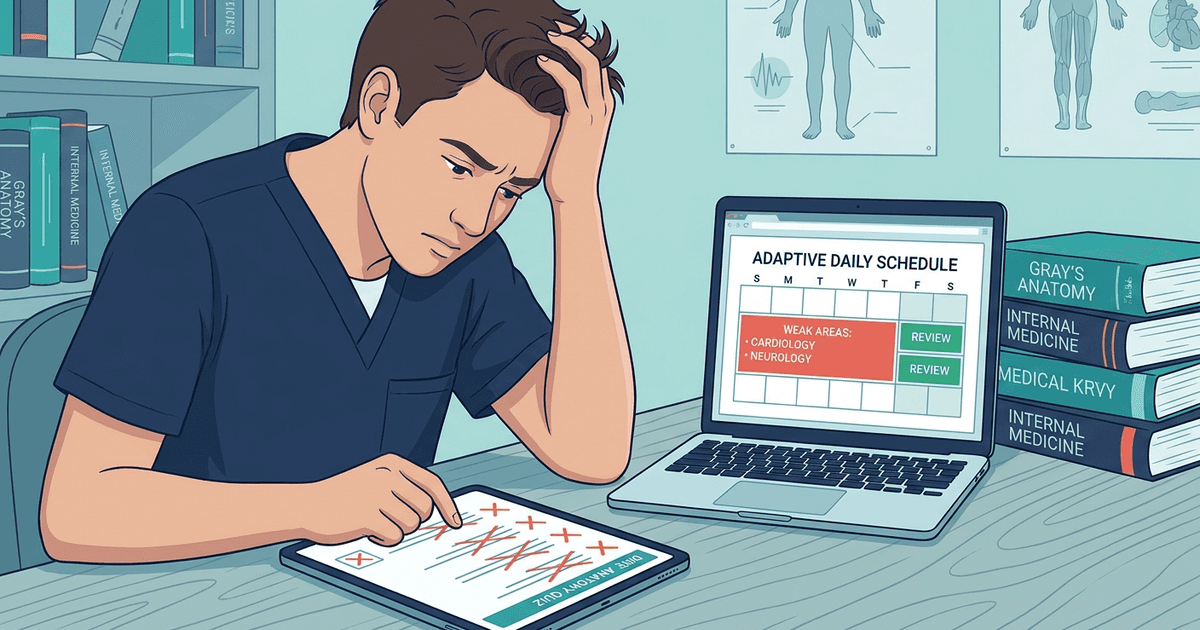
You probably know that feeling. 47 questions into a practice block, and you see the score: 68%. Not terrible, but those 15 wrong answers are staring at you. The real question isnt "why did I get these wrong?" — its "which ones matter most for my score?"
USMLE Step 1 has 280 questions across seven 60-minute blocks. With that volume, every wrong answer is data. The students who jump 20+ points in 6 weeks dont just practice more — they practice the right things. They turn their daily misses into a systematic weak area workflow that prioritizes what moves the needle.
This isnt about confidence. Its about triage.
The Real Problem With Weak Areas
Most students treat weak areas like a confidence problem. "I'm bad at cardiology" becomes "I need to read more cardiology." But Step 1 weak areas are actually a prioritization problem.
Here's what actually happens when you miss questions:
Content gaps: You dont know the mechanism
Application failures: You know it but cant apply it under time pressure
Pattern recognition issues: The question format throws you off
Interference: Similar concepts blur together
Each type needs a different fix. Reading more cardiology wont help if your real issue is differentiating between similar arrhythmias under time pressure.
The students who improve fastest dont study their weak areas harder — they study them smarter. They diagnose the type of weakness first, then match the right practice method to the problem.
The Daily Weak Area Diagnostic Loop
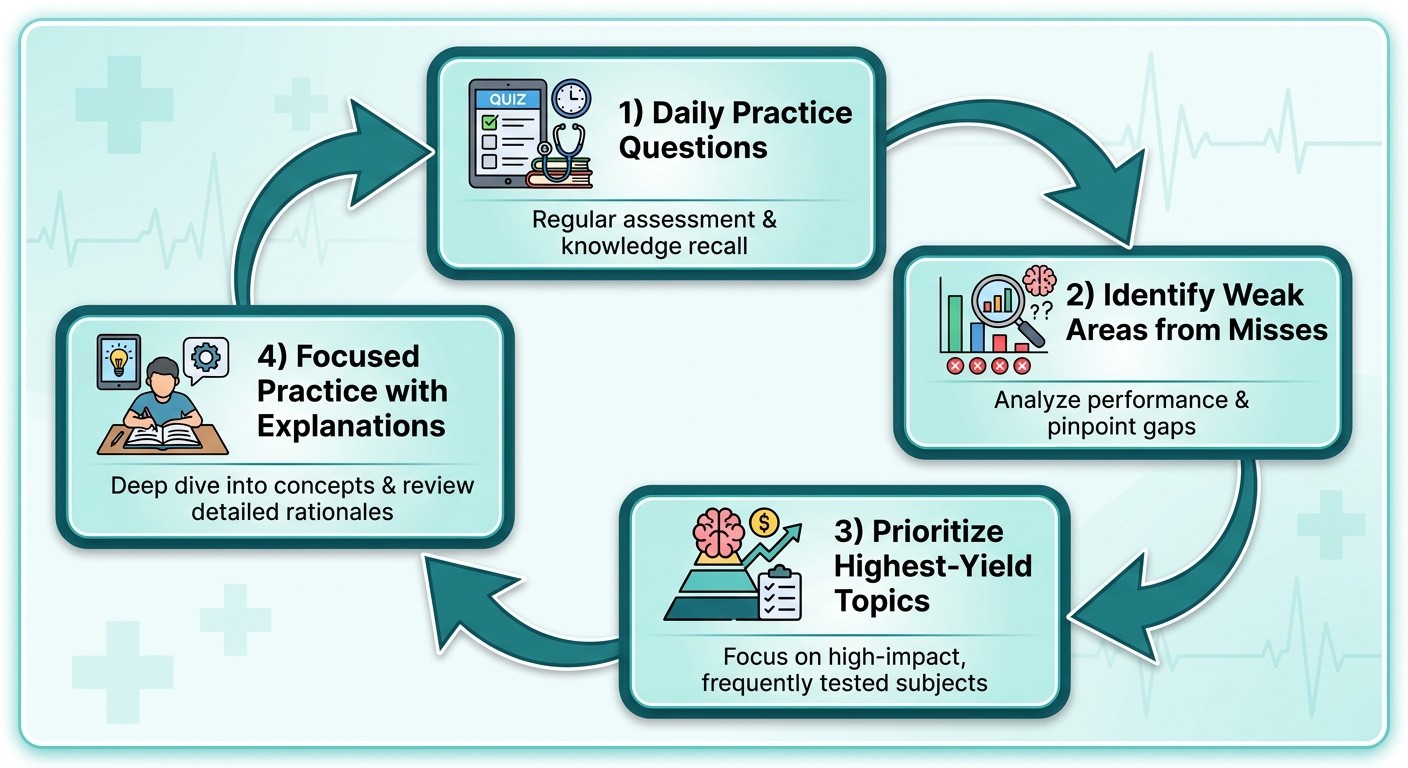
Your daily practice questions are a diagnostic tool. Every wrong answer tells you something specific about what to fix. Here's the systematic workflow that high scorers use:
Step 1: Daily Practice With Intent
Start with 40-80 questions per day in timed, mixed blocks. This isnt just "doing questions" — its active data collection. Track these markers for every wrong answer:
Subject area (Cardiology, Biochemistry, Pharmacology)
Question type (Mechanism, Clinical application, Diagnostic)
Time spent (Over 90 seconds indicates pattern recognition issues)
Confidence level (Were you guessing or genuinely confused?)
Step 2: Group Your Misses by Pattern
After each practice session, spend 15 minutes categorizing your wrong answers. Dont review explanations yet — just group them:
High-frequency subjects that keep showing up in your misses Specific question types within those subjects Time management patterns (rushed vs. overthought)
For example: "5/8 cardiology misses were arrhythmia mechanisms, all took over 2 minutes, high confidence but wrong reasoning."
That's not a "cardiology weakness" — thats a specific pattern requiring targeted practice.
Step 3: Prioritize Using the 2x2 Matrix
Not all weak areas deserve equal attention. Use this matrix to triage:
High Step 1 Weight | Low Step 1 Weight | |
|---|---|---|
High Miss Rate | URGENT FIX | Quick Review |
Low Miss Rate | Maintain | Ignore |
Urgent Fix areas: High-weight subjects where you miss frequently (Cardiology arrhythmias, Biochemistry pathways, Pharmacology mechanisms)
Step 4: Execute Targeted Practice Daily
Match your practice method to the weakness type:
For content gaps: Use targeted question sets on specific mechanisms you missed For application failures: Do timed, focused question sets in that area with immediate review For pattern recognition: Untimed practice with similar question variations For interference issues: Direct comparison tables and back-to-back similar concepts
Using Oncourse's Weak Area Tools in Your Daily Loop
Daily Plan Integration: Your Daily Plan automatically adapts based on recent performance, surfacing more questions from subjects where you've missed recently. It's targeted reinforcement of your actual weak spots. Weak Topics Targeting: Use the Weak Topics flow to get focused question sets on your specific problem areas. Instead of generic "cardiology practice," you get targeted questions on the exact subtopics where you missed questions this week. Explanation Deep-Dives: When you miss a question, use Rezzy's explanation chat to ask follow-up questions: "Why is this mechanism different from what I was thinking?" This turns every miss into a mini-tutorial session.
Common Weak Area Patterns in Step 1
Based on NBME data and student performance trends, these patterns show up repeatedly:
The Biochemistry Cascade Problem
Pattern: You know individual enzymes but miss questions about pathway regulation Fix: Focus on rate-limiting steps and allosteric regulation rather than memorizing every enzyme
The Pharmacology Mechanism Gap
Pattern: You know drug names and uses but miss mechanism-of-action questions Fix: Learn drugs by mechanism categories, not individual agents
The Clinical Application Miss
Pattern: You know the basic science but cant apply it to clinical vignettes Fix: Practice translating mechanisms into clinical presentations
The 6-Week Weak Area Fix Protocol
Weeks 1-2: Diagnostic Phase
60 mixed questions daily with detailed miss tracking
Identify top 3 weak areas using the 2x2 matrix
Weeks 3-4: Targeted Practice Phase
40 mixed questions + 20 focused questions daily
Focus blocks rotate between your top weak areas
Weeks 5-6: Integration Phase
80% mixed questions, 20% targeted review
Verify that weak areas no longer show up in daily misses
When Weak Areas Arent Really Weak Areas
Sometimes what looks like a subject weakness is actually something else:
Test-taking fatigue: Your accuracy drops in blocks 4-7, regardless of subject Time pressure panic: You know the content but rush under time constraints Question format unfamiliarity: You miss questions because of how theyre asked, not what they ask
Track these patterns separately. A "cardiology weakness" that only shows up in timed blocks after 2 hours isnt a content problem — its a stamina and pacing issue.
The Long-Term Weak Area Strategy
Your weak areas will evolve as you study. Keep a running weak area log with these fields:
Date identified
Specific pattern (not just "cardiology")
Practice method used
Date resolved (when accuracy consistently improves)
This becomes your personal Step 1 improvement playbook. The goal isnt to eliminate all weak areas — its to ensure your remaining weak areas are low-yield topics that wont significantly impact your score.
You can practice targeted weak areas using Oncourse's Step 1 lessons, focused question banks, and spaced repetition flashcards for each subject area.
Frequently Asked Questions
How many weak areas should I focus on at once?
Focus on 2-3 maximum. More than that splits your attention and slows progress. Fix your highest-yield weak areas first, then move to the next tier.
How do I know when a weak area is actually fixed?
When you maintain >80% accuracy on focused question sets in that area for 2 consecutive weeks, and it stops showing up in your daily practice misses.
Should I avoid my weak areas until I've studied them more?
No. Keep doing mixed practice daily. Avoiding weak areas in mixed blocks wont help you on test day when they show up randomly.
What if my weak areas are low-yield subjects?
If youre consistently missing low-yield topics but solid on high-yield ones, focus on maintaining your strengths. Dont sacrifice high-yield review time for low-yield weak areas.
How much time should I spend on explanations vs new questions?
Spend 2-3 times as long reviewing explanations as you do answering questions. For every 40-question block (60 minutes), spend 2-3 hours on explanation review and weak area practice.
When should I stop focusing on weak areas and switch to mixed practice only?
In your final 2-3 weeks, shift to 80% mixed practice and 20% weak area maintenance. You want to ensure pattern recognition stays sharp across all topics.
Turn Daily Practice Into Daily Progress
Your USMLE Step 1 weak areas arent character flaws — theyre data points. Every wrong answer is information about what to prioritize next. The students who improve fastest treat their daily practice like a diagnostic tool, not just a score generator.
The difference between a 220 and a 250 isnt studying more hours. Its studying the right things in the right order, guided by actual performance data rather than general anxiety about "weak subjects."
Start tomorrow: do your usual practice questions, but spend the extra 15 minutes categorizing your misses. In 6 weeks, those targeted fixes will be the reason your score jumps 20+ points.
Prepare smarter with Oncourse AI — adaptive MCQs, spaced repetition, and AI explanations built for USMLE Step 1. Download free on Android and iOS