USMLE Step 1 Resources: How Daily Plan + Weak-Area Analytics Changes USMLE Prep
Transform USMLE Step 1 prep from chaotic resource lists into a focused feedback loop. Learn how daily planning and weak-area analytics turn study materials into an adaptive system that improves with your performance.
USMLE Step 1 Resources: How Daily Plan + Weak-Area Analytics Changes USMLE Prep
You are probably staring at a list of USMLE Step 1 resources right now. First Aid. UWorld. Pathoma. Sketchy. Anki decks with 30,000 cards. The problem isnt having too few resources — its not knowing what to do next.
USMLE Step 1 has 280 questions across 14 blocks. You have 90 seconds per question after May 14, 2026. But most students spend weeks organizing resources instead of using them effectively. The gap between "having good materials" and "knowing what to study today" kills more Step 1 prep than bad resources ever could.
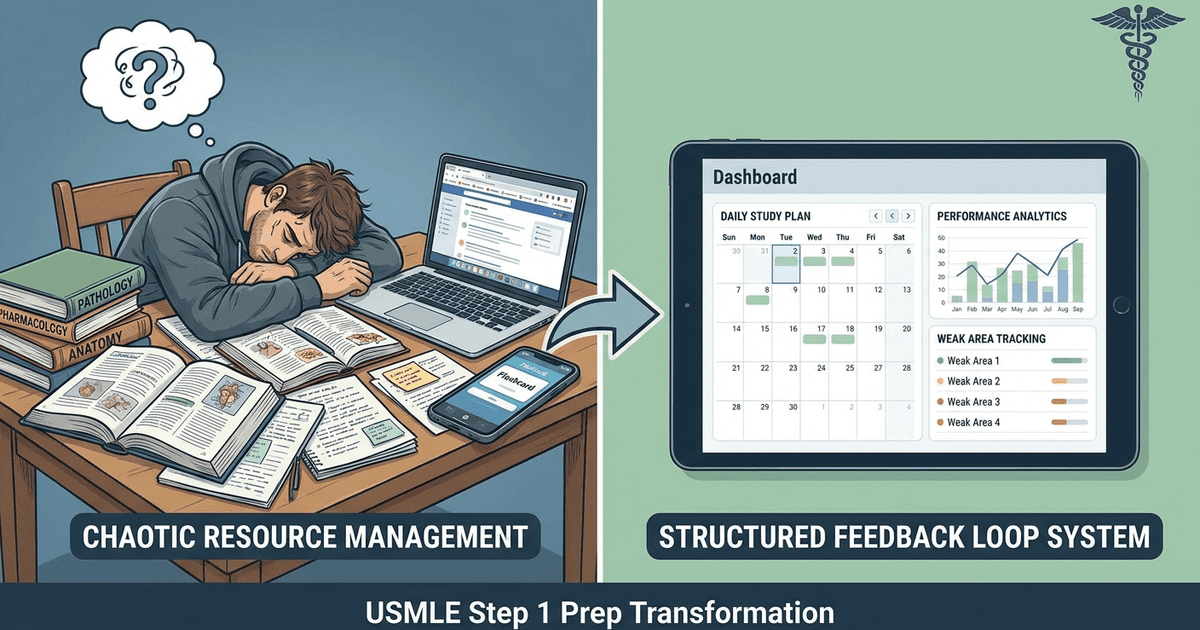
Here's what actually works: turning your USMLE Step 1 study resources into a feedback loop. Daily planning tells you exactly what to do today. Weak-area analytics tells you which systems need attention first. Together, they transform passive resource lists into an active study system that adapts as you improve.
Why Resource Lists Fail Step 1 Students
Most USMLE Step 1 guidance gives you resource recommendations without workflow. "Use UWorld and First Aid" doesnt tell you which UWorld questions to do when your Cardiology is at 58% but your Neuro is at 73%.
The real problems:
Decision paralysis: 30 minutes deciding between Sketchy Micro and weak Biochemistry topics
Random review: jumping between systems without data about which ones need work
No priorities: treating all mistakes equally instead of focusing on high-yield gaps
Static schedules: following the same plan whether you're struggling or crushing it
Generic study schedules assume every student has the same weak areas. They dont. Your Step 1 prep should change based on your actual performance, not a template someone else made.
How Daily Plans Change Resource Management
A daily plan maps study sessions into concrete next actions. Instead of "study Cardiology," you get "complete 20 Cardiology MCQs focusing on arrhythmia mechanisms, then review yesterday's Renal incorrects."
Before daily planning:
20 minutes deciding what to study
Switching between resources mid-session
Forgetting to review yesterday's mistakes
Studying comfortable topics instead of weak areas
After daily planning:
Start studying immediately — your plan tells you what's next
Complete focused sessions with specific targets
Built-in review of previous errors
Automatic prioritization of struggling systems
Your daily plan becomes your study GPS. When Biochemistry drops to 55%, tomorrows plan adjusts automatically. When you master Micro basics, more advanced questions appear. The system responds to your data, not calendar dates.
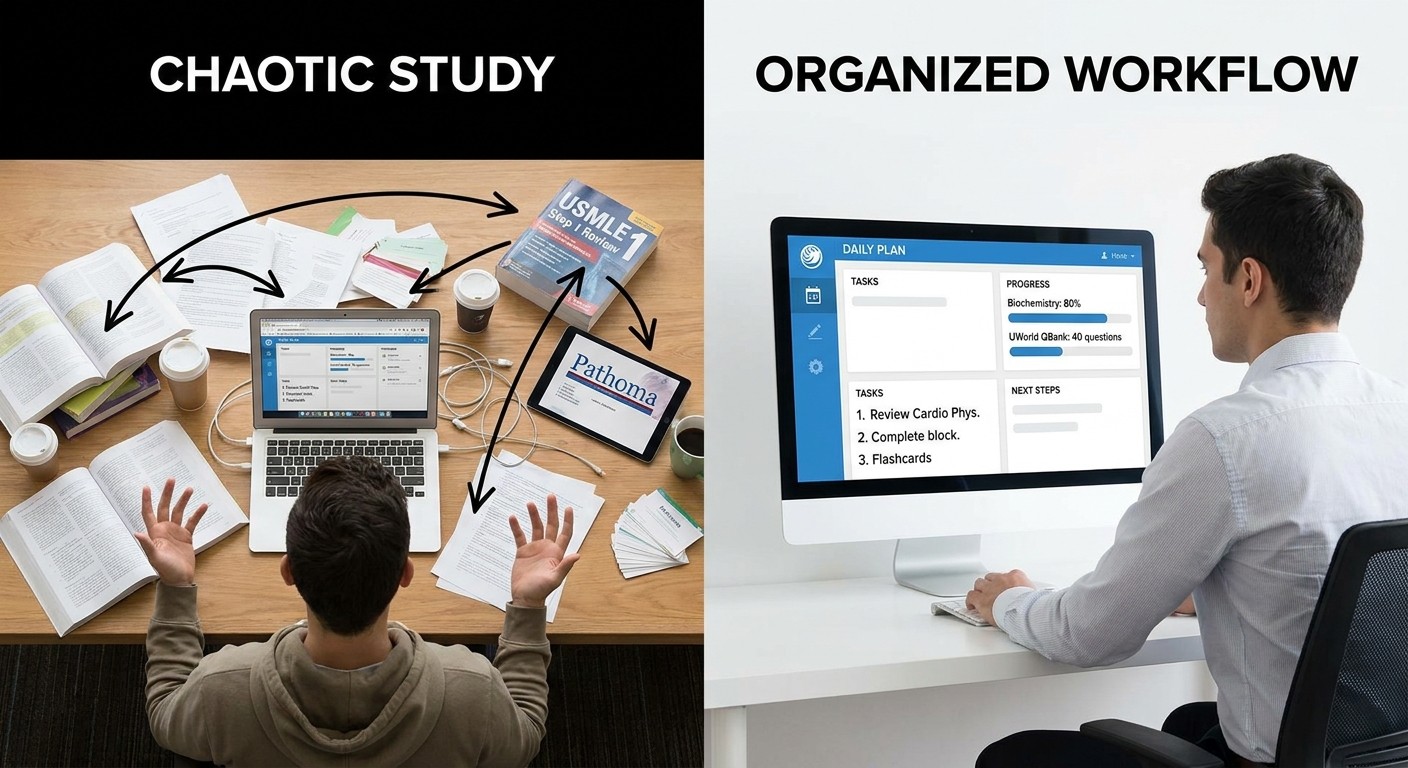
For example, Oncourse's Daily Plan feature maps out each study session based on your current performance data. When you complete 40 Cardiology questions at 65% accuracy, the system knows to schedule more Cardiology review tomorrow while maintaining other systems. No guessing, no decision fatigue.
Weak-Area Analytics: From Mistakes to Priorities
Traditional USMLE Step 1 prep treats all incorrects the same. You miss a Pathology question, make an Anki card, move on. Weak-area analytics turns that random mistake into actionable data.
What weak-area analytics tracks:
System-level performance (Cardiology: 67%, Endocrine: 52%)
Question type accuracy (mechanism vs. clinical presentation)
Improvement trends over time
Time per question by topic
High-yield vs. low-yield topic gaps
How it changes resource use:
Instead of reviewing 50 random incorrects, you see that 80% of your Endocrine mistakes are insulin/glucose mechanisms. Tomorrow's plan prioritizes those specific subtopics until performance improves.
Example workflow:
1. Complete mixed practice block (40 questions)
2. System automatically categorizes each incorrect by organ system
3. Analytics identify Respiratory as weakest performer (48% accuracy)
4. Tomorrows plan includes targeted Respiratory review and additional practice
5. System tracks improvement and adjusts focus as scores improve
The feedback loop ensures youre always working on the highest-impact gaps. When you fix low-hanging fruit in Respiratory, analytics shift attention to the next weak system.
The Step 1 Resource Stack That Actually Works
Effective USMLE Step 1 prep uses fewer resources more intelligently. Quality over quantity, guided by performance data.
Core Resource Categories
Primary Learning:
Step 1 lessons for mechanism-focused review
First Aid for reference and annotation
Pathoma for high-yield pathology integration
Active Practice:
Step 1 questions with detailed explanations
UWorld for comprehensive question practice
NBME self-assessments for progress tracking
Spaced Review:
Step 1 flashcards for active recall
Custom flashcards from missed questions
High-yield fact review before exam blocks
The key is connecting these resources through your daily plan and weak-area data. When analytics show Biochemistry weakness, your plan automatically increases Biochemistry lessons, questions, and flashcards until performance improves.
Smart Resource Rotation
Effective Step 1 prep rotates resources based on learning stage and performance:
Discovery Phase (weak areas below 60%):
Primary: lessons and concept review
Secondary: targeted questions on specific topics
Minimal: broad mixed practice
Improvement Phase (60-75% range):
Primary: focused question practice
Secondary: flashcard review of key facts
Growing: mixed practice to maintain other systems
Mastery Phase (75%+ consistent):
Primary: mixed practice and difficult questions
Secondary: rapid flashcard review
Maintenance: periodic concept refresh
The system adapts resource allocation as you progress. Early weak areas get intensive lesson work. Improving areas shift to question practice. Strong areas move to maintenance mode.
Building Your Step 1 Feedback Loop
Creating an effective USMLE Step 1 study system requires three components working together:
Component 1: Performance Tracking
Track these metrics weekly:
Overall accuracy percentage
System-specific performance (aim for 65%+ across all systems)
Time per question (target under 90 seconds)
Improvement trends over 2-week windows
Set accuracy targets by phase:
Weeks 1-4: 55-65% overall, focus on building foundation
Weeks 5-8: 65-75% overall, target weak systems
Final 2-3 weeks: 70-80% overall, maintain and fine-tune
Component 2: Adaptive Planning
Your daily plan should adjust based on yesterday's performance:
After strong performance (75%+ on practice):
Maintain current system with mixed questions
Add new challenging subtopics
Increase review of other systems
After weak performance (below 60%):
Focus on that system tomorrow
Review basic mechanisms before more questions
Reduce new content until performance stabilizes
After mixed performance (60-75%):
Continue targeted practice in struggling areas
Review missed question explanations thoroughly
Add flashcards for fact-based mistakes
Component 3: Resource Integration
Connect performance data to specific actions:
High-Impact Actions for Weak Systems:
1. Complete focused lesson review on core concepts
2. Practice 20-30 targeted questions daily until improvement
3. Create flashcards for repeatedly missed facts
4. Schedule follow-up mixed practice to confirm gains
When Oncourse analytics show Pharmacology dropping to 58%, the integrated approach kicks in: targeted pharmacology lessons focusing on your specific weak areas, followed by adaptive questions that reinforce those concepts, plus automated flashcard generation from your mistakes.
Sample Step 1 Daily Schedule Using Analytics
Here's how a data-driven USMLE Step 1 daily study schedule looks in practice:
Morning Block (3-4 hours)
30 minutes: Review yesterday's incorrects and flashcards
90 minutes: Complete targeted question block (40 questions on weakest system)
90 minutes: Deep review of explanations, create flashcards from mistakes
Afternoon Block (3-4 hours)
60 minutes: Concept review for struggling topics using lessons
90 minutes: Mixed practice block (40 questions across systems)
60 minutes: Analytics review and tomorrow's plan adjustment
Evening Block (1-2 hours)
45 minutes: High-yield flashcard review
30 minutes: Quick concept review or light reading
15 minutes: Plan review and mindset preparation
Weekly rhythm:
Monday-Friday: Full study schedule as above
Saturday: Longer practice blocks (80-120 questions) plus analytics review
Sunday: Light review, flashcards only, prep for next week
The schedule adapts based on analytics. Weak Cardiology performance triggers more Cardiology lessons and questions. Strong Neuro performance allows maintenance-level review while focusing elsewhere.
Advanced Analytics: Beyond Basic Tracking
Sophisticated USMLE Step 1 prep uses multi-dimensional performance data:
Question-Level Analytics
Mechanism vs. clinical questions: Are you missing pathophysiology or diagnosis?
Recall vs. application: Do you know facts but struggle with clinical reasoning?
System integration: Performance on multi-system questions
Image-based questions: Separate tracking for visual interpretation
Time-Based Patterns
Peak performance hours: When do you score highest?
Fatigue curves: How does accuracy change during long sessions?
Weekly trends: Are you improving consistently or plateauing?
Pre-exam anxiety: Performance changes as test date approaches
Predictive Metrics
Readiness probability: Likelihood of passing based on current trajectory
Weak system alerts: Early warning when performance drops
Study efficiency: How much improvement per hour of focused study
Resource effectiveness: Which materials drive the biggest gains
Advanced users track these patterns to optimize study timing, resource allocation, and exam scheduling. For instance, if analytics show your accuracy drops 15% after 3 hours, you know to take breaks or split long sessions.
Common Step 1 Resource Mistakes to Avoid
Even with good analytics, students make predictable mistakes:
Mistake 1: Resource Hoarding
Collecting every possible USMLE Step 1 resource instead of mastering a focused set. More resources dont equal better scores.
Solution: Pick 3-5 core resources maximum. Use analytics to optimize those before adding anything new. Mistake 2: Ignoring Time Data
Tracking accuracy but ignoring time per question. Step 1 requires both accuracy and speed.
Solution: Set time targets (90 seconds post-May 2026) and practice under strict timing. Analytics should track both accuracy and speed. Mistake 3: Static Weak Areas
Identifying weak areas once and never rechecking. Your weaknesses change as you improve.
Solution: Weekly analytics review to identify current weak spots. What was weak 4 weeks ago might be strong now. Mistake 4: All-or-Nothing Thinking
Completely abandoning strong systems to focus only on weak areas.
Solution: Maintenance-level review for strong systems (20% of study time) while prioritizing weak areas (60% of study time).
Step 1 Study Games and Active Learning
Traditional question practice can become monotonous. Learning games provide active recall practice in engaging formats.
Game-based learning works because it requires immediate decision-making under time pressure — similar to Step 1 exam conditions. For example, the Probe game presents rapid-fire medical scenarios requiring quick diagnosis and treatment decisions, simulating the clinical reasoning tested on Step 1.
These interactive formats complement traditional question banks by providing variety while maintaining educational focus. They're particularly effective during study breaks or when motivation for standard question practice wanes.
Technology Integration for Step 1 Success
Modern USMLE Step 1 prep benefits from integrated technology:
AI-Powered Explanations: When you miss a question about ACE inhibitor mechanisms, Rezzy AI tutor can immediately connect that concept to related topics you've struggled with, creating a personalized explanation that addresses your specific knowledge gaps. Cross-Platform Syncing:
Study progress, analytics, and plans should sync across devices. Review flashcards on your phone during commute, complete questions on laptop, access analytics anywhere.
Adaptive Scheduling:
Technology can optimize study schedules based on your peak performance hours, break patterns, and learning curve. If you retain Biochemistry better in morning sessions, the system schedules accordingly.
Integration Benefits:
Seamless transitions between content types (lessons → questions → flashcards)
Unified performance tracking across all study activities
Automatic adjustment of resource allocation based on improvement
The goal is removing friction from studying so you spend time learning, not managing multiple apps and schedules.
Frequently Asked Questions
How many USMLE Step 1 resources do I actually need?
You need 3-5 core resources maximum: one primary question bank, one comprehensive review source, one flashcard system, and official NBME assessments. More resources create decision paralysis without improving outcomes.
When should I start using weak-area analytics?
Start tracking performance from day one, but dont make major study plan changes until week 2-3. You need baseline data before analytics become useful. Early performance can be misleadingly low as you're still learning the material.
How often should I review my Step 1 performance analytics?
Check basic metrics (accuracy, time) after each study session. Do comprehensive analytics review weekly to identify trends and adjust plans. Monthly deep-dives help ensure you're on track for exam day.
What if analytics show everything is a weak area?
This is normal in early prep. Prioritize high-yield systems first: Cardiology, Pulmonology, and Pathology mechanisms that appear frequently. Build confidence with easier wins before tackling complex systems.
Can I use analytics if I prefer traditional study methods?
Yes. Even basic tracking (accuracy by system, time per question) improves outcomes. You dont need sophisticated software — a simple spreadsheet tracking weekly performance by system provides valuable insight.
How do I balance new learning with weak area review?
Use the 70-30 rule: 70% of study time on identified weak areas, 30% on new content or maintenance. As weak areas improve, this balance can shift toward new material or broader mixed practice.
---
Prepare smarter with Oncourse AI — adaptive MCQs, spaced repetition, and AI explanations built for USMLE Step 1. Download free on Android and iOS.