How to Study Behavioral Science for USMLE Step 1 2026: Ethics, Biostatistics & Psychiatry High-Yield Guide
Master USMLE Step 1 behavioral science with this complete guide covering ethics frameworks, biostatistics calculations, and psychiatry essentials. Study strategy for 10% of exam content.
How to Study Behavioral Science for USMLE Step 1 2026: Ethics, Biostatistics & Psychiatry High-Yield Guide
You are probably staring at First Aid's behavioral science chapter wondering how 47 pages can possibly cover 10% of your Step 1 exam. The truth is, most students completely underestimate behavioral science until they hit their first practice block and realize they missed 7 out of 8 ethics questions and cant calculate positive predictive value to save their life.
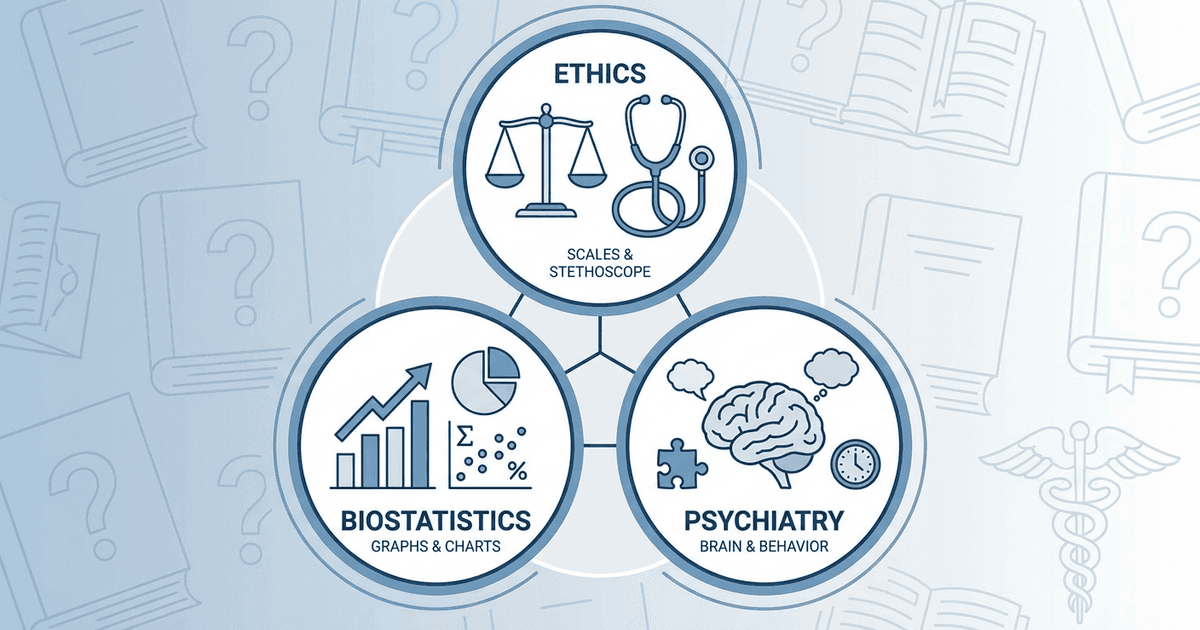
Here's what happened: behavioral science isnt one subject. It's three overlapping domains crammed into a single chapter. Medical ethics and law. Biostatistics and epidemiology. Psychiatry and psychology. Each requires a different study approach, and cramming them together during dedicated is a recipe for disaster.
The students who nail behavioral science start early and treat each domain separately. They practice biostatistics calculations until they can work backwards from any 2x2 table. They memorize the 4-box ethics framework until they can spot autonomy violations instantly. They drill psychiatric criteria until they can distinguish major depression from adjustment disorder in 30 seconds.
This guide breaks down exactly how to master each domain, avoid the common traps, and integrate behavioral science into your Step 1 prep without losing time on higher-yield subjects.
Why Behavioral Science Trips Up Step 1 Students
Behavioral science feels deceptively easy when you first read through it. Medical ethics seems like common sense. Biostatistics formulas look straightforward. Psychiatric diagnoses appear logical.
Then you hit your first practice exam and realize the questions arent testing memorization — they're testing application under time pressure. Can you calculate sensitivity when given a study with 1,200 participants in 45 seconds? Can you identify which ethical principle is violated in a complex doctor-patient scenario? Can you distinguish between normal grief and major depressive disorder when both presentations look similar?
The problem is that most resources treat behavioral science as a memorization subject. They give you lists of defense mechanisms and biostatistics formulas without teaching you how to think through Step 1 scenarios. Real exam questions embed behavioral science concepts in clinical vignettes that require you to synthesize information quickly and accurately.
Students who excel at behavioral science approach it like clinical reasoning: they learn frameworks, practice application, and build pattern recognition through repetition.
Domain 1: Medical Ethics and Law
Medical ethics represents roughly 3-4% of Step 1 questions, but they're often the difference between a passing and failing score. Ethics questions test your ability to navigate complex doctor-patient relationships under time pressure.
Master the 4-Box Ethics Framework
Every medical ethics question on Step 1 can be analyzed using four principles:
1. Autonomy: Patient's right to make their own decisions
2. Beneficence: Acting in the patient's best interest
3. Non-maleficence: "Do no harm"
4. Justice: Fair distribution of benefits and burdens
When you see an ethics vignette, identify which principle is at stake before looking at answer choices. This prevents you from getting distracted by emotionally charged scenarios.
For complex cases involving ethics, Oncourse's AI explanations break down exactly which ethical principle applies and why other choices violate patient autonomy or beneficence.
High-Yield Ethics Topics
Informed Consent Requirements:
Disclosure of diagnosis, prognosis, treatment options
Patient understanding verification
Voluntary decision without coercion
Patient capacity to make decisions
Capacity vs. Competency:
Capacity: Clinical assessment of decision-making ability
Competency: Legal determination by court
Four elements: understanding, appreciation, reasoning, choice expression
Exceptions to Confidentiality:
Imminent danger to self or others
Child or elder abuse
Gunshot wounds (state-dependent)
Communicable diseases requiring public health notification
End-of-Life Care:
Advance directives vs. living wills vs. healthcare proxies
Withdrawal vs. withholding treatment (ethically equivalent)
Palliative care vs. euthanasia vs. physician-assisted suicide
When practicing ethics scenarios, use ethics-focused MCQs that simulate real Step 1 question complexity. Each vignette should force you to choose between competing ethical principles.
Common Ethics Pitfalls
Mistake 1: Choosing the "nicest" answer instead of the ethically correct one. Step 1 ethics questions often include tempting choices that sound compassionate but violate patient autonomy. Mistake 2: Applying personal values instead of medical ethics principles. Your personal beliefs about controversial topics like abortion or end-of-life care don't determine the correct answer. Mistake 3: Overthinking straightforward scenarios. If a competent adult refuses treatment, respect their autonomy — even if the refusal seems medically unwise.
Domain 2: Biostatistics and Epidemiology
Biostatistics questions make up 4-5% of Step 1 and are often the most missed by students who try to memorize formulas without understanding their applications. These questions test calculation speed and conceptual understanding under time pressure.
Essential Biostatistics Calculations
Sensitivity and Specificity:
Sensitivity = True Positives / (True Positives + False Negatives)
Specificity = True Negatives / (True Negatives + False Positives)
High sensitivity rules OUT disease (SnOUT)
High specificity rules IN disease (SpIN)
Positive and Negative Predictive Values:
PPV = True Positives / (True Positives + False Positives)
NPV = True Negatives / (True Negatives + False Negatives)
PPV and NPV change with disease prevalence
Sensitivity and specificity remain constant regardless of prevalence
For students struggling with biostatistics calculations, Oncourse's adaptive engine identifies exactly which formulas you keep missing and increases their frequency until you achieve consistent accuracy.
Study Design Recognition
Case-Control Studies:
Start with outcome (cases vs. controls)
Look backwards for exposures
Calculate odds ratio
Good for rare diseases
Cohort Studies:
Start with exposure groups
Follow forward for outcomes
Calculate relative risk
Good for common exposures
Cross-Sectional Studies:
Single point in time
Calculate prevalence
Cannot establish causation
Randomized Controlled Trials:
Gold standard for intervention studies
Random assignment reduces bias
Can establish causation
Bias Types and Prevention
Selection Bias:
Berkson bias: Hospital patients not representative
Healthy worker effect: Working populations healthier than general population
Prevention: Proper randomization and representative sampling
Information Bias:
Recall bias: Cases remember exposures better than controls
Observer bias: Investigator expectations influence data collection
Prevention: Blinding and objective measurements
Confounding:
Third variable affects both exposure and outcome
Prevention: Randomization, matching, stratification
Practice biostatistics with targeted questions that mix calculation problems with study design interpretation. Time yourself to build speed.
Domain 3: Psychiatry and Psychology
Psychiatric content on Step 1 focuses on major psychiatric disorders, defense mechanisms, and behavioral science concepts. Unlike Step 2 CK, Step 1 psychiatry emphasizes pathophysiology and basic science connections.
High-Yield Psychiatric Disorders
Major Depressive Disorder:
5+ symptoms for 2+ weeks
Must include depressed mood OR anhedonia
Significant functional impairment
Rule out substance use or medical conditions
Bipolar Disorder:
Manic episode: 1+ week of elevated mood with 3+ symptoms
Mixed episode: Criteria for both mania and depression
Cyclothymic disorder: 2+ years of mood swings not meeting full criteria
Anxiety Disorders:
Generalized anxiety: 6+ months of excessive worry
Panic disorder: Recurrent panic attacks with persistent concern
Social anxiety: Fear of social situations with avoidance
Schizophrenia:
2+ positive/negative symptoms for 6+ months
Functional decline from baseline
Positive symptoms: Hallucinations, delusions, disorganized speech
Negative symptoms: Avolition, alogia, anhedonia
Freudian Defense Mechanisms
Defense mechanisms appear regularly on Step 1, often embedded in clinical vignettes. Memorize these high-yield mechanisms:
Mature Defenses:
Sublimation: Channeling unacceptable impulses into socially acceptable activities
Suppression: Consciously putting aside disturbing thoughts
Humor: Using comedy to deal with stress
Immature Defenses:
Denial: Refusing to acknowledge reality
Projection: Attributing own feelings to others
Splitting: Viewing people as all good or all bad
Acting out: Direct expression of unconscious conflict through behavior
Use spaced repetition flashcards to retain psychiatric criteria and defense mechanisms. The optimal review intervals help you remember DSM criteria through exam day, not just during your psychiatry block.
Behavioral Science Concepts
Kübler-Ross Stages of Grief:
1. Denial
2. Anger
3. Bargaining
4. Depression
5. Acceptance
Health Behavior Models:
Health Belief Model: Perceived susceptibility, severity, benefits, barriers
Transtheoretical Model: Precontemplation, contemplation, preparation, action, maintenance
Social Cognitive Theory: Self-efficacy, outcome expectations, environment
Integrated Study Strategy for Behavioral Science
Successful Step 1 students dont study behavioral science in isolation — they integrate it with other subjects and practice mixed question blocks that simulate real exam conditions.
Week-by-Week Approach
Weeks 1-2: Foundation Building
Read First Aid Behavioral Science chapter completely
Complete ethics lessons for framework understanding
Practice basic biostatistics calculations until automatic
Weeks 3-4: Application Practice
Do 20-30 behavioral science questions daily
Focus on timed practice to build speed
Review missed questions immediately with detailed explanations
Weeks 5-8: Mixed Integration
Include behavioral science in mixed subject blocks
Practice 280-question blocks with 10-15% behavioral science
Identify remaining weak areas for targeted review
Dedicated Period: Maintenance
Daily review of high-yield concepts
Continue mixed practice blocks
Final review of ethics frameworks and biostatistics formulas
Question-Based Learning Strategy
Instead of reading behavioral science theory in isolation, use a question-driven approach:
1. Attempt questions first before reading explanations
2. Analyze wrong answers to identify knowledge gaps
3. Practice similar questions until pattern recognition develops
4. Review concepts only after seeing how they're tested
When you miss a behavioral science question, Oncourse's AI explanations dont just tell you the right answer — they walk through the reasoning framework and explain why each wrong choice violates specific principles or calculations.
Time Management During the Exam
Behavioral science questions on Step 1 should take 45-60 seconds each. Here's how to manage your time:
Ethics Questions (45 seconds):
Read stem once to identify ethical dilemma
Apply 4-box framework immediately
Eliminate choices that violate identified principle
Select answer without second-guessing
Biostatistics Questions (60 seconds):
Identify study type and requested calculation
Set up 2x2 table if needed
Calculate quickly using memorized formulas
Double-check calculation only if time permits
Psychiatry Questions (45 seconds):
Focus on DSM criteria and duration requirements
Rule out substance use and medical causes
Match symptoms to specific diagnostic criteria
Avoid overanalyzing complex psychodynamics
Common Study Mistakes to Avoid
Mistake 1: Skipping Behavioral Science Until Dedicated
Behavioral science concepts need time to solidify through repeated exposure. Students who start during dedicated often run out of time and guess on 10% of their exam.
Mistake 2: Memorizing Without Application
Reading lists of defense mechanisms or biostatistics formulas without practicing questions leads to confusion during the exam. Pattern recognition develops through question practice, not passive reading.
Mistake 3: Treating Ethics as Opinion-Based
Step 1 ethics questions have objective correct answers based on established medical ethics principles. Your personal opinions or cultural background dont determine the right choice.
Mistake 4: Calculator Dependence for Biostatistics
The real exam provides a basic calculator, but you should practice calculations by hand to build speed and catch errors quickly.
Mistake 5: Mixing Up Step 1 vs. Step 2 Psychiatry
Step 1 focuses on basic science and pathophysiology of psychiatric disorders. Step 2 emphasizes detailed treatment and management. Dont over-study psychiatric treatments for Step 1.
High-Yield Review Topics by Domain
Ethics Quick Reference
Autonomy violations: Coercion, inadequate informed consent
Beneficence conflicts: Paternalistic decision-making
Confidentiality exceptions: Duty to warn, mandatory reporting
Capacity assessment: Four-element evaluation
Biostatistics Formula Sheet
Sensitivity = TP/(TP+FN)
Specificity = TN/(TN+FP)
PPV = TP/(TP+FP)
NPV = TN/(TN+FN)
Incidence = New cases/Population at risk
Prevalence = Total cases/Total population
NNT = 1/ARR
Psychiatry Essentials
Major depression: 5 symptoms, 2 weeks, functional impairment
Mania: 1 week elevated mood, 3+ symptoms
GAD: 6 months excessive worry, 3+ physical symptoms
Panic disorder: Recurrent attacks + persistent concern
Defense mechanisms: Mature vs. immature categories
Frequently Asked Questions
How much time should I spend on behavioral science daily?
Dedicate 30-45 minutes daily to behavioral science throughout your Step 1 prep. This includes 20-30 minutes of question practice and 10-15 minutes reviewing missed concepts. During dedicated, maintain this schedule rather than cramming.
Can I skip biostatistics if I'm running out of time?
No. Biostatistics questions are often straightforward once you master the calculations. They represent free points if you practice consistently. Focus on the highest-yield formulas: sensitivity, specificity, PPV, NPV, and basic study designs.
Should I memorize all psychiatric DSM criteria for Step 1?
Focus on major disorders that appear frequently: depression, bipolar disorder, schizophrenia, anxiety disorders, and ADHD. Know duration requirements and key distinguishing features. Step 1 doesnt test obscure psychiatric conditions in detail.
How do I approach ethics questions when multiple answers seem correct?
Apply the 4-box ethics framework systematically. Identify which ethical principle is primary in the scenario, then eliminate answers that violate that principle. When in doubt, choose the option that best respects patient autonomy.
Is First Aid enough for behavioral science, or do I need additional resources?
First Aid provides a good framework, but you need additional question practice and detailed explanations. The concepts in First Aid are condensed — you need to see how they're applied in complex clinical scenarios through practice questions.
How can I improve my biostatistics calculation speed?
Practice calculations without a calculator until you can work through 2x2 tables quickly. Memorize common fraction-to-percentage conversions. Time yourself on biostatistics questions to identify which formulas slow you down.
Prepare smarter with Oncourse AI — adaptive MCQs, spaced repetition, and AI explanations built for USMLE Step 1. Download free on Android and iOS.