Step 2 Scores by Specialty: 2026 Match Benchmarks and How to Plan Your Target Score
Complete Step 2 CK score table by specialty for 2026 match data. Average scores for dermatology (265), emergency medicine (252), OB/GYN (250), surgery, and all specialties with planning strategies.
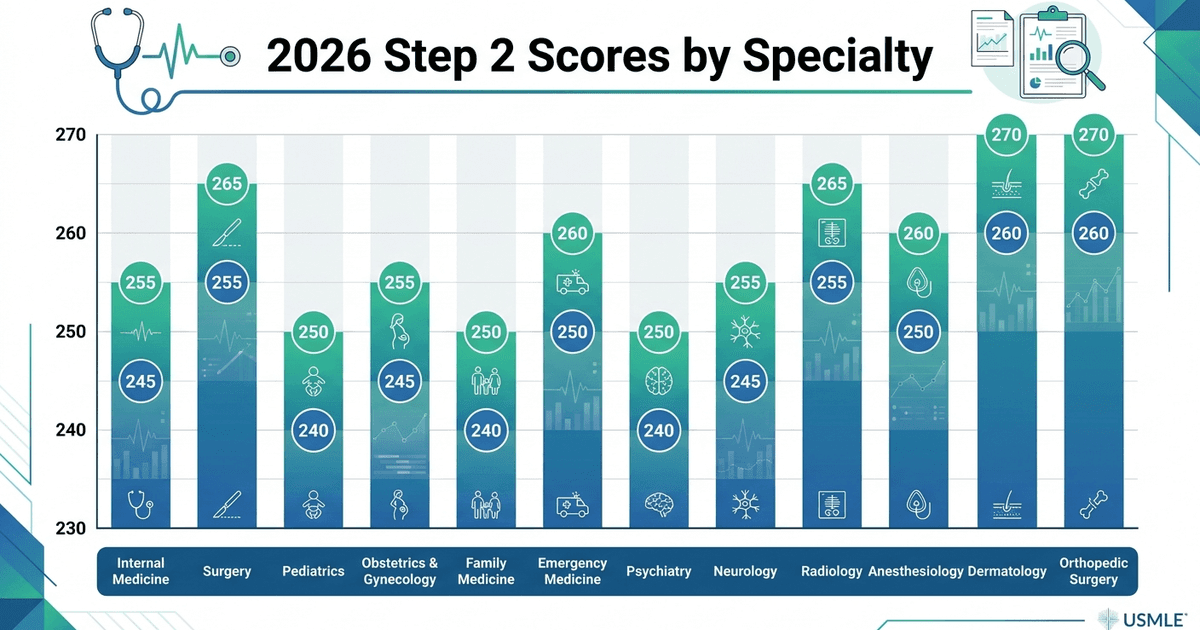
Step 2 Scores by Specialty: 2026 Match Benchmarks and How to Plan Your Target Score
You just got your Step 2 CK score. 248. Is that competitive for emergency medicine? What about orthopedic surgery? Your advisor says "scores aren't everything," but you know dermatology programs filter anyone under 260.
Here's what you actually need to know. The 2026 match data shows exactly where successful applicants scored across every specialty. No guessing, no outdated advice — just the real benchmarks that determine your competitiveness.
Since Step 1 went pass/fail, Step 2 CK became the primary numerical filter. Programs rely on it more than ever to screen applicants and make ranking decisions. Understanding these benchmarks isn't just helpful — it's essential for strategic planning.
Complete Step 2 CK Score Benchmarks by Specialty (2026)
Based on 2026 NRMP match data and program reporting, here are the actual scores that matched residents achieved:
Specialty | Mean Score | 25th Percentile | 75th Percentile | US MD Match Rate |
|---|---|---|---|---|
Dermatology | 265 | 258 | 272 | 73% |
Radiation Oncology | 262 | 255 | 269 | 65% |
Diagnostic Radiology | 258 | 250 | 266 | 87% |
Anesthesiology | 255 | 246 | 264 | 94% |
Emergency Medicine | 252 | 243 | 261 | 76% |
Orthopedic Surgery | 251 | 242 | 260 | 82% |
OB/GYN | 250 | 241 | 259 | 85% |
General Surgery | 249 | 240 | 258 | 89% |
Neurology | 247 | 238 | 256 | 91% |
Psychiatry | 245 | 236 | 254 | 95% |
Internal Medicine | 243 | 234 | 252 | 97% |
Pediatrics | 242 | 233 | 251 | 96% |
Family Medicine | 240 | 231 | 249 | 98% |
Pathology | 238 | 229 | 247 | 93% |
What These Numbers Mean for Your Match Strategy
The Elite Tier (260+)
Dermatology and radiation oncology sit at the top with means of 265 and 262. These aren't just high averages — they represent the reality that half of matched applicants scored even higher.
A 260 in dermatology puts you at the 25th percentile of matched applicants. That's not failed territory, but it means you need exceptional clinical grades, research, and connections to compensate.
The Competitive Zone (250-259)
Emergency medicine, orthopedic surgery, OB/GYN, and general surgery cluster around 250-252. This is where most students with strong Step 2 performance find themselves competitive.
If you're targeting these specialties with a 245, you're below the 25th percentile. Still possible, but you'll need outstanding rotations and research to stand out.
The Accessible Range (240-249)
Internal medicine, pediatrics, psychiatry, and neurology offer broader pathways. The 25th percentiles range from 233-238, meaning scores in the low 240s keep you competitive.
The Broad Match Zone (Below 245)
Family medicine, pathology, and some psychiatry tracks regularly match students scoring in the 230s. These aren't "backup" specialties — they're legitimate choices with different score expectations.
How Step 2 CK Functions in 2026 Residency Selection
Step 2 CK serves three distinct functions in residency matching:
Initial Screening (Automated Filters)
Many programs set minimum cutoffs to narrow applicant pools. Common thresholds cluster around 230-240 for most specialties, with competitive fields requiring 250+.
Interview Invitations (Human Review)
Once past initial screens, Step 2 CK influences interview decisions. Higher scores increase interview likelihood, especially at top-tier programs.
Final Ranking (Tiebreaker)
Programs use Step 2 CK to differentiate between similarly qualified applicants. A 10-point difference can shift your rank position significantly.
Specialty-Specific Planning Strategies
Targeting Highly Competitive Specialties
If you're aiming for dermatology, radiation oncology, or top-tier surgical specialties, plan around these realities:
Score Target: 260+ This puts you in the competitive range, though not guaranteed territory. When preparing for these scores, focus on mastery rather than coverage. Oncourse's USMLE cardiology lessons emphasize the deep clinical reasoning that separates 260+ performers from average scorers. Timeline Planning
Take Step 2 CK early in fourth year to allow retake time if needed. These specialties forgive very little.
Backup Planning
Even with a 265, have alternatives ready. Match rates below 80% mean excellent candidates don't match.
Emergency Medicine Strategy
EM sits at a 252 mean with 76% US MD match rate. The score matters, but geography and away rotations carry significant weight.
Score Target: 250+
This keeps you competitive at most programs. Below 245 requires exceptional clinical performance and strategic program selection.
Geographic Considerations EM programs favor local candidates and those with regional ties. A 245 with strong local connections often beats a 255 without ties. During your EM rotation, focus on procedures and critical decision-making — the same skills tested in Oncourse's Probe clinical reasoning game.
OB/GYN Approach
The 250 mean reflects OB/GYN's emphasis on clinical decision-making under pressure. Step 2 CK tests exactly what these programs value.
Score Target: 248-255
This range keeps you competitive across most programs. Above 255 significantly improves your chances at academic centers.
Clinical Integration
OB/GYN programs weight shelf exam performance heavily. Strong performance on your rotation often correlates with Step 2 CK success.
Internal Medicine Planning
With a 243 mean and 97% US MD match rate, IM offers more score flexibility. The challenge isn't matching — it's matching where you want.
Score Target: 240+
This opens most IM programs. Subspecialty competitive programs (cardiology, gastroenterology) prefer 250+.
Program Tier Considerations Top academic IM programs increasingly use Step 2 CK as a screen, despite the high overall match rate. When reviewing complex cases, the clinical reasoning skills tested in Step 2 CK directly translate to what these programs value. Oncourse's internal medicine question bank focuses on the multi-step diagnostic thinking that sets competitive applicants apart.
IMG vs US MD Score Considerations
International medical graduates face different benchmarks due to additional screening factors:
Score Gap Reality
IMGs typically need 15-20 points higher than US MDs for similar match rates. If the US MD average is 243 for internal medicine, IMGs should target 260+ for comparable competitiveness.
Visa and Program Fit
Many programs limit IMG positions regardless of scores. High Step 2 CK performance helps overcome initial screening but doesn't eliminate program-specific barriers.
Regional Targeting
IMG-friendly programs often have different score expectations. Research program history before assuming score requirements.
Creating Your Target Score Plan
Step 1: Identify Your Competitive Tier
Look at your target specialty's 25th and 75th percentile ranges. Where do you need to fall for realistic competitiveness?
75th percentile or above: Strong likelihood at most programs
50th-75th percentile: Competitive with solid application
25th-50th percentile: Possible with exceptional non-score factors
Below 25th percentile: Consider broader applications or alternative specialties
Step 2: Timeline Planning
6-8 Week Dedicated Period
Most successful high scorers dedicate 6-8 weeks of focused study. Shorter periods work for some, but don't risk your match on optimistic timelines.
Score Release Timing
Plan your test date 6-10 weeks before ERAS submission. This allows score inclusion in applications and potential retake time.
Step 3: Resource Allocation
Content Review vs Question Practice
High scorers typically spend 30% on content review and 70% on practice questions. Step 2 CK tests application more than recall.
Weakness Identification Use practice tests to identify weak areas early. Don't wait until the final weeks to address major gaps. Oncourse's adaptive AI tutor Rezzy personalizes study plans based on your performance patterns, focusing study time where you need it most rather than following generic schedules. Spaced Repetition Integration
High-yield facts need consistent reinforcement. Build review cycles into your study plan rather than cramming at the end.
Common Score Planning Mistakes to Avoid
Mistake 1: Using Outdated Benchmarks
Step 2 CK expectations shift yearly. Don't rely on advice from residents who matched 3-5 years ago.
Mistake 2: Ignoring Score Distribution
A specialty's mean score tells only part of the story. Understanding 25th and 75th percentiles reveals competitive reality.
Mistake 3: Over-relying on Score Alone
High scores open doors, but clinical performance, research, and fit determine final decisions. Balance score preparation with other application components.
Mistake 4: Inadequate Timeline Planning
Rushing Step 2 CK preparation because of application deadlines leads to suboptimal scores. Plan backward from application submission dates.
Advanced Score Optimization Strategies
Targeting the 75th Percentile
If you're aiming for highly competitive programs, target the 75th percentile for your specialty. This typically requires:
Mastery-Based Learning
Focus on understanding concepts deeply rather than memorizing isolated facts. Step 2 CK tests clinical application and reasoning.
Multi-Pass Question Practice
Complete question banks multiple times with different focuses: first pass for learning, second for timing, third for reinforcement.
Weakness Remediation
Spend disproportionate time on weak areas early in preparation. Don't let comfortable topics consume study time.
Score Improvement Strategies
For Retakers
Identify specific weakness patterns from your first attempt. Broad review rarely improves scores significantly.
For Time-Pressed Students
Focus on high-yield topics that appear frequently. Internal medicine, surgery, and OB/GYN comprise the majority of questions.
For International Students
Emphasize US-specific guidelines and standard-of-care approaches. Step 2 CK tests US clinical practice patterns.
Frequently Asked Questions
What's the minimum Step 2 CK score for competitive specialties?
There's no true minimum, but practical thresholds exist. Most competitive specialties (dermatology, orthopedic surgery, radiation oncology) have few successful applicants below 250. Emergency medicine and OB/GYN occasionally match candidates in the mid-240s with exceptional applications.
How much do Step 2 CK scores matter compared to clinical grades?
Step 2 CK functions as an initial screen and tiebreaker, while clinical grades demonstrate sustained performance. Both matter significantly. Strong clinical grades can partially compensate for borderline scores, but very low Step 2 CK scores limit interview opportunities regardless of grades.
Should I retake a 245 if I want emergency medicine?
A 245 in emergency medicine puts you below the 25th percentile but within possible range. Consider retaking if you have time and are confident about improvement. Otherwise, focus on outstanding away rotations and geographic ties to programs.
Do IMG candidates need higher Step 2 CK scores than US MDs?
Yes, significantly. IMGs typically need 15-20 points higher for comparable match rates in most specialties. The gap reflects additional screening factors beyond scores, including visa requirements and program familiarity preferences.
When should I take Step 2 CK for optimal timing?
Take Step 2 CK 6-10 weeks before ERAS submission. This timing allows score inclusion in applications, provides buffer time for potential retakes, and reduces application stress. Avoid taking it after ERAS submission unless programs specifically request it.
How accurate are these benchmarks for future years?
These benchmarks reflect current competitiveness patterns and typically remain stable year-to-year with gradual increases. Expect 1-2 point annual increases in competitive specialties as Step 1 pass/fail effects stabilize. Use these numbers as planning guides, not guarantees.
Step 2 CK scores matter more than ever in 2026 residency matching. Understanding exact benchmarks helps you set realistic targets, plan appropriate timelines, and make informed specialty decisions. Remember that scores open doors, but your overall application determines final outcomes.
Prepare smarter with Oncourse AI — adaptive MCQs, spaced repetition, and AI explanations built for USMLE success. Download free on Android and iOS.