UPSC CMS 90-Day Study Plan 2026: High-Yield Subject Strategy for Paper I and Paper II
Complete 90-day UPSC CMS preparation roadmap with week-by-week study plan, Paper I vs Paper II priorities, high-yield topics, and topper strategies for 2026 medical officer exam.
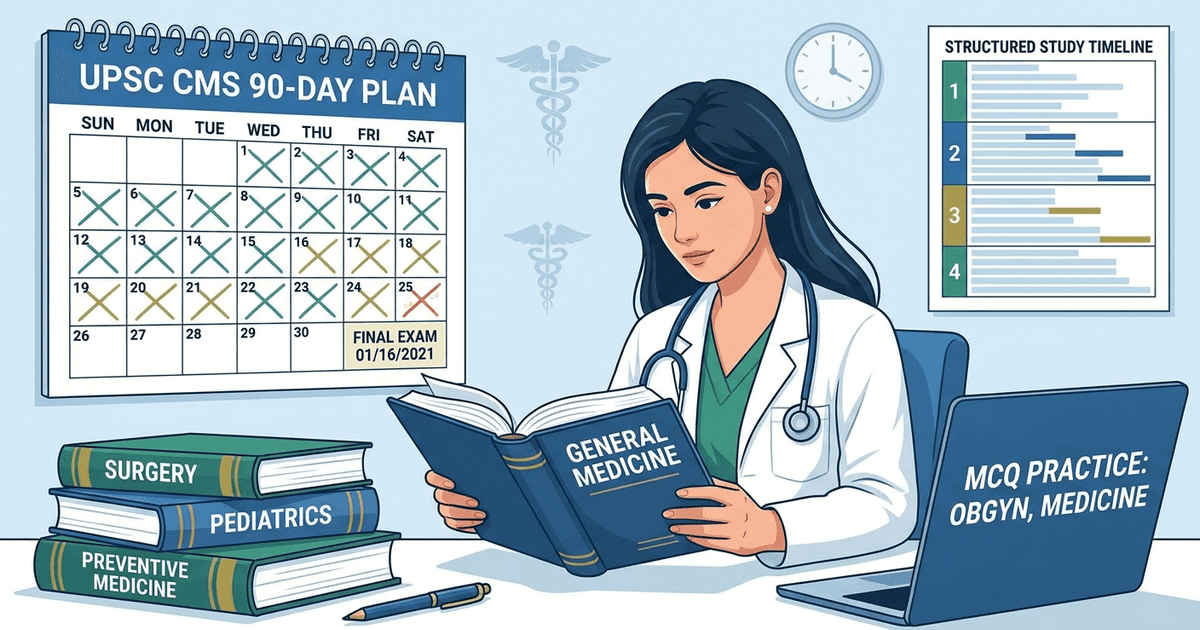
UPSC CMS 90-Day Study Plan 2026: High-Yield Subject Strategy for Paper I and Paper II
You have exactly 90 days to crack the UPSC CMS 2026 exam. That's 2,160 hours to master everything from general medicine's 96 questions to preventive medicine's latest national health programs. Most candidates waste weeks figuring out what to study first. You dont have that luxury.
The UPSC Combined Medical Services Examination on August 2, 2026, isnt just another MCQ test. It's your gateway to 1,358 medical officer positions across Central Health Services, Indian Railways, and municipal corporations. The competition is fierce, but the pattern is predictable.
Here's what separates toppers from the rest: they know exactly which 20% of topics yield 80% of their marks. They understand that Paper I's general medicine dominates with 96 questions, while Paper II balances three subjects equally. Most importantly, they follow a system that builds knowledge in layers, not chunks.
This 90-day roadmap eliminates guesswork. Every week has a purpose. Every subject gets its due weightage. Every mistake gets addressed before it becomes a habit.
Understanding UPSC CMS 2026: Paper I vs Paper II Strategy
The UPSC CMS exam structure determines your entire preparation approach. You're facing 240 multiple-choice questions across two papers, each carrying 250 marks with a brutal 1/3 negative marking penalty.
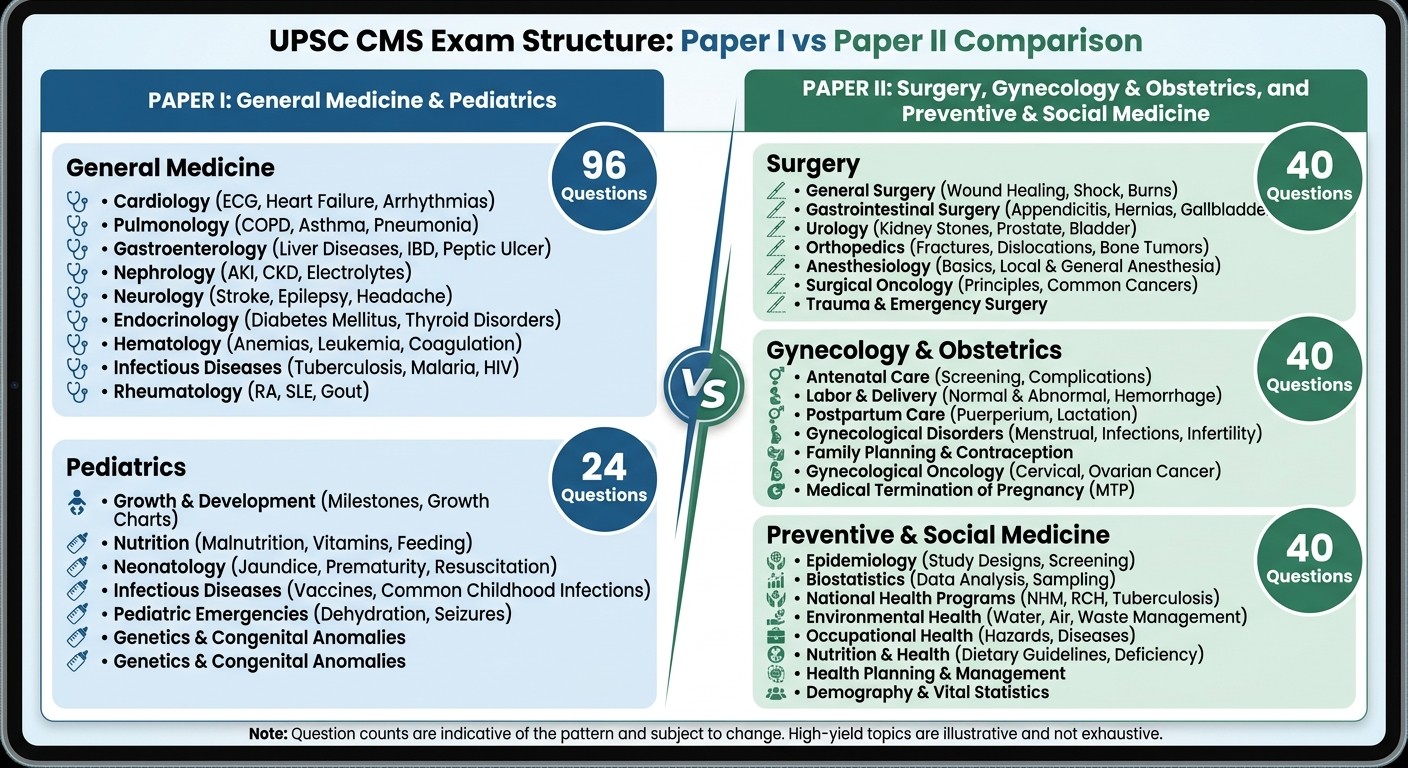
Paper I Breakdown:
General Medicine: 96 questions (80% weightage)
Pediatrics: 24 questions (20% weightage)
Duration: 2 hours
Focus: Clinical reasoning, diagnostics, management protocols
Paper II Distribution:
Surgery: 40 questions
Gynecology & Obstetrics: 40 questions
Preventive & Social Medicine: 40 questions
Duration: 2 hours
Focus: Procedures, complications, public health programs
The mathematics is simple but crucial. Paper I's general medicine section alone contributes 96 out of 240 total questions – that's 40% of your entire score. This means your time allocation must reflect this reality.
Study time should follow the 60-25-15 rule: 60% for Paper I subjects (with heavy emphasis on general medicine), 25% for Paper II clinical subjects (surgery and gynecology), and 15% for preventive medicine. This isnt equal distribution – it's strategic distribution based on question weightage.
Most candidates make the mistake of treating all subjects equally. Toppers understand that mastering general medicine's cardiology, infectious diseases, and endocrinology can secure more marks than perfecting surgical subspecialties.
90-Day Phase-Based Strategy
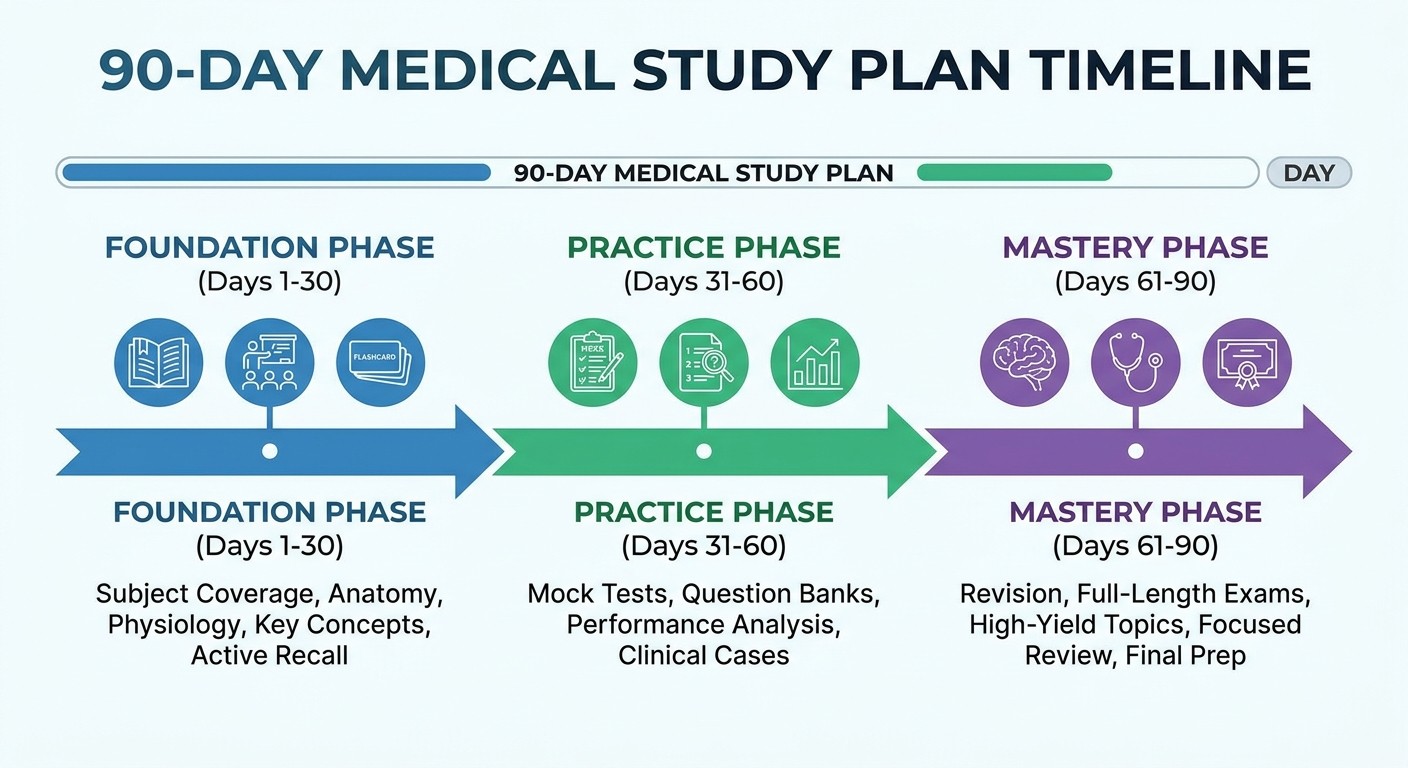
Foundation Phase (Days 1-30): Building Core Knowledge
Week 1-2: General Medicine Foundation
Days 1-3: Cardiovascular system (MI management, arrhythmias, heart failure basics)
Days 4-6: Respiratory system (pneumonia, COPD, asthma protocols)
Days 7-10: Endocrinology (diabetes management, thyroid disorders)
Days 11-14: Infectious diseases (malaria, tuberculosis per NTEP guidelines, dengue)
Start each topic with pathophysiology, then move to clinical presentation, diagnostics, and management. The Oncourse AI adaptive question bank helps identify your weak areas within each system – if you're consistently missing cardiology rhythm questions, that signals where to drill deeper. Week 3: Pediatrics + Surgery Basics
Days 15-18: Pediatric growth milestones, immunization schedule (latest 2026 updates), neonatal care
Days 19-21: General surgery principles, wound healing, fluid management
Week 4: Gynecology + PSM Introduction
Days 22-25: Obstetric emergencies, antenatal care protocols, MTP Act updates
Days 26-30: Epidemiology basics, biostatistics fundamentals
Daily Structure for Foundation Phase:
6 hours active study
2 hours MCQ practice (target: 50-60 questions daily)
1 hour revision of previous day's topics
Track weak areas using performance analytics
Practice Phase (Days 31-60): Application and Testing
Week 5-6: Integrated Medicine Practice
Switch from system-wise to case-based learning
Practice 80-100 MCQs daily across all general medicine topics
Focus on clinical scenarios and image-based questions
Begin mock tests (2 per week)
This phase introduces Oncourse's smart revision system through spaced repetition flashcards. Instead of randomly reviewing topics, the algorithm ensures you encounter weak areas more frequently while maintaining stronger topics at optimal intervals. Week 7-8: Paper II Integration
Dedicate alternate days to surgery and gynecology
Master high-yield PSM topics: National Health Mission updates, maternal mortality ratios, immunization coverage statistics
Increase mock frequency to 3 per week
Time management practice: complete 120 questions in 110 minutes
Week 9: Subject Rotation
Monday/Wednesday/Friday: General medicine + Pediatrics
Tuesday/Thursday: Surgery + Gynecology
Saturday: PSM + Mock test
Sunday: Weak area drilling based on mock performance
Mastery Phase (Days 61-90): Peak Performance
Week 10-11: Peak Practice
Daily full-length mocks alternating between Paper I and Paper II
Score analysis and targeted revision
Memorize key formulas: Naegele's Rule, Parkland Formula, sensitivity/specificity calculations, BMI ranges
Week 12: Final Sprint
Days 82-85: High-yield topic revision using condensed notes
Days 86-88: Final 3 full-length mocks under strict exam conditions
Days 89-90: Light revision, formula review, confidence building
High-Yield Subject Priorities by Paper
Paper I: General Medicine (96 Questions)
Cardiology (20-25% of medicine questions):
Acute coronary syndromes: STEMI vs NSTEMI management
Heart failure classification and treatment protocols
Arrhythmia recognition and emergency management
Hypertension guidelines and target BP ranges
Infectious Diseases (15-20%):
Malaria: Latest treatment protocols, severe malaria management
Tuberculosis: DOTS, MDR-TB, NTEP guidelines 2026
Dengue: Warning signs, fluid management, complications
HIV/AIDS: Current ART protocols, opportunistic infections
Use general medicine lessons to build conceptual clarity, then reinforce with targeted MCQs. The key is active recall – can you explain malaria management without looking at notes? Endocrinology (10-15%):
Diabetes mellitus: HbA1c targets, complications screening
Thyroid disorders: TSH interpretation, hyperthyroid crisis
Adrenal disorders: Addison's disease, Cushing's syndrome
Paper I: Pediatrics (24 Questions)
Growth and Development (30% of pediatric questions):
Normal developmental milestones by age
Failure to thrive evaluation and management
Vaccination schedule updates for 2026
Neonatal Medicine (25%):
APGAR scoring and interpretation
Neonatal jaundice: physiologic vs pathologic
Birth asphyxia management protocols
Common Pediatric Illnesses (45%):
Acute respiratory infections in children
Diarrhea and dehydration management
Common poisoning and emergency care
Paper II: Surgery (40 Questions)
General Surgery Principles (50%):
Pre-operative assessment and risk stratification
Post-operative complications recognition
Wound healing and surgical site infections
Trauma and Emergency Surgery (30%):
ATLS protocols and primary survey
Shock recognition and fluid resuscitation
Common surgical emergencies: appendicitis, intestinal obstruction
Surgical Subspecialties (20%):
Basic orthopedic principles
Common ENT conditions
Elementary ophthalmology emergencies
Paper II: Gynecology & Obstetrics (40 Questions)
Obstetrics (60%):
Antenatal care protocols and high-risk pregnancy
Labor management and delivery complications
Postpartum hemorrhage and eclampsia management
Gynecology (40%):
Menstrual disorders and PCOS management
Contraception methods and family planning
Gynecologic oncology screening programs
Paper II: Preventive & Social Medicine (40 Questions)
Epidemiology and Biostatistics (40%):
Study design types and their applications
Sensitivity, specificity, and predictive values
Screening test principles and ROC curves
National Health Programs (35%):
National Health Mission components
Maternal and child health indicators
Disease-specific programs: NTEP, NVBDCP, NPCB
Environmental and Occupational Health (25%):
Air and water pollution health effects
Biomedical waste management protocols
Occupational diseases and prevention
The community medicine lessons cover these topics systematically, but focus extra attention on current statistics – PSM questions often test updated numbers for 2026.
Week-by-Week Study Schedule
Weeks 1-4: Foundation Building
Week 1 Daily Pattern:
9:00-11:00 AM: Cardiology theory + cases
11:30 AM-12:30 PM: Cardiology MCQs (30 questions)
2:00-4:00 PM: Respiratory medicine concepts
4:30-5:30 PM: Respiratory MCQs (30 questions)
6:00-7:00 PM: Previous day quick revision
Week 2 Focus:
Days 8-10: Endocrinology deep dive (diabetes, thyroid, adrenals)
Days 11-14: Infectious diseases mastery (malaria, TB, dengue, HIV)
Daily target: 40-50 MCQs with detailed explanation review
Week 3 Integration:
Pediatrics fundamentals with adult medicine correlation
Surgery basics focusing on emergency management
Daily target: 50-60 MCQs across multiple subjects
Week 4 Paper II Introduction:
Obstetrics and gynecology core concepts
PSM epidemiology and biostatistics foundation
First mock test attempt with analysis
Weeks 5-8: Practice Integration
Subject Rotation Schedule:
Monday/Wednesday/Friday: General Medicine focus (3 hours) + Pediatrics (1 hour) + Mixed practice (80 MCQs)
Tuesday/Thursday: Surgery (2 hours) + Gynecology (2 hours) + Targeted MCQs (60 questions)
Saturday: PSM intensive study + Paper II mock test
Sunday: Comprehensive revision + weak area drilling
Mock test frequency increases to 3-4 per week by Week 8, with score targets progressing from 50% to 70%.
Weeks 9-12: Mastery Phase
Peak Practice Schedule:
Daily morning: Subject-specific intensive study (2 hours)
Afternoon: Full-length mock test (2 hours) OR targeted practice (100+ MCQs)
Evening: Mock analysis and remediation (2 hours)
Night: Light revision and formula practice (1 hour)
Performance analytics becomes crucial during this phase – track which topics consistently drain your scores and allocate extra practice time accordingly.
Mock Test Strategy and Score Targets
Your mock test performance predicts exam success better than study hours. Follow this progressive scoring system:
Days 1-30 (Foundation):
Week 4: First baseline mock (target: 40-50%)
Focus: Identify major knowledge gaps
Analysis time: 2x test time (4 hours analysis for 2-hour test)
Days 31-60 (Practice):
Frequency: 3 mocks per week
Score progression: 50% → 60% → 65% → 70%
Strategy refinement: Time management + negative marking awareness
Days 61-90 (Mastery):
Peak frequency: 1 mock daily
Target: 75% → 80% → 85%
Final week: 3 mocks under strict exam conditions
Mock Analysis Framework: 1. Immediate Review (within 2 hours):
- Categorize errors: knowledge gaps vs careless mistakes vs time pressure
- Identify subject-wise weak areas
- Note question patterns and difficulty levels
2. Action Planning (next day):
- Schedule targeted study for weak topics
- Practice similar questions from question banks
- Adjust daily study schedule based on gaps
3. Progress Tracking (weekly):
- Compare scores across multiple attempts
- Monitor improvement in specific subjects
- Evaluate time management efficiency
The key insight: mock tests are diagnostic tools, not just practice exercises. Each mock should reveal something new about your preparation status.
Last 14-Day Checklist
Days 77-83 (Final Preparation Week):
[ ] Complete comprehensive revision of all high-yield topics
[ ] Practice 2 full-length mocks daily under exam conditions
[ ] Memorize all formulas, normal values, and key statistics
[ ] Review current affairs related to health policies for 2026
[ ] Optimize time management: aim to complete each paper in 110 minutes
Days 84-90 (Confidence Building Week):
[ ] Light revision using concise notes only
[ ] Practice relaxation and stress management techniques
[ ] Maintain consistent sleep schedule matching exam timings
[ ] Final 3 mock tests with detailed performance analysis
[ ] Prepare all exam day logistics and documentation
The final week should feel like a controlled wind-down, not a frantic cramming session. Your preparation quality is already determined – focus on optimizing performance conditions.
Common Mistakes to Avoid
Time Allocation Errors:
Most candidates spend equal time on all subjects, ignoring question weightage. Surgery and gynecology each contribute only 40 questions, while general medicine alone has 96 questions. Adjust your study hours accordingly.
Mock Test Misuse:
Taking mocks without thorough analysis wastes valuable practice opportunities. Spend twice as much time analyzing each mock as you spent taking it. Focus on understanding why wrong answers seemed attractive.
Passive Study Methods: Highlighting textbooks and making notes feels productive but doesnt improve exam performance. Replace passive reading with active recall practice using medical flashcards and question solving. Negative Marking Negligence:
With 1/3 mark deduction for wrong answers, random guessing is counterproductive. Develop a clear strategy: attempt questions only when you can confidently eliminate at least 2 options.
Current Affairs Ignorance:
PSM questions frequently test recent health policy updates and statistical changes. Dedicate 30 minutes weekly to health ministry notifications and national program updates for 2026.
Physical Health Neglect:
Intense 90-day preparation without adequate rest leads to burnout during the final weeks. Maintain 7-8 hours sleep, include 1 hour daily exercise, and take one complete day off weekly.
Frequently Asked Questions
Is 90 days sufficient for UPSC CMS preparation from scratch?
Absolutely, but only with focused preparation. The key is prioritizing high-yield topics over comprehensive coverage. With disciplined study (6-8 hours daily) and systematic mock practice, 90 days can yield competitive scores. Your MBBS foundation provides the baseline knowledge – this timeframe optimizes exam-specific skills.
How should I distribute study time between Paper I and Paper II?
Follow the 3:2 ratio rule. Paper I (general medicine + pediatrics) should get 60% of your study time since it contributes 120 out of 240 total questions. Paper II gets 40% time, distributed equally among surgery, gynecology, and PSM. This weightage-based allocation maximizes score potential.
What mock test score indicates exam readiness?
Target consistent 75%+ scores in your final month of preparation. However, focus on improvement trajectory rather than absolute numbers. A candidate improving from 45% to 70% over 8 weeks has better success odds than someone stagnant at 75%.
Should I join coaching during this 90-day preparation?
Coaching isnt essential with quality self-study resources. The 90-day timeline is too compressed for most coaching schedules. Instead, invest in adaptive learning platforms that provide personalized weak-area identification and targeted practice recommendations.
How many practice questions should I solve daily?
Aim for 60-100 MCQs daily, distributed across subjects. Quality matters more than quantity – focus on understanding explanations and identifying knowledge gaps rather than just answering questions. Track your accuracy patterns to guide future study priorities.
What if I consistently perform poorly in specific subjects?
Switch your learning approach for weak subjects. If surgery concepts arent clicking through textbook study, try case-based learning or video explanations. Use performance analytics to identify specific subtopics within weak subjects and practice those intensively for 1-2 weeks while maintaining other areas.
Prepare smarter with Oncourse AI — adaptive MCQs, spaced repetition, and AI explanations built for UPSC CMS. Download free on Android and iOS.