USMLE Step 1 Practice Questions: Use Oncourse AI to Practice the Questions That Expose Weak Areas
Learn to use USMLE Step 1 practice questions diagnostically to identify weak areas, analyze errors systematically, and convert missed questions into targeted learning for exam success.

USMLE Step 1 Practice Questions: Use Oncourse AI to Practice the Questions That Expose Weak Areas
You have 280 questions and 8 hours to prove you understand the foundational science that will make you a competent physician. That's less than 2 minutes per question to process a clinical vignette, eliminate distractors, and choose the single best answer from concepts spanning pathology, pharmacology, physiology, anatomy, and biochemistry.
Most students approach Step 1 practice questions like a numbers game: complete 3,000+ questions, hit 70% accuracy, and hope that translates to a pass on test day. But here's the problem with that strategy — it treats all questions equally when they're not. Missing a straightforward glycolysis question signals a different gap than struggling with a complex heart failure case that requires integrating physiology, pathology, and pharmacology.
The students who pass Step 1 efficiently dont just accumulate question attempts. They use practice questions diagnostically to map their knowledge gaps, identify recurring reasoning traps, and convert every missed question into targeted learning. Instead of grinding through random blocks, they practice strategically with questions that expose exactly where their understanding breaks down.
Why Random Question Grinding Fails
Most question banks encourage volume over precision. Complete 40 questions daily. Hit your target percentage. Move to the next block. This approach creates the illusion of progress while missing the actual learning opportunity.
When you answer 40 mixed questions and score 72%, what have you actually learned? That youre hitting your target percentage. But you haven't identified why you missed the 11 questions you got wrong, whether those misses cluster around specific topics or reasoning patterns, or how to prevent similar errors tomorrow.
Random question grinding fails for three reasons:
Surface-level pattern recognition: Without analyzing your errors systematically, you start recognizing question stems rather than understanding the underlying pathophysiology. You see "45-year-old man with chest pain" and immediately think MI, but you haven't learned to differentiate MI from anxiety, costochondritis, or aortic dissection based on the specific clinical details. Illusion of competence: Answering questions correctly doesn't guarantee you understand the concept. You might nail a question about loop diuretics through elimination or educated guessing, then completely miss a different loop diuretic question that approaches the same mechanism from a slightly different angle. Inefficient time allocation: Spending equal time on strong and weak areas wastes your limited study hours. If you consistently score 85% on anatomy questions but struggle at 55% with pharmacology, equal practice time for both subjects doesnt make strategic sense.
The alternative is diagnostic practice — using questions to create a detailed map of your knowledge gaps, then targeting those gaps with precision.
How Practice Questions Expose Weak Areas
Effective diagnostic practice requires shifting from "How many did I get right?" to "Why did I get these specific ones wrong?" This process reveals patterns that random question grinding misses completely.
When you miss a question, the error usually falls into one of four categories:
Knowledge gap: You simply dont know the concept being tested. Missing a question about the mechanism of ACE inhibitors because youve never learned how they affect the renin-angiotensin-aldosterone system. Application failure: You know the isolated fact but cant apply it in context. You know that thiazide diuretics cause hyponatremia, but when presented with a complex case involving an elderly patient on multiple medications, you dont recognize thiazide-induced hyponatremia as the likely cause of her confusion. Reasoning trap: You understand the concept but get misled by distractors or misinterpret the question stem. You know the signs of diabetic ketoacidosis but choose hyperosmolar hyperglycemic state because the question mentions "altered mental status" and you fixate on that single detail. Time pressure error: You know the material and would get it right given unlimited time, but make careless mistakes under timed conditions. These errors often disappear when you slow down and read more carefully.
Each error type requires a different intervention. Knowledge gaps need targeted content review. Application failures require more complex practice questions that test the same concept in various contexts. Reasoning traps need careful analysis of why the wrong answers seemed tempting. Time pressure errors need timed practice with specific pacing strategies.
But most students never categorize their errors this way. They see a wrong answer, read the explanation once, and move on. The missed learning opportunity compounds over thousands of questions.
Timed vs Untimed Practice: When to Use Each Mode
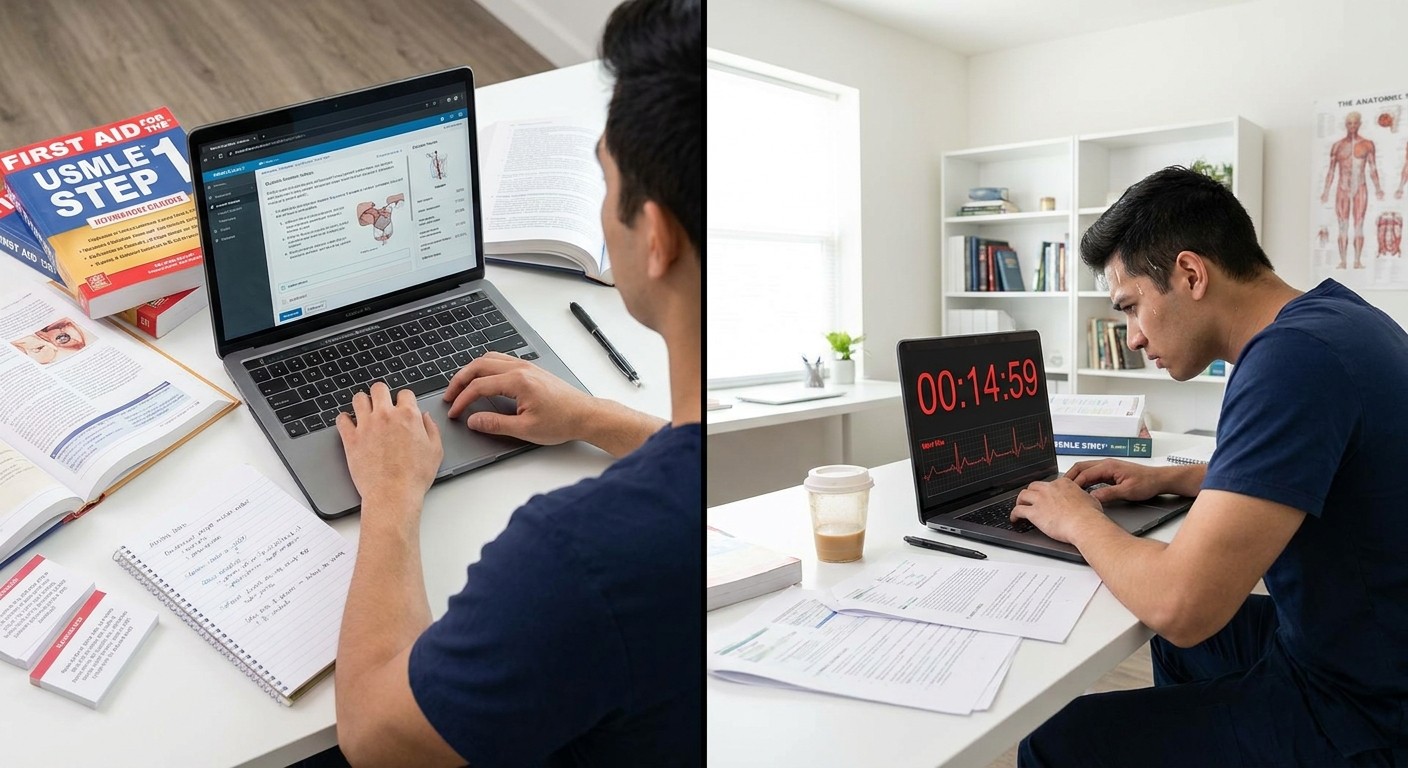
The timing mode you choose changes what youre actually practicing. Timed blocks simulate test-day pressure and reveal pacing issues. Untimed practice lets you focus on reasoning without the artificial constraint of 1.7 minutes per question.
Use untimed practice during your foundation-building phase, typically the first 4-6 weeks of dedicated study:
When learning new concepts or reviewing subjects where your accuracy is below 60%
For complex questions requiring multiple steps of reasoning
When you want to practice the systematic approach to elimination without time pressure
During deep-dive sessions where youre analyzing wrong answers and building conceptual connections
During untimed practice, your goal isn't speed — its developing reproducible thought processes. Take 3-4 minutes per question if needed. Write out your reasoning. Identify the key clinical details that point toward the correct answer. Practice eliminating distractors systematically rather than through quick guesses.
Switch to timed practice during the final 3-4 weeks before your exam:
When your untimed accuracy is consistently above 70% in most subjects
For building stamina and managing test-day anxiety
To identify questions where time pressure causes careless errors
During full-length practice blocks that simulate actual exam conditions
Oncourse AI's question bank adapts to both modes, letting you practice Step 1-style questions untimed when you're building conceptual understanding, then switching to timed blocks when you're ready to simulate exam conditions. The adaptive algorithm tracks your performance in both modes, identifying concepts where you struggle specifically under time pressure.
Reading Explanations Without Passive Memorization
The explanation is where the real learning happens, but most students read them passively. They scan the correct answer, nod along with the reasoning, and move to the next question. This approach creates familiarity without understanding.
Effective explanation analysis requires active engagement with the content. Instead of passively reading why choice A is correct, challenge yourself to understand why choices B, C, and D seemed plausible but are ultimately wrong.
Start with the question stem analysis. Before reading the explanation, identify the key clinical details that should have guided you toward the correct answer. In a question about chest pain, was the crucial detail the patient's age, the character of the pain, associated symptoms, or ECG findings? Understanding which details matter helps you recognize similar patterns in future questions.
Next, analyze each answer choice systematically. For the correct answer, ensure you understand not just that it's right, but why it's the single best choice. For incorrect choices, identify what makes them wrong. Sometimes distractors are completely unrelated to the case. Other times, they represent reasonable considerations that are less likely given the specific clinical context.
This is where Oncourse's Explanation Chat feature becomes particularly valuable. Instead of accepting gaps in understanding, you can ask follow-up questions about confusing mechanisms, clinical reasoning steps, or why certain distractors were designed to seem appealing. Rather than leaving with a half-understood explanation, you can dig deeper until the concept clicks completely.
Pay special attention to questions you got right for the wrong reasons. If you chose the correct answer through elimination or educated guessing rather than solid understanding, treat it like a missed question. These "lucky guesses" often become actual misses on test day when the same concept appears with different distractors.
Finally, connect each explanation to broader concepts and patterns. A question about beta-blocker contraindications isn't just about that specific drug class — it's about understanding autonomic physiology, cardiovascular pathophysiology, and how medications can exacerbate underlying conditions. Look for these conceptual connections rather than memorizing isolated facts.
Weak-Area Tagging and Tracking Systems
Converting missed questions into targeted improvement requires a systematic approach to categorizing and tracking your errors. Most students rely on memory or informal notes, but this approach fails when you're dealing with thousands of practice questions over several months.
Effective weak-area tracking operates on two levels: subject-level patterns and concept-level gaps. Subject-level tracking reveals broad areas like "consistently struggling with pharmacology" or "strong performance in anatomy." Concept-level tracking goes deeper: "struggles specifically with diuretic mechanisms but strong on antiarrhythmic drugs" or "consistently misses questions about glomerular filtration but solid on tubular transport."
Create categories that match how Step 1 actually tests material:
By organ system: Cardiovascular, pulmonary, renal, GI, endocrine, reproductive, musculoskeletal, nervous system, skin/subcutaneous tissue By discipline: Pathology, pharmacology, physiology, anatomy, biochemistry, microbiology, immunology By reasoning type: Direct recall, mechanism-based, clinical application, diagnostic reasoning, treatment selection
When you miss a question, tag it with the relevant categories. A question about ACE inhibitor side effects might get tagged as: cardiovascular (organ system), pharmacology (discipline), and mechanism-based (reasoning type).
Oncourse AI's Performance Analytics dashboard automates much of this tracking, turning your question results into a visual map of weak systems and topics. Instead of manually categorizing every missed question, the platform identifies patterns automatically: you consistently struggle with endocrine pathology but excel at cardiovascular pharmacology, or you nail direct recall questions but struggle when clinical reasoning is required.
The key insight comes from tracking trends over time rather than isolated performance snapshots. Are your cardiology scores improving with targeted practice? Do you consistently miss metabolism questions regardless of how much biochemistry you review? Are there specific types of distractors that consistently fool you?
Weekly Review Loops for Continuous Improvement
Diagnostic practice requires regular review cycles to convert identified weaknesses into actual improvements. Most students practice questions daily but never step back to analyze broader patterns or adjust their approach based on accumulating data.
Implement a weekly review process that transforms your question performance into actionable study adjustments:
Monday: Data analysis (15 minutes): Review the past week's question performance by subject, accuracy trends, and error types. Identify 2-3 areas that showed concerning patterns or unexpected drops in performance. Wednesday: Mid-week check (10 minutes): Quick assessment of whether your targeted practice is improving the weak areas identified Monday. If cardiology accuracy isn't improving despite focused practice, the issue might be approach rather than volume. Friday: Weekly planning (20 minutes): Based on the week's data, adjust next week's study focus. If you've brought pharmacology up to consistent 75%+ accuracy, shift more time to the subjects that are still struggling.
This review cycle prevents two common mistakes: continuing to practice strong areas out of habit, and abandoning weak areas too quickly when they don't improve immediately. Some concepts require multiple exposures and different explanatory approaches before they click.
The weekly review also helps you notice plateau patterns — subjects where your accuracy has stalled despite continued practice. These plateaus often indicate that you need a different study approach rather than more practice questions. If biochemistry accuracy has been stuck at 65% for three weeks despite daily practice, you might need to go back to fundamental content review rather than continuing with questions.

Final 30-Day Practice Cadence
The month before your Step 1 exam requires a specific practice approach that balances continued learning with test-day preparation. This isn't the time for major content gaps or experimental study methods — it's about optimizing performance on material you already understand reasonably well.
Days 30-21: Targeted reinforcement
Focus your question practice on the 3-4 subjects where you have the biggest room for improvement while maintaining confidence in stronger areas. If youre consistently scoring 60% in pathology but 80% in anatomy, spend 70% of your question time on pathology-heavy blocks.
During this phase, use mostly timed blocks to identify concepts that break down under pressure. Some students discover they know pharmacology mechanisms perfectly during untimed review but make careless errors when they have to recall the same information quickly.
Days 20-11: Mixed practice with pattern recognition
Shift to mixed-topic blocks that mirror the actual exam format. Step 1 doesnt test subjects in isolation — youll see cardiovascular pathology followed by renal physiology followed by infectious disease microbiology. Practice switching between different conceptual frameworks rapidly.
Pay attention to context cues that help you identify what the question is actually testing. A question stem might mention chest pain, but the real focus could be on ECG interpretation, cardiac enzymes, imaging findings, or treatment selection. Learning to identify these cues quickly improves both accuracy and timing.
Days 10-1: Maintenance and confidence building
Reduce your question volume but maintain daily practice to keep concepts fresh. Focus on reviewing previously missed questions rather than attempting new ones. At this point, new mistakes often create anxiety rather than learning opportunities.
Use your final practice sessions to reinforce correct reasoning patterns rather than discover new weaknesses. If you encounter a concept youve never seen, make a brief note but dont spend hours trying to master it. Step 1 tests foundational knowledge, not obscure details you haven't encountered in months of preparation.
Common Mistakes That Sabotage Question Practice
Even students who understand the importance of diagnostic practice often sabotage their efforts through predictable mistakes:
Mistake 1: Focusing on percentage scores rather than error patterns
Celebrating when you hit 75% accuracy without analyzing what types of questions youre still missing. A student who gets 75% by nailing easy recall questions but missing all the clinical reasoning items has a very different profile than someone who struggles with basic facts but excels at application.
Mistake 2: Moving too quickly through explanations
Reading explanations just long enough to understand why you were wrong, but not long enough to understand why the distractors seemed plausible. This approach prevents you from recognizing similar traps in future questions.
Mistake 3: Practicing only in comfort zones
Unconsciously gravitating toward subjects or question types where you already perform well. This feels productive because you get positive feedback, but it doesnt address the areas that will actually determine your exam outcome.
Mistake 4: Inconsistent tracking systems
Starting multiple organizational systems (spreadsheets, apps, handwritten notes) but not maintaining any of them consistently enough to reveal patterns. Partial data often leads to worse decisions than no data.
Mistake 5: Overreacting to single bad performance
Completely restructuring your study plan based on one difficult practice block rather than looking at trends over multiple sessions. Day-to-day performance varies for many reasons — fatigue, question difficulty, random topic clustering — that don't reflect your true preparation level.
The solution is maintaining consistent systems and trusting your data over daily emotional reactions to practice performance.
Frequently Asked Questions
How many practice questions should I complete before taking Step 1?
Most successful students complete 2,000-3,500 practice questions, but the total number matters less than how systematically you analyze your errors. Completing 2,500 questions with thorough error analysis beats rushing through 4,000 questions without understanding your mistakes. Focus on quality of practice over raw quantity.
Should I repeat questions I've already seen?
Repeat questions you initially got wrong, but space out the repetitions. Immediately retrying a missed question tests short-term memory rather than actual understanding. Wait at least a week before revisiting incorrect questions, and focus on whether you can apply the same reasoning to similar but not identical scenarios.
How do I know if I'm ready to take Step 1?
Readiness isn't just about hitting a target percentage — it's about consistent performance across multiple subjects and question types. You're likely ready when you can maintain 70%+ accuracy across mixed-topic, timed blocks for at least two consecutive weeks, with no major subject areas below 60%.
What should I do if my scores plateau despite continued practice?
Plateaus often indicate you need a different study approach rather than more questions. If accuracy stalls in a subject, temporarily shift to content review using different resources. Sometimes concepts need multiple explanatory approaches before they click. Consider seeking tutoring or study group discussion for persistently difficult topics.
How important is it to simulate exact exam conditions during practice?
Exact simulation becomes more important as your exam approaches. During early preparation, prioritize learning over realism. In your final 2-3 weeks, practice under exam conditions: 8-hour sessions, timed blocks, minimal breaks, and the same testing interface you'll use on exam day.
Should I focus more on my weak areas or maintain my strong areas?
Allocate about 70% of your practice time to weak areas and 30% to maintaining strong areas. Completely neglecting strong subjects can lead to unexpected drops in performance, but spending equal time on all subjects ignores the areas where you have the most room for improvement.
Practice questions reveal exactly what you need to learn next — if you let them. Most students treat questions as tests of what they already know rather than diagnostic tools for what they need to work on. The difference between these approaches often determines who passes Step 1 efficiently and who needs multiple attempts.
Prepare smarter with Oncourse AI — adaptive MCQs, spaced repetition, and AI explanations built for USMLE Step 1. Download free on Android and iOS.