Medical Exam Question Bank Strategy: Use Oncourse AI to Stop Doing Random Questions
Transform random question grinding into strategic, AI-powered practice. Learn how to set purpose for every block, analyze mistake patterns, and use adaptive learning to target weak areas for medical exam success.
Medical Exam Question Bank Strategy: Use Oncourse AI to Stop Doing Random Questions
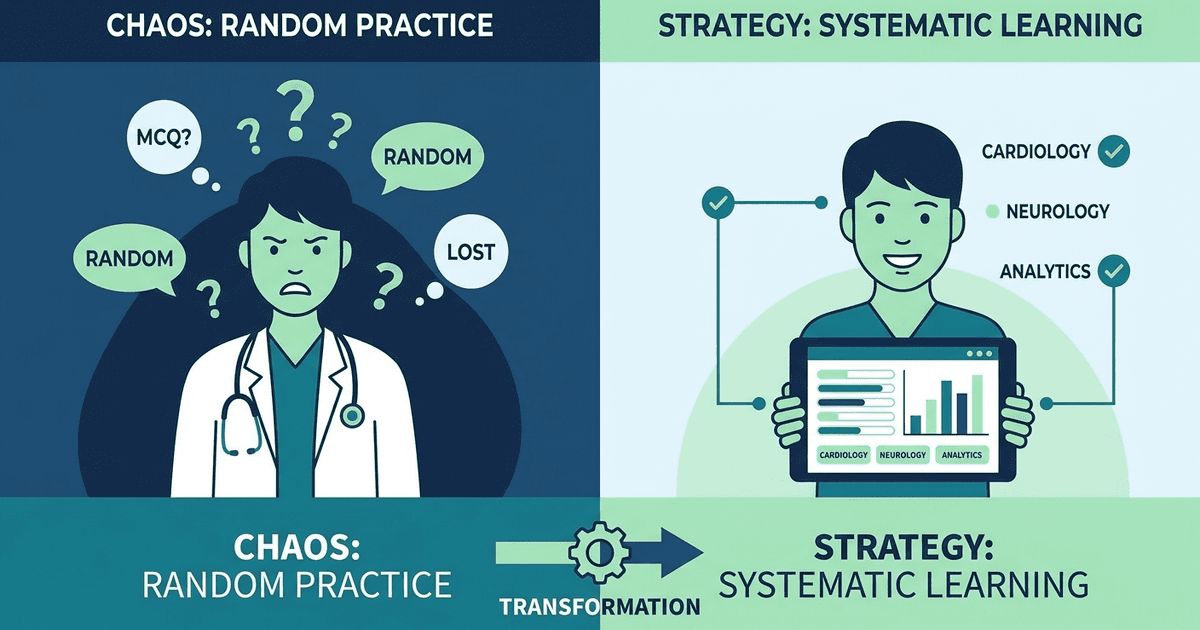
You are probably grinding through 200 questions per day. You feel productive checking boxes. Your question counter climbs higher each week. But here's the uncomfortable truth: random question marathons waste more time than they save.
NEET-PG has 200 questions. USMLE Step 1 tests 280. You get 90 seconds per question on average. That's not enough time to figure out patterns during the exam itself. The students who score in the 90th percentile dont just know more facts — they recognize question types faster and avoid the same mistakes twice.
Random practice feels like progress because you are actively doing something. But learning science reveals why this approach backfires: without purpose, questions become pattern recognition drills instead of diagnostic reasoning practice. Your brain memorizes surface-level features instead of building the deeper connections that transfer to new scenarios.
The solution isnt more questions. It's strategic practice with AI-powered tools that turn every wrong answer into targeted learning. Oncourse AI question banks dont just track your score — they map your knowledge gaps and serve the exact practice you need next. Instead of grinding through random blocks, you get adaptive sequences that build on your strengths while systematically fixing weak areas.
This isnt about working harder. It's about working with precision. When each question serves a specific learning objective, 50 strategic questions teach more than 200 random ones. Here's exactly how to transform your question bank strategy from quantity-focused grinding to intelligence-driven practice that actually moves your scores.
Why Random Question Grinding Fails
Random question practice creates the illusion of learning while reinforcing bad habits. When you jump between cardiology, dermatology, and psychiatry questions without structure, your brain treats each topic as isolated information instead of building the conceptual frameworks that medical reasoning requires.
Research published in BMC Medical Education shows that medical students who focus on rationales and explanations rather than just getting answers right demonstrate better long-term retention and clinical reasoning skills. Random practice prevents this deep processing because you never spend enough consecutive time in one domain to recognize patterns or build mental models.
The testing effect — where retrieval practice strengthens memory — only works when feedback connects new information to existing knowledge. Random questions scatter this feedback across unrelated topics, making it impossible to build the systematic understanding that high-scoring candidates possess.
Even worse, random practice reinforces the wrong study behaviors. When questions feel too hard or too easy, you cant tell if its because of content gaps, reasoning errors, or timing issues. You end up repeating the same mistakes because the practice format doesnt provide diagnostic information about why you got something wrong.
Medical exams test pattern recognition speed under time pressure. Random practice never builds this skill because your brain never gets enough exposure to similar question types in sequence. You need concentrated practice in specific domains to develop the rapid recognition that separates top performers from average ones.
Setting Purpose for Every Question Block
Every question session needs a specific learning objective before you start. Instead of launching into "mixed practice," define what you want to accomplish: diagnostic practice for weak areas, timing calibration for known topics, or knowledge gaps assessment in new domains.
Cold diagnostic blocks serve one purpose: mapping your current knowledge state. Use these when starting a new topic or returning after a break. Set 20-40 questions from a single subject area, untimed, with immediate feedback after each question. The goal isnt speed or accuracy — it's honest assessment of what you know and what you dont. Targeted weak-area drills focus on your bottom 3-5 performing topics. Oncourse AI's adaptive question bank automatically identifies these areas from your practice history and serves concentrated practice in those domains. Instead of getting 2-3 cardiology questions mixed in with other subjects, you get 30-50 cardiology questions that build on each other systematically. Timed simulation blocks prepare you for exam conditions once you have content mastery. These should mirror actual exam parameters: question count, time limits, and mixed topics. But only use these when your diagnostic accuracy is already where it needs to be.
The key insight: match your practice format to your learning objective. Most students default to mixed, timed blocks for everything, which serves none of these purposes well. When Rezzy AI tutor reviews your performance patterns, it can suggest which block type will help you most based on your current preparation phase.
Understanding Timed vs Untimed Practice
Timing pressure changes how your brain processes information. Under time constraints, you rely more on pattern recognition and less on systematic reasoning. This means timed and untimed practice develop different skills — and you need both at different phases of preparation.
Untimed practice builds accuracy and deep reasoning. Use this when learning new content areas or when your accuracy on a topic falls below 70%. Without time pressure, you can work through complex question stems methodically and absorb explanations thoroughly. This is where conceptual understanding develops. Timed practice builds speed and confidence. Start this when your untimed accuracy consistently hits 75-80% in a subject area. The goal is maintaining accuracy while developing the rapid pattern recognition that exams require.
The transition point matters more than you think. Students who move to timed practice too early develop anxiety and surface-level shortcuts that hurt them on test day. Students who avoid timed practice entirely never build the speed needed for high-pressure situations.
Oncourse AI tracks both your timed and untimed performance separately, showing you when youre ready to add timing pressure in each subject area. The adaptive algorithm serves untimed questions when building concepts and switches to timed blocks when reinforcing speed.
Tutor Mode vs Exam Mode Practice
Tutor mode shows explanations immediately after each question. This creates active learning because you process feedback while the question context is still fresh in working memory. Use tutor mode when accuracy is your primary goal — typically in weak subject areas or when learning new topics. Exam mode delays feedback until the end of your session. This simulates real test conditions and builds tolerance for uncertainty. The delayed feedback also creates stronger memory consolidation through the testing effect, but only when your baseline accuracy is already solid.
Most students use exam mode too early because it feels more realistic. But learning science shows that immediate feedback accelerates initial learning, while delayed feedback strengthens retention of already-learned material. The sequence matters: build accuracy with tutor mode, then strengthen it with exam mode.
Oncourse AI's Explanation Chat feature enhances tutor mode by letting you ask follow-up questions about confusing explanations. Instead of moving on when an explanation doesnt click, you can probe deeper: "Why is this mechanism different from the one in hypertension?" or "What other conditions present similarly?" This active dialogue transforms passive reading into engaged learning.
Active Explanation Review Strategy
Reading explanations passively wastes the most valuable part of question practice. The explanation is where learning happens — but only if you engage with it strategically.
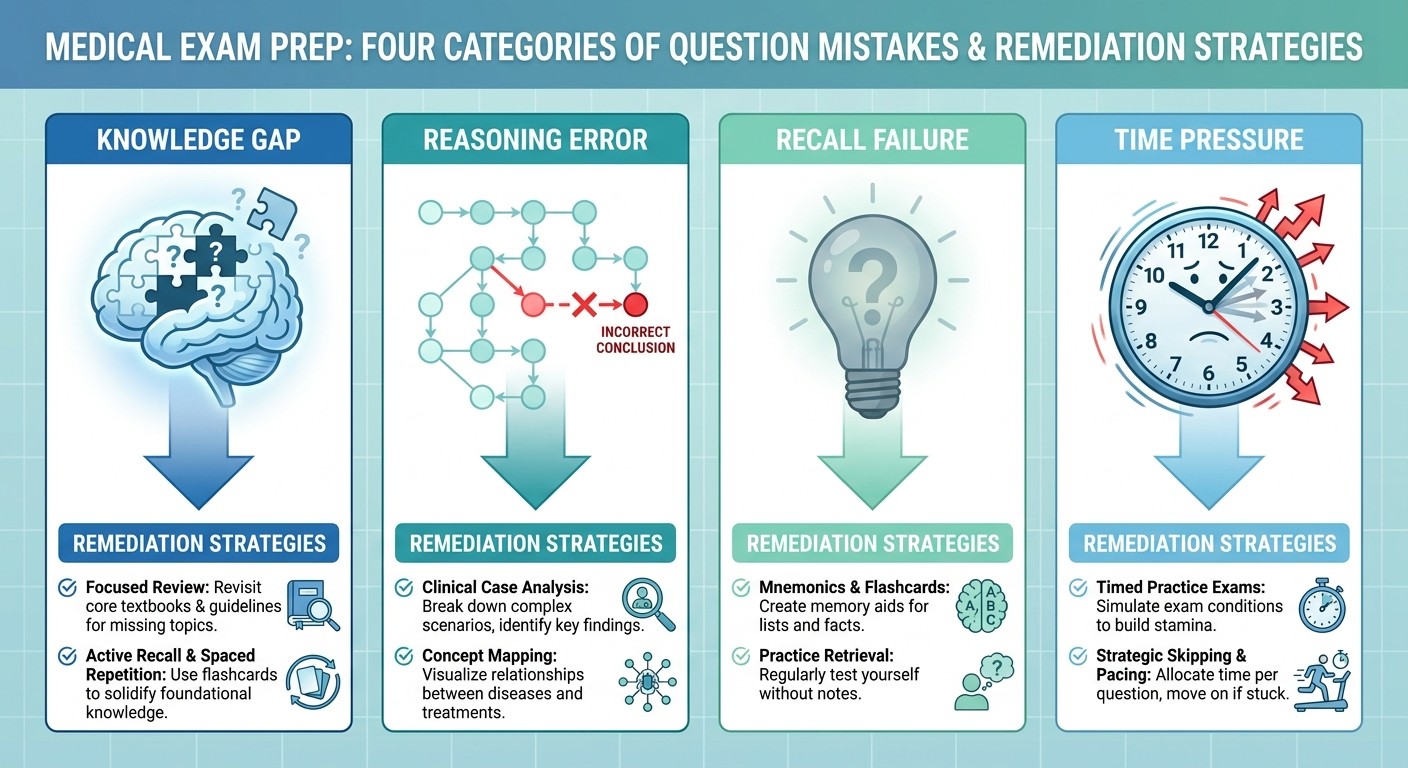
Before reading the explanation, write down why you chose your answer and what you were unsure about. This creates cognitive commitment and helps you identify reasoning patterns. While reading, focus on the reasoning process, not just the facts. Ask: What clinical clues pointed to this diagnosis? Which distractors were designed to trap me? What would I need to know to answer a similar question correctly? After reading, categorize your mistake. Was it a knowledge gap (didnt know the pathophysiology), reasoning error (knew the facts but connected them wrong), recall failure (studied this but forgot), or time pressure (would have gotten it with more time)?
This categorization step transforms wrong answers into actionable data. Knowledge gaps need content review. Reasoning errors need practice with similar question types. Recall failures need spaced repetition. Time pressure issues need timing practice.
Oncourse AI's performance analytics automatically track these error patterns across your practice sessions, showing you which types of mistakes are most common in each subject area. This visibility helps you choose the right remediation strategy instead of generic "study more."
Converting Wrong Answers into Revision Tasks
Every missed question should generate a specific follow-up action. Instead of marking it "review later" and forgetting about it, create immediate revision tasks that address the underlying issue.
For knowledge gaps: add the missed concept to your spaced repetition flashcards immediately. Include the specific clinical context from the question, not just isolated facts. For example, if you missed a question about nephritic syndrome, dont just add "nephritic syndrome causes." Add "Patient with hematuria, proteinuria, and hypertension — think nephritic syndrome, especially if recent strep infection." For reasoning errors: find 3-5 similar questions in the same topic area and practice them consecutively. The goal is recognizing the pattern that you missed. If you confused bacterial vs viral meningitis, practice several meningitis cases in a row until the distinguishing features become automatic. For recall failures: this indicates your initial learning wasnt strong enough. Go back to your primary resources and re-study the topic, then test yourself again within 48 hours. The spacing effect requires successful retrieval soon after re-learning to strengthen memory traces. For time pressure mistakes: practice similar questions under progressively shorter time constraints. Start at 2x the normal time limit, then 1.5x, then normal timing. This builds speed without sacrificing accuracy.
Oncourse AI automatically suggests these remediation pathways based on your error patterns. When you miss a cardiology question due to a knowledge gap, it adds relevant flashcards to your daily review queue and schedules follow-up practice in that topic area.
Weekly Performance Dashboard Reviews
Your question bank data is only useful if you analyze it systematically. Schedule 30 minutes each week to review your performance dashboard and adjust your study plan based on what the data reveals.
Accuracy trends show which topics are improving vs stagnating. If your cardiology accuracy hasnt improved in 2 weeks despite regular practice, you need a different learning approach — perhaps more foundational content review or different question types. Time per question reveals efficiency patterns. Topics where you consistently take too long need more pattern recognition practice. Topics where you rush and make careless errors need deliberate slowing down until accuracy stabilizes. Mistake patterns highlight your cognitive weaknesses. If you consistently miss questions due to not reading carefully enough, the solution isnt more practice — its developing better test-taking habits. Subject distribution shows whether youre neglecting important topics. Medical exams weight subjects differently, and your practice should reflect exam blueprints, not your personal preferences.
The weekly review isnt about judging your performance. It's about making your practice more intelligent. When you see the patterns clearly, you can make targeted adjustments instead of hoping that more volume will solve everything.
Oncourse AI's analytics dashboard visualizes these trends automatically, showing you which areas need immediate attention vs which ones are progressing well. The adaptive daily plan then adjusts your practice schedule based on these insights, ensuring your time goes to the highest-yield activities.
Final 30-Day Practice Cadence
The last month before your exam needs a different strategy than your earlier preparation. Random practice becomes especially harmful here because it can shake your confidence in areas where youre already prepared.
Weeks 4-3 before exam: Mixed practice with emphasis on your weakest 20% of topics. Use 60/40 split — 60% of questions from weak areas, 40% from strong areas to maintain confidence. This is your last chance to shore up major gaps. Weeks 2-1 before exam: Shift to exam simulation mode. Full-length practice tests under actual timing conditions, but still review explanations thoroughly. The goal is building stamina and test-taking rhythm while identifying any remaining content gaps. Final week: Maintenance practice only. Light review of your highest-yield flashcards and previous mistake categories, plus one final practice exam for timing calibration. No new content learning — your brain needs time to consolidate what you already know.
The key principle: trust your preparation and avoid the panic-driven random question binges that hurt more than they help. Students who maintain strategic focus in their final weeks consistently outperform those who revert to volume-based grinding.
During this final phase, Oncourse AI shifts from broad skill building to targeted confidence maintenance. The adaptive algorithm reduces question volume while maintaining coverage of your historically weak areas, helping you peak at the right time without burning out.
Common Question Bank Mistakes to Avoid
Mistake 1: Starting with mixed practice too early. Mixed questions are harder than subject-specific practice because your brain must identify the domain before solving the problem. Build subject mastery first, then add the complexity of mixed practice. Mistake 2: Ignoring your mistake patterns. If you consistently miss questions for the same reasons (not reading carefully, overthinking, forgetting key details), more questions wont fix the problem. You need different practice habits, not more volume. Mistake 3: Using timing pressure as a crutch. Some students add time pressure to make easy questions feel challenging. But this builds anxiety instead of knowledge. Master accuracy first, then add speed. Mistake 4: Question shopping for easy wins. Switching between question banks when one feels too hard prevents you from working through your actual weak areas. Difficulty is information about what you need to learn, not a reason to find easier questions. Mistake 5: Treating explanations as optional. The explanation is where learning happens. Reading only explanations for wrong answers misses 70% of the learning opportunities in your practice sessions. Mistake 6: Practicing without spacing. Cramming 100 questions in one subject in a single day creates short-term familiarity but poor long-term retention. Distribute practice across multiple days for better consolidation.
These mistakes feel productive in the moment but create false confidence that collapses under exam pressure. Recognizing them early lets you course-correct before they become ingrained habits.
Frequently Asked Questions
How many questions should I do per day during active preparation?
Quality trumps quantity every time. 50 strategic questions with thorough explanation review teach more than 200 random questions. Focus on 30-80 questions daily based on your available study time, but never sacrifice explanation review for higher volume.
When should I switch from untimed to timed practice?
Make the switch when your untimed accuracy consistently hits 75-80% in a subject area. Starting timed practice too early builds bad shortcuts. Starting too late leaves you underprepared for time pressure. Use your accuracy data, not calendar dates, to make this decision.
Should I repeat questions Ive already seen?
Yes, but strategically. Questions you got wrong the first time should be repeated after 3-7 days to test retention. Questions you got right but werent confident about are also worth repeating. Fresh questions are important, but reinforcing previous learning through spaced repetition is equally valuable.
How do I balance question practice with content review?
Use your question bank performance to guide content review priorities. If youre missing 40% of cardiology questions due to knowledge gaps, spend more time with cardiology resources before doing more cardiology questions. Questions should test knowledge, not teach it from scratch.
What if Im consistently scoring below passing on practice questions?
This signals a content knowledge issue, not a test-taking problem. Reduce question volume and increase content review time. Focus on understanding concepts thoroughly before testing retention. Consider whether your timeline needs adjustment — forcing speed when foundation knowledge is shaky rarely works.
How can I tell if my practice is actually helping my exam performance?
Track accuracy trends over time, not day-to-day fluctuations. You should see gradual improvement in your weak areas and maintained performance in strong areas. If accuracy stagnates despite consistent practice, you need a different learning approach, not more questions.
---
Stop grinding random questions and start practicing with purpose. Oncourse AI turns every practice session into targeted learning that actually moves your scores. The adaptive question bank identifies your weak areas automatically, while AI explanations help you understand not just what's right, but why other options are wrong.
Prepare smarter with Oncourse AI — adaptive MCQs, spaced repetition, and AI explanations built for medical exams. Download free on Android and iOS.