Back
INICET Question Bank: Use Oncourse AI to Practice the Questions That Expose Weak Areas
Master INICET question bank strategy that identifies weak areas through diagnostic practice. Convert missed questions into targeted revision with Oncourse AI.

INICET Question Bank: Use Oncourse AI to Practice the Questions That Expose Weak Areas
You probably spent the last week grinding through 200 random INICET questions, checking answers, and moving on. But here's the uncomfortable truth: your score plateaued at 67%, and you cant pinpoint why you're missing questions on topics you thought you knew.
Random question grinding doesnt work for INICET. The exam tests integrated clinical reasoning across 19 subjects in 180 minutes with negative marking. Every missed question costs you 1.33 marks, and the difference between ranks often comes down to identifying and fixing the specific gaps that trip you up repeatedly.
This isnt about working harder — it's about using your INICET question bank diagnostically. Instead of treating practice questions as isolated problems, you need a systematic approach that turns every wrong answer into a targeted revision plan and every weak pattern into a strengthened skill.
Why Random Question Grinding Fails for INICET
Most INICET aspirants approach question banks like a slot machine: attempt, check answer, move to the next question. This creates an illusion of progress while missing the deeper patterns that determine your actual score.
INICET's 200-question format combines clinical vignettes, one-liners, and image-based questions across medical, surgical, and diagnostic disciplines. When you miss a pharmacology question about drug interactions, it might signal a gap in mechanism understanding, clinical correlation weakness, or simply misreading complex scenarios under time pressure.
The exam rewards students who recognize these patterns. A missed cardiology question about heart failure management might connect to gaps in pathophysiology, pharmacology mechanisms, or diagnostic interpretation. Without systematic analysis, you'll keep missing related questions without understanding why.
Traditional question banks show you what you got wrong but dont reveal why you consistently struggle with specific reasoning patterns or clinical scenarios. This is where diagnostic practice becomes essential — using each question attempt to map your exact knowledge gaps and reasoning blind spots.
The Diagnostic Question Bank Workflow That Actually Works
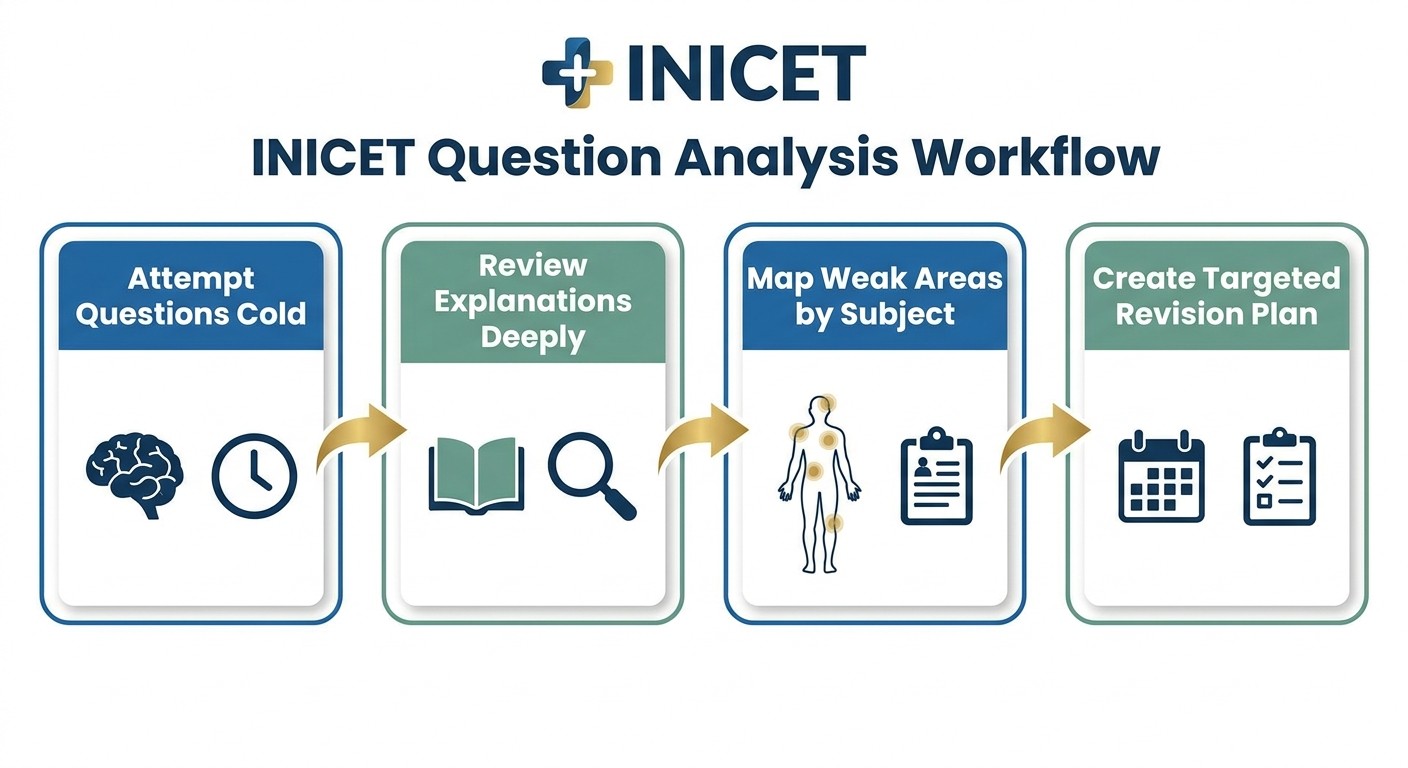
Effective INICET question practice follows a four-step diagnostic cycle that converts every practice session into targeted learning:
Step 1: Attempt Questions Cold
Start each practice session without reviewing related material first. This reveals your actual recall strength and clinical reasoning ability under exam-like conditions. When you practice surgery questions after just studying surgery notes, you're testing reading comprehension, not clinical knowledge retention.
Choose 20-30 questions from mixed subjects or focus on a specific domain, but always attempt them in exam-style conditions. This baseline attempt shows you what your brain can actually retrieve and apply when it matters most.
Step 2: Deep Explanation Review (Not Answer Checking)
After completing your question block, resist the urge to simply check correct answers. Instead, read explanations for every question — correct and incorrect attempts. The goal isnt validation; it's understanding the clinical reasoning pathway that leads to each answer choice.
For questions you got right, confirm that your reasoning matched the explanation. Sometimes you arrive at correct answers through flawed logic, creating false confidence in topics where you actually have gaps.
For missed questions, identify whether you failed due to knowledge gaps, misinterpretation, or reasoning errors. This distinction determines your corrective action: content review, reading practice, or clinical correlation work.
Oncourse's AI-powered explanations help bridge these gaps by breaking down the clinical reasoning behind each answer choice, helping you understand why specific distractors are wrong and what clinical principles you might have missed.
Step 3: Subject and Topic Mapping
After reviewing explanations, categorize your mistakes by subject, topic, and error type. Create a simple tracking system:
Knowledge Gaps: Missing facts, mechanisms, or clinical correlations Interpretation Errors: Misreading questions or clinical scenarios Reasoning Mistakes: Correct information applied incorrectly Time Pressure Issues: Rushing leads to careless errors
This mapping reveals patterns that pure accuracy percentages miss. You might score 70% in medicine overall but consistently struggle with cardiology drug mechanisms or infectious disease diagnostics.
Step 4: Convert Patterns into Targeted Revision
The most critical step happens outside your question bank. Use your error analysis to create focused revision sessions that address specific gaps before they cost you marks in the actual exam.
If you miss pharmacology questions about drug interactions, schedule dedicated time to map drug families, mechanisms, and contraindications. If surgical questions about trauma management trip you up, focus on clinical decision trees and emergency protocols.
Subject-Wise vs Mixed Practice: What Works When
Your INICET question bank strategy should balance focused subject practice with integrated, mixed-subject sessions that mirror the actual exam format.
Subject-wise blocks work best during initial topic mastery and when addressing specific weak areas identified through diagnostic practice. When you discover gaps in pathology concepts about neoplasia, dedicated pathology sessions help consolidate related mechanisms and classifications.
Use INICET-focused pathology questions to drill specific weak areas once you've identified them through mixed practice.
Mixed-subject practice becomes essential 4-6 weeks before your exam. INICET's 200-question format jumps between subjects, requiring rapid mental transitions from surgery scenarios to pharmacology mechanisms to diagnostic radiology interpretation.
The key is using subject-wise practice diagnostically — to identify and address gaps — then validating your improvement through mixed practice that simulates actual exam conditions.
Timed vs Untimed Blocks: Strategic Use for Different Goals
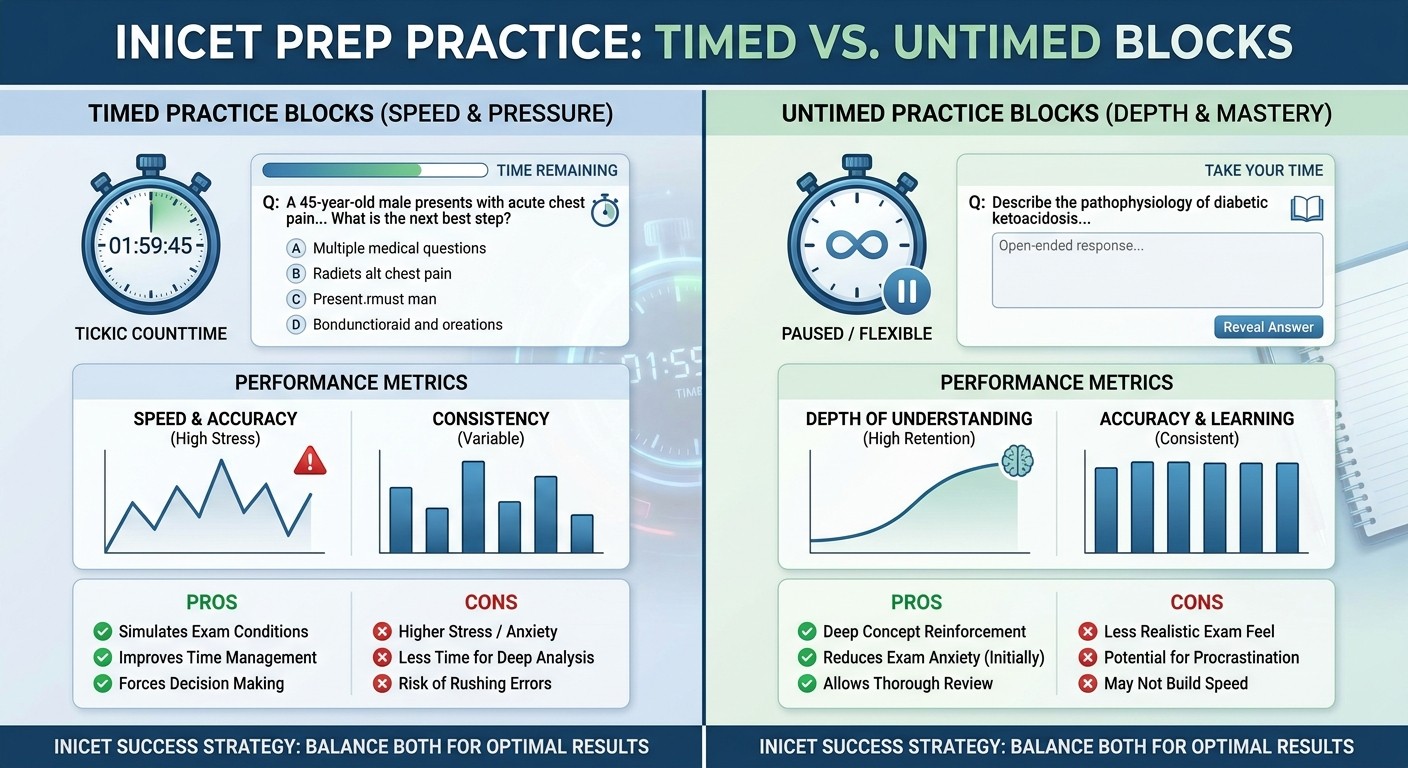
Both timed and untimed practice serve specific diagnostic purposes in your INICET preparation:
Untimed practice helps you understand your actual knowledge depth without time pressure masking true understanding. Use this format when:
Identifying knowledge gaps in new topics
Working through complex clinical vignettes that require careful analysis
Reviewing explanations thoroughly without rushing to the next question
Timed practice reveals how knowledge translates under exam pressure — the conditions that determine your actual INICET score. Use timed blocks to:
Simulate exam-day conditions with 45 minutes per 50-question section
Identify questions where you know the answer but cant access it quickly enough
Practice strategic time allocation between different question types
Most students benefit from a 70-30 split: 70% untimed practice for learning and gap identification, 30% timed practice for speed and exam simulation.
Reading Explanations Without Passive Memorization
The explanation review phase separates strategic practice from random grinding, but most students approach it passively — reading through explanations without active engagement.
Effective explanation review requires asking specific questions about each answer choice:
Why is the correct answer right? Identify the clinical reasoning, pathophysiology, or diagnostic criteria that make this choice optimal. Why are distractors wrong? Understanding incorrect options helps you recognize similar traps in future questions. Often, distractors represent common clinical misconceptions or incomplete reasoning. What concept connects this to other questions? Look for underlying principles that apply across multiple scenarios. A missed question about ACE inhibitor side effects might connect to broader concepts about cardiovascular pharmacology or renal physiology. Where would I apply this clinically? Connect question concepts to real clinical scenarios or other exam topics. This builds the integrated knowledge that INICET tests extensively.
When you hit a confusing explanation, dont just move on. Oncourse's AI tutor Rezzy lets you ask follow-up questions about mechanisms, clinical correlations, and why specific distractors were designed to mislead you.
Weak Area Tagging and Weekly Review Loops
Effective diagnostic practice requires systematic tracking of weak areas and regular review to ensure gaps actually close rather than persist despite practice.
Create a simple tagging system for questions based on your error analysis:
Red flags: Consistent mistakes in specific topics that need immediate attention
Yellow alerts: Occasional errors that suggest incomplete understanding
Green confirmations: Strong areas where mistakes are rare and reasoning is solid
Weekly review sessions should focus heavily on red flag areas while maintaining yellow alert topics through spaced review. Green areas need minimal time unless question patterns change.
The goal isnt perfect recall of every question you've attempted, but recognition of the clinical reasoning patterns and knowledge applications that determine your INICET performance. When you tag and review systematically, weak areas transform into strengthened skills rather than persistent blind spots.
Oncourse's performance analytics dashboard automatically tracks these patterns, showing you exactly which subjects, topics, and question types need attention based on your practice history. Instead of manually cataloguing every mistake, the platform identifies trends and suggests targeted practice focus based on your actual performance data.
Your Final 30-Day Question Bank Cadence
The last month before INICET requires a specific question bank rhythm that balances comprehensive review with targeted weak area reinforcement:
Weeks 4-3 before exam: Focus on diagnostic mixed practice with immediate gap analysis. Complete 50-75 questions daily across all subjects, spending equal time on explanations and error categorization. This phase identifies your final weak areas and confirms strong subjects. Weeks 2-1 before exam: Shift to targeted practice in identified weak areas combined with full-length mock exams. Spend 60% of question time on red flag topics, 25% on mixed practice, and 15% on confidence-building in strong areas. Final week: Light, confidence-building practice focused on high-yield areas and pattern recognition. Complete 25-30 questions daily, emphasizing quick review of core concepts rather than learning new material.
Throughout this final month, every practice session should include immediate explanation review and error analysis. The closer you get to exam day, the more important it becomes to understand exactly why you miss questions and how to prevent similar mistakes.
Common INICET Question Bank Mistakes to Avoid
Even students who practice extensively often make strategic errors that limit their diagnostic benefit:
Mistake 1: Practicing quantity over quality. Attempting 100 questions with surface-level review beats your confidence but doesnt address underlying gaps. Better to complete 30 questions with thorough analysis than 100 questions with cursory review. Mistake 2: Avoiding difficult subjects. Many students unconsciously skip questions from their weakest areas, practicing mainly in comfortable topics. This creates an illusion of improvement while leaving major gaps untouched. Mistake 3: Explanation reading without application. Reading explanations passively without connecting concepts to broader clinical principles misses the integrated learning that INICET demands. Mistake 4: Inconsistent error tracking. Sporadic analysis of mistakes prevents pattern recognition. Without systematic tracking, the same reasoning errors repeat throughout your preparation. Mistake 5: No spaced review of weak areas. Identifying gaps without scheduled reinforcement means those areas remain weak. Effective practice includes planned return to previously identified problem topics.
When you practice with these mistakes in mind, your question bank becomes a powerful diagnostic tool that strengthens exactly the areas that determine your INICET rank.
Converting Missed Concepts into Revision Plans
The ultimate value of diagnostic question practice lies in converting identified gaps into targeted study sessions that actually address root causes rather than surface symptoms.
When you miss questions about drug mechanisms, dont just memorize the specific drugs from those questions. Instead, create a focused revision session on pharmacological principles that apply across drug families: receptor binding, metabolism pathways, drug interactions, and clinical applications.
For clinical reasoning errors in surgery questions, develop decision trees that guide you through similar scenarios: trauma assessment protocols, surgical indications, post-operative complications, and emergency management principles.
The revision sessions that emerge from question analysis should feel different from generic topic review. They're targeted, specific, and directly connected to the reasoning patterns and knowledge applications that determine your exam performance.
When you miss clinical pharmacology questions, immediately review the core mechanisms and drug families that apply across similar questions, then test your understanding with targeted pharmacology MCQs.
Frequently Asked Questions
How many INICET questions should I attempt daily for effective diagnostic practice?
Focus on 50-75 questions daily with thorough analysis rather than attempting 100+ questions superficially. The diagnostic value comes from explanation review and error categorization, not raw question volume. Spend at least 45 minutes analyzing explanations for every 30 minutes of question attempts.
Should I repeat questions I got wrong previously?
Yes, but not immediately. Review incorrectly answered questions after 1-2 weeks to confirm that you've actually addressed the underlying gap rather than memorized the specific answer. If you still miss the question or cant explain the reasoning clearly, it indicates deeper concept work is needed.
How do I balance subject-wise and mixed practice for maximum diagnostic benefit?
Use a 60-40 split: 60% mixed practice for comprehensive gap identification and exam simulation, 40% subject-wise practice for targeted weak area reinforcement. Adjust this ratio based on your proximity to the exam and identified weak areas.
What should I do if my question bank accuracy isnt improving despite consistent practice?
This usually indicates analysis gaps rather than practice volume issues. Focus more time on explanation review, error categorization, and targeted revision of identified weak areas. If you're practicing without improving, you're likely practicing incorrectly rather than insufficiently.
How can I prevent forgetting concepts I've already mastered in previous question practice?
Implement spaced review of previously strong areas alongside intensive work on current weak spots. Schedule light review sessions for green flag topics every 7-10 days to maintain strength while addressing gaps. Complete practice reduces all areas.
When should I switch from diagnostic practice to confidence-building practice?
Make this transition about 10-14 days before your exam. Early diagnostic practice should focus on gap identification and targeted improvement. Final practice should emphasize speed, pattern recognition, and confidence in strong areas while maintaining weak area gains.
Prepare smarter with Oncourse AI — adaptive MCQs, spaced repetition, and AI explanations built for INICET. Download free on Android and iOS.