Back
FMGE Question Bank: Use Oncourse AI to Practice the Questions That Expose Weak Areas
Master FMGE 2026 with strategic question bank practice that exposes weak areas. Learn diagnostic analysis, pattern recognition, and targeted revision techniques.

FMGE Question Bank: Use Oncourse AI to Practice the Questions That Expose Weak Areas
You are probably staring at your FMGE question bank wondering which 300 questions out of thousands will actually show up on exam day. Here's the reality: FMGE has 300 questions and you have 270 minutes. That's 54 seconds per question to read, analyze, eliminate, and select the correct answer.
The difference between the 15% who pass and the 85% who dont isn't how many questions they solve. It's how they use questions to expose their reasoning gaps and convert those discoveries into targeted fixes.
Random question grinding creates an illusion of progress. Strategic question analysis reveals what you actually need to learn. This guide shows you how to transform your FMGE question bank from a passive practice tool into a diagnostic engine that identifies weak areas and guides your revision priorities.
Why Random Question Grinding Fails in FMGE
Most FMGE aspirants approach question banks like this: solve 100 questions daily, check answers, feel good about the 70% score, repeat tomorrow. This approach fails because it treats symptoms instead of diagnosing the disease.
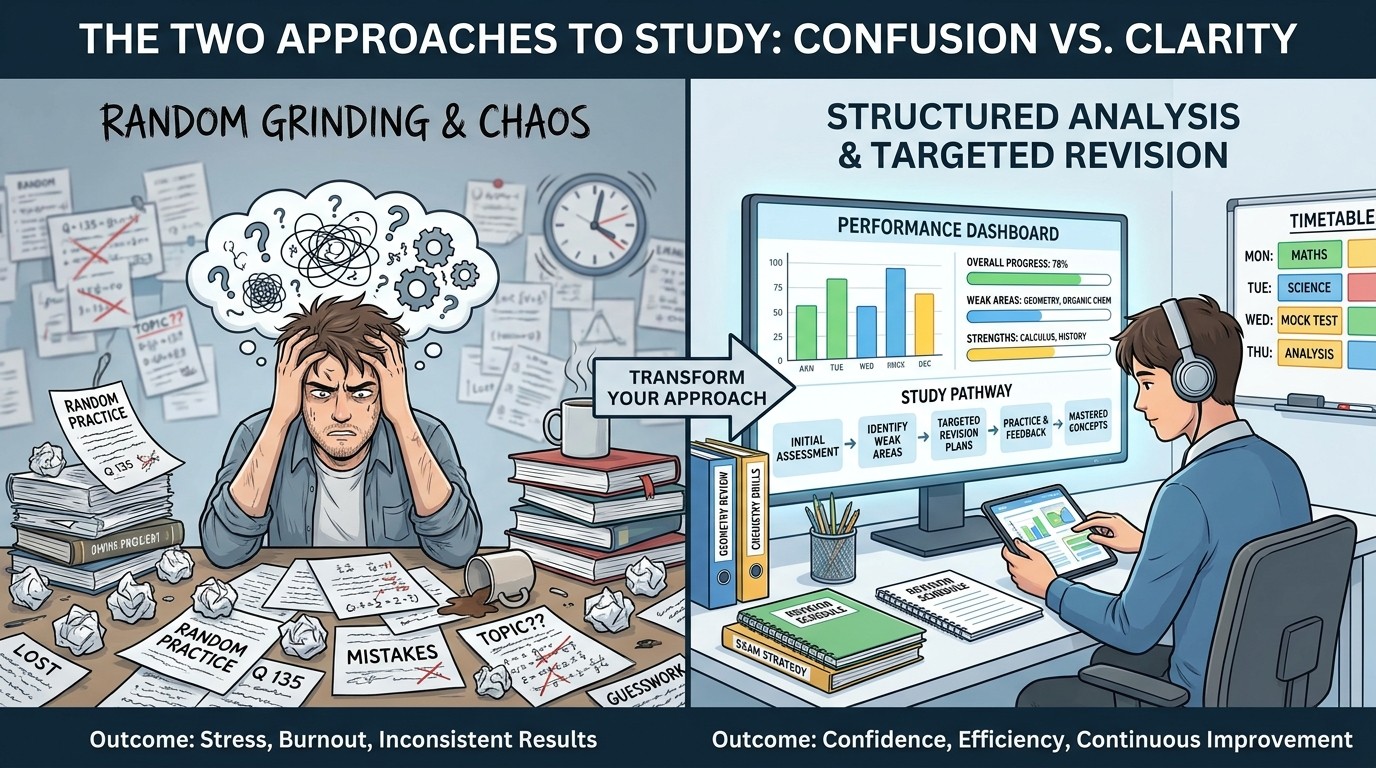
FMGE covers 19 subjects spanning pre-clinical, para-clinical, and clinical domains. The breadth is massive: from embryology details in anatomy to emergency protocols in surgery. When you solve questions randomly, you might get medicine questions right by luck but miss the underlying reasoning gaps in pathophysiology that will surface in different question formats.
The exam doesn't just test recall. FMGE increasingly emphasizes clinical application, image-based questions, and diagnostic reasoning. A question about chest pain isn't just testing whether you know MI symptoms. It's testing whether you can differentiate between STEMI and NSTEMI based on ECG changes, correlate with clinical presentation, and select appropriate immediate management.
Random practice doesn't reveal these reasoning patterns. You need a diagnostic approach that exposes where your clinical thinking breaks down.
What a Strategic FMGE Question Bank Workflow Should Reveal
A good FMGE question bank strategy turns every wrong answer into intelligence about your weak areas. Here's what your practice sessions should uncover:
Subject-Level Weak Areas
Track performance across Medicine, Surgery, OBG, Pediatrics, Community Medicine, and other subjects. If you consistently score 40% in pharmacology but 80% in anatomy, that's not random variation. That's a signal that pharmacology mechanisms need targeted revision before drug-disease correlations.
Topic-Level Reasoning Gaps
Within each subject, identify specific topics where reasoning fails. Maybe you understand hypertension pathophysiology but struggle with antihypertensive drug mechanisms. Or you can diagnose pneumonia but miss antibiotic selection questions.
Question Type Vulnerabilities
FMGE uses different question formats: direct factual recall, clinical vignettes, image-based questions, and negative questions ("Which is NOT true about..."). Track which formats trip you up. Vignette questions revealing weak clinical correlation skills need different fixes than factual recall gaps.
Repeated Reasoning Traps
Certain distractor patterns appear repeatedly in FMGE. Questions often include plausible wrong answers that test common misconceptions. When you consistently fall for similar traps across different topics, that reveals systematic reasoning gaps that need addressing.
Your question bank analysis should produce a clear weak area map: specific subjects, topics, and reasoning patterns that need targeted intervention.
Cold Attempts vs Guided Practice: When to Use Each
Effective FMGE question bank usage requires different practice modes for different purposes.
Cold Attempts for Diagnostic Assessment
Start new topics with cold attempts. No notes, no hints, just pure reasoning from your current knowledge base. This reveals your actual understanding level, not your ability to recognize recently studied content.
For FMGE diagnostic assessment, create mixed question sets covering 2-3 subjects. This simulates exam conditions where you can't predict what's coming next. If you can answer cardiology questions correctly after studying respiratory topics, that demonstrates true mastery rather than short-term recall.
Cold attempts expose knowledge gaps honestly. When you guess and get lucky, that's different from confident correct answers. Track both accuracy and confidence levels to distinguish genuine knowledge from lucky guesses.
Guided Practice for Concept Building
After identifying weak areas through cold attempts, switch to guided practice. Use Oncourse's adaptive question bank which provides immediate explanations and lets you ask follow-up questions when concepts aren't clear.
When encountering a complex pharmacology question about drug interactions, don't just read the standard explanation. Use Rezzy's explanation chat feature to ask specific questions: "Why does this drug inhibit CYP450?" or "How does this mechanism differ from similar drugs?" This converts passive reading into active concept building.
Guided practice should focus on understanding the reasoning process, not just memorizing correct answers. The goal is developing systematic approaches to clinical thinking that work across question variations.
Subject-Wise vs Mixed Practice: Timing Matters
Your FMGE preparation timeline determines whether to use subject-wise blocks or mixed practice sessions.
Subject-Wise Blocks for Initial Learning
When covering each subject for the first time, use subject-wise question blocks. After completing medicine topics, solve 50-100 medicine questions to consolidate learning within that domain. This helps pattern recognition within specific subject areas.
Subject-wise practice lets you identify knowledge gaps while the content is fresh. If you struggle with endocrinology questions after studying diabetes, hypothyroidism, and thyroid disorders, you can immediately return to those topics for targeted review.
For FMGE's clinical subjects (Medicine, Surgery, OBG, Pediatrics), subject-wise blocks help you understand diagnostic approaches specific to each specialty. Pediatric dosing calculations require different thinking from adult medicine protocols.
Mixed Practice for Integration and Exam Simulation
As exam approaches, shift to mixed practice that mirrors FMGE's random question distribution. Create 150-question blocks covering all subjects to simulate actual exam conditions.
Mixed practice reveals integration gaps. Can you shift mental frameworks quickly from anatomy to pathology to pharmacology? FMGE tests this cognitive flexibility through rapid topic changes.
Use mixed blocks for timing practice. 54 seconds per question sounds manageable until you encounter a complex clinical vignette followed by a straightforward anatomy question. Mixed practice develops the mental agility needed for FMGE's pace and variety.
Reading Explanations Without Passive Memorization
Most FMGE question explanations read like textbook excerpts. They provide correct information but don't develop reasoning skills. Here's how to extract maximum learning from explanations:
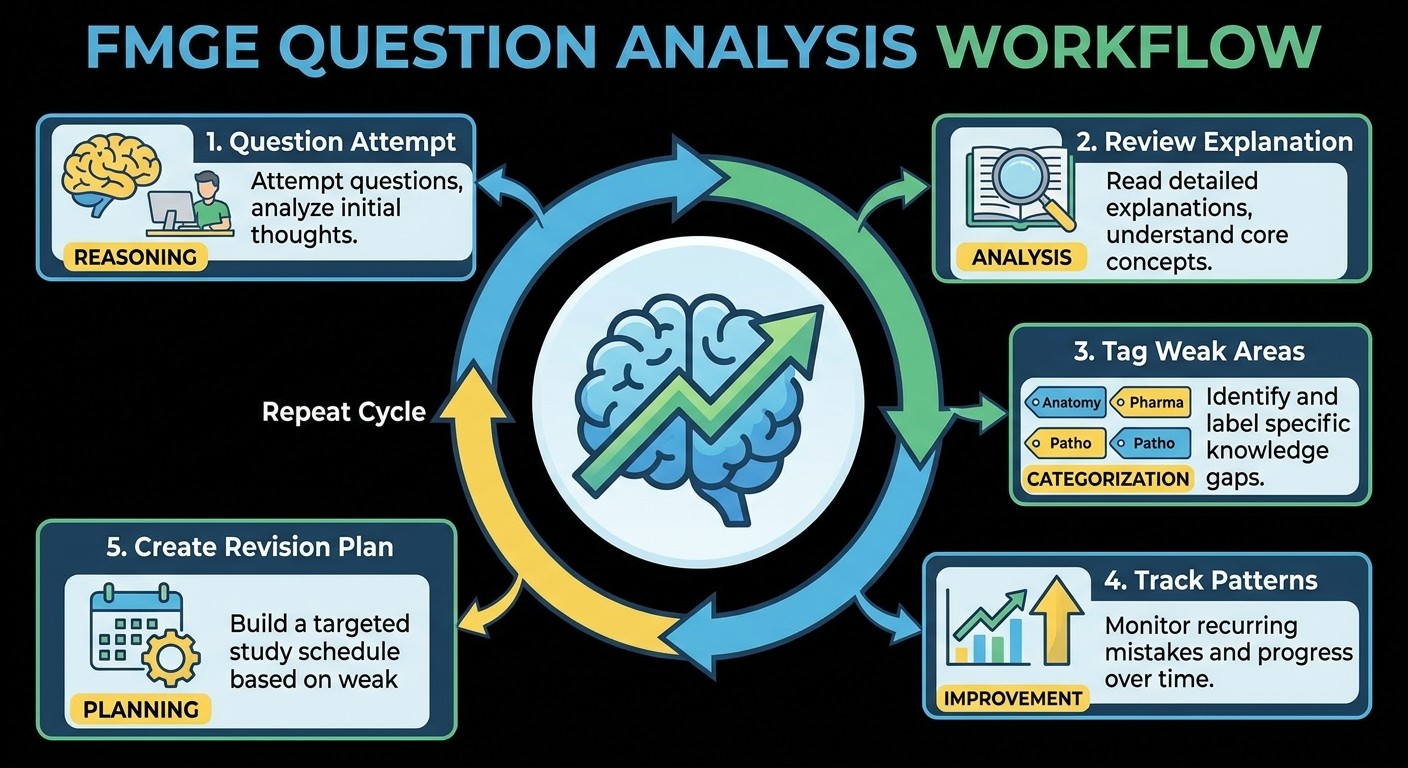
Active Explanation Analysis
Before reading the explanation, analyze your reasoning process. Why did you select that answer? What information guided your decision? What made other options seem incorrect?
Compare your reasoning to the explanation's logic. If you got the right answer for wrong reasons, that's a learning opportunity. If you used correct reasoning but missed a key detail, that's a different type of gap requiring targeted fact review.
For clinical vignette questions, map the explanation's diagnostic approach: initial presentation → key differentiating features → diagnostic tests → treatment selection. This systematic approach applies across different clinical scenarios.
Converting Explanations into Patterns
Don't just read that "aspirin is contraindicated in children due to Reye's syndrome risk." Extract the underlying pattern: age-specific contraindications exist for many drugs. Create a mental framework for drug safety considerations across age groups.
When explanations mention drug mechanisms, connect them to broader pharmacological principles. Beta-blocker explanations should reinforce your understanding of autonomic nervous system, not just specific drug effects.
Using AI for Deeper Understanding
Traditional question banks provide static explanations. When something isn't clear, you're stuck. Oncourse's AI-powered explanations let you drill deeper immediately.
If a cardiology explanation mentions "preload" but you're unclear about the concept, ask Rezzy: "Explain preload in simple terms with clinical examples." This converts confusion into understanding without breaking your practice flow.
Weak Area Tagging and Weekly Review Loops
Effective FMGE preparation requires systematic tracking of weak areas and regular review cycles to ensure gaps don't resurface.
Tagging System for Weak Areas
Develop a consistent tagging system for question mistakes. Tag by:
Subject: Medicine, Surgery, OBG, Pediatrics, etc.
Topic: Within medicine, tag as cardiology, endocrinology, infectious diseases
Mistake Type: Factual gap, reasoning error, clinical correlation miss, time pressure mistake
Confidence Level: Was this a blind guess or confident wrong answer?
This granular tagging reveals patterns in your weak areas. Maybe you consistently struggle with pediatric dosing calculations across different drugs, or you miss infectious disease questions when they're presented as clinical vignettes rather than direct fact questions.
Weekly Review Protocols
Don't let weak areas accumulate unchecked. Institute weekly review sessions targeting your tagged mistakes:
Monday: Review previous week's medicine mistakes, focusing on reasoning processes rather than just correct answers. Wednesday: Revisit surgery and OBG weak areas, emphasizing clinical decision-making patterns. Friday: Mixed review of all tagged areas, using similar question formats to test whether understanding has improved.
Track whether previously weak areas show improvement in subsequent weeks. If cardiology questions consistently appear in your weak area tags across multiple weeks, that subject needs dedicated study time, not just question practice.
Performance Analytics Integration
Use Oncourse's performance analytics dashboard to visualize your weak area trends over time. Seeing improvement curves for different subjects provides motivation and helps allocate study time effectively.
The dashboard should show subject-wise accuracy trends, question type performance, and topic-level weak areas. This data-driven approach prevents emotional decision-making about what to study next.
Final 30-Day Question Bank Cadence
The month before FMGE requires a different question bank approach focused on consolidation and exam readiness rather than new learning.
Week 1-2: Intensive Mixed Practice
Solve 200+ questions daily using mixed subject blocks. Focus on maintaining accuracy under time pressure rather than learning new concepts. If accuracy drops below your target (aim for 60%+ to ensure passing), identify specific subjects pulling down your overall score.
Use these weeks for final weak area elimination. Any subject consistently scoring below 50% needs immediate targeted review. Don't ignore small subjects like ENT or ophthalmology assuming they won't impact overall score.
Week 3: Exam Simulation and Timing
Practice with complete 300-question blocks under exact exam conditions. 270 minutes, no breaks, computer-based format. This builds stamina for the actual exam length and identifies timing issues.
Track question-wise timing. If you spend 2 minutes on complex vignettes, you need 30-second questions elsewhere to maintain average pace. Develop skip strategies for extremely difficult questions that consume disproportionate time.
Week 4: Rapid Review and Confidence Building
Reduce question volume to 100-150 daily, focusing on high-yield topics and previous mistakes review. This week should build confidence rather than expose new weak areas.
Use spaced repetition to review previously tagged weak areas. Questions you got wrong 2-3 weeks ago should be attempted again to verify concept retention. Practice with Oncourse's spaced repetition flashcards for rapid fact review.
Common FMGE Question Bank Mistakes
Avoid these strategic errors that prevent effective weak area identification:
Chasing High Daily Question Counts
Solving 200+ questions daily creates volume illusion without depth. Better to solve 75 questions with thorough analysis than 150 questions with superficial review. FMGE rewards understanding, not just exposure.
Ignoring Image-Based Questions
FMGE includes significant image-based content: X-rays, CT scans, histology slides, clinical photographs. Many question banks under-represent visual questions. Ensure your practice includes adequate image interpretation across all clinical subjects.
Subject Bias in Practice
Don't overstudy comfortable subjects while avoiding challenging ones. If you enjoy cardiology but struggle with endocrinology, forcing endocrinology practice is more valuable than additional cardiology questions.
Explanation Skipping
Reading explanations only for wrong answers misses learning opportunities. Correct answers often succeed for incomplete reasons. Review explanations for questions where you guessed correctly or felt uncertain despite selecting right answers.
No Error Pattern Analysis
Tracking individual mistakes without analyzing patterns provides limited benefit. Monthly analysis of mistake categories reveals systematic gaps requiring specific interventions.
Frequently Asked Questions
How many FMGE questions should I solve daily?
Aim for 75-100 questions daily with thorough analysis rather than 200+ questions with superficial review. Quality analysis beats quantity exposure for FMGE success. During final month, increase to 150-200 questions with maintained analysis depth.
When should I start mixed subject practice for FMGE?
Begin mixed practice after completing first-pass study of all subjects, typically 2-3 months before exam. Use subject-wise blocks during initial learning phase, then gradually introduce mixed sessions to build integration skills needed for FMGE's random question distribution.
How do I handle FMGE clinical vignette questions effectively?
Develop systematic vignette analysis: identify chief complaint, note key demographics, extract relevant positives and negatives, formulate differential diagnosis, select most likely diagnosis based on given information. Practice this approach consistently across different clinical scenarios.
Should I review explanations for questions I answered correctly?
Yes, review explanations for correct answers when you guessed or felt uncertain. FMGE explanations often reveal reasoning approaches that apply to similar questions. This prevents future mistakes on question variations testing same concepts through different presentations.
How do I balance weak area focus with comprehensive review?
Use 70-30 rule: dedicate 70% of practice time to identified weak areas, 30% to comprehensive mixed review. This ensures weak areas receive targeted attention while maintaining knowledge across all FMGE subjects.
What's the best way to practice FMGE image-based questions?
Create dedicated image question sessions covering radiology, pathology, dermatology, and clinical photographs. Practice quick pattern recognition: identify key findings, correlate with clinical presentation, eliminate less likely diagnoses. Build systematic approach to different image types.
Prepare smarter with Oncourse AI — adaptive MCQs, spaced repetition, and AI explanations built for FMGE success. Download free on Android and iOS.