Back
The Psychology of Medical Exam Anxiety: Why It Happens and How to Beat It in 2026
Discover the science behind medical exam anxiety and evidence-based strategies to overcome NEET-PG, USMLE, and UKMLA test stress. Practical techniques that work.
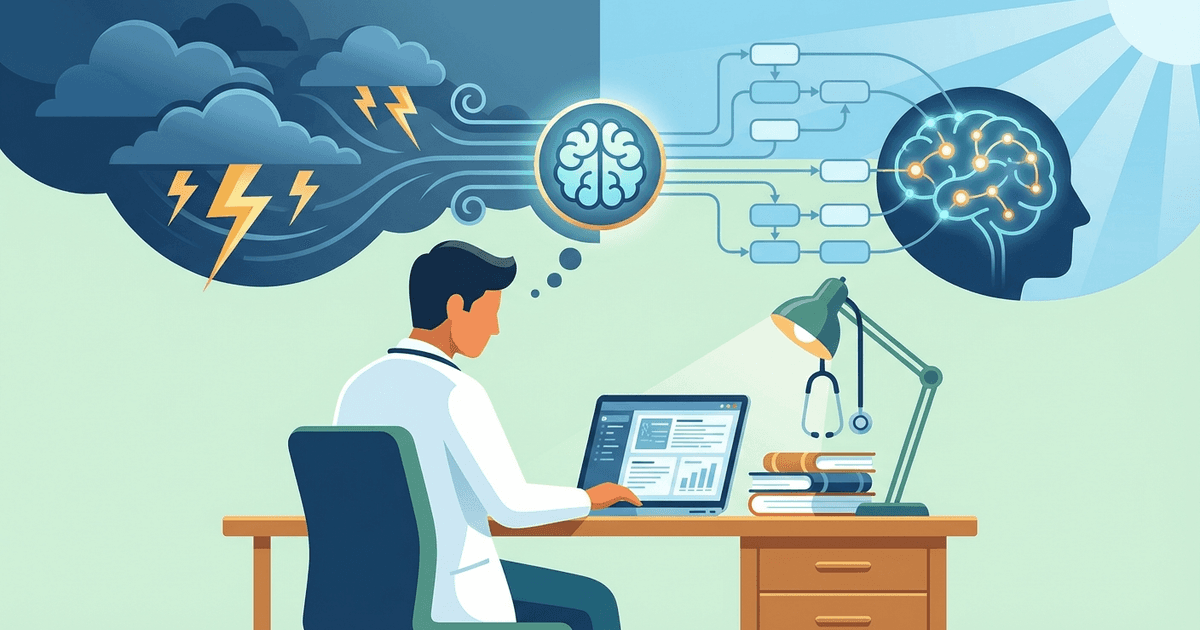
The Psychology of Medical Exam Anxiety: Why It Happens and How to Beat It in 2026
You are sitting in front of your NEET PG books at 2 AM, heart racing, wondering if you will ever feel ready. Your USMLE prep schedule looks perfect on paper, but that knot in your stomach says otherwise. You know the material, but the moment someone mentions "exam day," your mind goes blank.
Here's what nobody tells you: medical exam anxiety isn't about not knowing enough. It's about how your brain processes the enormous cognitive load, impossibly high stakes, and direct threat to your identity as a future doctor. The good news? Neuroscience has cracked the code on why this happens and exactly how to fix it.
Let's get into the psychology behind medical exam anxiety and the evidence-based strategies that actually work — not the generic "just relax" advice that helps nobody.
Why Medical Exams Trigger Unique Anxiety Responses
Medical exam anxiety isn't regular test stress on steroids. It's a distinct psychological phenomenon with three core triggers that interact to create the perfect storm.
Cognitive Overload and Decision Paralysis
Your brain can only process 7±2 pieces of information simultaneously in working memory. Medical exams demand you integrate pathophysiology, pharmacology, clinical presentation, diagnostic workup, and treatment options — all while the clock ticks down to 90 seconds per question.
Research from cognitive psychology shows that when working memory exceeds capacity, the prefrontal cortex (your decision-making center) literally shuts down. This is why you can know everything about diabetes but freeze when asked about diabetic ketoacidosis management under time pressure.
The anxiety loop starts here: you notice the cognitive overload, interpret it as "not being prepared enough," which triggers more anxiety, which further reduces cognitive capacity. Decision fatigue kicks in before you even open the question paper.
Identity Threat and Impostor Syndrome
Medical students face what psychologists call "identity foreclosure" — your entire sense of self becomes tied to being "the smart one who will become a doctor." When exam performance threatens this identity, your brain activates the same threat response as physical danger.
Studies show that high achievers experience more severe anxiety when their competence is questioned because their self-worth depends entirely on performance. Every practice question you get wrong feels like evidence that you dont belong in medicine.
This identity threat explains why medical exam anxiety often includes physical symptoms (sweating, nausea, heart palpitations) typically reserved for life-or-death situations. To your brain, failing the exam literally feels like dying.
The High-Stakes Pressure Cooker
Unlike other professional exams, medical licensing tests carry uniquely high stakes. NEET PG determines your specialty and location for the next three years. USMLE scores affect residency matching for life. UKMLA failure means delaying your career by months or years.
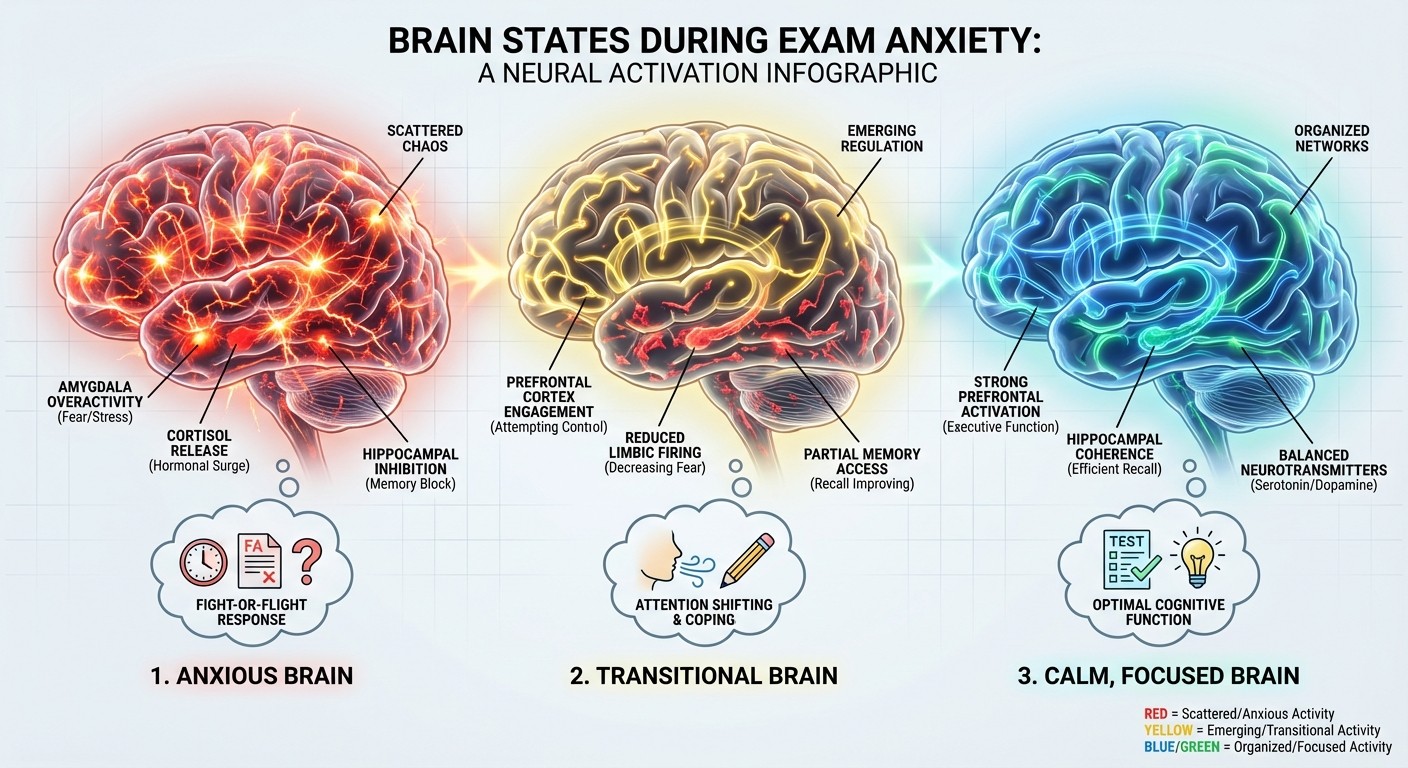
This pressure creates what researchers call "choking under pressure" — a phenomenon where anxiety actually impairs performance in people who know the material well. The anterior cingulate cortex, which monitors for errors, becomes hyperactive and interferes with automatic recall processes.
The Neuroscience of Test Anxiety: What Happens in Your Brain
Understanding the brain science behind exam anxiety helps you target interventions more precisely. When you sit down for NEET PG or USMLE, three key brain systems interact:
The Amygdala (Fear Center): Scans for threats and triggers fight-or-flight responses. During exams, it interprets time pressure and high stakes as immediate danger. The Prefrontal Cortex (Executive Function): Handles working memory, decision-making, and logical reasoning. Anxiety impairs its function, making complex medical reasoning harder. The Hippocampus (Memory Formation): Retrieves stored information and forms new memories. Stress hormones like cortisol directly interfere with hippocampal function, causing the "I studied this but cant remember" phenomenon.
Research shows that moderate anxiety can enhance performance through increased alertness, but high anxiety creates an inverted-U curve where performance plummets. The key is finding your optimal arousal zone — alert but not overwhelmed.
Evidence-Based Strategies to Overcome Medical Exam Anxiety
The most effective interventions target the specific psychological triggers we just covered. Here are the science-backed approaches that work:
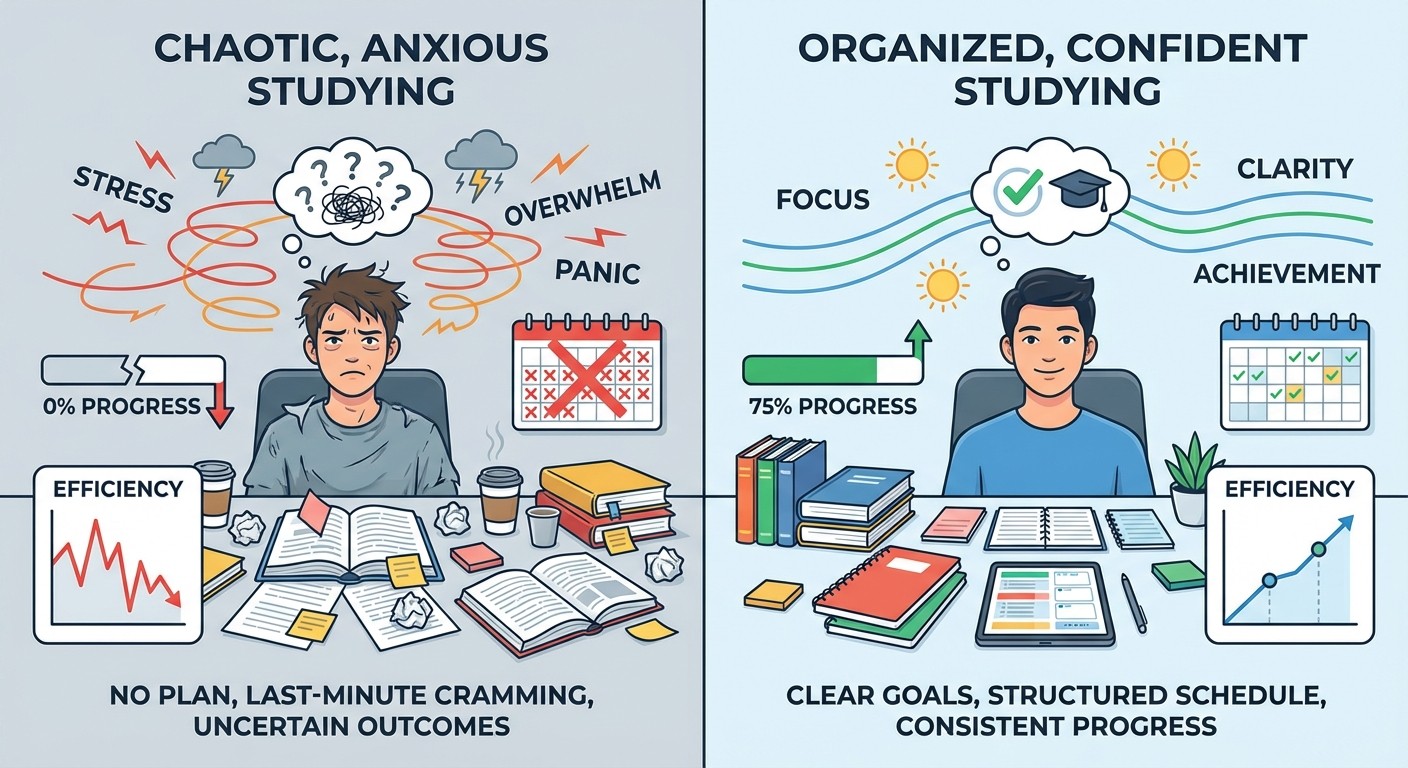
1. Structured Planning to Reduce Decision Fatigue
Decision fatigue is a major anxiety driver because your brain constantly questions, "Am I studying the right thing?" Structured daily plans eliminate this uncertainty by removing decisions from your cognitive load.
An adaptive daily plan takes this further by adjusting based on your performance data, ensuring you always know exactly what to study next. This replaces the anxiety loop of "am I prepared?" with concrete, actionable next steps that your brain can execute automatically.
2. Progress Tracking to Convert Anxiety into Action
Vague anxiety ("I dont feel ready") is harder to manage than specific concerns ("I'm weak in cardiology"). Real-time progress data from a performance dashboard transforms worry into a to-do list by showing exactly where your knowledge gaps are.
When you can see that you're scoring 78% in pharmacology but only 52% in pathology, your brain shifts from generalized panic to targeted problem-solving. This converts the emotional experience of anxiety into the cognitive task of gap analysis.
3. Spaced Repetition for Confidence Building
Neuroscience research shows that successful retrieval practice builds confidence through repeated positive experiences with recall. Each time you successfully remember information through spaced repetition, you strengthen both the memory trace and your confidence in your ability to access it.
This is why cramming increases anxiety even when you "know" the material — your brain hasn't had enough positive retrieval experiences to trust that the information will be there when needed. Consistent spaced review with flashcards builds the neural confidence that reduces test anxiety.
4. Cognitive Restructuring for Identity Threats
Challenge the all-or-nothing thinking that fuels medical exam anxiety. Instead of "I must score 650+ or I'm not meant to be a doctor," try "This exam is one data point about my current knowledge level, not my worth as a future physician."
Research on cognitive behavioral therapy shows that identifying and challenging catastrophic thoughts reduces anxiety more effectively than trying to suppress worrying thoughts entirely.
5. Physiological Regulation Techniques
Since medical exam anxiety triggers real physical symptoms, you need physiological interventions:
Box Breathing: 4 counts in, hold 4, out 4, hold 4. This activates parasympathetic nervous system responses that directly counter anxiety physiology. Progressive Muscle Relaxation: Systematically tense and release muscle groups to reset your nervous system. Particularly effective before practice exams. Cold Water Protocol: Splash cold water on your face or wrists. This triggers the mammalian dive response, which rapidly slows heart rate and reduces anxiety.
Exam Day Anxiety Management: Real-Time Strategies
Even with excellent preparation, exam day brings unique psychological challenges. Here's how to handle anxiety when it matters most:
The 5-4-3-2-1 Grounding Technique
When anxiety spikes during the exam, use this sensory grounding method:
5 things you can see (question text, desk, computer screen)
4 things you can touch (chair, pen, desk surface)
3 things you can hear (air conditioning, typing, breathing)
2 things you can smell (coffee, sanitizer)
1 thing you can taste (gum, mint)
This pulls your attention away from anxious thoughts and back to the present moment.
Question-by-Question Reset
Treat each question as an independent event. After submitting an answer, take one deep breath and mentally "reset" before reading the next question. This prevents anxiety from one difficult question affecting your performance on subsequent ones.
Time Pressure Reframing
Instead of thinking "I only have 90 seconds," reframe as "I have a full 90 seconds to work through this systematically." Language matters for anxiety management — your brain responds differently to "only" versus "full."
Building Long-Term Resilience Against Test Anxiety
Beyond specific techniques, building overall resilience reduces anxiety across all medical exams:
Sleep and Anxiety Connection
Sleep deprivation amplifies anxiety by 30% according to neuroscience research. Your amygdala becomes hyperactive while your prefrontal cortex loses its ability to regulate emotional responses. Consistent 7-8 hours of sleep isn't optional for anxiety management — it's essential.
Exercise as Anxiety Medicine
Regular aerobic exercise increases brain-derived neurotrophic factor (BDNF), which strengthens connections between the prefrontal cortex and amygdala. This literally rewires your brain to handle stress better. Even 20 minutes of walking daily makes a measurable difference.
Social Support Networks
Isolation amplifies medical exam anxiety. Regular contact with fellow medical students who understand your specific pressures provides both emotional support and reality-checking for catastrophic thoughts.
When to Seek Professional Help
Medical exam anxiety becomes a clinical concern when it:
Interferes with daily functioning beyond study periods
Causes persistent sleep disturbances
Triggers panic attacks during practice exams
Leads to avoidance of exam registration or preparation
Student counseling services at medical schools often provide specialized support for academic anxiety. Cognitive behavioral therapy (CBT) and acceptance and commitment therapy (ACT) both show strong evidence for treating test anxiety specifically.
Frequently Asked Questions
Is exam anxiety normal for medical students?
Yes, studies show that 65-80% of medical students experience significant test anxiety. The high-stakes nature of medical licensing exams makes anxiety a nearly universal experience. What matters is learning to manage it effectively.
How long before an exam should I start anxiety management?
Start anxiety management techniques during your regular study routine, not just before exams. Building these skills takes practice — you cant expect to master breathing techniques the day before NEET PG if youve never used them during practice sessions.
Can anxiety actually improve exam performance?
Moderate anxiety can enhance focus and attention, but only up to a point. Research shows that optimal performance occurs with mild anxiety that increases alertness without overwhelming cognitive capacity. The goal isn't to eliminate anxiety completely but to keep it in the productive range.
Why do I know the material but freeze during practice tests?
This happens because knowledge storage and knowledge retrieval use different brain systems. You may have strong declarative memory (knowing facts) but weak procedural memory (accessing facts under pressure). This is why practice testing under timed conditions is essential for building retrieval confidence.
Should I avoid caffeine before medical exams?
If you regularly consume caffeine, dont change your routine on exam day. However, excessive caffeine can amplify anxiety symptoms. Stick to your normal intake — typically 1-2 cups of coffee or equivalent.
How do I handle anxiety if I start panicking during the actual exam?
Use the grounding technique (5-4-3-2-1), take three slow breaths, and remind yourself that one difficult question doesnt determine your entire score. If panic persists, raise your hand and request a brief break if allowed by exam protocols.
Medical exam anxiety is real, but it's not insurmountable. Understanding the psychology behind your stress response gives you the tools to manage it effectively. Remember, anxiety often signals that something matters deeply to you — and becoming a doctor clearly matters to you.
Prepare smarter with Oncourse AI — adaptive MCQs, spaced repetition, and AI explanations built for NEET-PG, USMLE, and UKMLA. Download free on Android and iOS.