Back
USMLE Step 1 Study Schedule: A Week-by-Week Guide for US Medical Students
Complete week-by-week USMLE Step 1 study schedule for US medical students balancing coursework and dedicated prep. Includes system-specific focus areas and timeline.
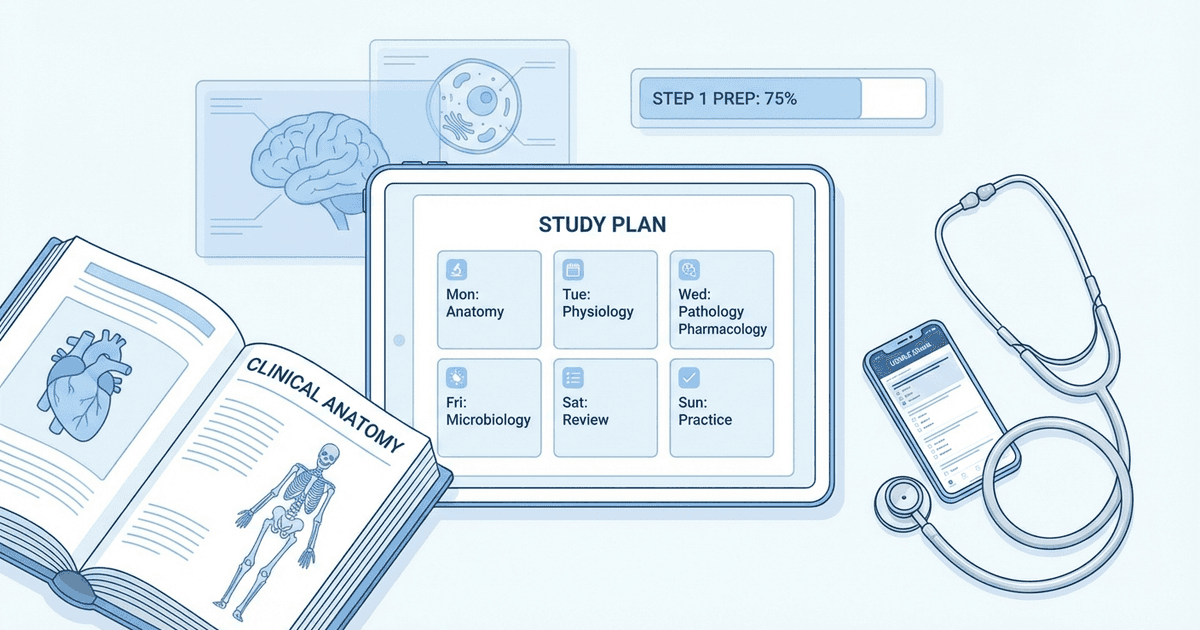
USMLE Step 1 Study Schedule: A Week-by-Week Guide for US Medical Students
You are probably staring at your calendar wondering how the hell you are going to fit Step 1 prep around M2 coursework, shelf exams, and actually having a life. Every study plan you have found online assumes you are starting from zero or have 6 months of uninterrupted time. You dont.
Here's the truth: Step 1 preparation for US medical students looks completely different from IMG prep. You already have a foundation from your coursework. You dont need to relearn everything — you need to synthesize what you know and fill specific gaps. Most importantly, you need a plan that works alongside your school's timeline, not against it.
This week-by-week Step 1 study schedule is built for students who are juggling M2 classes, preparing for shelf exams, and trying to maximize their Step 1 score without burning out. It assumes you have 16-20 weeks total: 12-16 weeks of concurrent prep during coursework plus 4-6 weeks of dedicated study time.
Understanding Your Step 1 Timeline
The average US medical student takes Step 1 between February and June of M2 year, depending on their school's curriculum. Unlike IMG students who might dedicate 6-12 months solely to Step 1, you have competing priorities that actually work in your favor — if you plan correctly.
Your coursework is already covering Step 1 material. The key is strategic reinforcement rather than starting from scratch. When you are studying cardiology in class, that's when you should be doing cardio questions and reviewing high-yield cardio facts for Step 1.
Timeline Overview:
Weeks 1-12: Concurrent preparation (alongside coursework)
Weeks 13-16: Bridge period (lighter coursework, heavier Step 1 focus)
Weeks 17-20: Dedicated study period (4-6 weeks before exam)
Weeks 1-4: Foundation Building Phase
Week 1: Assessment and System Setup
Monday-Wednesday: Take a baseline NBME or UWSA to identify your starting point. Dont worry about the score — this is data, not judgment. Most students score 140-180 on their first practice test. Thursday-Friday: Set up your study systems. Download question banks, organize your schedule, and map out which organ systems align with your current coursework. Weekend: Review your baseline exam results. Identify your three weakest organ systems — these become your priority targets throughout the entire prep period.
The key insight here is using an adaptive daily plan that integrates with your current system block. Instead of following a generic schedule, your daily prep should adjust based on what you are learning in class and where your weak areas are showing up in practice questions.
Daily commitment this week: 1-2 hours Step 1-specific study
Week 2: Active Learning Integration
Start integrating Step 1 prep with your current coursework. If you are covering respiratory in class, spend your Step 1 study time on respiratory questions and pathology review.
Monday-Wednesday: 40 questions daily from your current organ system + 10 mixed questions from weak areas Thursday-Friday: 30 questions daily + flashcard review for high-yield facts Weekend: Comprehensive review of the week's mistakes. Create a running list of concepts you need to revisit. Daily commitment: 2-2.5 hours
Week 3: Pattern Recognition
This week focuses on recognizing Step 1 question patterns and building speed. You should notice your accuracy improving on subjects you have already covered in class.
Monday-Wednesday: 50 questions daily (40 current system + 10 mixed) Thursday-Friday: 40 questions + dedicated weak area review using targeted question sets Weekend: Full practice test under timed conditions (3.5 hours). This gives you real exam endurance data. Daily commitment: 2.5-3 hours
Week 4: Consistency Check
Monday-Friday: Maintain 50 questions daily with immediate review. Focus on understanding explanations rather than just getting answers right. Weekend: Review your month of data. Which systems are improving? Which ones are stuck? Adjust your daily question distribution for the next phase.
Use a performance dashboard to track your system-by-system accuracy. This real-time feedback helps you decide where to spend your limited study time most effectively.
Daily commitment: 2.5-3 hours
Weeks 5-8: System Mastery Phase
Week 5: Cardiovascular Focus
Whether or not you are covering cardio in class this week, it's time for dedicated cardiovascular review. Cardio represents roughly 12-15% of Step 1 and has high-yield pharmacology crossover.
Monday-Wednesday: 30 cardio questions + 20 mixed questions daily Thursday-Friday: Pathophysiology deep-dive. Review heart failure, arrhythmias, and ischemic heart disease mechanisms. Weekend: Cardio pharmacology review (beta blockers, ACE inhibitors, diuretics). Create drug mechanism flashcards. Daily commitment: 3 hours
Week 6: Respiratory and Renal Systems
These systems often appear together on Step 1 and share acid-base physiology connections.
Monday-Tuesday: 25 respiratory questions + 25 renal questions Wednesday-Thursday: Acid-base disorders deep-dive. Practice arterial blood gas interpretation. Friday: Mixed questions (50) to maintain other systems Weekend: Respiratory and renal pathology review. Focus on restrictive vs obstructive patterns and acute vs chronic kidney disease. Daily commitment: 3 hours
Week 7: Gastrointestinal System
GI is heavily tested and includes both anatomy and physiology components that often confuse students.
Monday-Wednesday: 40 GI questions daily + 10 mixed Thursday-Friday: GI pharmacology and microbiology. Review PPI mechanisms, IBD treatments, and GI infections. Weekend: Liver pathology and hepatitis patterns. This is one of the highest-yield areas within GI. Daily commitment: 3 hours
Week 8: Endocrine System
Endocrine questions often integrate with other systems, making this a crucial review week.
Monday-Wednesday: 35 endocrine questions + 15 mixed daily Thursday-Friday: Diabetes and thyroid disorders focus. Review insulin mechanisms and thyroid function tests. Weekend: Adrenal disorders and reproductive endocrinology. These are often missed by students who focus only on diabetes and thyroid. Daily commitment: 3 hours
Weeks 9-12: Integration and Weak Area Attack
Week 9: Neurology and Psychiatry
Neuro scares many students but represents consistent Step 1 content. Psychiatry is often underestimated.
Monday-Tuesday: 30 neuro questions + 15 psychiatry questions daily Wednesday-Thursday: Neuroanatomy review. Focus on stroke syndromes and cranial nerve functions. Friday: Mixed questions focusing on your three weakest systems Weekend: Psychiatric medications and diagnostic criteria. DSM-5 criteria for major depression, schizophrenia, and bipolar disorder. Daily commitment: 3-3.5 hours
Week 10: Infectious Disease and Immunology
These systems integrate heavily with microbiology and pathology concepts.
Monday-Wednesday: 40 ID/Immunology questions + 10 mixed daily Thursday-Friday: Antibiotic mechanisms and resistance patterns. Review beta-lactams, quinolones, and protein synthesis inhibitors. Weekend: Immunodeficiency syndromes and autoimmune disorders. Focus on primary vs secondary immunodeficiencies. Daily commitment: 3-3.5 hours
Week 11: Musculoskeletal and Dermatology
Often considered "easier" systems, but they contain high-yield pharm and path concepts.
Monday-Wednesday: 35 MSK/Derm questions + 15 mixed daily Thursday-Friday: Rheumatologic disorders and skin cancer patterns. Review autoimmune arthritis and melanoma vs other skin cancers. Weekend: Bone disorders and muscle pathology. Focus on osteoporosis, Paget disease, and muscular dystrophies. Daily commitment: 3-3.5 hours
Week 12: Comprehensive Review and Practice Test
Monday-Wednesday: 60 mixed questions daily covering all systems Thursday: Light review day — go through your accumulated weak areas list Friday: Full practice test (NBME or UWSA) Weekend: Comprehensive practice test review. Calculate your predicted score and identify any remaining weak areas. Daily commitment: 4 hours
Weeks 13-16: Bridge to Dedicated Phase
Week 13: Pathology Integration
This week focuses on connecting pathology concepts across systems rather than memorizing isolated facts.
Monday-Wednesday: 50 mixed questions daily with emphasis on pathology mechanisms Thursday-Friday: Cross-system pathology review. How does diabetes affect kidneys, eyes, and nerves? How does hypertension connect to cardiovascular and renal pathology? Weekend: Practice test and review
Using an adaptive question bank with organ system tagging becomes crucial here — it can automatically prioritize the systems where you are still struggling instead of giving you random questions.
Daily commitment: 4-4.5 hours
Week 14: Pharmacology Integration
Pharmacology represents roughly 15% of Step 1 and integrates with every organ system.
Monday-Wednesday: 40 mixed questions + 30 minutes dedicated pharmacology review daily Thursday-Friday: Drug mechanism deep-dives. Focus on MOA, side effects, and contraindications for major drug classes. Weekend: Antimicrobials and chemotherapy agents. These are often the most challenging pharmacology topics. Daily commitment: 4-4.5 hours
Week 15: Behavioral Science and Ethics
Often overlooked but represents easy points if you prepare systematically.
Monday-Tuesday: 30 behavioral science questions + 20 mixed daily Wednesday-Thursday: Medical ethics scenarios and patient communication principles. Friday-Weekend: Biostatistics review. Focus on sensitivity, specificity, positive predictive value, and study design concepts. Daily commitment: 4-4.5 hours
Week 16: Final Systems Review
Monday-Wednesday: 60 mixed questions daily focusing on your historically weakest areas Thursday-Friday: Light content review. No new material — just reinforcing concepts you have already learned. Weekend: Practice test and detailed review session Daily commitment: 4.5-5 hours
Weeks 17-20: Dedicated Study Period
Week 17: High-Yield Focus
You are now in dedicated study mode. No more new content — everything is review and practice.
Monday-Wednesday: 80 questions daily + immediate review Thursday-Friday: High-yield fact review using flashcards and summary sheets Weekend: Full practice test + comprehensive review
Your performance dashboard should show consistent improvement by now. Most students see a 20-30 point increase between their baseline and this point.
Daily commitment: 6-7 hours
Week 18: Weak Area Elimination
This week is about eliminating your remaining weak spots.
Monday-Tuesday: 100 questions daily focused on your three weakest systems Wednesday-Thursday: Content review for weak areas only. Use active recall, not passive reading. Friday-Weekend: Practice test + review focusing specifically on missed questions Daily commitment: 7-8 hours
Week 19: Practice and Polish
Monday-Wednesday: 80-100 mixed questions daily under timed conditions Thursday-Friday: Light review of commonly missed facts. No heavy content work. Weekend: Final comprehensive practice test Daily commitment: 6-7 hours
Week 20: Final Week
Monday-Tuesday: 40-50 questions daily. Focus on maintaining sharpness, not learning new material. Wednesday-Thursday: Light review of high-yield facts. Avoid heavy studying to prevent burnout. Friday: Rest day. Do something relaxing and get good sleep. Weekend: Exam day
Daily Study Routine Structure
Morning Block (2-3 hours)
40-60 questions with immediate review
Focus on your current weak systems
Track performance metrics
Afternoon Block (1-2 hours)
Content review based on morning's missed questions
Flashcard review for high-yield facts
System-specific deep-dives when needed
Evening Block (30-60 minutes)
Light review or additional questions if energy permits
Prepare next day's focus areas based on performance data
Resource Allocation Strategy
Question Banks
Aim for 2,500-3,500 total questions during your prep period. Focus on immediate explanation review rather than just question volume.
Content Review
Your medical school coursework provides the foundation. Use Step 1 resources to fill gaps and reinforce weak areas, not to relearn everything.
Practice Tests
Take one every 2-3 weeks during concurrent prep, then weekly during dedicated study. Use different brands (NBME, UWSA) for varied question styles.
Flashcards and Quick Review
Use spaced repetition for high-yield facts that you keep missing. Don't create flashcards for concepts you already know well.
Adjusting for Your School's Schedule
Quarter System Schools
Compress the concurrent prep phase to 10-12 weeks and extend dedicated time to 6-8 weeks if possible.
Semester System Schools
Follow the standard timeline but adjust organ system focus to match your coursework calendar.
Schools with Early Clinical Exposure
Use clinical experiences to reinforce Step 1 concepts. Real patient cases make textbook knowledge stick better.
Pass/Fail Step 1 Considerations
Even with pass/fail, aim for a strong performance. Your Step 2 CK score will carry more weight, so building good study habits now pays off later.
Common Mistakes to Avoid
Mistake 1: Starting Too Late
Beginning Step 1 prep 6 weeks before your exam date is a recipe for panic studying. You need concurrent prep time to build your foundation.
Mistake 2: Ignoring Weak Areas
It's tempting to keep doing questions in systems where you already score well. Force yourself to spend extra time on your consistently low-scoring areas.
Mistake 3: Over-Studying Strong Areas
If you are consistently scoring 80%+ in a system, maintain it with light review but don't dedicate heavy study time to it.
Mistake 4: Passive Content Review
Reading First Aid cover-to-cover without active practice is inefficient. Use practice questions to identify gaps, then do targeted content review.
Mistake 5: Neglecting Self-Care
All-nighters and constant stress hurt your long-term retention and test performance. Build rest days into your schedule.
When to Take Your Exam
Green Light Indicators:
Consistently scoring at or above your target on practice tests
Weak areas have improved to acceptable levels (60%+ accuracy)
You can complete 280 questions in 7 hours without mental fatigue
Your practice test scores have plateaued at your target level
Red Light Indicators:
Practice test scores declining or highly variable
Multiple organ systems still below 50% accuracy
Extreme test anxiety or physical symptoms of burnout
Unable to finish practice tests due to fatigue or time pressure
Most students are ready after 4-6 weeks of dedicated study if they did proper concurrent preparation. Don't rush to test early, but don't over-prepare to the point of burnout either.
Study Schedule Modifications
For High Achievers (Target Score 250+):
Extend dedicated period to 6-8 weeks
Increase daily question volume to 100-120 during dedicated phase
Add advanced question banks for challenging practice
Focus heavily on connecting concepts across systems
For Students Needing Basic Pass:
Focus on high-yield, commonly tested material
Prioritize your weakest systems more aggressively
Consider extending concurrent prep period if needed
Use simplified review resources rather than comprehensive textbooks
For Students with Test Anxiety:
Take practice tests weekly to build familiarity
Include anxiety management techniques in your daily routine
Consider professional counseling or medical support if needed
Practice test-taking strategies specifically for anxiety management
Frequently Asked Questions
How many questions should I do per day during concurrent prep?
Start with 20-30 questions daily in weeks 1-2, building to 50-60 questions by weeks 8-12. The key is consistent daily practice rather than cramming large volumes irregularly.
Should I read First Aid cover to cover before starting questions?
No. Use questions to identify your weak areas, then use First Aid and other resources for targeted review. Reading First Aid without context is inefficient for most students.
How do I balance Step 1 prep with shelf exams?
Align your Step 1 system focus with upcoming shelf exams when possible. Studying cardiology for your medicine shelf also helps your Step 1 cardio performance. The content overlaps significantly.
What if I am not improving after 8 weeks of preparation?
Reassess your study methods. Are you reviewing explanations thoroughly? Are you focusing enough time on weak areas? Consider extending your concurrent prep period or getting tutoring for specific systems.
How many practice tests should I take total?
Plan for 8-12 practice tests total: one baseline, 4-6 during concurrent prep (every 2-3 weeks), and 4-6 during dedicated study (weekly). More tests aren't necessarily better if you are not learning from them.
Should I postpone my exam if my practice scores are below my target?
If you are consistently scoring 15+ points below your target after 6+ weeks of dedicated study, consider postponing. However, don't postpone for small gaps or temporary score fluctuations.
Prepare smarter with Oncourse AI — adaptive MCQs, spaced repetition, and AI explanations built for USMLE Step 1. Download free on Android and iOS