UKMLA AKT Preparation Guide for IMGs: How to Pass on Your First Attempt in 2026
Complete UKMLA AKT preparation guide for international medical graduates. Learn UK clinical reasoning, avoid common IMG pitfalls, and master the exam format with a proven 12-week study plan.

UKMLA AKT Preparation Guide for IMGs: How to Pass on Your First Attempt in 2026
You are probably staring at the UKMLA AKT requirements thinking "This looks nothing like MBBS finals." You are right. The Applied Knowledge Test isnt about memorizing Harrison's or reciting drug classifications. It tests clinical reasoning in ways that feel foreign if you trained outside the UK system.
Here's what matters: 200 questions. 3 hours. Pass mark around 500-520 out of 1000 scaled points. The difference between passing and failing often comes down to understanding how UK medicine thinks about patient care - not just what you know, but how you apply it.
This guide cuts through the noise. No generic study tips that work for everyone. This is specifically for IMGs who need to recalibrate from their home country's medical training to UK clinical decision-making patterns.
Understanding UKMLA AKT Format for IMGs
The AKT isnt a knowledge dump. Every question presents a clinical scenario where you choose the single best answer. The twist? "Best" means best according to UK guidelines, UK priorities, and UK healthcare context.
Key Differences from Other Medical Exams
Your Background | What Changes in UKMLA AKT |
|---|---|
Indian MBBS | Less rote learning, more clinical reasoning. Guidelines follow NICE/BNF, not Indian textbooks |
USMLE Background | Less basic science, more practical management. Different antibiotic choices, investigation sequences |
PLAB Experience | AKT goes deeper into clinical reasoning. Scenarios are longer, more complex |
Question Structure That Trips Up IMGs
Each AKT question follows this pattern:
1. Clinical vignette (2-4 sentences setting the scene)
2. Patient presentation (symptoms, examination findings, basic investigations)
3. Question stem (what's the most appropriate next step/investigation/management?)
4. 5 options (all plausible, one definitively best)
The challenge? UK medicine prioritizes differently. Where you might investigate extensively, UK guidelines often favor watchful waiting. Where you might start broad-spectrum antibiotics, UK protocols specify narrow-spectrum first-line choices.
IMG-specific tip: Oncourse's Adaptive Daily Plan tailors your UKMLA AKT study schedule around this clinical reasoning-heavy format, particularly useful when recalibrating from exam systems that emphasize different priorities.
High-Yield Topics for UKMLA AKT Success
Tier 1: Core Clinical Areas (40% of questions)
Cardiovascular Medicine
Acute coronary syndromes (ECG interpretation, troponin significance)
Heart failure management (ACE inhibitors vs ARBs, SGLT2 inhibitors)
Hypertension guidelines (NICE stepped approach)
Arrhythmia management (when to anticoagulate, cardioversion protocols)
Respiratory Medicine
Asthma vs COPD management algorithms
Pneumonia severity scoring (CURB-65 application)
Pulmonary embolism diagnosis (Wells score, D-dimer interpretation)
Gastroenterology
Inflammatory bowel disease (Crohn's vs ulcerative colitis management)
Upper GI bleeding protocols
Jaundice investigation pathways
Tier 2: Primary Care Emphasis (25% of questions)
Diabetes Management
HbA1c targets for different patient groups
Metformin contraindications and alternatives
Diabetic foot care protocols
Mental Health
Depression screening tools (PHQ-9 application)
Anxiety disorder management
Suicide risk assessment
Women's Health
Contraception counseling
Cervical screening guidelines
Menopause management
Quick insight: many IMG backgrounds emphasize specialist care. UKMLA AKT heavily weights primary care decision-making. Study how UK GPs approach common presentations before referring to specialists.
Tier 3: Emergency and Acute Care (20% of questions)
Emergency Protocols
Sepsis recognition and management
Anaphylaxis treatment algorithms
Major trauma assessment
Prescribing Safety
Drug interactions (particularly warfarin, digoxin, lithium)
Monitoring requirements for common medications
Contraindications in kidney/liver disease
Common IMG Pitfalls and How to Avoid Them
Pitfall 1: Over-Investigating
The Problem: Your medical training emphasized thorough investigation before treatment. UK medicine often favors empirical treatment or watchful waiting. Example: Young woman with UTI symptoms. IMGs might order urine culture first. UK approach: empirical antibiotics for uncomplicated UTI, culture only if treatment fails. Solution: Learn the "red flags" that trigger investigation vs conditions managed empirically. Practice questions help you internalize when UK guidelines say "treat" vs "investigate."
Pitfall 2: Wrong First-Line Treatments
The Problem: Drug choices vary by country. Your first-line might be UK's second or third-line. Examples:
Hypertension: Your training might favor calcium channel blockers. UK prefers ACE inhibitors for most patients under 55.
UTI: You might reach for fluoroquinolones. UK uses nitrofurantoin or trimethoprim first-line.
Solution: Memorize UK first-line choices for common conditions. The BNF is your bible - not your home country's treatment guidelines.
Practice with UKMLA-style clinical scenario questions that mirror AKT question formats to get comfortable with UK clinical decision-making style.
Pitfall 3: Missing Social Context
The Problem: UKMLA AKT questions often include social factors that change management. IMGs sometimes focus purely on medical factors. Example: Elderly patient with recurrent falls. Medical issue: possible medication side effects. Social context: lives alone, poor mobility, safety concerns. Best answer might address home safety assessment, not just medication review. Solution: Always consider: How does this patient's social situation affect management? UK medicine heavily emphasizes holistic care.
IMG-Specific UKMLA Study Timeline
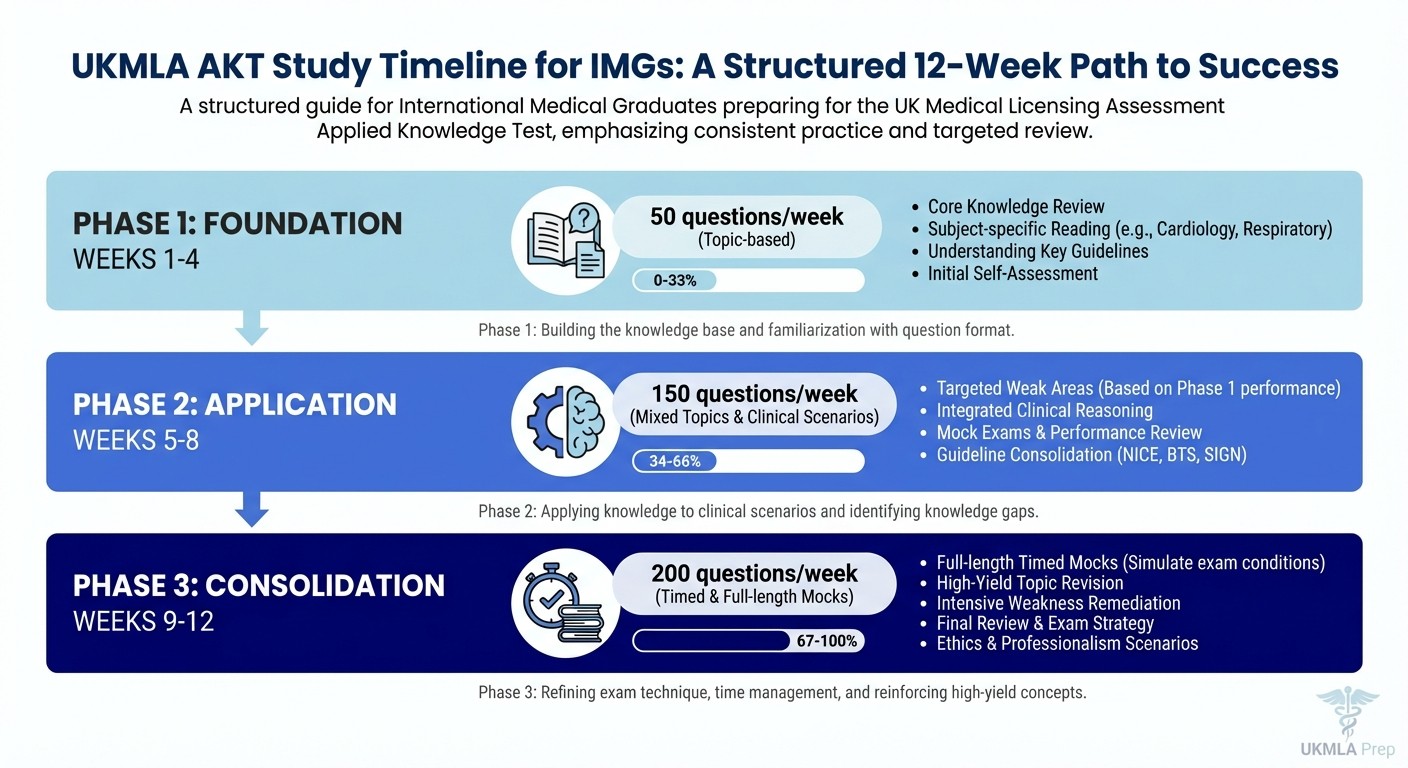
Phase 1: Foundation (Weeks 1-4)
Week 1-2: System Calibration
Read through NICE guidelines for 5 common conditions
Complete 50 practice questions, focus on understanding explanations
Identify knowledge gaps vs reasoning gaps
Week 3-4: Core Knowledge Building
Study high-yield topics using UK resources (BNF, NICE)
Complete 100 questions weekly
Track performance by topic area
The Performance Dashboard tracks your AKT readiness with UK-specific benchmarks, showing where you stand relative to pass-mark thresholds in real time.
Phase 2: Application (Weeks 5-8)
Week 5-6: Clinical Reasoning Focus
150 questions weekly, timed conditions
Review every incorrect answer, understand the UK logic
Study question stems that repeatedly trip you up
Week 7-8: Weak Area Intensive
Focus 70% of study time on lowest-scoring topics
Complete mini-tests by specialty
Simulate exam conditions with 200-question practice tests
Phase 3: Consolidation (Weeks 9-12)
Week 9-10: Speed and Accuracy
Full-length practice tests twice weekly
Target 90 seconds per question average
Review flagged questions from previous weeks
Week 11-12: Final Polish
Light review of core concepts
Maintain question practice rhythm
Focus on test-day logistics and timing
Quick timing tip: you get roughly 54 seconds per question. Spend them wisely - read the question stem first to focus your reading of the clinical vignette.
Question Practice Strategy for IMGs
Start with Learning Mode
Begin each topic with untimed questions where you can immediately see explanations. This builds the UK clinical reasoning patterns before you worry about speed.
Progression Timeline
Weeks 1-4 | Weeks 5-8 | Weeks 9-12 |
|---|---|---|
50 questions/week | 150 questions/week | 200 questions/week |
Untimed, learning focus | Timed by topic | Full exam simulations |
Read every explanation | Review incorrect only | Focus on speed/accuracy |
Advanced Question Analysis
For questions you get wrong, ask:
1. Did I miss clinical knowledge or UK guidelines?
2. Did I misread the question stem?
3. Was my reasoning process wrong?
4. Would I make the same mistake on a similar question?
This meta-analysis prevents repeating the same errors. Track patterns - are you consistently missing cardiology questions? Prescribing safety? Social context factors?
Essential Resources for UKMLA AKT Preparation
UK-Specific Guidelines (Primary Sources)
NICE Guidelines - Your primary reference for investigation and management pathways. Focus on:
BNF (British National Formulary) - Essential for prescribing questions. Know:
First-line drug choices for common conditions
Important contraindications and interactions
Monitoring requirements for high-risk medications
SIGN Guidelines - Scottish guidelines often referenced in AKT questions
Question Banks and Practice Materials
Quality matters more than quantity. Focus on question banks that mirror actual AKT style and difficulty. Look for:
UK-written questions following NICE/BNF guidelines
Detailed explanations that teach UK clinical reasoning
Performance tracking to identify weak areas
Adaptive difficulty that adjusts to your level
Additional Study Materials
Oxford Handbook of Clinical Medicine - Concise reference for quick reviews Kumar & Clark's Clinical Medicine - Comprehensive textbook aligned with UK practice Pastest UKMLA - Specific question bank for AKT preparation
Remember: IMG success on UKMLA AKT correlates more with UK guideline familiarity than general medical knowledge. Prioritize UK-specific resources over international textbooks.
Exam Day Strategy for IMGs
Time Management Approach
First Pass (90 minutes)
Answer all questions you're confident about
Flag questions where you need more thought time
Dont spend more than 2 minutes on any single question
Second Pass (60 minutes)
Return to flagged questions
Use elimination strategy for difficult options
Make educated guesses based on UK clinical patterns
Final Review (30 minutes)
Check for silly mistakes
Ensure you haven't left any blank answers
Review questions where you changed your mind
Managing IMG-Specific Anxiety
Many IMGs report feeling uncertain about their grasp of UK clinical culture. This uncertainty can hurt performance even when knowledge is adequate.
Pre-exam Week:
Complete one full-length practice test
Review your strongest topic areas to build confidence
Avoid cramming new information
Exam Day:
Trust your UK guideline knowledge
When unsure, choose the most conservative management option
Remember: UK medicine favors patient safety over aggressive intervention
Building UK Clinical Reasoning Skills
Understanding UK Medical Culture
UK medicine emphasizes:
Patient autonomy - Shared decision making, informed consent
Resource consciousness - Appropriate use of investigations and referrals
Safety netting - Clear follow-up plans and red flag advice
Holistic care - Social and psychological factors matter
Practical Application
Case Example: 35-year-old presents with chest pain. IMG tendency: Order extensive cardiac workup immediately UK approach: Risk stratify first. Low-risk young patient might get ECG, basic observations, and safety netting advice. High-risk features trigger further investigation.
The key difference: UK guidelines teach you when NOT to investigate as much as when TO investigate.
Developing Clinical Judgment
Practice recognizing patterns in UKMLA questions:
When questions mention "most appropriate next step," they usually want the safest, most conservative option
When they ask for "first-line management," stick to NICE recommendations
When social factors appear in vignettes, they're usually relevant to the answer
Use Oncourse's UKMLA question bank to drill these UK-specific reasoning patterns until they become automatic.
Frequently Asked Questions
How long should IMGs study for UKMLA AKT?
Most IMGs need 12-16 weeks of focused preparation. This accounts for learning UK guidelines alongside clinical knowledge gaps. If you have PLAB experience, 8-12 weeks might suffice. Fresh medical graduates should plan for 16+ weeks.
What's the minimum passing score for UKMLA AKT?
The pass mark varies by exam sitting but typically falls between 500-520 out of 1000 scaled points. This roughly translates to correctly answering 65-70% of questions. Focus on consistently scoring above 70% on practice tests.
Can I retake UKMLA AKT if I fail?
Yes, but there's a mandatory waiting period and additional fees. Most candidates can retake after 4 months. Plan to pass on your first attempt - retaking delays your licensing timeline significantly.
Are UKMLA AKT questions harder than PLAB 1?
UKMLA AKT questions are longer and more scenario-based than PLAB 1. They test clinical reasoning more deeply but cover less basic science. If you passed PLAB 1, you have the foundation - you need to adapt your thinking to longer, more complex scenarios.
Should IMGs focus on subspecialty topics?
No. UKMLA AKT heavily emphasizes primary care and common presentations. Study cardiology, respiratory, and GI medicine, but dont neglect mental health, women's health, and prescribing safety. Subspecialty medicine appears less frequently.
How important are UK drug names vs international names?
Very important. Learn UK-specific drug names and preparations. For example, UK uses "co-codamol" where other countries might say "acetaminophen with codeine." The BNF is essential for this.
---
The UKMLA AKT tests whether you can think like a UK doctor. That means understanding not just what UK medicine knows, but how it prioritizes, investigates, and treats. For IMGs, this shift in clinical reasoning is often the biggest hurdle.
Start with UK guidelines. Practice with UK-style questions. Trust the process - your medical knowledge is solid, you just need to recalibrate how you apply it.
Prepare smarter with Oncourse AI — adaptive MCQs, spaced repetition, and AI explanations built for UKMLA. Download free on Android and iOS.