NEET PG Study Plan 2026: Complete Subject-Wise Schedule, Weekly Targets and Topper Strategy
Master NEET PG 2026 with this proven study plan. Get subject-wise schedules, weekly targets, revision cycles, and topper strategies for 6-12 month preparation journey.
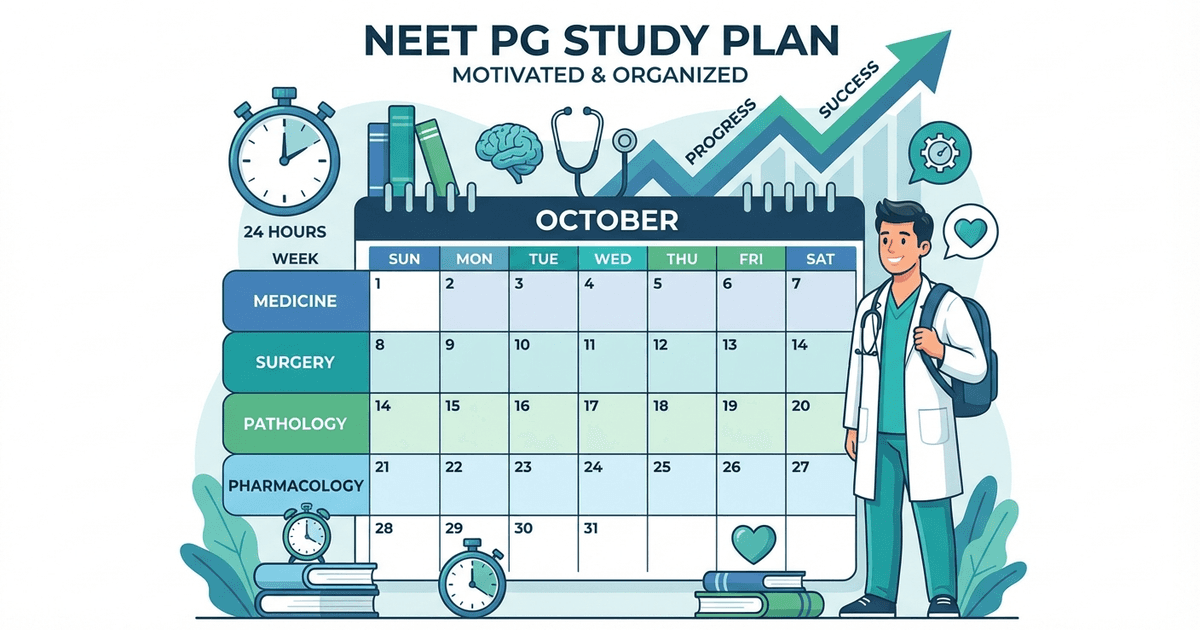
NEET PG Study Plan 2026: Complete Subject-Wise Schedule, Weekly Targets and Topper Strategy
You are staring at your NEET PG 2026 prep thinking, "Where do I even start?" You have 200 questions to master across 19 subjects. Medicine alone has 45-50 questions, Surgery another 45, and then there's that mountain of Pathology, Pharmacology, and everything else.
Here's what separates toppers from the crowd: they dont study harder, they study with a system. A clear weekly target. A subject sequence that builds knowledge instead of scattering it. And most importantly, they know exactly which topics can make or break their rank.
This isnt another generic "study 12 hours a day" guide. This is the exact framework that AIR-holders use — broken down by months, weeks, and daily targets. Whether you have 12 months or 6 months left, you'll walk away with a concrete plan that actually works.
Understanding NEET PG 2026: The Numbers That Matter
Before diving into study schedules, let's get the basics straight. NEET PG 2026 has 200 questions spread across 19 subjects, but not all subjects are created equal.
High-Yield Subjects (70% of your score):
Medicine: 45-50 questions
Surgery: 45 questions
Pathology: 25 questions
Social & Preventive Medicine: 25 questions
Pharmacology: 20 questions
Microbiology: 20 questions
Medium-Yield Subjects (20% of your score):
Obstetrics & Gynecology: 30-35 questions
Anatomy: 15-17 questions
Physiology: 15-17 questions
Pediatrics: 15 questions
Lower-Yield but Easy Scoring (10% of your score):
Radiology: 12-15 questions
Biochemistry: 12-15 questions
Forensic Medicine: 10 questions
ENT: 10 questions
Ophthalmology: 10 questions
Orthopedics: 10 questions
This distribution comes from analyzing recent NEET PG papers, and it's exactly why your study plan needs to be weighted, not balanced.
The Topper's 12-Month NEET PG Study Plan
Phase 1: Foundation Building (Months 1-4)
Goal: Complete first reading of all high-yield subjects + start MCQ practice Month 1-2: The Heavy Hitters
Pathology (30 days): Start here because it connects everything
Medicine (30 days): Build on pathology foundations
Week-by-week breakdown for Pathology:
Week 1: General Pathology + Cell injury
Week 2: Inflammation + Healing
Week 3: Neoplasia + Tumor pathology
Week 4: Systemic pathology (CVS, Respiratory)
Daily target: 6-8 hours study, 50 MCQs from the topics you covered
Month 3-4: Core Subjects
Surgery (25 days): GI surgery, trauma, emergency surgery first
Pharmacology (20 days): Focus on antimicrobials, CVS drugs, CNS drugs
Microbiology (15 days): Bacteriology first, then virology
The beauty of Oncourse's adaptive question bank becomes apparent here — instead of grinding random MCQs, the platform adjusts difficulty based on your subject-wise performance. If you're weak in antimicrobials but strong in CNS pharmacology, you'll get more antimicrobial questions automatically. This maps perfectly to your weekly targets: spend the right time on weak subjects, not by guessing.
Phase 2: Coverage + Consolidation (Months 5-8)
Goal: Complete remaining subjects + intensive MCQ practice Month 5-6: Fill the Gaps
OB-GYN (20 days): Labor, obstetric emergencies, gynecological malignancies
Social & Preventive Medicine (15 days): Epidemiology, national programs, biostatistics
Pediatrics (15 days): Vaccines, growth charts, neonatology
Remaining pre-clinical: Anatomy, Physiology, Biochemistry (10 days each)
Month 7-8: Minor Subjects + First Revision
Forensic Medicine, ENT, Ophthalmology, Orthopedics, Radiology (5-7 days each)
Start first revision of Medicine, Surgery, Pathology
Daily MCQ target: 100-150 questions
Weekly schedule for revision phase:
Monday-Tuesday: Medicine revision + 50 Medicine MCQs
Wednesday: Surgery revision + 50 Surgery MCQs
Thursday: Pathology + Pharmacology revision + mixed MCQs
Friday: OB-GYN + Pediatrics + mixed MCQs
Saturday: Minor subjects revision + subject-wise tests
Sunday: Full-length mock test + analysis
Oncourse's revision flashcards with spaced repetition are perfect for this phase. Instead of re-reading entire chapters, the flashcards surface high-yield facts exactly when you're about to forget them — making your weekly revision targets far more achievable.
Phase 3: Peak Performance (Months 9-12)
Goal: Speed + accuracy through rapid revision + intensive testing Month 9-10: Rapid Revision Cycles
Complete syllabus revision every 15 days
200+ MCQs daily
Weekly subject-wise tests
Identify and drill weak areas
Month 11-12: Exam Mode
Daily full-length mocks (200 questions in 3.5 hours)
Quick revision through flashcards only
Previous year questions analysis
Fine-tune exam strategy
A good NEET PG study plan must include full-length mock practice under exam conditions. Oncourse's timed tests simulate the actual NEET PG environment and provide detailed post-test analytics — topic-wise accuracy, time per question, comparative analysis. This helps you calibrate your revision targets each week rather than studying blindly.
The 6-Month Intensive NEET PG Study Plan
Starting late? Here's how to compress without compromising:
Months 1-2: Speed Foundation
Week 1-2: Pathology (compressed to key topics only)
Week 3-4: Medicine (focus on cardiology, neurology, infectious diseases)
Week 5-6: Surgery (emergency surgery, GI surgery, trauma)
Week 7-8: Pharmacology + Microbiology combined
Daily commitment: 8-10 hours, 100 MCQs minimum
Months 3-4: Coverage + Practice
Week 9-10: OB-GYN + Pediatrics
Week 11-12: PSM + remaining pre-clinical subjects
Week 13-14: Minor subjects (5 subjects in 2 weeks)
Week 15-16: First complete revision + intensive MCQs
Months 5-6: Mastery + Mocks
Month 5: Rapid revision cycles (complete syllabus every 10 days)
Month 6: Daily mocks + weak area drilling + PYQ analysis
Subject-Wise Weekly Targets That Work
Medicine (45-50 questions)
Week 1: Cardiology (MI, heart failure, arrhythmias) Week 2: Neurology (stroke, seizures, movement disorders) Week 3: Infectious diseases (fever workup, antimicrobial therapy) Week 4: Endocrinology (diabetes, thyroid disorders)
Daily target: 25 Medicine MCQs, focus on clinical scenarios and recent advances
Surgery (45 questions)
Week 1: Emergency surgery (trauma, acute abdomen) Week 2: GI surgery (peptic ulcer, IBD, colorectal) Week 3: Urology + basic orthopedics Week 4: Anesthesia + perioperative care
Pathology (25 questions)
Week 1: General pathology + cell injury Week 2: Systemic pathology (CVS, respiratory, GI) Week 3: Hematopathology + immunopathology Week 4: Tumor pathology + special stains
Track your progress with NEET PG pathology questions and use biochemistry flashcards for quick reviews.
Daily Schedule Framework
For 12-Month Prep:
6:00-8:00 AM: Fresh mind subjects (new topics, complex concepts)
8:00-9:00 AM: Breakfast + light review
9:00-12:00 PM: Core study block (Medicine/Surgery/Pathology)
12:00-1:00 PM: Lunch break
1:00-3:00 PM: MCQ practice + analysis
3:00-4:00 PM: Break
4:00-6:00 PM: Second subject or revision
6:00-7:00 PM: Dinner break
7:00-9:00 PM: Light subjects (ENT, Ophthalmology) or flashcard revision
9:00-10:00 PM: Day's performance analysis + next day planning
For 6-Month Intensive:
Add 2 hours of early morning study (4:30-6:30 AM) and extend evening study till 10:30 PM.
The Weekly Testing Strategy
Monday-Friday: Subject-specific MCQs (50-100 per day) Saturday: Mixed practice test (100-150 questions) Sunday: Full-length mock (200 questions) + detailed analysis Testing progression:
Months 1-4: Focus on subject completion over test scores
Months 5-8: Target 60-70% accuracy in subject tests
Months 9-12: Aim for 75%+ in mocks, time management under 3.5 hours
Use Oncourse's Rezzy AI tutor to clarify doubts from your MCQ practice — it's like having a senior resident available 24/7 who can explain why your answer was wrong and what concept you missed.
Revision Cycles That Stick
The 3-Round Strategy:
Round 1 (Months 7-9): Detailed revision
30-45 days for complete syllabus
Include diagram drawing, drug classifications, clinical criteria
Heavy flashcard creation phase
Round 2 (Months 10-11): Rapid revision
15-20 days for complete syllabus
Focus on high-yield topics and weak areas
MCQ-driven revision
Round 3 (Month 12): Super rapid revision
5-7 days for complete syllabus
Flashcards and one-liners only
Previous year pattern analysis
For quick concept reinforcement, try Oncourse's Probe game during study breaks — it gamifies medical facts and helps with pattern recognition that shows up in NEET PG's tricky clinical vignettes.
Topper Insights: What Actually Works
Time Management Secrets:
1. Block scheduling beats hourly planning — study one subject for 2-3 hours straight 2. Active breaks over passive breaks — walk and mentally review instead of scrolling phones 3. Weekly planning on Sundays — adjust targets based on previous week's performance 4. Sleep is non-negotiable — 6-7 hours minimum, preferably 7-8 hours
Subject Mastery Tactics:
1. Image-based questions practice — at least 20% of your MCQs should have images 2. Recent advances focus — dedicate 1 hour weekly to current medical guidelines 3. Drug mechanism over drug names — understand pathways, side effects follow naturally 4. Clinical correlation always — every fact should connect to a clinical scenario
Mental Game Strategies:
1. Track daily wins — subjects completed, MCQ accuracy, concepts mastered 2. Compete with your past performance — not with other aspirants 3. Build exam stamina early — practice 3.5-hour sitting from Month 6 onwards 4. Mistake journal maintenance — review incorrect MCQs weekly, not daily
Common Study Plan Mistakes to Avoid
The Resource Trap
Dont collect 10 different books and video series. Pick one primary source per subject and stick to it. Oncourse's comprehensive lesson library covers all NEET PG topics with the right depth — you dont need to hunt for multiple resources.
The Perfectionist Problem
You dont need 100% completion to move forward. If you understand 80% of Medicine before moving to Surgery, you're doing fine. The remaining 20% gets filled during revision cycles.
The Mock Test Mistake
Starting mocks too early (before Month 6) can be demoralizing and time-consuming. Focus on building knowledge first, speed second.
The Minor Subject Trap
Spending 30 days on ENT when it has only 10 questions is inefficient. Allocate time proportional to question weightage.
Technology Integration in Your Study Plan
Digital Tools That Add Value:
1. Spaced repetition apps for flashcard review (Oncourse handles this automatically) 2. Performance tracking spreadsheets for weekly target monitoring 3. Timer apps for focused study sessions and mock test practice 4. Medical calculator apps for quick formula references
Smart MCQ Strategy:
Use subject-wise filtering in question banks
Focus on explanation quality over quantity of questions
Track topic-wise accuracy to identify weak areas
Practice image-based questions separately
For comprehensive practice, explore NEET PG preparation resources and get detailed subject strategies.
Adapting Your Plan: Mid-Course Corrections
If You're Falling Behind:
1. Compress, dont skip — reduce time per topic by 20-30%, not by skipping entirely 2. Focus on high-yield topics — within each subject, prioritize frequently asked areas 3. Increase MCQ ratio — shift from 70% study, 30% MCQ to 60% study, 40% MCQ 4. Seek help early — unclear concepts compound, address them immediately
If You're Ahead of Schedule:
1. Deepen understanding — add clinical case discussions, recent papers 2. Increase mock frequency — move to daily mocks earlier 3. Help other aspirants — teaching solidifies your own knowledge 4. Explore niche topics — rare diseases, latest guidelines, international recommendations
Peak Performance in the Final Month
Week 1-2: Confidence Building
Daily full-length mocks
Focus on strong subjects to boost confidence
Quick revision of frequently forgotten topics
Maintain regular exercise and sleep schedule
Week 3: Strategic Preparation
Analysis of all previous mocks
Focus on time management strategies
Practice educated guessing techniques
Review important drug lists, normal values, formulas
Final Week: Exam Ready
Light revision only — no new topics
Previous year papers (last 3 years)
Stress management techniques
Logistics planning (travel, documents, backup plans)
Frequently Asked Questions
How many hours should I study daily for NEET PG 2026?
Quality matters more than quantity. For 12-month prep, 6-8 hours of focused study is sufficient. For 6-month intensive prep, aim for 8-10 hours daily. Remember, sitting for 12 hours with frequent distractions is less effective than 6 hours of deep focus.
Should I complete all subjects before starting MCQ practice?
No. Start MCQs from Day 1, but limit them to topics you've already studied. This reinforces learning and identifies gaps early. Aim for 50 MCQs daily during foundation phase, scaling up to 200+ during intensive phases.
Which subject should I start with for NEET PG preparation?
Two proven approaches: Start with Pathology (connects all clinical subjects) or start with Medicine (high-yield and motivating). Avoid starting multiple subjects simultaneously. Complete one subject before moving to the next.
How do I manage NEET PG prep with final year MBBS?
Focus on overlap subjects during clinics — Medicine, Surgery, OB-GYN, Pediatrics. Use clinical postings to reinforce NEET PG concepts. Dedicate 3-4 hours daily to pure NEET PG prep, focusing on Pathology, Pharmacology, and Microbiology.
Is 6 months enough for NEET PG preparation?
Yes, but requires 8-10 hours daily commitment and strategic subject selection. Focus heavily on high-yield subjects (Medicine, Surgery, Pathology). Use adaptive question banks to optimize your weak area practice time.
When should I start taking full-length mocks?
Start subject-wise tests after completing 60% of that subject. Begin full-length mocks only after completing 70% of the entire syllabus (typically Month 6 in 12-month plan, Month 3 in 6-month plan). Earlier mock tests can be demoralizing and time-consuming.
Prepare smarter with Oncourse AI — adaptive MCQs, spaced repetition, and AI explanations built for NEET PG. Download free on Android and iOS.