Back
USMLE Step 1 Anki 2026: How to Use Flashcards Effectively, Best Decks, and Why AI-Adaptive Prep Is Replacing It
Complete guide to Anki for USMLE Step 1 in 2026: best decks (AnKing, Lightyear), optimal settings, daily strategies, and why AI-adaptive platforms are becoming the smarter choice for Step 1 prep.
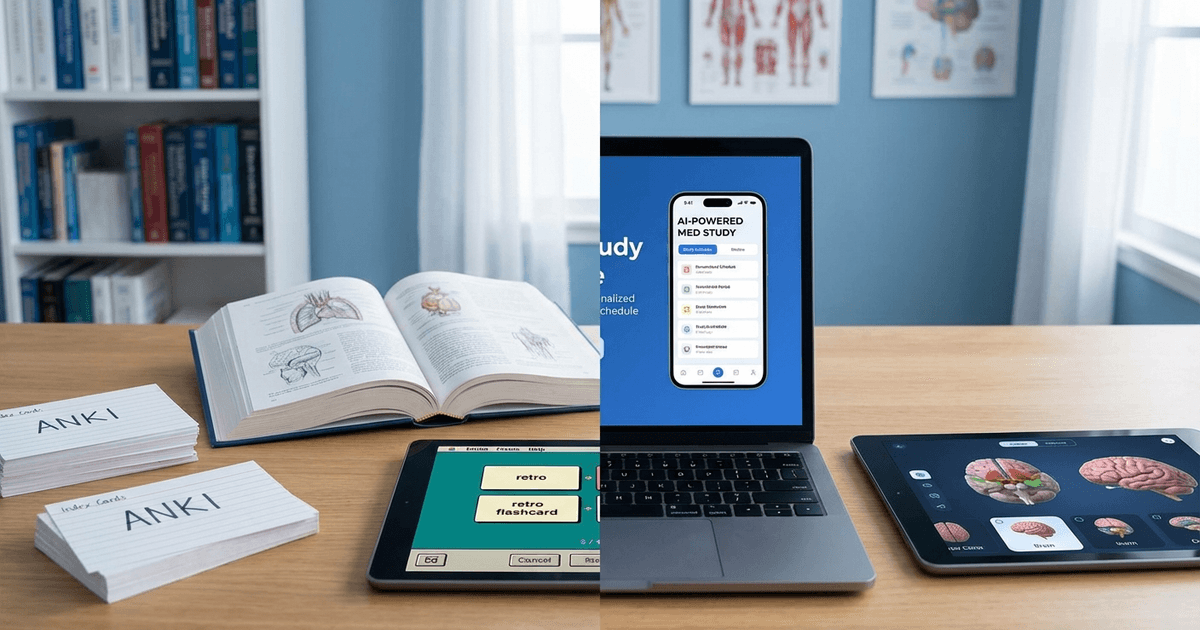
USMLE Step 1 Anki 2026: How to Use Flashcards Effectively, Best Decks, and Why AI-Adaptive Prep Is Replacing It
You are probably staring at 30,000 Anki cards right now, wondering if this mountain of flashcards will actually get you through Step 1. The honest answer? Anki still works — but the landscape has shifted dramatically since Step 1 went pass/fail.
First-time pass rates dropped from 95% to 89% for US MD students in recent years, with even steeper declines for DOs and IMGs. Meanwhile, AI-powered platforms are now delivering spaced repetition benefits without the setup overhead, deck maintenance nightmares, or the daily grind of 700+ review cards that leads straight to burnout.
Here's what you need to know about using Anki for USMLE Step 1 in 2026, the best decks that still matter, and why adaptive AI platforms are becoming the smarter choice for Step 1 prep.
The Science Behind Anki: Why Spaced Repetition Still Matters
Anki works because of two proven learning principles: the testing effect (active retrieval strengthens memory) and spaced repetition (optimally distributed reviews beat cramming).
Research consistently shows mature Anki card counts correlate with higher preclinical exam scores. One cohort study found AnKing deck completion was the only statistically significant predictor of course performance, explaining over a third of score variability.
But here's the catch — the same studies show diminishing returns after 200-300 daily review cards. Beyond that threshold, students report increased burnout without proportional score improvements.
How Anki's Algorithm Actually Works
Anki uses a modified SM-2 algorithm that adjusts intervals based on your performance:
Again (1): Card reappears in 1 minute
Hard (2): Interval multiplied by 1.2
Good (3): Interval multiplied by 2.5 (default)
Easy (4): Interval multiplied by 1.3, then by easy bonus
The algorithm works, but it's entirely manual. Unlike adaptive systems that automatically surface your weakest areas, Anki shows you whatever's scheduled — regardless of whether you're struggling with cardiology or crushing biochemistry.
Best Anki Decks for USMLE Step 1 in 2026
1. AnKing Step 1 Deck (V12) — The Gold Standard
The AnKing deck remains the undisputed champion with 30,000+ cards used by over 100,000 students. What sets it apart is continuous maintenance — over 200,000 cumulative updates since launch, with the latest version adding overlap tags that distinguish Step 1-only from Step 2 content.
Key Features:
Tagged to First Aid, Boards & Beyond, Pathoma, Sketchy, and 98% of UWorld questions
Real-time updates via AnkiHub ($5-10/month)
Custom 3D medical illustrations
Consistent note types and stable organization
Best for: Students wanting comprehensive coverage with seamless resource integration. Drawback: The sheer volume can be overwhelming without a systematic approach to suspending irrelevant cards.
2. Lightyear Deck — Video-First Learning
Lightyear contains 13,000 cards specifically designed to pair with Boards & Beyond videos. Each card references specific timestamps, making it ideal for students who prefer video-based learning.
Key Features:
Smaller, more manageable card count
Direct video integration
High-quality anatomical images
Curriculum-synced organization
Best for: Students already committed to Boards & Beyond who want flashcards that complement video content. Drawback: Less comprehensive than AnKing; requires additional resources for complete coverage.
3. Pepper Decks (Sketchy Micro/Pharm) — Visual Mnemonics
The Pepper decks excel at converting Sketchy's visual stories into memorable flashcards. Particularly strong for microbiology and pharmacology — traditionally difficult subjects for pure memorization.
Key Features:
Image-heavy cards with Sketchy screenshots
Excellent for visual learners
Covers high-yield bugs and drugs
Community-maintained with regular updates
Best for: Visual learners who struggle with traditional text-based cards for micro/pharm. Drawback: Limited to Sketchy content; needs to be layered with other decks for complete coverage.
4. Duke Pathoma Deck — Pathology Focus
A streamlined 2,500-card deck covering Pathoma's high-yield pathology concepts. Quality over quantity approach with excellent organization by organ system.
Key Features:
Concise, high-yield content
Excellent image integration
Pathoma-specific tagging
Regular community updates
Best for: Students who want focused pathology review without card overload.
Daily Anki Strategy: What Actually Works
The 4-Hour Rule
Successful Step 1 students typically cap Anki at 2-4 hours daily, including new cards and reviews. Beyond this, you're eating into UWorld time — which research shows is more predictive of Step 1 performance than card completion rates.
Optimal Daily Targets
Study Phase | New Cards/Day | Expected Reviews | Total Time |
|---|---|---|---|
Preclinical | 20-40 | 150-300 | 2-3 hours |
Dedicated Prep | 10-20 | 200-400 | 1.5-2.5 hours |
Final Review | 0-5 | 100-200 | 1-1.5 hours |
Settings That Matter
New Cards:
Steps: 25 1440 (25 minutes, then 1 day)
Graduating interval: 3 days
Easy interval: 4 days
Reviews:
Maximum interval: 365 days
Easy bonus: 130%
Interval modifier: 100% (adjust based on retention)
Watch for warning signs: if daily reviews consistently exceed 400 cards, you're heading toward burnout territory. Better to suspend low-yield cards than push through unsustainable volumes.
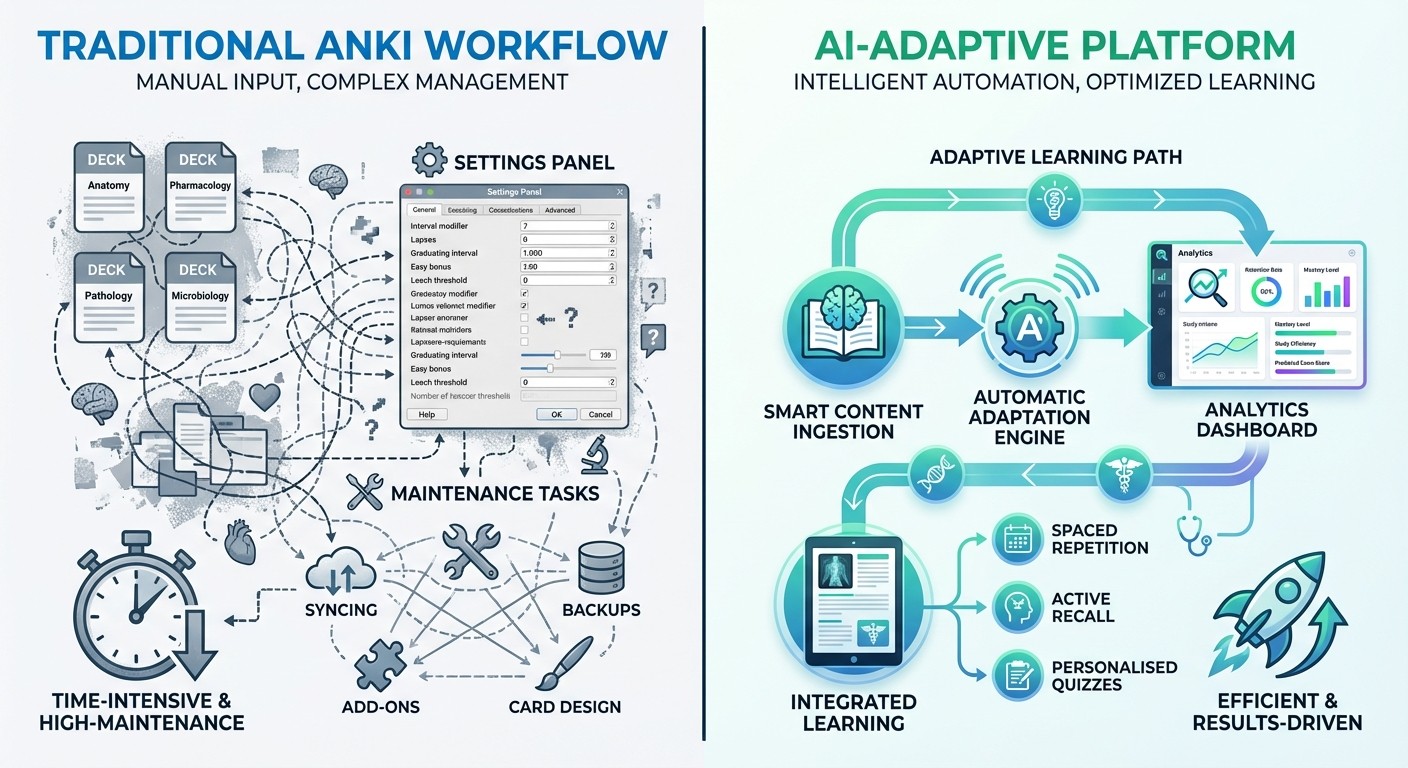
The Hidden Costs of Traditional Anki
While Anki delivers results, the overhead is substantial:
Time Investment Beyond Study Time:
Deck selection and setup: 10-15 hours
Card suspension and customization: 2-3 hours weekly
Troubleshooting and maintenance: 1-2 hours weekly
Managing multiple decks and updates: Ongoing
Cognitive Load Issues:
Manual weak area identification
Deck quality inconsistencies between creators
No integration with question bank performance
Static content that doesn't adapt to your progress
Unlike adaptive platforms, Anki treats all information equally. A card about a rare genetic disorder gets the same algorithmic weight as high-yield cardiology concepts that appear on every practice exam.
Why AI-Adaptive Platforms Are Taking Over
Modern AI platforms address Anki's biggest limitations while preserving the spaced repetition benefits that make flashcards effective.
Real-Time Adaptation vs Static Algorithms
Traditional Anki shows you whatever's scheduled. Oncourse's adaptive question bank automatically identifies weak areas from your question performance and surfaces relevant high-yield content in real time, creating a feedback loop that mirrors actual exam difficulty curves.
Integrated Performance Analytics
While Anki only tracks card reviews, modern platforms map performance across organ systems, disciplines, and NBME-style question formats. Instead of guessing which cardiology topics need more attention, you get precise analytics showing exactly which Step 1 domains require additional focus.
Built-In Spaced Repetition Without Setup Overhead
Oncourse's spaced repetition engine is calibrated specifically to USMLE Step 1 topics, delivering retention benefits without deck hunting, card creation, or quality inconsistencies. You get the neuroplasticity benefits of spaced repetition with zero maintenance time.
How to Transition from Anki to AI-Adaptive Study
Phase 1: Assess Your Current Anki Habit
If you're already deep into an Anki deck:
Check your mature card percentage and daily review burden
Identify which subjects show consistently low retention (under 85%)
Note time spent on maintenance vs actual studying
If you're considering starting Anki:
Skip the 2-week setup phase and test an adaptive platform first
Compare how much Step 1 content you can cover in the same time investment
Phase 2: Hybrid Approach Testing
Many students successfully blend approaches:
Use Anki for subjects where you have working decks with high retention
Switch to adaptive platforms for weak areas identified through question bank performance
Let the AI platform handle new topics you haven't covered yet
The key insight: your study method should adapt to your performance, not force you to adapt to the method.
Common Anki Mistakes That Kill Step 1 Scores
Mistake #1: Treating All Cards Equally
Not all flashcards deserve equal time. High-yield Step 1 topics like heart failure mechanisms, antimicrobial spectra, and vitamin deficiencies appear on every practice exam. Rare genetic syndromes appear once every 200 questions.
Yet standard Anki algorithms give both equal scheduling weight. Smart students either manually suspend low-yield cards or use platforms that automatically prioritize high-yield content.
Mistake #2: The "Completion Trap"
Many students obsess over deck completion percentages instead of actual retention and application. You can have 95% mature cards and still struggle with Step 1 questions if those cards test isolated facts instead of clinical reasoning patterns.
Mistake #3: Ignoring Question Bank Integration
Anki works best when integrated with question practice. Students who only do flashcards without regular UWorld blocks show weaker performance on actual Step 1 questions, which test application more than pure recall.
Mistake #4: Burnout Denial
When daily reviews exceed 400+ cards consistently, students often push through instead of adjusting. This leads to decreased retention, longer study sessions, and ultimately lower Step 1 performance. Sustainable methods beat heroic efforts over months of preparation.
Step 1-Specific Anki Optimization
High-Yield Card Types for Step 1
Clinical Vignette Cards:
Instead of "What causes X?", create cards like "25-year-old with chest pain, elevated troponins, normal coronaries → diagnosis?"
Mechanism-Based Cards:
"ACE inhibitors reduce afterload by blocking angiotensin II formation → decreases SVR" works better than simple drug classification cards.
Differential Diagnosis Cards:
"Acute shortness of breath + clear lungs + elevated JVP → think: PE, MI, tamponade" mirrors Step 1 question stems.
Subject-Specific Strategies
Pharmacology: Focus on mechanism of action and side effect patterns rather than drug names. Step 1 loves questions about "a drug that works by blocking X receptor." Practice with targeted ACE inhibitor flashcards to master these patterns. Pathology: Emphasize gross and microscopic image recognition. Many students underestimate how image-heavy Step 1 has become. Physiology: Create cards that test understanding of normal vs abnormal physiology in clinical contexts, not isolated graph interpretation.
When Anki Still Makes Sense in 2026
Ideal Anki Candidates
You should stick with Anki if you:
Have already built substantial mature card counts (>70% mature) in a high-quality deck
Enjoy the manual control and customization options
Have effective systems for limiting daily review burden
Successfully integrate Anki with regular question practice
When to Skip Anki Entirely
Consider AI-adaptive platforms if you:
Are starting Step 1 prep from scratch
Struggle with deck maintenance and customization
Want automated weak area identification
Prefer integrated question banks and flashcards
Have limited study time and need maximum efficiency
Building Your Step 1 Flashcard Strategy
The Hybrid Approach (Most Effective)
1. Assessment Phase (Week 1):
- Take a comprehensive baseline exam (NBME or equivalent)
- Identify your strongest and weakest organ systems
- Calculate realistic daily study time available
2. Method Selection (Week 2):
- Use Anki for subjects where you already have momentum
- Switch to adaptive platforms for weak areas needing intensive work
- Integrate both with regular question practice
3. Optimization Phase (Ongoing):
- Track retention rates and time investment across methods
- Adjust based on practice exam performance trends
- Maintain consistency rather than perfection
Integration with Question Banks
Regardless of flashcard method, successful Step 1 students maintain a 60/40 split: 60% active question practice, 40% targeted review (flashcards, weak areas, concept reinforcement).
The flashcard method — whether Anki or AI-adaptive — should support question practice, not replace it.
Frequently Asked Questions
How many Anki cards should I do daily for Step 1?
For dedicated Step 1 prep, target 150-300 review cards plus 10-20 new cards daily. If reviews consistently exceed 400 cards, suspend low-yield content or switch to more targeted methods. Total Anki time shouldnt exceed 2-3 hours daily.
Is AnKing deck still worth it in 2026?
Yes, if you can commit to the full setup process and have 6+ months for dedicated preparation. The deck quality and community support remain excellent. However, consider AI-adaptive alternatives if you want immediate productivity without the learning curve.
Can I pass Step 1 without Anki?
Absolutely. Multiple studies show question bank completion rates correlate more strongly with Step 1 performance than flashcard usage. Many successful students use mixed methods: targeted flashcards for weak areas plus intensive question practice.
How long does it take to see results from spaced repetition?
Most students notice improved retention within 2-3 weeks of consistent daily practice. However, the real benefits compound over months. Plan for at least 8-12 weeks of consistent use before major examinations.
Should IMGs use different Anki strategies than US students?
IMGs often benefit from more aggressive new card rates (30-50 daily) during initial content learning phases, then transition to review-heavy schedules. The AnKing deck works well, but consider platforms with built-in explanations if English-language medical education is newer for you.
What's the biggest mistake students make with Step 1 flashcards?
Treating flashcard completion as the goal instead of Step 1 performance. Students get trapped optimizing their Anki metrics while neglecting question practice, clinical reasoning development, and weak area identification from practice exams.
---
The flashcard landscape for USMLE Step 1 has evolved dramatically. While Anki remains powerful for students who master its complexity, AI-adaptive platforms now deliver the same neuroplasticity benefits with significantly less overhead.
Your choice depends on available study time, technical comfort, and learning preferences. Both paths can lead to Step 1 success — the key is choosing one and maintaining consistency over months of preparation.
Prepare smarter with Oncourse AI — adaptive MCQs, spaced repetition, and AI explanations built for USMLE Step 1. Download free on Android and iOS.