Back
PLAB 2 Preparation 2026: Complete Study Guide for IMGs — OSCE Stations, Clinical Skills and How to Pass First Attempt
Master PLAB 2 OSCE stations with this complete study guide for IMGs. Learn clinical skills, communication frameworks, and first-attempt strategies for GMC licensing success in 2026.
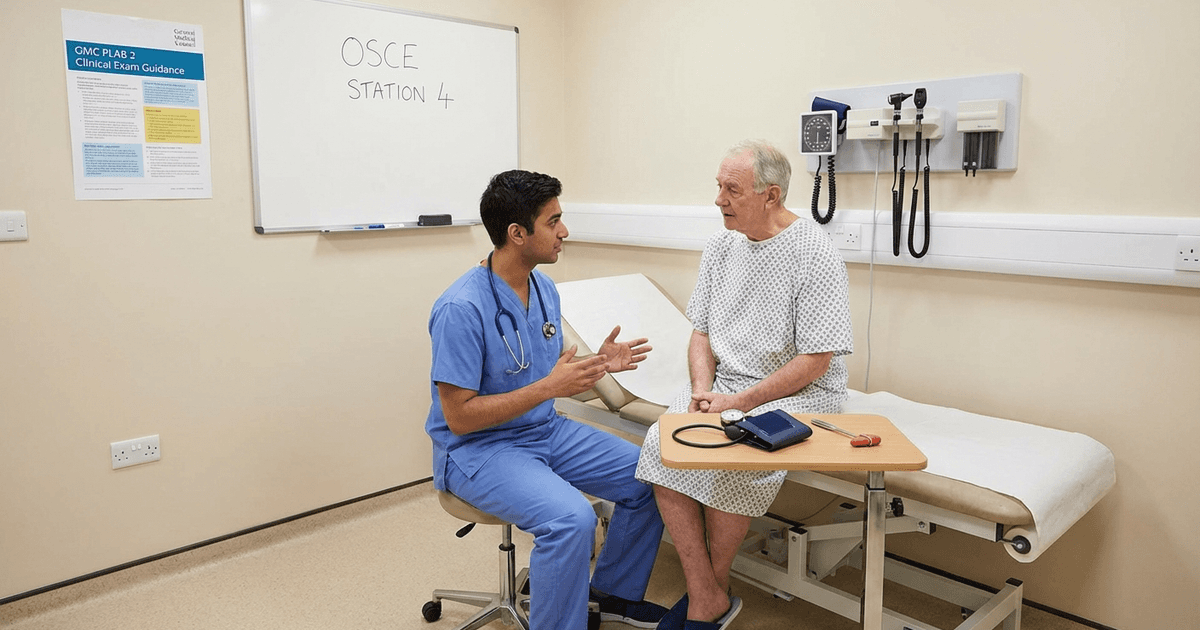
PLAB 2 Preparation 2026: Complete Study Guide for IMGs — OSCE Stations, Clinical Skills and How to Pass First Attempt
You stare at the GMC website, having just passed PLAB 1. The relief is short-lived. Now comes PLAB 2 — 16 clinical stations, 8 minutes each, and your entire UK medical career hanging in the balance.
Unlike the multiple-choice format of PLAB 1, PLAB 2 tests what you actually need to work as a doctor: talking to patients, examining them systematically, and making clinical decisions under pressure. There is no hiding behind theoretical knowledge here.
The pass rate hovers around 70-75%, which means 1 in 4 doctors fail on their first attempt. The difference between passing and failing is not clinical knowledge — most IMGs have that covered. Its the ability to demonstrate competence in a structured 8-minute window while an examiner watches your every move.
This guide breaks down exactly what PLAB 2 tests, how to approach each station type, and the specific skills that separate first-attempt passers from repeat sitters.
What is PLAB 2?
PLAB 2 is the clinical skills component of the GMC licensing pathway for international medical graduates. Its an Objective Structured Clinical Examination (OSCE) consisting of 16 stations, each lasting 8 minutes with 90 seconds between stations to read the next brief.
The exam runs at GMC test centres in Manchester and covers five core areas:
History taking and communication skills
Physical examination techniques
Clinical procedures and practical skills
Prescribing and therapeutics
Data interpretation and clinical reasoning
You need to demonstrate the clinical competence expected of a UK Foundation Year 1 doctor — the level at which you would start working immediately after passing.
PLAB 2 OSCE Station Types
History Taking Stations (3-4 stations)
These stations test your ability to gather relevant clinical information efficiently. You have 8 minutes to take a focused history from a standardized patient presenting with a specific complaint.
Common scenarios:
Chest pain (cardiac vs non-cardiac causes)
Shortness of breath (heart failure, asthma, PE)
Abdominal pain (appendicitis, gallstones, bowel obstruction)
Headache (tension, migraine, red flags)
Back pain (mechanical vs serious pathology)
Key approach:
1. Introduce yourself and confirm patient identity
2. Use open questions initially: "Tell me about the pain"
3. Follow the SOCRATES framework for pain
4. Screen for red flags systematically
5. Ask about ICE (Ideas, Concerns, Expectations)
6. Summarize and check understanding
When practicing history scenarios, Clinical Rounds lets you work through realistic patient encounters with time pressure — exactly what you need to nail the pacing for these 8-minute stations.
Physical Examination Stations (4-5 stations)
You will examine real patients or standardized patients with actual clinical signs. Common examination stations include:
Cardiovascular examination:
Systematic approach: inspection, palpation, auscultation
Comment on findings as you go
Know common murmurs and their significance
Practice on patients with actual pathology
Respiratory examination:
Chest expansion, tactile fremitus, percussion, auscultation
Recognize pleural effusion, consolidation, pneumothorax
Explain significance of findings
Abdominal examination:
Nine regions approach
Palpation technique for masses and organomegaly
Recognize ascites, hernias, bowel sounds
Neurological examination:
Cranial nerves (especially common combinations)
Peripheral nervous system (UMN vs LMN signs)
Cerebellar examination
Gait assessment
The key is developing muscle memory for each examination sequence. Practice until you can perform each routine automatically, freeing your mind to focus on identifying and interpreting findings.
Communication Skills Stations (2-3 stations)
These test your ability to handle sensitive situations with empathy and professionalism.
Breaking bad news:
Use the SPIKES framework:
Setting: Ensure privacy, sit down, make eye contact
Perception: "What is your understanding of your condition?"
Invitation: "Would you like me to explain the results?"
Knowledge: Give information in small chunks
Emotions: Respond to emotional reactions
Strategy: Discuss next steps
Angry or upset patients:
Acknowledge their feelings first
Dont take it personally
Use phrases like "I can see you are frustrated"
Focus on what you can do to help
Set appropriate boundaries if needed
Consent discussions:
Explain procedure in simple terms
Discuss risks, benefits, and alternatives
Check understanding: "Can you tell me what we have discussed?"
Ensure voluntary agreement
If you struggle with communication frameworks, Rezzy can help you understand why certain approaches work — like why acknowledging emotions before providing solutions diffuses tension, or how the ICE framework builds rapport by showing you care about the patient's perspective.
Practical Procedures (2-3 stations)
You will perform common procedures on manikins or volunteer patients.
Common procedures:
IV cannulation
Urethral catheterization
Suturing
Joint injection
Basic life support
Taking blood cultures
ECG interpretation
Key points:
Explain what you are doing throughout
Maintain sterile technique where appropriate
Handle equipment confidently
Know when to stop if complications arise
Prescribing Stations (1-2 stations)
These test safe prescribing practices and drug knowledge.
What you might encounter:
Writing discharge medications
Calculating drug doses (especially in elderly/renal impairment)
Identifying drug interactions
Antimicrobial prescribing
Pain management protocols
Recognizing contraindications
Key principles:
Always check allergies first
Consider renal and hepatic function
Know common drug interactions
Understand when to stop medications
Use generic names, correct doses, and frequencies
For drug doses and contraindications that you keep forgetting, Synapses can help you memorize the high-yield prescribing facts through spaced repetition — so key information like metformin contraindications or digoxin dosing sticks when you need it most.
GMC Marking Criteria: What Examiners Look For
PLAB 2 uses criterion-referenced marking. You need to demonstrate specific competencies, not just perform better than other candidates.
The four marking domains:
Clinical Skills (40%)
Systematic approach to examination
Correct technique and sequence
Recognition of clinical signs
Appropriate use of equipment
Communication Skills (30%)
Professional manner and empathy
Clear explanation of procedures
Appropriate questioning technique
Responding to patient concerns
Professional Behavior (20%)
Respectful interaction with patients
Appropriate dress and conduct
Time management within stations
Ethical decision making
Clinical Knowledge (10%)
Understanding of conditions presented
Appropriate differential diagnosis
Recognition of red flags
Safe prescribing practices
Pass marks:
Each station is marked on a scale, and you need to achieve the pass standard across all domains. There is no official disclosure of exact cut-off scores, but aim for consistent performance rather than trying to excel in some areas while neglecting others.
Common Reasons for PLAB 2 Failure
1. Poor time management
Spending too long on history and running out of time for examination or summary. Practice with strict timers.
2. Ignoring the patient
Focusing on the examiner instead of engaging with the patient. Remember, patient interaction is being assessed.
3. Incomplete examination routines
Skipping steps in standard examinations. Learn complete sequences and practice them religiously.
4. Lack of structure in communication
Rambling explanations or failing to check patient understanding. Use frameworks like SPIKES and ICE.
5. Poor clinical reasoning
Not explaining your thought process or differential diagnosis when asked.
6. Unsafe prescribing
Forgetting to check allergies, using incorrect doses, or missing contraindications.
Study Timeline and Resources
3-4 Month Preparation Plan
Months 1-2: Foundation Building
Master examination routines for all systems
Learn communication frameworks (SPIKES, ICE, Calgary-Cambridge)
Practice basic procedures on manikins
Build prescribing knowledge base
Month 3: Intensive Practice
Book mock OSCE sessions
Practice with standardized patients
Time all practice sessions strictly
Identify and address weak areas
Month 4: Fine-Tuning
Final mock exams
Review high-yield clinical signs
Practice prescribing scenarios
Mental preparation and confidence building
Essential Study Resources
OSCE Practice Books:
"OSCE Cases with Mark Schemes" by Feather, Lumley & Dacre
"Clinical Skills for OSCEs" by Neel Burton
"Pocket OSCEs for Medical Students" by Ryder, Stickley & Black
Online Platforms:
Geeky Medics OSCE guides and videos
Pastest PLAB 2 question bank
YouTube channels: Geeky Medics, Calgary Guide, Osmosis
Mock OSCE Providers:
RCGP online mock OSCEs
Local medical schools (many offer paid mock sessions)
PLAB preparation courses in London
What to Expect on Exam Day
Before the Exam:
Arrive 30 minutes early
Bring GMC appointment letter and photo ID
Dress professionally (business attire, not scrubs)
Eat a good breakfast but avoid heavy meals
During the Exam:
Listen carefully to instructions at each station
Use the 90 seconds between stations to mentally prepare
Stay calm if you make mistakes — dont let one station affect the next
Maintain professional demeanor throughout
Station Management:
Read instructions quickly but thoroughly
Introduce yourself to every patient/actor
Explain what you are doing as you go
Check the time regularly but dont obsess
Summarize findings when appropriate
After PLAB 2: Next Steps
If You Pass:
Apply for GMC registration within 3 months
Start job hunting (Foundation Programme or Trust Grade posts)
Complete mandatory GMC induction when you start work
If You Fail:
Results available 6-8 weeks after exam
Can resit after 6 months minimum
Maximum 4 attempts total
Focus on identified weak areas for next attempt
Consider additional mock OSCE practice
The GMC provides general feedback on performance domains, but not station-by-station breakdowns. Use this to guide your preparation for resits.
Building Confidence for First-Attempt Success
PLAB 2 success is not just about knowledge — its about performing under pressure while maintaining professional standards. Here are the psychological strategies that help:
Practice Realistic Conditions:
Time every practice session strictly
Practice with unfamiliar patients when possible
Simulate exam day stress with mock OSCEs
Record yourself to identify unconscious habits
Develop Routine Responses:
Memorize opening lines for each station type
Practice standard phrases for common situations
Have backup plans when things dont go as expected
Manage Exam Anxiety:
Practice deep breathing techniques
Visualize successful performance
Focus on one station at a time
Remember that minor mistakes wont fail you
Frequently Asked Questions
How long should I prepare for PLAB 2?
Most successful candidates prepare for 3-4 months of intensive study. If you are working clinically, you might need longer. The key is consistent practice rather than cramming.
Can I pass PLAB 2 without clinical experience in the UK?
Yes, but its harder. The exam tests UK clinical standards and communication styles. Consider observing in UK hospitals or doing clinical attachments if possible.
What happens if I fail one domain but pass others?
You need to achieve the pass standard in all four domains. Failing any single domain means failing overall, regardless of performance in other areas.
Should I focus more on clinical knowledge or communication skills?
Communication skills carry more weight (30% vs 10% for pure knowledge). Many candidates with excellent clinical knowledge fail due to poor patient interaction or unclear explanations.
How many mock OSCEs should I do?
Aim for at least 3-4 complete mock OSCE circuits (16 stations each) in your final month. More is better if you can afford it — the exam format becomes familiar and less intimidating.
Is PLAB 2 harder than medical school OSCEs?
PLAB 2 expects Foundation Year 1 competence, which is higher than most medical school finals. The time pressure (8 minutes per station) is also more intense than many university OSCEs.
PLAB 2 preparation requires systematic practice across all clinical skills domains. The candidates who pass first attempt dont necessarily know more medicine — they execute clinical skills more reliably under exam conditions. Start with solid examination routines, layer on communication frameworks, and practice intensively with realistic time constraints.
Prepare smarter with Oncourse AI — adaptive MCQs, spaced repetition, and AI explanations built for UKMLA success. Download free on Android and iOS.