NEET PG Mock Test 2026: How Oncourse Benchmark Tests Accelerate Your Prep
Discover why Oncourse Benchmark Tests are the game-changer for NEET PG 2026 prep. Get detailed score analysis, weak area identification, and personalized study paths.

NEET PG Mock Test 2026: How Oncourse Benchmark Tests Accelerate Your Prep
You are probably scrolling through endless mock test options, wondering which one actually mirrors the real NEET PG experience. Here's the reality: NEET PG has 200 questions. You have exactly 63 seconds per question. The pressure is real, the stakes are high, and most mock tests dont prepare you for what actually matters.
Generic mock tests give you scores. They dont tell you why you missed that pharmacology question or how you compare to thousands of other aspirants taking the same test. They definitely dont build a study plan based on your specific gaps.
That's where Oncourse Benchmark Tests change everything.
Why Generic Mock Tests Fall Short for NEET PG Prep
Most NEET PG mock tests are built like practice worksheets, not exam simulators. They miss the crucial elements that make or break your actual exam performance.
The Interface Problem
Real NEET PG happens on a computer screen with specific navigation patterns. You cant go back to previous questions once you move forward in certain sections. The clock ticks differently. The pressure builds differently. Generic tests use basic web forms that feel nothing like the actual NBE interface.
The Question Quality Gap
Random question banks pull from outdated sources or create questions that sound medical but miss the NEET PG pattern entirely. Real NEET PG questions have a specific structure: clinical vignettes that test application, not just recall. They integrate multiple subjects in single questions. They use specific language patterns that you need to recognize under time pressure.
The Analysis Void
Traditional mock tests give you a score percentage and maybe subject-wise breakdowns. They dont tell you that you consistently struggle with pharmacokinetics questions when they appear in surgery contexts, or that you lose time on image-based pathology questions. They cant tell you that your accuracy drops after the 150th question when fatigue sets in.
Without granular analysis, you end up studying everything instead of focusing on what actually needs work. That's not efficient when you have months, not years.
What Makes Oncourse Benchmark Tests Different
Oncourse Benchmark Tests are full-length NEET PG simulations built from the ground up to mirror real exam conditions. Every question follows NBE patterns. Every interface element matches exam day reality. Every timing constraint matches what you'll face on August 30th.
The questions come from analyzing thousands of previous NEET PG papers, not generic medical textbooks. Each question integrates multiple concepts the way real NEET PG does. Clinical scenarios that test your ability to apply knowledge under pressure, not just memorize facts.
But the real difference starts after you submit the test.
Real-Time Exam Conditions
When you take an Oncourse Benchmark Test, you experience the same time pressure, the same navigation constraints, and the same fatigue curve that hits during the actual exam. Questions are sequenced to match NEET PG difficulty progression. Image questions load at realistic speeds. The interface responds exactly like the NBE system.
Your brain builds the muscle memory for exam day. You develop timing instincts that only come from repeated exposure to realistic conditions. When exam day arrives, everything feels familiar instead of foreign.
The Post-Test Analytics That Actually Matter
Here's where Oncourse transforms mock testing from score checking into strategic preparation.
Subject-Wise Accuracy Deep Dive
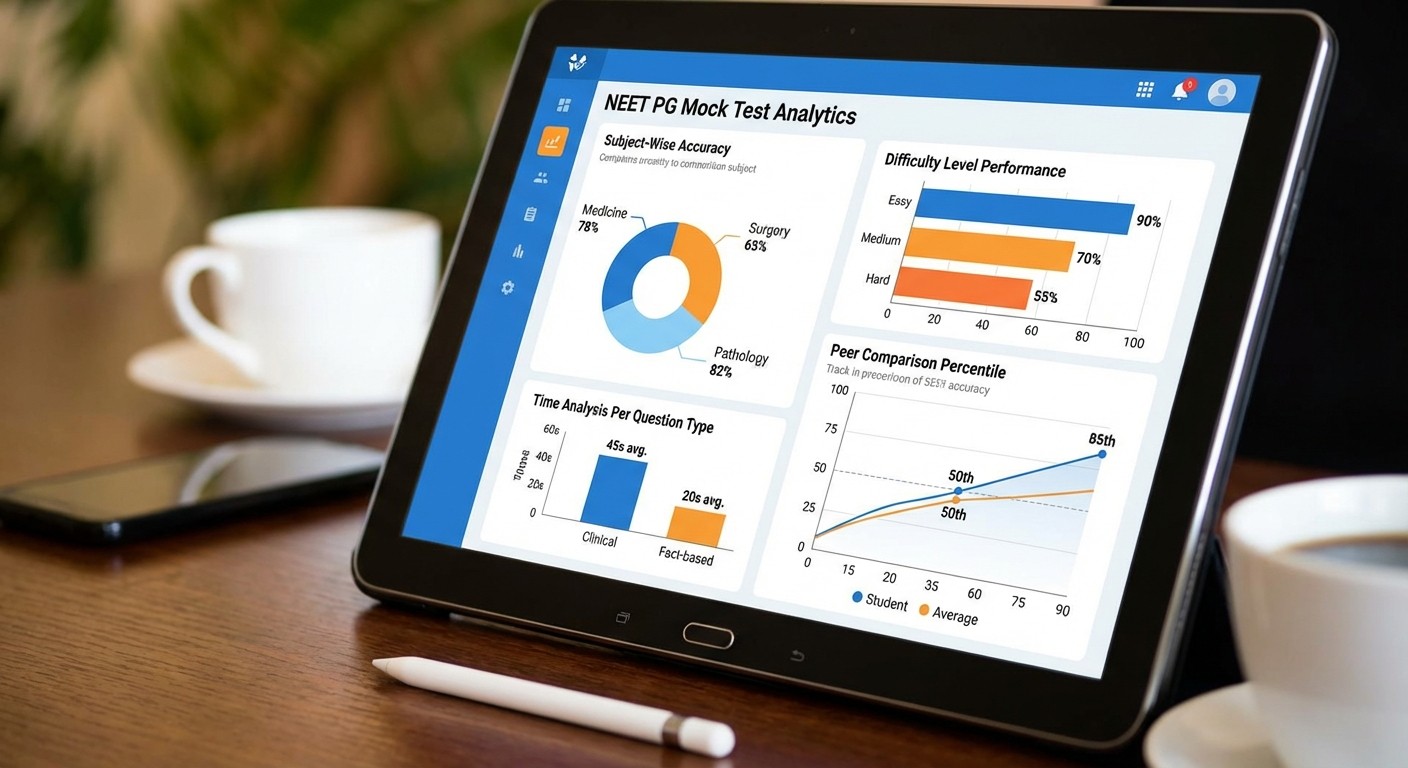
After each Benchmark Test, you get a complete breakdown showing accuracy rates across all 19 NEET PG subjects. But it goes deeper than percentages. You see which topics within each subject caused the most trouble, which question types tripped you up, and which clinical scenarios you handled well.
For example, you might discover that your pharmacology accuracy is 67% overall, but it drops to 43% when pharmacology questions appear in surgery contexts. That's actionable intelligence you cant get from generic score reports.
Time Analysis Per Question Type
The system tracks exactly how long you spent on each question category. Maybe you're spending 2 minutes on straightforward anatomy questions but rushing through complex clinical scenarios in 45 seconds. The data shows you where your time allocation needs adjustment.
Real NEET PG success depends on time management as much as knowledge. Oncourse's Post-Test Analytics help you build an optimal pacing strategy specific to your strengths and weaknesses.
Difficulty Level Performance Mapping
Each question in the Benchmark Test is calibrated to match NEET PG difficulty levels. Your results show performance across easy, moderate, and difficult questions. This reveals crucial patterns: Are you missing easy questions due to carelessness? Are you spending too much time on impossible questions while missing moderate ones you could have solved?
Peer Benchmarking: Where You Stand vs Other Aspirants
One of the most valuable features of Oncourse Benchmark Tests is peer comparison data. After each test, you see exactly where you rank among thousands of other NEET PG 2026 aspirants using the platform.
Percentile Rankings by Subject
You get percentile rankings for each subject area, showing whether your medicine knowledge puts you in the top 10% or if your surgery preparation needs urgent attention. These rankings update in real-time as more students take the same test, giving you current competitive positioning.
Question-Level Peer Performance
For each question you missed, you can see what percentage of other test-takers got it right. This helps identify truly difficult questions (that most people missed) versus questions you should have known (that 80% of others got correct).
Trend Analysis Over Time
As you take multiple Benchmark Tests, the system builds a trend analysis showing how your performance evolves relative to the peer group. Are you gaining ground in weak subjects? Are you maintaining your lead in strong areas? This long-term view helps you adjust strategy as exam day approaches.
Personalized Study Paths Based on Your Results
The most powerful aspect of Oncourse Benchmark Tests is what happens after the analysis: targeted study recommendations that adapt to your specific performance patterns.
Weak Area Targeting
Based on your test results, Oncourse surfaces specific lessons, questions, and flashcards for your weak areas. Not generic recommendations—precise targeting based on the exact topics and question types where you lost marks.
If you struggled with endocrine pathology questions, the system will direct you to targeted pharmacology lessons and pathology practice questions that address your specific gaps. You dont waste time reviewing concepts you already know.
High-Yield Revision Modules
The Personalized Study Paths identify high-impact revision opportunities: topics that appear frequently in NEET PG and where small improvements in your accuracy could significantly boost your overall score. These arent necessarily your worst subjects—they're the areas where focused effort yields maximum return.
Adaptive Question Recommendations
Instead of random practice questions, you get curated MCQ sets designed around your performance patterns. More questions in areas where you need reinforcement, fewer in subjects where you're already strong. The adaptive algorithm ensures every practice question serves a specific purpose in addressing your benchmark test results.
Building Your Targeted Revision Plan
Your Benchmark Test results become the foundation for a data-driven revision strategy that maximizes your remaining prep time.
The 70-20-10 Rule Applied
Based on your test analytics, allocate your study time using the 70-20-10 framework: 70% on identified weak areas, 20% on maintaining strong subjects, and 10% on new topics. Your Benchmark Test results tell you exactly which subjects fall into each category.
Question Type Prioritization
If your results show consistent struggles with image-based pathology questions, prioritize visual learning resources and image question practice. If clinical reasoning questions trip you up, focus on case-based learning modules. Let the data guide your study method choices.
Progressive Difficulty Targeting
Use your difficulty level performance to structure practice sessions. If you're missing too many moderate-level questions, theres no point attempting the hardest questions yet. Build competency systematically based on your current performance profile.
The Compounding Effect of Repeated Benchmarking
Taking Benchmark Tests regularly creates a compounding improvement effect that goes beyond knowledge accumulation.
Exam Temperament Development
Each full-length test builds your mental stamina for the 3.5-hour exam marathon. You develop strategies for maintaining focus when fatigue sets in around question 150. You learn to manage anxiety when encountering difficult question clusters.
The confidence that comes from completing multiple realistic simulations is invaluable on exam day. Nothing rattles you because you have experienced every scenario multiple times.
Pattern Recognition Acceleration
Repeated exposure to NEET PG-style questions helps your brain recognize patterns faster. You start identifying question types within seconds, not minutes. You develop intuition for eliminating obviously wrong options quickly, leaving more time for challenging questions.
Strategic Iteration Based on Data
Each Benchmark Test provides new data to refine your strategy. Maybe your accuracy improves but your timing gets worse, indicating you need speed practice. Maybe your weak subjects improve but you develop gaps in previously strong areas, suggesting you need maintenance practice.
This iterative improvement based on objective data is impossible with traditional study methods. You make decisions based on performance evidence, not gut feelings about your preparation.
Long-Term Progress Tracking
The cumulative data from multiple Benchmark Tests reveals your preparation trajectory over months. You can see which interventions worked (sudden improvement after focused pathology revision) and which didn't (no improvement despite increased study hours in certain subjects).
This longitudinal view helps you adjust strategies with confidence and avoid preparation approaches that aren't delivering results.
Maximizing Your Benchmark Test Strategy
To get the most value from Oncourse Benchmark Tests, treat them as strategic checkpoints rather than random practice sessions.
Optimal Testing Frequency
Take a Benchmark Test every 10-14 days throughout your preparation. This frequency gives you enough time to implement study plan changes between tests while maintaining consistent performance monitoring. Taking them too frequently becomes exhausting; too infrequently provides insufficient feedback for course correction.
Pre-Test Preparation
Approach each Benchmark Test like the real exam. Get adequate sleep the night before. Take the test at the same time of day as your actual exam slot. Use the same physical setup you plan for exam day. This consistency builds reliable performance patterns.
Post-Test Analysis Protocol
Spend at least 2 hours analyzing each Benchmark Test result. Go question by question through your incorrect answers. Understand not just the right answer, but why you chose the wrong one. Update your revision flashcards based on missed concepts.
The analysis is as important as taking the test. Without thorough review, you miss the learning opportunities that make the test valuable.
Integration with Your Overall Prep Strategy
Benchmark Tests work best when integrated with your daily study routine, not treated as separate activities.
Daily Practice Questions
Between Benchmark Tests, focus on targeted question practice in your weak areas identified by previous test results. Use Oncourse's subject-specific question banks to build competency systematically.
Concept Reinforcement
When Benchmark Test results identify knowledge gaps, go back to foundational learning through targeted lessons. Don't just practice more questions in weak areas—ensure you understand the underlying concepts.
Spaced Repetition Implementation
Use your Benchmark Test error patterns to guide spaced repetition focus. Concepts you missed on multiple tests need more frequent review cycles. Strong areas can be reviewed less frequently, maintaining your knowledge without over-studying.
Frequently Asked Questions
How often should I take NEET PG mock tests during preparation?
Take a full-length Benchmark Test every 10-14 days throughout your preparation. This frequency provides sufficient feedback for strategy adjustments while giving you time to implement changes between tests. In the final month, increase frequency to weekly.
What's the difference between Oncourse Benchmark Tests and other mock tests?
Oncourse Benchmark Tests mirror actual NEET PG exam conditions exactly—same interface, timing, navigation constraints, and question quality. Most importantly, they provide detailed analytics showing your weak areas, peer comparisons, and personalized study recommendations that other platforms cant match.
How many mock tests should I take before NEET PG 2026?
Aim for 15-20 full-length Benchmark Tests throughout your preparation period. This gives you enough data to identify patterns and track improvement while building exam temperament. Quality analysis of fewer tests is better than taking many tests without proper review.
Can mock test scores predict my actual NEET PG performance?
Oncourse Benchmark Tests are highly predictive when taken under realistic conditions. The score correlation with actual NEET PG results is strong, but remember that test performance improves with practice. Focus on the trend in your scores rather than individual test results.
Should I focus on mock tests or concept study in the final months?
Balance both based on your Benchmark Test results. If you're missing questions due to knowledge gaps, prioritize concept study. If you know the material but struggle with timing or question interpretation, focus more on practice tests and question-solving techniques.
What if my mock test scores are not improving despite regular practice?
Analyze your Benchmark Test results to identify whether the issue is knowledge gaps, timing problems, or test-taking strategy. Often, scores plateau when you're studying inefficiently. Use the personalized study paths to target your actual weak areas rather than studying broadly.
Transform Your NEET PG Prep with Strategic Mock Testing
NEET PG 2026 success depends on more than knowledge accumulation—it requires strategic preparation guided by objective performance data. Oncourse Benchmark Tests provide that data, along with the analysis and personalized recommendations that turn mock testing from score checking into strategic advantage.
Every Benchmark Test is a stepping stone toward exam day confidence. The detailed analytics, peer comparisons, and adaptive study recommendations ensure that your preparation time is invested in the areas that matter most for your success.
Prepare smarter with Oncourse AI—adaptive MCQs, spaced repetition, and AI explanations built for NEET PG. Download free on Android and iOS.