Back
INICET Preparation 2026: Complete Subject-Wise Strategy, High-Yield Topics and Study Plan for Toppers
Master INICET 2026 with this comprehensive preparation guide. Subject-wise strategies, high-yield topics, realistic study plans, and first-attempt success strategies for AIIMS PG entrance.

INICET Preparation 2026: Complete Subject-Wise Strategy, High-Yield Topics and Study Plan for Toppers
You are probably staring at 18 subjects spread across your MBBS curriculum, wondering how to crack INICET 2026 in the time you have left. The Institute of National Importance Combined Entrance Test isnt just another PG entrance—its your gateway to AIIMS, JIPMER, PGIMER, and NIMHANS. These are seats that can change your medical career trajectory.
INICET has 200 questions. You get 180 minutes total, divided into 4 sections of 45 minutes each. The kicker? Once you submit a section, theres no going back. Every correct answer gets you +1 mark, but wrong answers cost you 1/3 mark. The exam happens twice a year, and for July 2026 session, the exam date is May 16, 2026.
If you have attempted NEET-PG before, you already know 80% of what INICET tests. The difference? INICET loves clinical vignettes and image-based questions. While NEET-PG might ask you about drug mechanisms, INICET shows you a patient scenario and asks for the best management. This is why your preparation strategy needs to be different.
What Makes INICET Different From NEET-PG
INICET isnt just testing your memory—its testing your clinical thinking. The exam pattern shows this clearly:
Aspect | INICET | NEET-PG |
|---|---|---|
Questions | 200 MCQs | 200 MCQs |
Duration | 180 minutes (4 sections × 45 min) | 210 minutes |
Negative marking | -1/3 for wrong answers | -1 for wrong answers |
Question type | Heavy on clinical vignettes | More direct recall |
Image-based | 25-30% questions | 15-20% questions |
Seats | ~1,400 seats | ~10,000+ seats |
The sectional time limit is what catches most students. You cant spend 2 hours on the first two sections and rush through surgery. Time management isnt optional—its survival.
INICET Subject-Wise Weightage: Where Your Marks Come From
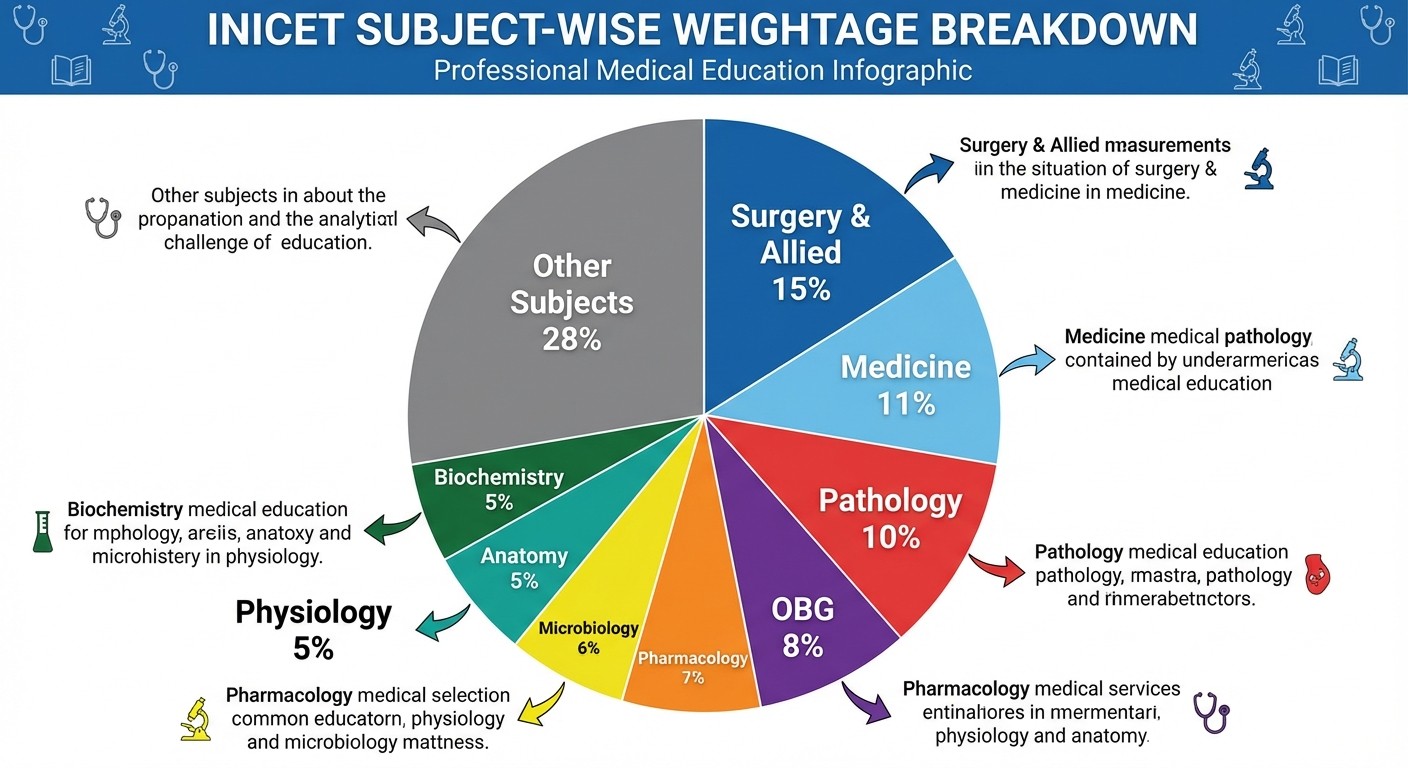
Understanding subject weightage helps you prioritize your preparation time. Based on analysis of recent INICET papers, heres where your questions come from:
Subject | Questions | Percentage | Priority Level |
|---|---|---|---|
Medicine | 22 | 11% | High |
Surgery & Allied | 30 | 15% | High |
OBG | 16 | 8% | High |
Pathology | 20 | 10% | High |
Pharmacology | 14 | 7% | Medium |
Microbiology | 12 | 6% | Medium |
Anatomy | 10 | 5% | Medium |
Physiology | 10 | 5% | Medium |
Biochemistry | 10 | 5% | Medium |
Pediatrics | 10 | 5% | Medium |
Others | 46 | 23% | Mixed |
The "Others" category includes ENT, Ophthalmology, Orthopedics, Anesthesia, Radiology, Forensic Medicine, and PSM. Each contributes 3-6 questions.
Your strategy should be: nail the high-weightage subjects first, then fill gaps in medium-weightage ones. If you can score 80% in Medicine, Surgery, OBG, and Pathology alone, thats 70+ marks—enough to get you in the game.
High-Yield Topics: What INICET Actually Tests
Medicine (22 Questions - 11%)
Image-heavy areas:
ECG interpretation (STEMI, NSTEMI, arrhythmias)
Chest X-rays (pneumonia patterns, pleural effusion)
Endocrine disorders (thyroid function tests interpretation)
Clinical scenarios:
Acute coronary syndromes management
Heart failure staging and treatment
Diabetes complications and management
Respiratory failure and ventilation
Poisoning antidotes and management
Using adaptive MCQ practice helps you drill these scenarios repeatedly until pattern recognition becomes automatic.
Surgery & Allied (30 Questions - 15%)
This includes general surgery, orthopedics, ENT, ophthalmology, and anesthesia.
Surgery (12-15 questions):
Acute abdomen differentials
Trauma management (ATLS protocols)
Wound healing and complications
GI bleeding sources and management
Appendicitis vs other causes of RIF pain
Orthopedics (4-5 questions):
Fracture classifications (especially femur, humerus)
Joint dislocations management
Compartment syndrome
ENT (3-4 questions):
Hearing loss types and Weber/Rinne tests
Epistaxis management
Throat infections
Ophthalmology (3-4 questions):
Red eye differentials
Glaucoma vs cataract
Fundus findings
Anesthesia (3-4 questions):
ASA classification
Local anesthesia complications
Airway management
OBG (16 Questions - 8%)
Obstetrics (8-10 questions):
Antepartum hemorrhage causes
Pre-eclampsia management
Normal vs abnormal labor
Fetal monitoring interpretation
Gynecology (6-8 questions):
Menstrual disorders
Contraception methods and complications
Pelvic inflammatory disease
Ovarian cyst complications
Pathology (20 Questions - 10%)
Systemic pathology:
Neoplasia (staging, grading, metastasis)
Inflammation (acute vs chronic)
Cell injury and death
Immunopathology basics
Organ-specific:
CVS pathology (atherosclerosis, MI changes)
Respiratory pathology (COPD, lung cancers)
GIT pathology (inflammatory bowel disease)
Renal pathology (glomerulonephritis types)
When studying pathology concepts, cross-referencing with detailed pathology lessons helps connect microscopic findings to clinical presentations.
Pharmacology (14 Questions - 7%)
High-yield drug classes:
Cardiovascular drugs (ACE inhibitors, beta-blockers, diuretics)
Antibiotics (mechanism, spectrum, resistance)
CNS drugs (antipsychotics, antidepressants)
Endocrine drugs (insulin types, thyroid medications)
Adverse effects and contraindications:
Drug interactions
Pregnancy category classifications
Organ-specific toxicity
Microbiology (12 Questions - 6%)
Bacteriology:
Gram-positive vs gram-negative identification
Antibiotic sensitivity patterns
Hospital-acquired infections
Virology:
Hepatitis viruses comparison
HIV stages and opportunistic infections
Respiratory viral infections
Parasitology:
Malaria species and treatment
Intestinal parasites
Vector-borne diseases
6-Month INICET Study Plan: The Complete Roadmap
Months 1-2: Foundation Building
Daily schedule: 8-9 hours
Morning (3 hours): High-yield subjects (Medicine/Surgery alternate days)
Afternoon (2 hours): Medium-yield subjects (Pathology/Pharmacology)
Evening (2 hours): Basic sciences (Anatomy/Physiology/Biochemistry)
Night (1 hour): MCQ practice (50 questions daily)
Week-wise breakdown:
Week 1-2: Complete Medicine (cardiovascular, respiratory systems)
Week 3-4: Complete Surgery basics (trauma, acute abdomen)
Week 5-6: Complete Pathology (neoplasia, inflammation)
Week 7-8: Complete Pharmacology (cardiovascular, CNS drugs)
Months 3-4: Integration Phase
Daily schedule: 9-10 hours
Morning (3 hours): Clinical subjects with case-based learning
Afternoon (2 hours): Microbiology and Parasitology
Evening (2 hours): OBG and Pediatrics
Night (2-3 hours): MCQ practice (100 questions daily)
During this phase, using Oncourse's adaptive question bank becomes crucial. You can filter questions by subject, track your weak areas, and get progressively harder questions as your accuracy improves—essentially creating a personalized gap-analysis study path.
Months 5-6: Mastery and Mock Tests
Daily schedule: 10-12 hours
Morning (4 hours): Weak subject reinforcement
Afternoon (3 hours): Image-based question practice
Evening (2 hours): Grand tests and analysis
Night (3 hours): Revision of high-yield points
Mock test strategy:
Month 5: 2 full-length tests per week
Month 6: 1 test every alternate day
Target accuracy: 75%+ overall, 80%+ in high-weightage subjects
3-Month Crash Plan: Maximum Impact Preparation
If you have 3 months left, focus becomes critical. Heres the accelerated approach:
Month 1: High-Yield Focus (70% time allocation)
Medicine: 25% of study time
Surgery: 20% of study time
Pathology: 15% of study time
OBG: 10% of study time
Month 2: Integration + Weak Areas (20% theory, 80% practice)
Daily MCQ practice: 150 questions
Weekly grand tests: 3 full-length
Error analysis: 2 hours daily
Month 3: Final Polish (90% revision, 10% new content)
High-yield point revision
Image-based question drills
Time management practice
When analyzing your mock test performance, Oncourse's performance analytics provides subject-wise accuracy charts and percentile comparisons with other INICET aspirants. You can see exactly which subjects drag your score down and how much time to reallocate in the final weeks.
1-Month Final Strategy: The Last Mile
With 30 days left, your approach changes completely:
Week 1: Diagnostic Assessment
Take 3 full-length mocks
Identify your top 3 weak subjects
Calculate minimum scores needed per section
Week 2: Targeted Improvement
Focus 60% time on weak subjects
40% time on revision of strong subjects
Practice image-based questions daily
Week 3: Speed and Accuracy
Daily sectional tests (45 minutes each)
Time management drills
Clinical case scenario practice
Week 4: Peak Performance
Light revision only
One mock test every 2 days
Focus on exam day simulation
Grand Test Strategy: Making Mocks Count
Most students take mocks but dont analyze them properly. Heres how to make them count:
Before the Mock
Simulate exam conditions completely
Keep 4 sections of 45 minutes each
No breaks between sections
During Analysis (spend 2x test time on this)
1. Section-wise breakdown: Calculate accuracy per section 2. Subject-wise analysis: Which subjects are consistently weak? 3. Question type analysis: Struggling with images or clinical cases? 4. Time management: Did you rush any section?
After Analysis
Create targeted study sessions for weak areas
Practice similar question types
Time management adjustments for next mock
Each wrong answer becomes a learning opportunity when paired with AI-powered explanations that link the concept to INICET exam patterns. This helps convert "why I got it wrong" into lasting memory rather than rote re-reading.
Common Mistakes Toppers Avoid
1. Starting Without a Clear Blueprint
Mistake: Jumping between subjects randomly based on mood. Solution: Create a weekly subject schedule and stick to it. Medicine on Monday, Surgery on Tuesday, Pathology on Wednesday—make it predictable.
2. Ignoring the Sectional Time Constraint
Mistake: Practicing questions without 45-minute section limits. Solution: Every practice session should be sectional. Train your brain for the actual exam rhythm.
3. Over-relying on Theory
Mistake: Reading textbooks extensively but avoiding MCQ practice. Solution: 70% MCQ practice, 30% theory. INICET tests application, not memory.
4. Neglecting Image-Based Questions
Mistake: Focusing only on text-based MCQs. Solution: Dedicate 30 minutes daily to image interpretation—X-rays, ECGs, histopathology slides, clinical photographs.
5. Not Tracking Performance Metrics
Mistake: Taking mocks without analyzing trends. Solution: Maintain a spreadsheet tracking subject-wise accuracy over time. Look for patterns.
Balancing Theory Revision with Question Practice
The golden ratio for INICET is 30:70 (theory:practice). Heres how to structure it:
Daily Theory Time (30%)
Morning fresh hours: Complex topics like pathophysiology
Use active recall: Close the book and explain concepts aloud
Link to clinical scenarios: Always ask "How would this present in a patient?"
Daily Practice Time (70%)
Sectional practice: 45-minute focused sessions
Mixed practice: Random questions across subjects
Weakness targeting: Extra practice in identified weak areas
Weekly Balance
Monday-Wednesday: Heavy theory with light practice
Thursday-Friday: Balanced theory and practice
Saturday-Sunday: Heavy practice with theory as needed
The key is connecting what you read to what you practice. When you encounter a pharmacology question about beta-blocker side effects, you should immediately recall not just the textbook list, but also patient scenarios where youd see these effects.
Revision Strategy: Making It Stick
Spaced Repetition Schedule
Day 1: Learn new topic
Day 3: Quick review
Day 7: Detailed revision
Day 21: Final reinforcement
Using spaced repetition flashcards helps cement high-yield facts in long-term memory. The algorithm shows you cards just before you're about to forget them, maximizing retention efficiency.
High-Yield Point Creation
Create one-page summaries for each subject containing:
Top 10 most-asked topics
Key differentials
Treatment protocols
Image findings
Active Recall Testing
Instead of passive reading:
Use blank paper to recreate topic flowcharts
Teach concepts to study partners
Create your own MCQs
Technology Integration: Smart Preparation Tools
Digital Question Banks
Filter questions by subject and difficulty
Track accuracy trends over time
Focus on INICET-pattern questions specifically
Image Recognition Apps
Practice ECG interpretation daily
Histopathology slide recognition
Radiology finding identification
Performance Tracking
Subject-wise accuracy monitoring helps identify exactly where to focus your limited time. When you see your Medicine accuracy stuck at 65% while Surgery is at 80%, you know where the next week's effort should go.
Mental Preparation: The Psychological Edge
Stress Management
Regular exercise (30 minutes daily)
Adequate sleep (7-8 hours minimum)
Meditation or breathing exercises
Exam Day Simulation
Practice with computer-based format
Simulate the 4-section timing
Handle technical glitches calmly
Confidence Building
Focus on improvement trends, not absolute scores
Celebrate small victories (subject mastery milestones)
Remember your clinical knowledge is solid—INICET tests application
Frequently Asked Questions
How many months are needed to prepare for INICET 2026?
With dedicated preparation, 6 months is optimal for comprehensive coverage. However, 3 months can work if you have a strong MBBS foundation and focus on high-yield topics. Students with previous PG exam experience can manage with 2-3 months of focused preparation.
What is the minimum score to qualify for INICET counseling?
General category candidates need 50th percentile, while reserved category candidates need 45th percentile. In recent sessions, this translates to approximately 120+ marks for general category and 110+ marks for reserved categories.
Should I focus more on AIIMS PG or INICET pattern questions?
INICET questions are more clinical and case-based compared to NEET-PG. Focus on vignette-style questions, image interpretation, and clinical reasoning rather than pure recall-based MCQs.
How important are mock tests for INICET preparation?
Mock tests are critical—they simulate the sectional time pressure and help identify weak areas. Take at least 15-20 full-length mocks in your final 2 months, analyzing each thoroughly.
Can I crack INICET while working as an intern?
Yes, but time management becomes crucial. Focus on high-yield subjects during peak energy hours, use clinical exposure to reinforce theoretical concepts, and maintain consistent daily study hours even if limited.
What percentage accuracy should I target in mock tests?
Aim for 75%+ overall accuracy in your final month. Break this down as: 80%+ in high-weightage subjects (Medicine, Surgery, OBG, Pathology) and 70%+ in others.
INICET 2026 rewards clinical thinking over rote memorization. Your MBBS foundation is strong—now its about applying that knowledge efficiently under time pressure. Focus on high-yield subjects, practice clinical scenarios daily, and simulate exam conditions regularly.
Prepare smarter with Oncourse AI—adaptive MCQs, spaced repetition, and AI explanations built for INICET. Download free on Android and iOS.