USMLE Step 2 CK Preparation: Complete Strategy, Study Timeline, and High-Yield Topics for US Medical Students (2026)
Master USMLE Step 2 CK with this comprehensive guide for US medical students. Covers optimal study timelines, high-yield topics, resource strategies, and common mistakes to avoid in 2026.

USMLE Step 2 CK Preparation: Complete Strategy, Study Timeline, and High-Yield Topics for US Medical Students (2026)
You're halfway through clerkships, shelf exams are behind you, and now everyone's asking: "When are you taking Step 2 CK?"
The question hits different for US students. You're not cramming basic sciences like Step 1 — you've been living clinical medicine for months. Step 2 CK tests whether you can think like a doctor under pressure, not whether you memorized every pathway in First Aid.
Here's what matters: Step 2 CK has 318 questions testing clinical reasoning across every major specialty. You'll see 20 questions per 30-minute block starting May 7, 2026. The format change means faster pacing — 90 seconds per question instead of the previous 90 seconds.
Most US students spend 4-8 weeks on dedicated preparation. The sweet spot? Six weeks for average performers, four weeks if your shelf scores were consistently above 75th percentile. This guide breaks down exactly how to structure that time.
What Step 2 CK Actually Tests (Clinical Reasoning, Not Recall)
Step 2 CK doesn't care if you memorized every antibiotic. It cares whether you can read a clinical vignette, identify the next best step, and pick the right management for a specific patient scenario.
The exam tests three core competencies:
Initial workup and diagnosis (35% of questions)
Continued care and monitoring (30% of questions)
Scientific concepts and mechanisms (35% of questions)
Unlike shelf exams that focus heavily on one specialty, Step 2 CK integrates knowledge across disciplines. You'll see internal medicine mixed with psychiatry, surgery combined with ethics, and pediatric cases requiring adult medicine knowledge.
The clinical vignettes are longer and more complex than shelf questions. Expect 4-6 sentence patient presentations with vital signs, lab values, and imaging findings. The answer choices test clinical judgment, not pattern recognition.
When to Start: Timeline for US Medical Students
Start planning during your penultimate clerkship — typically around month 8-9 of third year. Book your test date 6-8 weeks before you want to take it, especially if targeting peak dates in late spring.
Optimal Timing Windows:
March-May 2026: Peak season for fourth years applying for residency
June-August 2026: Good for students taking a gap year or research year
September-November 2026: Final window before ERAS submission
Most successful students take Step 2 CK after completing their core clerkships but before fourth year begins. This timing lets you use fresh clinical knowledge while having dedicated study time.
Red flag timing: Taking Step 2 CK during fourth year while managing interviews and residency applications. The cognitive load becomes overwhelming.
Dedicated Study Period: 4-8 Week Range Strategy
4-Week Intensive (For Strong Clinical Performers)
If your shelf scores averaged 75th percentile or higher, four weeks of focused preparation can be sufficient. This timeline requires 8-10 hours daily with zero wasted time.
Week 1-2: Complete UWorld first pass (80 questions/day) Week 3: UWorld incorrects + NBME Clinical Science Mastery Series Week 4: Final review + practice exams
6-Week Standard (Most US Students)
The most common and successful timeline for average to above-average students.
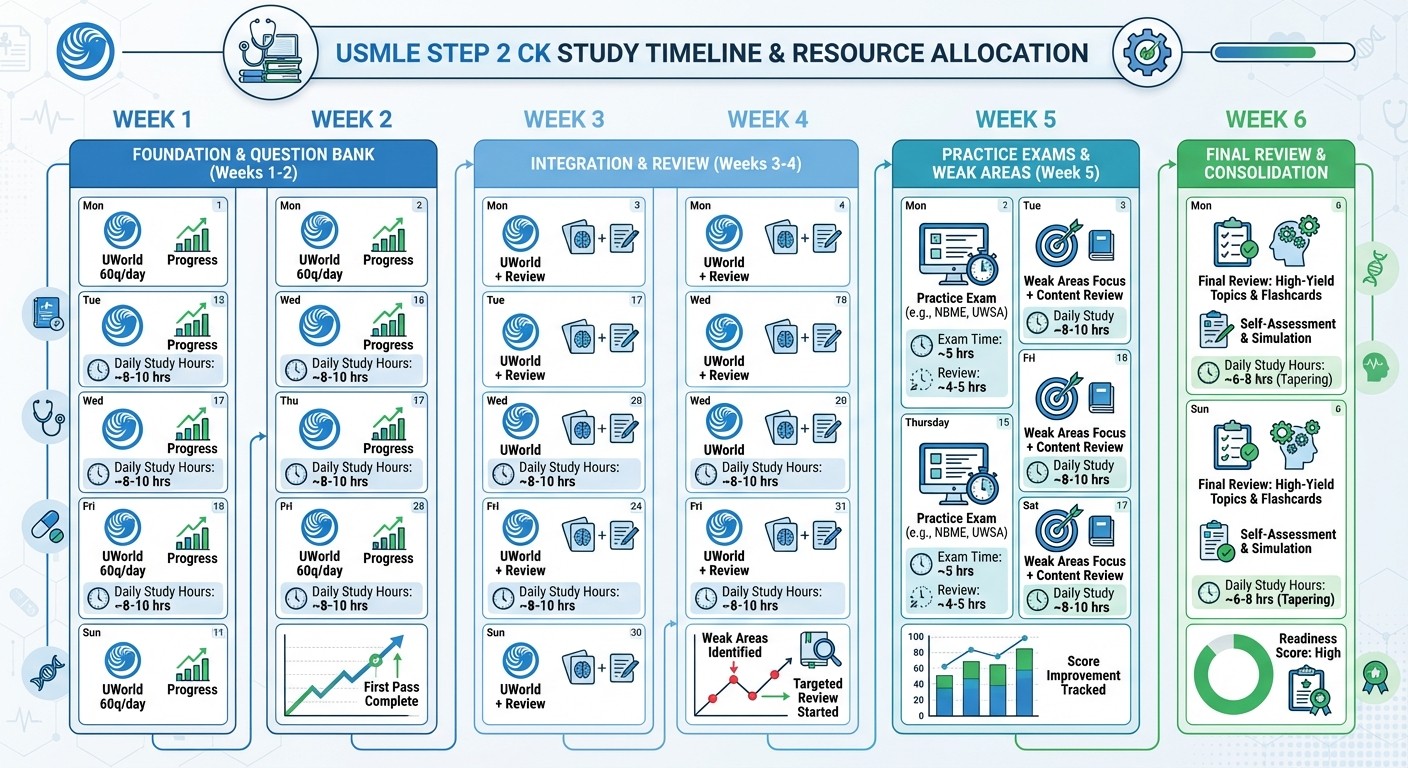
Week 1: Set baseline with NBME, begin UWorld (60 questions/day) Week 2-3: Continue UWorld first pass with targeted review Week 4: Complete first pass, begin second pass on weak areas Week 5: UWorld incorrects + additional practice exams Week 6: Final review, take UWSA2, and maintain sharp timing
8-Week Extended (For Extra Security)
Choose this timeline if shelf performance was inconsistent or if you want a high score for competitive specialties.
Week 1-2: Slow UWorld pace (40 questions/day) with deep review Week 3-4: Increase to 60 questions/day, add Amboss for weak areas Week 5-6: Second UWorld pass on incorrects and flagged questions Week 7-8: Intensive practice exams and final review
The key insight: more time doesn't automatically mean better scores. Consistency and active review matter more than total hours logged.
High-Yield Topics by Discipline
Internal Medicine (25-30% of exam)
Internal medicine dominates Step 2 CK. Focus on common presentations and management algorithms.
Cardiology essentials: Acute coronary syndrome management, heart failure staging, hypertension guidelines, arrhythmia recognition and treatment Pulmonology must-knows: Asthma vs COPD management, pneumonia treatment algorithms, pleural effusion workup, pulmonary embolism diagnosis Endocrinology high-yield: Diabetes management and complications, thyroid disorders, adrenal insufficiency, osteoporosis screening Nephrology core: Acute kidney injury workup, chronic kidney disease staging, electrolyte disorders, hypertension in kidney disease
Oncourse's adaptive question bank automatically identifies which internal medicine subspecialties need more attention — if you're missing 40% of cardiology questions, it'll serve up more cardiac cases until your accuracy improves.
Surgery (15-20% of exam)
General surgery: Appendicitis, cholecystitis, bowel obstruction, hernias, GI bleeding management Trauma: ATLS protocols, Glasgow Coma Scale, trauma bay priorities, when to activate massive transfusion Orthopedics: Fracture management, compartment syndrome, common dislocations, sports injuries in young adults Urology: Kidney stones, UTI management, prostate disorders, testicular emergencies Neurosurgery: Increased ICP management, stroke interventions, spinal cord injuries
The surgery questions focus on recognition and initial management rather than operative techniques. Know when to consult, when to admit, and when immediate intervention is needed.
Pediatrics (15-20% of exam)
Developmental milestones: Red flags for delays, normal vs concerning behaviors by age Infectious diseases: Childhood illnesses, vaccination schedules, fever management by age Adolescent medicine: Confidentiality issues, substance abuse screening, eating disorders Neonatal: Newborn screening, jaundice evaluation, feeding difficulties Emergency: Pediatric fever algorithms, dehydration management, child abuse recognition
Step 2 CK pediatrics questions often integrate with internal medicine — expect adolescent cases that require adult medicine knowledge and pediatric cases where family dynamics affect management decisions.
OB/GYN (10-15% of exam)
Obstetrics: Prenatal care schedules, labor management, pregnancy complications, postpartum care Gynecology: Abnormal uterine bleeding workup, contraception counseling, STI management, menopause Reproductive endocrinology: Infertility evaluation, PCOS diagnosis, abnormal Pap smear management
The questions emphasize appropriate screening intervals, when to refer to specialists, and urgent vs non-urgent presentations.
Psychiatry (10-15% of exam)
Mood disorders: Major depression diagnosis and treatment, bipolar disorder management, suicide risk assessment Psychotic disorders: Schizophrenia vs other causes of psychosis, antipsychotic side effects Anxiety disorders: Panic disorder, generalized anxiety, PTSD recognition and treatment Substance use: Intoxication and withdrawal management, screening tools, treatment approaches Ethics: Confidentiality, informed consent, capacity assessment, involuntary commitment criteria
Psychiatry questions often appear as consultation scenarios where the primary team needs psychiatric input for medical patients with mental health comorbidities.
Emergency Medicine (5-10% of exam)
Triage principles: Urgent vs non-urgent presentations, when to activate emergency protocols Toxicology: Common overdoses, antidote administration, poison control consultation Procedures: When to perform emergency procedures vs when to call specialists Shock states: Recognition and initial management of different shock types
Emergency medicine questions frequently integrate with other specialties — expect cardiac emergencies, surgical emergencies, and pediatric emergencies scattered throughout the exam.
Resource Stack: Building Your Study Arsenal
Primary Resources (Essential)
UWorld Step 2 CK remains the gold standard. 3,000+ questions with detailed explanations that teach clinical reasoning, not just facts. Plan for 1.5 passes minimum — complete first pass, then focus second pass on incorrects and flagged questions.
The performance analytics in Oncourse work similarly but surface patterns UWorld might miss — like consistently choosing the most aggressive management option or missing questions where the answer is "supportive care." These behavioral patterns matter more than subject-specific weaknesses.
NBME Clinical Science Mastery Series provides the most accurate score prediction. Take one early as a baseline, then use 2-3 more throughout dedicated study to track progress and adjust timeline if needed. First Aid for Step 2 CK serves as a quick reference, not a primary study tool. Use it to fill knowledge gaps identified during question practice, particularly for rapid review of treatment algorithms and diagnostic criteria.
Supplementary Resources (Optional)
Amboss Step 2 CK offers additional questions and an excellent clinical library. Most valuable for students who finish UWorld with time remaining or need extra practice in specific specialties. UpToDate provides current clinical guidelines when UWorld explanations reference "current recommendations" without specifics. Essential for clinical reasoning questions where guidelines have changed recently. OnlineMedEd videos help visual learners understand complex pathophysiology, particularly useful for students who struggled with certain shelf exams.
Oncourse's spaced repetition flashcards complement question practice by reinforcing high-yield facts at optimal intervals — instead of cramming 200 flashcards the night before your exam, the system shows you 30 cards daily, resurfacing the ones you're forgetting just before they slip from memory.
Timing Your Resources
Weeks 1-4: UWorld as primary resource (60-80 questions daily) Week 3: Add First Aid for targeted review of weak areas Week 4: Take first NBME to assess progress Weeks 5-6: UWorld second pass + additional NBMEs Final week: Light review only, maintain timing with practice questions
Common Mistakes US Students Make
Starting Too Late
The biggest error is underestimating preparation time needed. Clinical experience from clerkships helps, but Step 2 CK questions require systematic practice to master the format and timing.
Solution: Book your test date during your penultimate clerkship, giving yourself 6-8 weeks of dedicated preparation time.
Under-doing Practice Questions
Some students rely too heavily on reading and reviewing, spending only 30-40% of study time on active question practice.
Solution: Questions should comprise 70% of your study time. Reading supplements question practice, not the reverse.
Ignoring Weak Specialties
US students often skip pediatrics or psychiatry questions because they felt confident during those clerkships.
Solution: Track performance by specialty weekly. If accuracy in any area drops below 65%, spend extra time on those questions regardless of your clerkship performance.
Perfectionist Reviewing
Spending 10-15 minutes reviewing every single question explanation, including ones answered correctly on first try.
Solution: Review incorrects and flagged questions thoroughly. For questions answered correctly, read explanations only if you guessed or felt uncertain.
Cramming New Information
Trying to learn completely new topics during dedicated study rather than reinforcing and organizing existing knowledge.
Solution: If UWorld reveals major knowledge gaps, do targeted reading but don't attempt to master new subspecialties from scratch.
Using NBME Clinical Mastery Series for Score Prediction
The NBME Clinical Science Mastery Series provides the most reliable Step 2 CK score predictions available. These exams use retired USMLE questions and correlate strongly with actual exam performance.
Strategic NBME Usage
Baseline assessment: Take one NBME during week 1 of dedicated study to identify strengths and weaknesses across specialties. Progress tracking: Take NBMEs every 2-3 weeks to ensure your study plan is working. A 10-15 point improvement indicates effective preparation. Final prediction: UWSA2 taken 1-2 weeks before your exam provides the most accurate score prediction, typically within 5-10 points of actual performance.
Score Interpretation
NBME scores correlate with USMLE performance as follows:
200-220: Passing range, indicates solid clinical knowledge
220-240: Above average, competitive for most specialties
240-260: High performance, opens doors to competitive specialties
260+: Exceptional performance, top tier for any specialty
If your NBME scores plateau or decrease, extend your dedicated study period or adjust your resource allocation based on performance analytics.
Final 2-Week Sprint Strategy
Week -2: Intensive Review Phase
Complete any remaining UWorld questions
Review all incorrects from previous weeks
Take UWSA2 for final score prediction
Identify and drill remaining weak areas
Daily flashcard review for high-yield facts
Week -1: Maintenance Phase
Light question practice (30-40 questions daily)
Review key algorithms and treatment protocols
Practice proper timing and stamina
Avoid learning new information
Focus on maintaining confidence and sharpness
Final 48 Hours
No new practice questions
Light review of commonly missed topics only
Ensure proper sleep schedule (7-8 hours nightly)
Prepare all exam day logistics
Maintain normal routine and stress management
The key insight for the final sprint: maintain your edge without overthinking. Students who dramatically change their routine in the final weeks often see performance decline.
Optimizing Clinical Reasoning Skills
Step 2 CK success depends more on clinical reasoning ability than pure knowledge retention. Here's how to develop systematic approaches to different question types.
Diagnostic Questions
1. Read the question stem first to understand what's being asked 2. Identify key clinical features while reading the vignette 3. Generate a differential diagnosis before looking at answer choices 4. Use test characteristics (sensitivity, specificity) to choose the best test
Management Questions
1. Classify the clinical scenario (stable vs unstable, inpatient vs outpatient) 2. Consider immediate priorities (ABCs, life-threatening conditions) 3. Apply appropriate guidelines for the clinical situation 4. Choose the most appropriate next step rather than the textbook ideal
Next Best Step Questions
1. Determine the clinical setting (emergency, outpatient, hospital) 2. Assess acuity level (minutes, hours, days, weeks) 3. Consider available resources and practical constraints 4. Select the most reasonable immediate action
Oncourse's AI tutor Rezzy helps develop this systematic thinking by asking follow-up questions when you get questions wrong: "Why did you choose that management option?" or "What clinical features made you think of that diagnosis?" This builds the metacognitive skills essential for complex clinical reasoning.
Performance Tracking and Analytics
Success on Step 2 CK requires data-driven preparation. Unlike undergraduate exams where effort correlates with results, medical board exams reward strategic studying over total hours.
Key Metrics to Track Weekly
Overall accuracy percentage: Should improve 5-10% weekly during dedicated study. Stagnation indicates need to adjust study methods. Accuracy by specialty: Track internal medicine, surgery, pediatrics, OB/GYN, and psychiatry separately. Focus extra time on specialties below 65% accuracy. Question timing: Average 90 seconds per question on Step 2 CK. Students consistently running over time need to practice faster clinical reasoning. Incorrect answer patterns: Are you choosing answers that are too aggressive? Too conservative? Missing social and ethical considerations?
The performance dashboard in Oncourse automatically tracks these patterns and suggests weekly adjustments — like spending extra time on pediatric infectious disease questions or practicing faster recognition of psychiatric emergencies.
Using Analytics to Adjust Strategy
If accuracy is plateauing: Switch from passive reading to active recall techniques. Increase question volume and reduce time spent on explanations for correctly answered questions. If timing is consistently slow: Practice reading question stems faster and making decisions with incomplete information, as you would in clinical practice. If specific specialties lag: Dedicate entire study sessions to weak areas rather than mixing specialties randomly.
Managing Burnout During Dedicated Study
Six to eight weeks of intensive daily studying creates mental fatigue that can sabotage exam performance. US medical students face unique pressures — residency application anxiety, financial stress, and comparison with peers who seem effortlessly prepared.
Sustainable Study Practices
Structure breaks deliberately: Study in 2-3 hour blocks with 15-30 minute breaks. Mental fatigue reduces retention and clinical reasoning ability. Maintain physical activity: 30 minutes of exercise daily improves cognitive function and stress management. This isn't optional during dedicated study. Preserve social connections: Complete isolation worsens anxiety and depression. Schedule regular contact with supportive friends and family. Monitor sleep quality: 7-8 hours nightly is non-negotiable. Sleep deprivation impairs clinical reasoning more than knowledge gaps.
Warning Signs of Counterproductive Studying
Decreasing practice question accuracy despite increased study time
Inability to concentrate during review sessions
Persistent anxiety about exam readiness
Comparing your preparation unfavorably to peers
Obsessive reviewing of the same materials repeatedly
Recovery strategy: Take 2-3 complete days off studying. Engage in activities unrelated to medicine. Return to studying with modified schedule and realistic expectations.
Frequently Asked Questions
How long should I study for Step 2 CK as a US medical student?
Most US students need 4-8 weeks of dedicated preparation. Students with strong shelf exam performance (75th percentile or higher) can succeed with 4-6 weeks. Average performers should plan 6-8 weeks. The key is consistency rather than total hours.
Is UWorld enough for Step 2 CK preparation?
UWorld provides the foundation for most students' preparation, but success requires systematic review and additional practice exams. Complete UWorld once thoroughly, then focus on incorrects and weak areas. Add NBME practice exams for score prediction and timing practice.
When should I take Step 2 CK during medical school?
The optimal timing is after completing core clerkships but before fourth year responsibilities begin. Most students take Step 2 CK between March and June of their fourth year, allowing fresh clinical knowledge without residency application distractions.
What Step 2 CK score do I need for my specialty?
Family medicine and internal medicine programs typically accept scores above 220. Competitive specialties like dermatology, radiation oncology, and orthopedic surgery often expect scores above 240. Research your target programs' average Step 2 CK scores during the application process.
How accurate are NBME practice exams for predicting my Step 2 CK score?
NBME Clinical Science Mastery Series exams correlate strongly with actual Step 2 CK performance, typically within 10-15 points. UWSA2 taken within two weeks of your exam provides the most accurate prediction, usually within 5-10 points of your actual score.
Should I postpone Step 2 CK if my practice scores are low?
If NBME scores are consistently below 200 within 3-4 weeks of your test date, consider postponing. However, mild anxiety about readiness is normal. Consult with advisors and consider the opportunity cost of delaying, especially if applying for residency the same year.
---
Step 2 CK represents the culmination of your clinical medical education — it tests whether you can think systematically under pressure and make sound clinical decisions. The exam rewards students who practice clinical reasoning methodically, not those who memorize the most facts.
Your clerkship experience provides the foundation, but systematic question practice develops the test-taking skills and clinical reasoning patterns essential for success. Focus on understanding your knowledge gaps early, developing efficient review habits, and maintaining perspective throughout the process.
Prepare smarter with Oncourse AI — adaptive MCQs, spaced repetition, and AI explanations built for USMLE Step 2 CK. Download free on Android and iOS.