Back
PLAB 1 Preparation 2026: Complete Study Guide for IMGs — Exam Pattern, High-Yield Topics and First-Attempt Strategy
Master PLAB 1 on your first attempt with our complete 2026 preparation guide. Get exam pattern insights, high-yield topics, UK guidelines, and a proven 3-month study strategy.
PLAB 1 Preparation 2026: Complete Study Guide for IMGs — Exam Pattern, High-Yield Topics and First-Attempt Strategy
You are probably staring at the GMC website wondering how exactly you crack PLAB 1 on your first shot. The exam has 180 single best answer questions. Three hours to complete them. That gives you exactly 60 seconds per question — and unlike your medical school MCQs, these test UK-specific clinical decision-making, not textbook recall.
PLAB 1 is your gateway to UK medical practice, but most students underestimate its specificity. This isnt about memorizing Harrison's or Kumar & Clark. This is about knowing what an NHS doctor would actually do when a 65-year-old presents with chest pain at 2 AM in Manchester.
The pass rate hovers around 70%, but first-attempt success depends on understanding one crucial difference: PLAB 1 tests clinical reasoning within UK healthcare guidelines, not just medical knowledge. Get this wrong, and you will find yourself booking a resit.
Understanding PLAB 1: More Than Just Medical Knowledge
PLAB 1 operates as the international equivalent of the UK Applied Knowledge Test. The GMC redesigned it to align with UKMLA standards, meaning you are assessed at the level of a doctor entering Foundation Year 2 training.
The exam structure is straightforward: 180 SBA questions across three hours, computer-based, with a passing score typically between 115-120 correct answers. No negative marking, so never leave a question blank.
What catches most students off-guard isnt the format — its the clinical reasoning style. Each question presents a scenario where you must decide the next best step in patient management, not just identify a diagnosis.
The Clinical Decision-Making Shift
Traditional medical school MCQs test: "What is this condition?"
PLAB 1 asks: "What would you do next for this patient?"
A typical PLAB question might present a 45-year-old with crushing central chest pain, diaphoresis, and ST-elevation in leads II, III, and aVF. You already know its an inferior STEMI. But the question asks for immediate management — and the correct answer is "Aspirin 300mg and call cardiology for primary PCI," not "Thrombolysis" (which might be correct in resource-limited settings but not NHS protocol).
This distinction separates passing candidates from those who resit.
PLAB 1 Exam Pattern and Clinical Domains
The GMC structures PLAB 1 around five core clinical domains, each weighted differently:
Domain | Question Weight | Key Focus Areas |
|---|---|---|
Medicine | 35-40% | Cardiology, respiratory, neurology, endocrinology |
Surgery | 20-25% | General surgery, orthopaedics, urology |
Paediatrics | 15-20% | Child safeguarding, developmental milestones, emergencies |
Obstetrics & Gynaecology | 10-15% | Emergency management, contraception, screening |
Psychiatry | 10-15% | Mental capacity, depression, safeguarding |
High-Yield Topics That Appear Repeatedly
Based on recent exam patterns, certain topics consistently yield 15+ questions:
Cardiology (20+ questions expected):
Acute coronary syndromes (STEMI vs NSTEMI management)
Hypertension stepped care (NICE pathways)
Heart failure management
Arrhythmia recognition and immediate treatment
Respiratory Medicine (15+ questions):
COPD exacerbation management
Asthma step-up therapy
Pneumonia severity assessment (CURB-65)
Pulmonary embolism Wells score
For memorizing complex clinical pathways like NICE hypertension management, Oncourse AI's mnemonic engine generates memorable devices for these multi-step protocols — turning "ACE inhibitor, then add calcium channel blocker, then add thiazide" into a single recalled phrase. Emergency Medicine (12-15 questions):
Sepsis recognition and management
Major trauma protocols
Poisoning and overdose management
Cardiac arrest algorithms
Psychiatry & Mental Health (12-15 questions):
Mental Capacity Act applications
Depression and anxiety management
Suicide risk assessment
Sectioning criteria
The psychiatric questions often test your understanding of UK legal frameworks. When you see a patient lacking capacity to consent, the answer usually involves "best interest decisions" or "involving next of kin" — not overriding patient autonomy, which trips up many international graduates.
The UK Guidelines Trap: NICE vs Your Medical School
This is where most first-attempt failures happen. Your medical school taught you evidence-based medicine. PLAB 1 tests UK evidence-based medicine — and they are not always the same.
Critical UK-Specific Guidelines to Master
Hypertension Management (NICE 2022):
Under 55 or diabetic: Start ACE inhibitor
Over 55 or Afro-Caribbean: Start calcium channel blocker
Step 2: Combine ACE + CCB
Step 3: Add thiazide-like diuretic
Many countries teach "start with any antihypertensive." In PLAB 1, age and ethnicity determine your first choice — get this wrong and you lose easy marks.
Antibiotic Prescribing:
UK guidelines heavily emphasize antibiotic stewardship. For uncomplicated UTI in women, the answer is often "trimethoprim 200mg BD for 3 days" — not the broad-spectrum antibiotics you might use elsewhere.
Mental Capacity Assessment:
The Mental Capacity Act 2005 governs every decision involving patients who cannot consent. The key principle: assume capacity unless proven otherwise, and always act in the patient's best interests.
When working through clinical scenarios that mirror PLAB 1's decision-making style, Clinical Rounds walks you through AI-guided cases that train this exact thinking pattern — helping you internalize the "what would an NHS doctor do next" approach.
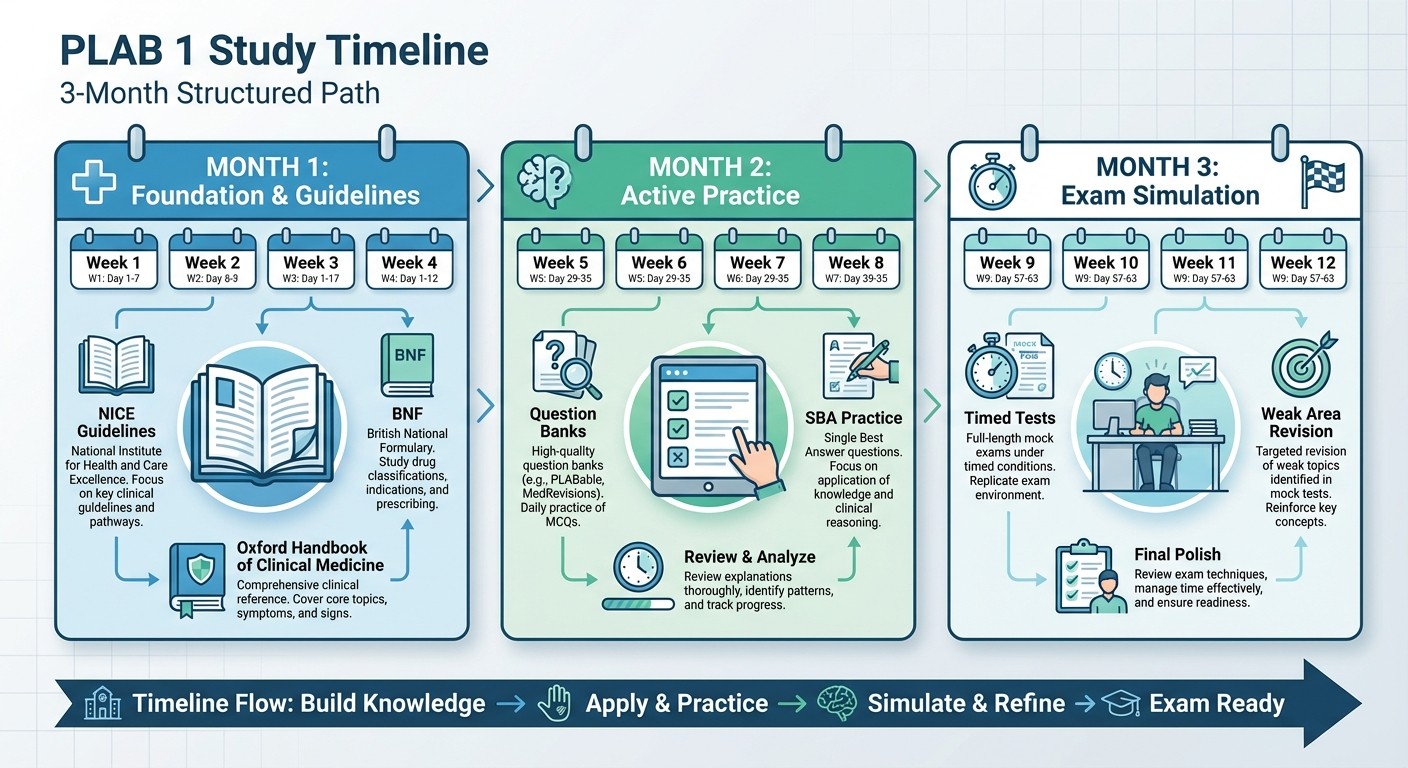
Your First-Attempt Study Strategy: 3-Month Plan
Most successful candidates follow a phased approach that frontloads UK guidelines before diving into question practice.
Month 1: Foundation and UK Guidelines
Dont start with question banks. Spend the first four weeks understanding how the NHS actually works.
Week 1-2: Core Resources Setup
Oxford Handbook of Clinical Medicine: Your primary reference
NICE Clinical Knowledge Summaries: Free online, covers 90% of PLAB scenarios
BNF Online: For drug dosages and interactions
Week 3-4: High-Yield Guidelines Deep Dive
Focus on these specific NICE guidelines:
Hypertension management
Type 2 diabetes stepped care
COPD and asthma management
Mental capacity assessment
Child safeguarding procedures
The key insight: NICE guidelines often trump textbook knowledge in PLAB 1. If Harrison's says one thing but NICE says another, NICE wins.
Month 2: Active Practice with Strategic Question Banks
Now you start drilling SBA questions, but with a specific strategy.
Primary Question Banks:
Plabable: Comprehensive question bank with detailed explanations
Samson PLAB Academy: Topic-wise practice with UK-focused explanations
PassMedicine: Good for topic-specific drilling
Daily Schedule:
Morning: 50 SBA questions (timed)
Afternoon: Review incorrect answers + read relevant Oxford Handbook sections
Evening: 20-30 questions from weak areas
The spaced repetition approach becomes crucial here. Rather than reviewing the same strong topics repeatedly, Oncourse AI's Synapses flashcard system surfaces your weak areas at optimal intervals — ensuring you spend revision time where it actually improves your score. Weekly Focus Areas:
Week 1: Medicine (Cardiology, Respiratory)
Week 2: Surgery + Emergency Medicine
Week 3: Paediatrics + O&G
Week 4: Psychiatry + Ethics + Mixed practice
Month 3: Exam Simulation and Weak Area Drilling
The final month focuses on exam technique and identifying remaining gaps.
Week 1-2: Full-Length Simulations
Take 180-question practice tests under exam conditions. Three hours, no breaks, computer-based format.
Target benchmarks:
First simulation: 130+ correct (indicates passing trajectory)
Second simulation: 140+ correct (comfortable passing range)
Third simulation: 150+ correct (high-confidence range)
Week 3-4: Targeted Revision
Identify your three weakest domains from simulations and drill these intensively.
Common weak areas for international graduates:
UK medication names and dosages
Mental capacity and consent laws
Child safeguarding protocols
NHS referral pathways
For rapid recall drilling on these UK-specific protocols, the Probe Game provides timed, rapid-fire questions that build the instant recognition needed for exam day.
Essential Resources That Actually Work
Skip the 15-book reading lists. Successful first-attempt candidates typically use 4-5 core resources effectively rather than spreading thin across everything available.
Tier 1: Must-Have Resources
Oxford Handbook of Clinical Medicine (2024 edition)
The single most important book for PLAB 1. Each topic page gives you exactly what you need: presentation, investigations, management. Nothing more, nothing less.
NICE Clinical Knowledge Summaries
Free online resource covering every condition you will encounter. When in doubt about management, check NICE first.
Plabable Question Bank
The most PLAB-specific question bank available. Their explanations reference UK guidelines consistently.
Tier 2: Supplementary Resources
BNF Online
Essential for drug dosages and interactions. PLAB 1 loves testing first-line antibiotic choices and contraindications.
Samson Notes
Concise topic summaries that work well for final-week revision. Good for quick refreshers, not primary learning.
PassMedicine
Useful for topic-specific drilling once you have identified weak areas.
Resources to Avoid
Skip these common traps:
Multiple comprehensive textbooks (Kumar & Clark, Harrison's) — too detailed for PLAB format
YouTube video playlists — passive learning doesnt build SBA technique
Generic medical MCQ apps — they dont test UK-specific management
Common First-Attempt Mistakes and How to Avoid Them
Mistake 1: Treating It Like a Knowledge Test
PLAB 1 tests decision-making, not recall. The question "A 25-year-old woman presents with palpitations" isnt asking you to list causes of palpitations. Its asking what you would do first: ECG, thyroid function tests, or detailed history?
Solution: Always read the question stem completely, then identify what type of decision its asking for: diagnosis, investigation, immediate management, or referral.
Mistake 2: Ignoring UK Legal Frameworks
Mental capacity, child safeguarding, and consent laws in the UK have specific legal requirements that override clinical preferences.
Example: A 16-year-old wants contraception but asks you not to tell her parents. The correct answer involves Fraser guidelines (she can consent if she understands), not "inform parents" or "refuse treatment."
Mistake 3: Over-Complicating Emergency Scenarios
PLAB 1 emergency questions test your ability to follow protocols, not demonstrate advanced knowledge.
For cardiac arrest: The answer is "start CPR and call for help," not "consider causes of PEA."
For major trauma: The answer is "ABCDE assessment," not "CT head and spine."
Mistake 4: Poor Time Management
Sixty seconds per question is tight. Spending 3 minutes on difficult questions leaves no time for easy marks later.
Strategy: First pass through all 180 questions, answering everything you know immediately. Mark difficult questions for review. Second pass: tackle marked questions with remaining time.
Your Final 4-Week Revision Strategy
The last month determines your first-attempt success. Most candidates either peak too early or cram ineffectively.
Week 1: Peak Performance Testing
Take your final full-length simulation under exact exam conditions. This identifies your current scoring level and remaining weak areas.
If scoring below 130: Focus the remaining three weeks on your three weakest domains only. Better to be excellent at medicine, surgery, and paediatrics than mediocre across everything.
If scoring 130-145: Continue mixed practice with emphasis on time management and avoiding silly errors.
If scoring 145+: Focus on maintaining performance and ensuring you dont make careless mistakes on exam day.
Week 2-3: Intensive Weak Area Drilling
Use your simulation results to create a focused study plan. For most candidates, this means:
High-yield focus areas:
Cardiology emergencies and chronic management
Respiratory guidelines (COPD, asthma stepped care)
Paediatric safeguarding scenarios
Mental capacity and consent
Daily routine:
Morning: 100 SBA questions from weak areas only
Afternoon: Review incorrect answers + read relevant guidelines
Evening: Quick review of Oxford Handbook high-yield topics
Week 4: Exam Readiness
Final week focuses on confidence-building and avoiding burnout.
3 days before: Stop learning new content. Review your error log and reinforce key guidelines only. 1 day before: Complete rest. Light review of drug dosages and emergency algorithms if needed, but no new material. Exam day: Arrive early, stay hydrated, trust your preparation.
Frequently Asked Questions
How many months should I dedicate to PLAB 1 preparation?
Three to four months is optimal for most candidates. Less than three months doesnt allow proper guideline integration; more than six months leads to burnout and forgetting early material.
Can I pass PLAB 1 using only question banks?
No. Question banks build exam technique, but you need the Oxford Handbook and NICE guidelines for foundational understanding. Pure question-bank preparation leads to gaps in UK-specific management.
What happens if I fail PLAB 1 on my first attempt?
You can retake PLAB 1 after 30 days. Most candidates who resit pass on their second attempt because they know exactly what the exam tests. However, this delays your overall timeline by 2-3 months.
Is PLAB 1 harder than medical school final exams?
Different, not harder. Medical school tests broad knowledge; PLAB 1 tests specific clinical decision-making within UK guidelines. Many candidates find it more challenging because it requires unlearning non-UK approaches.
Should I memorize NICE guidelines word-for-word?
Focus on management algorithms and first-line treatments rather than memorizing entire documents. PLAB 1 tests practical application, not guideline recitation.
How important are mock exams for success?
Critical. Full-length simulations under timed conditions identify weak areas and build stamina for the three-hour exam. Take at least three complete practice tests in your final month.
PLAB 1 success comes down to understanding one key principle: you are not just proving medical knowledge — you are demonstrating that you can make safe, appropriate clinical decisions within the NHS framework. Master the guidelines, practice the decision-making style, and trust the process.
Prepare smarter with Oncourse AI — adaptive MCQs, spaced repetition, and AI explanations built for UK medical licensing. Download free on Android and iOS.