Back
NEET PG Previous Year Questions: How to Use PYQs for Revision, Mocks, and Weak Areas
Master NEET PG previous year questions for targeted revision, mock analysis, and weak area practice. Learn PYQ classification, active recall techniques, and spaced repetition strategies.
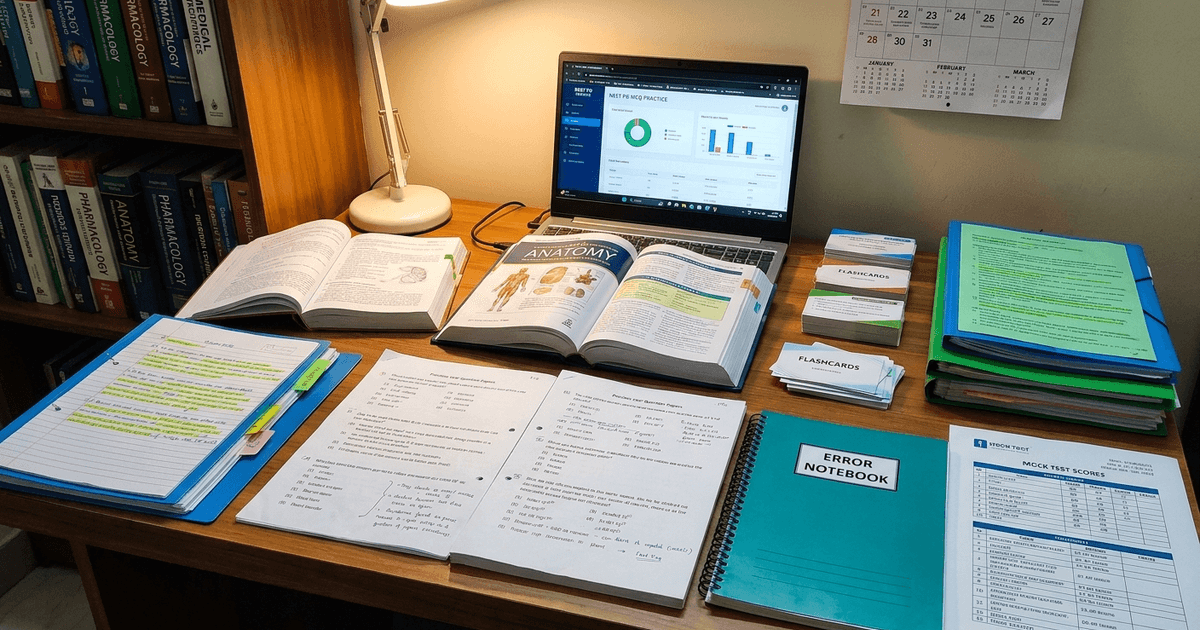
NEET PG Previous Year Questions: How to Use PYQs for Revision, Mocks, and Weak Areas
You are probably sitting with a stack of NEET PG previous year questions right now, wondering if solving them for the third time will actually help. Here's the truth: 63% of students use PYQs wrong. They treat them like practice tests instead of diagnostic tools.
NEET PG has 200 questions. You have 63 seconds each. Previous year questions aren't just about pattern recognition — they're your roadmap to understanding what the NBE actually tests, how they phrase tricky options, and where your knowledge has gaps that cost marks.
But here's what most students miss: PYQs are useless without a system. You need to classify every miss, turn weak patterns into daily drills, and build a revision loop that actually sticks. This isn't about solving more questions. It's about solving them smarter.
Why Previous Year Questions Matter (But Aren't Enough Alone)
NEET PG PYQs from 2019-2024 show clear patterns. About 40% of questions repeat concepts from previous years, but with different clinical presentations. Another 35% test the same high-yield topics with varied question stems.
The National Board of Examinations doesn't publish official difficulty trends, but pattern analysis reveals that NEET PG now rewards clinical reasoning over pure recall. While factual knowledge remains necessary, the exam emphasizes applying information to scenarios.
What PYQs actually show you:
Question phrasing patterns and common trap options
High-yield topics that appear every 2-3 years
Image-based question trends (now 45-50% of the paper)
Clinical vignette structures and key diagnostic clues
Subject-wise weightage shifts over time
What PYQs can't do:
Replace comprehensive subject coverage
Teach you concepts you've never learned
Simulate real exam time pressure (you know the answers)
Cover new pattern questions or current trends
The key insight: PYQs work best as diagnostic tools for gaps, not as your primary learning source. Use them to find what you don't know, then learn it properly.
The 5-Type PYQ Miss Classification System
Every wrong PYQ answer tells you something different. Most students just mark it wrong and move on. That's why they keep making the same mistakes.
Here's how to classify every miss:
Type 1: Knowledge Gap Misses
You genuinely didn't know the concept, mechanism, or fact being tested.
Example: Missing the mechanism of action of a specific antibiotic or not knowing the diagnostic criteria for a syndrome. Action: This needs proper learning, not just revision. Go to source material, create flashcards for the core facts, and practice related questions.
Type 2: Pattern Gap Misses
You knew the concept but didn't recognize how the question was asking for it.
Example: You know heart failure management but missed it when presented as "65-year-old with bilateral pedal edema and orthopnea." Action: Practice more clinical vignettes for that topic. Focus on how concepts present in different scenarios.
Type 3: Silly Mistake Misses
You knew the right answer but clicked wrong due to carelessness, misreading, or overthinking.
Example: Choosing "hyponatremia" when you meant "hypernatremia" or second-guessing your first instinct. Action: Develop better question-reading habits and elimination techniques.
Type 4: Image/Table Miss
You couldn't interpret the visual element properly.
Example: Missing ECG changes, X-ray findings, or histopathology slides. Action: Dedicated image-based practice and visual pattern recognition drills.
Type 5: Time Pressure Miss
You would have got it right with more time, but made hasty decisions under pressure.
Example: Complex calculation questions or lengthy clinical scenarios where you rushed. Action: Practice time management and develop shortcuts for common question types.
Track your misses in a simple format: "Question ID - Miss Type - Topic - Action Needed." This classification will guide your entire revision strategy.
Converting PYQ Misses into Targeted Weak Area Practice
Once you've classified your misses, you need a systematic approach to fix them. Here's the framework that actually works:
Immediate Drill (Same Day)
Right after reviewing a set of PYQs, identify your worst-performing topic from that session. Spend 30 minutes doing 20-30 additional questions on just that topic.
When you get a pharmacology mechanism wrong, use Rezzy to understand why that specific option was correct and what related mechanisms you should know. Don't just memorize the answer — understand the reasoning pattern.
Daily Weak Topic Sessions
Create a "Hit List" of your top 5-8 topics causing the most point loss. Dedicate 45 minutes daily to these topics using this rotation:
Monday: Topic 1 (15 MCQs + concept review)
Tuesday: Topic 2 (15 MCQs + concept review)
Wednesday: Topic 1 + 3 (10 MCQs each)
Thursday: Topic 4 (15 MCQs + concept review)
Friday: Mixed practice from all weak topics
Weekend: Full revision of the week's weak topics
Your Daily Plan should route these weak areas into focused sessions. Instead of random MCQ practice, you're hitting your actual gaps systematically.
Weekly Progress Checks
Every Sunday, retake 20-25 questions from your weakest topics of the previous week. If you're still missing more than 30%, that topic stays on your Hit List. If you're getting 70%+ correct, rotate it out for the next weakest area.
The Spaced Review Cycle
For concepts you've learned from PYQ mistakes:
Day 1: Learn the concept properly
Day 3: Quick flashcard review
Day 7: Practice 5-8 related questions
Day 21: Mixed practice including that topic
Day 60: Final check before exam
This isn't theoretical — it's based on how memory consolidation actually works. Convert your repeat PYQ misses into flashcards using spaced repetition. A quick Synapses game can help reinforce these facts through association patterns.
Combining PYQs with Mock Test Analysis for Maximum Impact
PYQs and mocks serve different diagnostic purposes. PYQs show you content gaps. Mocks reveal performance patterns under time pressure.
Here's how to integrate both:
The 48-Hour Analysis Cycle
After every mock test: 1. Day 1: Complete mock analysis (2-3 hours) 2. Day 2: PYQ practice on your weakest topics from the mock (1.5 hours) 3. Day 3: Targeted study of the concepts you missed in both (1 hour)
Mock-to-PYQ Mapping Strategy
When mock analysis shows weakness in "Cardiology - Heart Failure," don't just study heart failure generally. Go to PYQs from 2019-2024 and solve every heart failure question. Look for:
How they test acute vs chronic heart failure
Common trap answers (mixing up NYHA classes, drug contraindications)
Image-based presentations (chest X-rays, ECGs)
Associated conditions that appear in the same questions
Cross-Validation Technique
After studying a weak topic identified from mocks, validate your improvement by:
1. Solving 10-15 PYQ questions on that topic
2. Taking a topic-specific mini-test
3. Checking if similar mistakes appear in your next mock
If you're still making errors, the issue is deeper than surface knowledge. You might need to revisit fundamental concepts or practice more clinical application.
Performance Trending
Track these metrics weekly:
Mock accuracy by subject and topic
PYQ accuracy on the same topics
Time per question for different question types
Mistake type distribution (Knowledge vs Pattern vs Silly)
When mock performance improves but PYQ accuracy stays low, you're getting better at exam strategy but still have knowledge gaps. When PYQ accuracy improves but mock performance doesn't, you know the concepts but struggle with time pressure or question selection.
Your weak-topic analytics will show which areas need the most attention based on both mock and PYQ performance combined.
Timeline: When to Use PYQs in Your Final 90, 60, 30, 14, and 7 Days
Different phases of preparation need different PYQ strategies. Here's the proven timeline:
Last 90 Days: Pattern Recognition Phase
Daily PYQ volume: 30-40 questions across subjects
Focus: Understanding question patterns and high-yield topics
Method: Subject-wise PYQ practice with immediate concept review
Time allocation: 45 minutes PYQs + 45 minutes concept study per session
Goal: Complete 5 years of PYQs with full analysis
At this stage, you're still building knowledge. Don't rush through PYQs just to finish them. Spend time understanding why each option is right or wrong.
Last 60 Days: Integration and Weak Area Targeting
Daily PYQ volume: 50-60 questions, mixed subjects
Focus: Cross-subject integration and drilling identified weak areas
Method: Topic-specific PYQ clusters based on mock test analysis
Time allocation: 60 minutes PYQs + 30 minutes targeted study
Goal: Convert all major weak areas to average performance
This is when your NEET PG mock test analysis becomes crucial. Use mock results to guide which PYQ topics to prioritize.
Last 30 Days: Speed and Accuracy Optimization
Daily PYQ volume: 40-50 questions under time pressure
Focus: Eliminating silly mistakes and improving speed
Method: Mixed PYQ tests with 1.5 minutes per question maximum
Time allocation: 75 minutes practice + 45 minutes review
Goal: Achieve 70%+ accuracy under time pressure
Practice PYQs like real exam conditions. No pausing to think for 5 minutes. If you don't know in 90 seconds, make your best guess and move on.
Last 14 Days: Confidence Building and Gap Closing
Daily PYQ volume: 30-35 questions, high-yield topics only
Focus: Final revision of weak areas and confidence building
Method: PYQs from topics that still show up in your error log
Time allocation: 45 minutes practice + 15 minutes quick review
Goal: Close any remaining major gaps
For detailed strategies on this critical phase, check our NEET PG last 2 weeks revision guide.
Last 7 Days: Maintenance and Sharpening
Daily PYQ volume: 15-20 questions, mixed high-yield
Focus: Keeping your mind sharp without learning new concepts
Method: Quick PYQ rounds for topics you know well
Time allocation: 20 minutes practice + 10 minutes review
Goal: Maintain confidence and recall speed
Don't try to learn anything new from PYQs in this phase. Stick to topics where you consistently score 80%+ to build confidence.
Active Recall Techniques for PYQ Practice
Most students read PYQ explanations passively. That's why the same concepts keep tripping them up. Here are active recall methods that actually work:
The Explanation Challenge Method
Before reading any explanation:
1. Write down why you think your chosen answer is correct
2. Write down why you think each other option is wrong
3. If you got it wrong, write what made the correct answer better
4. Then read the official explanation and compare
This forces you to think through the reasoning process, not just memorize facts.
The Teaching Test
After solving a set of PYQs on a topic:
1. Pick the 3 most challenging questions
2. Explain each one out loud as if teaching a junior
3. Include why wrong options are traps and how to avoid them
4. If you can't explain it clearly, you don't understand it well enough
The Connection Mapping Technique
For every concept you learn from a PYQ mistake:
1. Connect it to 2-3 related concepts you already know
2. Identify how this concept could appear in different question types
3. Create a mini "concept cluster" in your notes
4. Practice questions that test the connections, not just isolated facts
When you miss a cardiology PYQ about ACE inhibitor side effects, don't just memorize "cough is a side effect." Connect it to: mechanism of action, other drugs in the class, alternative drug choices, and how this might appear in clinical vignettes about hypertension, heart failure, or diabetic nephropathy.
The Prediction Game
Before starting a new set of PYQs:
1. Based on the topic, predict what concepts will likely be tested
2. Guess what types of trap answers might appear
3. Identify 2-3 high-yield facts that often get tested
4. After solving, check how accurate your predictions were
This builds your intuition for what NBE actually tests versus what textbooks emphasize.
The key is making your brain work during PYQ practice, not just recognizing patterns. Active recall techniques turn PYQ practice from passive review into active learning.
Building Your Daily PYQ-Based Revision Loop
Consistency beats intensity when it comes to PYQ-based revision. Here's a sustainable daily system:
Morning Quick Strike (15 minutes)
Start each day with 10 PYQs from yesterday's weak topics. Don't spend time on detailed analysis — just quick recall practice. This primes your brain for the day and reinforces yesterday's learning.
Focused Study Block (60-90 minutes)
After your main study session on new topics, spend dedicated time on PYQ analysis:
30 minutes: Solve 25-30 fresh PYQs (mixed or topic-specific based on your phase)
30 minutes: Analyze misses using the 5-type classification system
15-30 minutes: Create flashcards for new facts or practice weak concepts immediately
Evening Consolidation (20 minutes)
Before ending your study day:
Review your PYQ error log from the day
Add any new weak topics to tomorrow's practice list
Plan which PYQ topics to focus on in the next day's session
Weekly Integration (2 hours, usually Sunday)
Solve 50-60 mixed PYQs under timed conditions
Complete analysis of the week's error patterns
Update your weak topic Hit List based on the week's performance
Plan next week's PYQ topic priorities
Your Daily Plan becomes the execution layer that converts these PYQ insights into focused practice sessions. Instead of random question solving, you're systematically addressing your actual gaps.
The Spaced PYQ Review System
Don't just solve PYQs once and forget them. Here's a spaced review approach:
Immediate: Solve + analyze same day
Day 3: Quick re-attempt of questions you got wrong
Week 2: Revisit the same PYQ set to check retention
Month 2: Final pass through most challenging questions
This ensures that PYQ learning actually sticks long-term, not just until your next study session.
Common PYQ Practice Mistakes to Avoid
After analyzing thousands of student PYQ patterns, these are the mistakes that kill scores:
Mistake 1: Answer Memorization Without Understanding
What students do: Remember that "Option C" is correct for a particular question without understanding why. Why it fails: Similar concepts appear with different answer positions. You can't transfer the learning. Better approach: Focus on understanding the reasoning pattern. Why was C correct? What made A, B, and D wrong? How would you recognize this concept in a different question format?
Mistake 2: Volume Over Quality
What students do: Rush through 100+ PYQs daily without proper analysis. Why it fails: You reinforce wrong thinking patterns and miss the diagnostic value. Better approach: 30-50 well-analyzed PYQs daily is better than 100 rushed ones. Spend more time on analysis than on solving.
Mistake 3: Ignoring Patterns in Wrong Options
What students do: Only study why the correct answer is right. Why it fails: NEET PG trap answers follow patterns. If you don't study them, you'll keep falling for similar traps. Better approach: Analyze why each wrong option is there. Common patterns include: mixing up similar drugs, confusing acute vs chronic presentations, or using outdated guidelines.
Mistake 4: Subject Isolation
What students do: Practice PYQs one subject at a time for weeks. Why it fails: NEET PG tests integrated knowledge. Questions often span multiple subjects. Better approach: After initial subject-wise practice, shift to mixed subject PYQs that mirror actual exam conditions.
Mistake 5: No Time Pressure Practice
What students do: Take unlimited time to solve PYQs, especially challenging ones. Why it fails: Exam day time pressure changes how your brain processes information. Better approach: At least 50% of your PYQ practice should be under strict time limits (90 seconds max per question).
Mistake 6: Forgetting the Forgetting Curve
What students do: Solve a topic's PYQs once, feel confident, and never return to it. Why it fails: Without spaced review, you forget 70% of what you learned within 2 weeks. Better approach: Use flashcards for high-yield PYQ facts and build them into your spaced repetition system.
The biggest meta-mistake: treating PYQs as just another question source instead of diagnostic tools that reveal exactly what you need to work on.
Advanced PYQ Strategies for High Scorers
If you're already scoring 60%+ on PYQs consistently, these advanced techniques can push you into the top percentile:
The Cross-Year Pattern Analysis
Don't just solve individual PYQs. Look at how the same concept was tested across different years:
How did the question format evolve?
Which aspects of the topic get emphasized repeatedly?
What are the common variations in clinical presentations?
Which associated concepts often appear together?
Example: Heart failure questions from 2019-2024 show increasing emphasis on guideline-based management and drug contraindications, with less focus on basic pathophysiology.
The Elimination Mastery Technique
Practice aggressive elimination on PYQs you've already solved:
Cover the correct answer
Practice eliminating wrong options without looking at explanations
Time yourself — elimination should take <30 seconds
Build elimination trees for common question types
This skill becomes crucial when you encounter unfamiliar questions on exam day.
The Weak Strength Conversion Method
Identify topics where you score 45-55% (weak but not terrible). These represent the highest ROI for improvement:
1. Collect all PYQs from these topics (across all years)
2. Create detailed concept maps showing how different aspects get tested
3. Practice these topics daily until you hit 75%+ consistency
4. These converted areas often add 15-20 marks to your final score
The Image Pattern Database
For high-yield image-based questions:
1. Create a visual database of commonly tested images from PYQs
2. Practice rapid pattern recognition (5-second glance diagnosis)
3. Learn to identify key diagnostic features that NBE emphasizes
4. Study how similar-looking conditions are differentiated
The Clinical Vignette Decoding System
Develop a systematic approach to clinical vignettes in PYQs:
1. Patient profile (age, gender, presenting symptoms) 2. Key diagnostic clues (timeline, associated symptoms) 3. Investigation findings (lab values, imaging) 4. Question focus (diagnosis, next step, treatment, prognosis)
Practice extracting these elements quickly and matching them to your knowledge framework.
When you encounter complex clinical presentations, use Explanation Chat to break down the diagnostic reasoning step-by-step, rather than just checking if your answer was right or wrong.
Frequently Asked Questions
How many years of NEET PG PYQs should I solve?
Solve at least 5 years (2019-2024) completely with full analysis. If you have extra time, go back to 2015-2018, but focus on high-yield topics only. The question patterns and emphasis have shifted significantly before 2018.
Should I solve PYQs multiple times?
Yes, but strategically. Solve each set once with full analysis, then revisit only the questions you got wrong after 2-3 weeks. Don't waste time on questions you consistently get right — focus that energy on weak areas or new content.
What if I keep making the same PYQ mistakes repeatedly?
This indicates a deeper issue than surface knowledge. Either you haven't truly understood the concept, or you have a consistent reasoning error. Use active recall techniques to identify the root cause. Sometimes the issue is anxiety or rushed reading rather than knowledge gaps.
How do I balance PYQs with regular study and mocks?
Follow the 3-2-1 rule in your final months: 3 parts regular study, 2 parts PYQ practice, 1 part mock tests. As you get closer to the exam, shift to 2-2-1, then 1-2-2 in the final weeks. PYQs should complement, not replace, comprehensive subject study.
Can I crack NEET PG using only previous year questions?
No. PYQs are diagnostic tools and pattern recognition aids, not comprehensive learning resources. You need proper subject coverage, concept understanding, and clinical knowledge. PYQs help you optimize and target your preparation, but they can't replace foundational learning.
How do I know if my PYQ practice is actually helping?
Track these metrics weekly: accuracy percentage by subject, average time per question, consistency of performance, and whether weak topics are improving. If these numbers aren't getting better over 2-3 weeks, change your PYQ approach or spend more time on concept building.
The Bottom Line: PYQs as Your Strategic Weapon
Previous year questions aren't just practice material — they're your diagnostic tool for surgical precision in NEET PG preparation. When used correctly, they reveal exactly what you need to work on, how NBE thinks about each topic, and where your current preparation has gaps that cost marks.
The difference between average and top performers isn't solving more PYQs. It's analyzing them better, classifying mistakes correctly, and building systematic review loops that turn weak areas into strengths.
Your PYQ practice should feel focused, not random. Every question should either teach you something new, confirm something you know, or reveal a gap you need to fix. If you're just going through the motions, you're wasting time that could be spent on targeted improvement.
Prepare smarter with Oncourse AI — understand your PYQ mistakes with Rezzy explanations, convert repeat misses into spaced repetition flashcards, and route weak areas into focused Daily Plan sessions. Download free on Android and iOS.