Back
FMGE Question Bank Strategy 2026: How to Practice PYQs, Mocks, and Weak Areas
Strategic FMGE question bank practice for 2026: Master PYQ patterns, mock test analysis, error classification, and 7-day weak area revision loops to clear FMGE on first attempt.

FMGE Question Bank Strategy 2026: How to Practice PYQs, Mocks, and Weak Areas
You've got your question bank open, 6,000+ questions staring back at you, and a nagging feeling that randomly clicking through MCQs won't cut it for FMGE 2026. You're right.
The students who clear FMGE in their first attempt don't just solve more questions — they solve them strategically. They treat their question bank like a diagnostic tool, not a lottery machine. They turn every missed question into data about what to study next, every mock test into a roadmap for the following week.
Here's the reality: FMGE has 300 questions in 5 hours. That's 60 seconds per MCQ, including the time to read clinical vignettes, analyze options, and mark your answer. You can't afford to waste those 60 seconds on topics you should already know, which means your question bank practice needs to be surgical — focused on plugging knowledge gaps and building speed on your strong areas.
This guide breaks down exactly how to divide your question bank practice into PYQs, subject blocks, mixed practice, and full mocks. More importantly, it shows you how to review each mistake, classify your errors, and build a 7-day revision loop that targets your actual weak areas instead of the topics you think you should study.
Important Note: Always verify the latest FMGE exam pattern, dates, eligibility criteria, and syllabus changes by checking the official NBEMS/NBE information bulletin before finalizing your preparation strategy.
Why Question Bank Volume Alone Isn't Enough
Most FMGE aspirants make the same mistake: they treat question banks like reading material. They solve 100 questions, check the answers, feel productive, and move on. Three weeks later, they're missing the same concepts on their mock tests.
The problem isn't the number of questions you solve — it's what you do after you solve them.
When you miss a Pharmacology question about beta-blocker contraindications, the mistake isn't just "I need to study more Pharmacology." The mistake might be:
You know beta-blockers are contraindicated in asthma but missed that the patient had COPD with reactive airway component
You confused propranolol (non-selective) with atenolol (cardioselective) properties
You rushed through the clinical vignette and missed the key phrase "recent bronchospasm episode"
You eliminated the right answer because you were thinking of outdated contraindication lists
Each of these requires a different fix. Question bank volume can't solve precision problems.
The FMGE Question Bank Framework: 4 Types of Practice
Divide your question bank practice into four distinct categories, each serving a different purpose in your preparation:
1. PYQ Pattern Analysis (Weeks 1-4)
Previous Year Questions aren't just practice — they're your blueprint for what NBEMS actually tests. Solve PYQs from the last 5 years (10 sessions total) with one specific goal: pattern recognition.
How to approach PYQs:
Solve one complete year (300 questions) in timed conditions
After completing, create a topic frequency chart: which concepts appeared most often?
Note question style evolution: has NBEMS shifted toward more clinical vignettes in recent years?
Mark recurring themes: tuberculosis drug regimens, obstetric emergencies, ECG interpretations appear consistently
PYQ insight example: If you notice that 8-10 questions per year focus on drug contraindications across different subjects, that's your signal to create a consolidated contraindication list rather than studying each drug class in isolation.
The Oncourse daily plan feature can help organize your PYQ analysis sessions around these high-frequency patterns, ensuring you cover the most tested topics first.
2. Subject-Wise Block Practice (Weeks 2-8)
After each study session, solve 30-50 questions from that specific topic. This isn't revision — it's active consolidation. Your brain needs to immediately apply what it just learned.
Block practice rules:
Solve immediately after completing a topic, not days later
Mix difficulty levels: 60% standard recall, 30% application-based, 10% tricky/edge cases
Time yourself: aim for 45-60 seconds per question to build speed
Review incorrects within 2 hours, while the study session is still fresh in your memory
For high-yield FMGE topics like Internal Medicine or Surgery, you can reinforce your block practice with targeted lessons from Oncourse's FMGE curriculum to ensure you're practicing the right depth of knowledge.
3. Mixed Timed Blocks (Weeks 6-10)
Once you've covered 60-70% of your syllabus, start solving mixed questions that combine multiple topics within the same session. This builds the mental flexibility needed for FMGE's randomized question order.
Mixed block structure:
75 questions per session, 75 minutes total
Draw from 4-5 different subjects randomly
Include image-based questions (X-rays, ECGs, histopathology slides)
Track accuracy by subject to identify subjects that drop when mixed with others
4. Full-Length Mock Tests (Weeks 8-12)
Your final phase focuses on 300-question mocks under exact FMGE conditions. But here's where most students go wrong: they treat mock tests like practice and ignore the analysis.
Mock test protocol:
Schedule 2-3 full mocks per week in your final month
Take them at the same time as your actual FMGE slot
Complete the entire test in one sitting, including the break between parts
Spend 2-3 hours analyzing each mock immediately after completion
Error Classification System: The 5 Types of FMGE Mistakes
Not all mistakes are equal. Before you can fix your weak areas, you need to classify what type of mistake each incorrect answer represents.
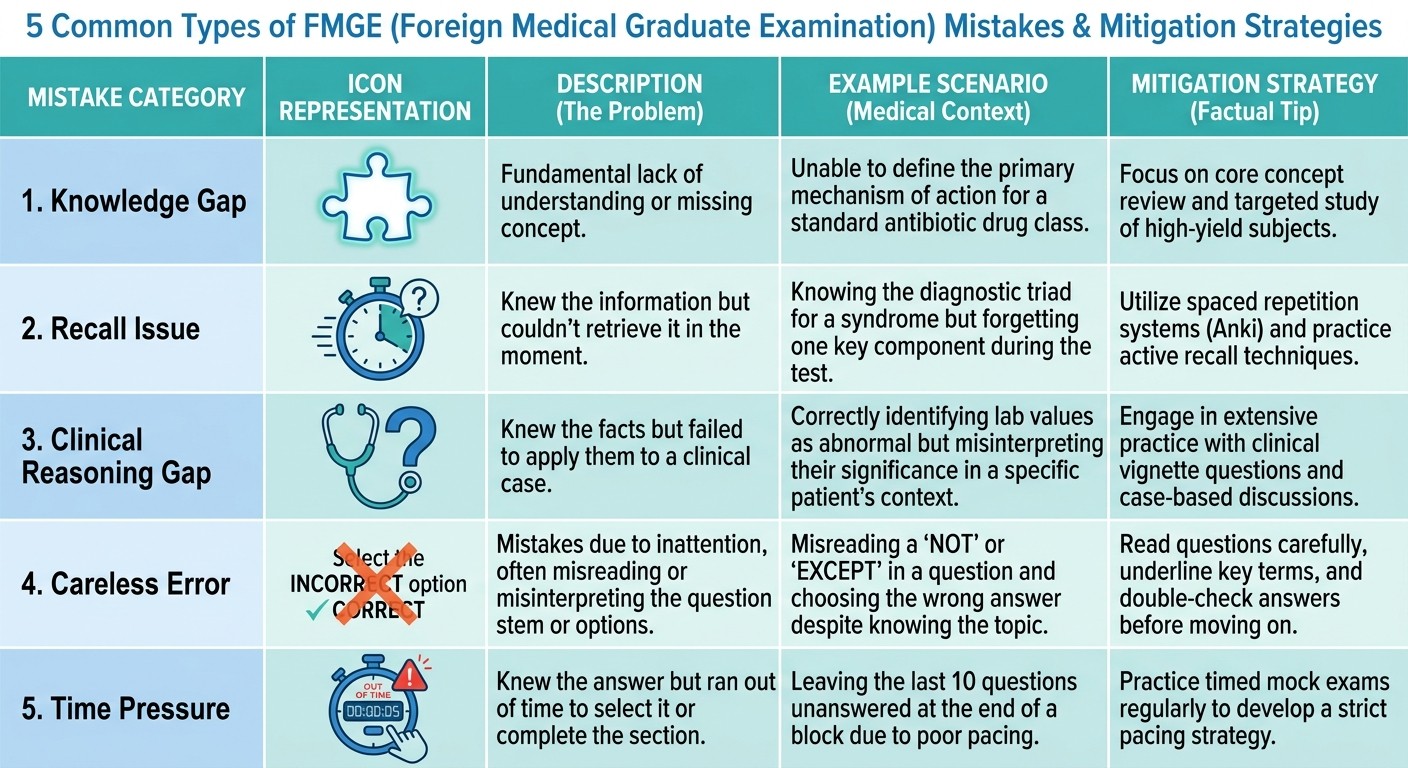
Type 1: Knowledge Gaps
You genuinely don't know the concept being tested.
Example: Question about first-line treatment for cryptococcal meningitis, and you've never encountered cryptococcal infections in your prep. Fix: Add the entire topic (cryptococcal infections) to your study list. This requires going back to your textbook or lectures.
Type 2: Recall Issues
You studied the concept but can't retrieve it during the test.
Example: You know that vitamin K deficiency causes bleeding disorders, but when the question presents with prolonged PT/INR and bleeding, you can't make the connection fast enough. Fix: Create active recall triggers. Use mnemonics or quick associations. The Synapses spaced repetition system can help reinforce these connections through timed recall practice.
Type 3: Clinical Reasoning Gaps
You know the individual facts but can't synthesize them into clinical decision-making.
Example: You know that ACE inhibitors cause hyperkalemia and that diabetes causes nephropathy, but when presented with a diabetic patient on lisinopril with elevated potassium, you miss the connection. Fix: Practice more clinical vignette questions. Focus on case-based reasoning rather than isolated fact recall.
Type 4: Careless Errors
You know the answer but make a reading comprehension mistake.
Example: Missing the word "NOT" in "Which of the following is NOT a contraindication for..." or confusing "increased" vs "decreased" in lab values. Fix: Develop a marking system. Circle keywords like NOT, EXCEPT, MOST, LEAST before reading the options.
Type 5: Time Pressure Issues
You know the concept and would get it right with more time, but the 60-second limit forces a guess.
Example: Complex ECG interpretation where you can identify the rhythm abnormality but need 90 seconds to work through the options. Fix: Build pattern recognition through repeated exposure to similar question types. This isn't a knowledge problem — it's a speed problem.
Building Your FMGE Error Log
Your error log is your roadmap for the next week's studying. Every student should maintain one, but most do it wrong.
Error log format (create this in a spreadsheet or notebook):
Date | Question Topic | Error Type | Specific Gap | Action Required | Review Date |
|---|---|---|---|---|---|
10-Feb | Diabetes - DKA | Knowledge Gap | Don't know HHS vs DKA criteria | Study endocrine emergencies chapter | 12-Feb |
10-Feb | Cardiology - MI | Recall Issue | Know troponin timeline but couldn't remember | Create troponin timeline flashcard | 11-Feb |
10-Feb | Psychiatry - Depression | Clinical Reasoning | Know SSRIs but missed drug interaction | Practice drug interaction cases | 13-Feb |
Weekly error log review:
Every Sunday, review your error log from the past week
Group similar mistakes together (e.g., all "drug contraindication" errors)
Identify patterns: are you consistently missing Pharmacology? Pediatric dosing? Clinical reasoning in Surgery?
Allocate your study hours for the coming week based on error frequency, not your comfort zones
If you're using Oncourse's question bank, you can correlate your error patterns with targeted practice — when you consistently miss cardiology questions, you can immediately access relevant cardiology lessons and reinforce with focused MCQ practice.
The 7-Day Weak Area Revision Loop
Once you've identified your weak areas through error analysis, you need a systematic approach to converting them into strengths. Here's the 7-day revision loop that FMGE toppers use:
Day 1-2: Concept Rebuild
Go back to your primary resource (textbook, lectures, notes) and relearn the weak area from scratch. Don't rush this phase.
Day 3: Active Recall Testing
Without looking at any material, write down everything you remember about the topic. Identify gaps in your recall.
Day 4: Targeted Question Practice
Solve 25-30 questions specifically from this weak area. Focus on understanding why each incorrect option is wrong.
Day 5: Integration Practice
Solve mixed questions that include your weak area alongside other topics. This tests whether you can identify and apply the concept in a randomized setting.
Day 6: Speed Building
Time yourself on questions from this area. Aim to get them right in under 45 seconds.
Day 7: Confidence Check
Take a small quiz (10-15 questions) from this topic. If you get 80%+ correct, move this topic to "maintenance" status. If not, repeat the cycle.
How to Use Mock Test Data Without Obsessing Over Scores
Your mock test score is less important than your mock test analysis. Here's how to extract actionable insights from each practice exam:
Immediate Post-Mock Analysis (First 30 Minutes)
Overall accuracy by subject
Time spent per section
Questions marked for review vs. attempted confidently
Pattern of silly mistakes vs. knowledge gaps
Deep Analysis (Next 2 Hours)
Review every incorrect answer and classify using your error types. But also review correct answers that you guessed or took too long on — these are future mistakes waiting to happen.
Weekly Mock Trends (Every Sunday)
Don't focus on score improvements from mock to mock. Instead, track:
Are you consistently weak in the same subjects?
Is your accuracy improving in previously weak areas?
Are you making the same types of errors repeatedly?
Is your timing getting better?
When you notice patterns in your mock performance, tools like Rezzy's AI explanations can help you understand not just why an answer is correct, but why your reasoning process led you astray.
Final Month Question Bank Strategy
Your last 4 weeks require a different approach to question bank practice. Volume matters less than precision and confidence.
Week 4 Before FMGE: Mock Marathon
3 full-length mocks per week
Immediate analysis after each mock
Focus revision time only on repeated error patterns
Stop learning new topics unless they appear in multiple mock mistakes
Week 3 Before FMGE: High-Yield Reinforcement
2 mocks per week
Daily 50-question sessions from your highest-error subjects
Revisit your error log from the past month
Practice only image-based questions (X-rays, ECGs, histopath) for 30 minutes daily
Week 2 Before FMGE: Pattern Recognition
1-2 mocks maximum
Focus on PYQ patterns and frequently missed topics
Quick 25-question daily sessions focused on speed and confidence
Review your consolidated high-yield facts list
Week 1 Before FMGE: Maintenance Mode
1 mock early in the week, then stop
15-20 questions daily to maintain sharpness
Focus only on topics you're confident about
No new concepts, no heavy analysis
Common Question Bank Mistakes to Avoid
Mistake 1: Only Reading Explanations
When you get a question wrong, you read the explanation for the correct answer and move on. This fixes one question but doesn't prevent related mistakes.
Better approach: Read the explanation for every option — correct and incorrect. Understand why each distractor was designed to trap you.
Mistake 2: Redoing Easy Questions
It feels good to solve questions you already know, but it doesn't improve your FMGE score.
Better approach: Focus 70% of your practice time on questions you get wrong or take too long on. Only 30% should be on reinforcing strong areas.
Mistake 3: Ignoring Image-Based Questions
Many students skip radiology, ECG, and histopathology images because they're "harder to practice."
Better approach: FMGE includes 15-20% image-based questions. Dedicate specific time slots to image recognition practice.
Mistake 4: Skipping Clinical Vignettes for Quick Facts
When you're behind schedule, it's tempting to focus on direct fact-based MCQs and skip the longer clinical cases.
Better approach: Clinical reasoning questions often carry higher weightage and help you practice the thinking process FMGE expects.
Mistake 5: Not Revisiting Corrected Mistakes
You solve a question wrong, review the explanation, understand it, and never see it again until you make the same mistake on a mock test.
Better approach: Create a "mistake retry" list. Questions you got wrong initially should be attempted again after 48 hours, then again after 1 week.
Weekly Question Bank Schedule Template
Here's a practical weekly schedule you can adapt based on your preparation timeline:
Monday: 50 PYQ questions + analysis (2 hours total) Tuesday: Subject-wise block practice from current study topic (1.5 hours) Wednesday: Mixed topic practice, 75 questions timed (2 hours) Thursday: Weak area focused practice based on error log (1.5 hours) Friday: Image-based questions and clinical vignettes (1.5 hours) Saturday: Full mock test (5 hours) OR subject review based on week's mistakes Sunday: Error log review and next week's study planning (1 hour)
Adjust the volume based on your available study hours, but maintain the variety. Your brain needs different types of practice to build the flexibility FMGE demands.
Frequently Asked Questions
How many questions should I solve daily for FMGE 2026?
Target 75-100 questions daily during active preparation (months 2-5 of your prep). In your final month, reduce to 25-50 daily to focus on analysis over volume. Quality of review matters more than question count.
Should I solve all PYQs first or mix them with other questions?
Solve PYQs in phases: first for pattern analysis (months 1-2), then integrated with your topic-wise study (months 3-4), and finally as timed practice tests (months 5-6). Don't save them all for the end.
How do I know if a question bank is good for FMGE?
Look for: NBEMS-aligned explanations, India-specific medical guidelines, recent FMGE pattern questions, detailed answer rationales that explain why wrong options are incorrect, and performance analytics to track your weak areas.
What if I keep making the same mistakes repeatedly?
This indicates either a knowledge gap (go back to textbook) or a recall issue (create better memory triggers). Use the 7-day weak area revision loop and don't move on until you can get similar questions right consistently.
How many mock tests should I take before FMGE?
Aim for 15-20 full-length mocks spread over your last 6 weeks. Focus on analysis quality, not test quantity. Each mock should teach you something specific about your gaps or improvement areas.
Should I use multiple question banks or stick to one?
Stick to one primary question bank for consistency, but supplement with PYQs from other sources. Multiple question banks often have different explanation styles, which can confuse your understanding of NBEMS's preferred approach to clinical reasoning.
---
Your FMGE question bank isn't just practice material — it's your diagnostic tool, your weak area identifier, and your confidence builder. Treat every question as data about your readiness, not just a step toward some arbitrary daily target.
The students who clear FMGE don't just solve more questions. They solve them strategically, analyze them thoroughly, and use each mistake to drive their study decisions for the following week. Your question bank strategy can be the difference between another attempt and clearing FMGE 2026 on your first try.
Prepare smarter with Oncourse AI — adaptive MCQs, spaced repetition, and AI explanations built for FMGE. Download free on Android and iOS.