Back
Average Step 2 Score by Specialty: How Rezzy Tutor + Explanation Chat Changes USMLE Prep in 2026
Complete guide to Step 2 CK scores by specialty in 2026. Learn average scores for dermatology, surgery, internal medicine & more. Discover how Rezzy AI tutor transforms your prep.

Average Step 2 Score by Specialty: How Rezzy Tutor + Explanation Chat Changes USMLE Prep in 2026
You just got your Step 2 CK score. The number stares back at you — 247. Is that good? Bad? Depends entirely on where you want to match. For family medicine, you are sitting pretty above the average. For dermatology, you need a different strategy entirely.
Step 2 CK scores have become the new Step 1 since scoring went pass/fail. With residency programs drowning in applications, that three-digit number determines who gets interview invites and who doesnt. But heres the thing — knowing the averages is just the beginning. The gap between knowing you need a 257 for ortho and actually achieving it? That's where adaptive AI tutoring changes everything.
This guide breaks down exactly what scores you need for each specialty in 2026, how to interpret Step 2 percentiles, and why Rezzy AI tutor represents a fundamental shift in how students close score gaps efficiently.
Step 2 CK Score Landscape: The 2026 Reality
The National Resident Matching Program (NRMP) tracks match data religiously. For 2026 Match cycles, the patterns are clear: Step 2 CK carries unprecedented weight in residency selection.
Overall Score Trends
Across all specialties, matched U.S. MD seniors averaged 250.4 on Step 2 CK (SD ~13). For DOs, the average dropped to 243.9. These numbers represent a 2-3 point increase from previous years — score inflation is real and accelerating.
The passing threshold increased to 218 as of July 2025, but passing barely gets you in the conversation. Most competitive programs screen at 240+ before even looking at applications.
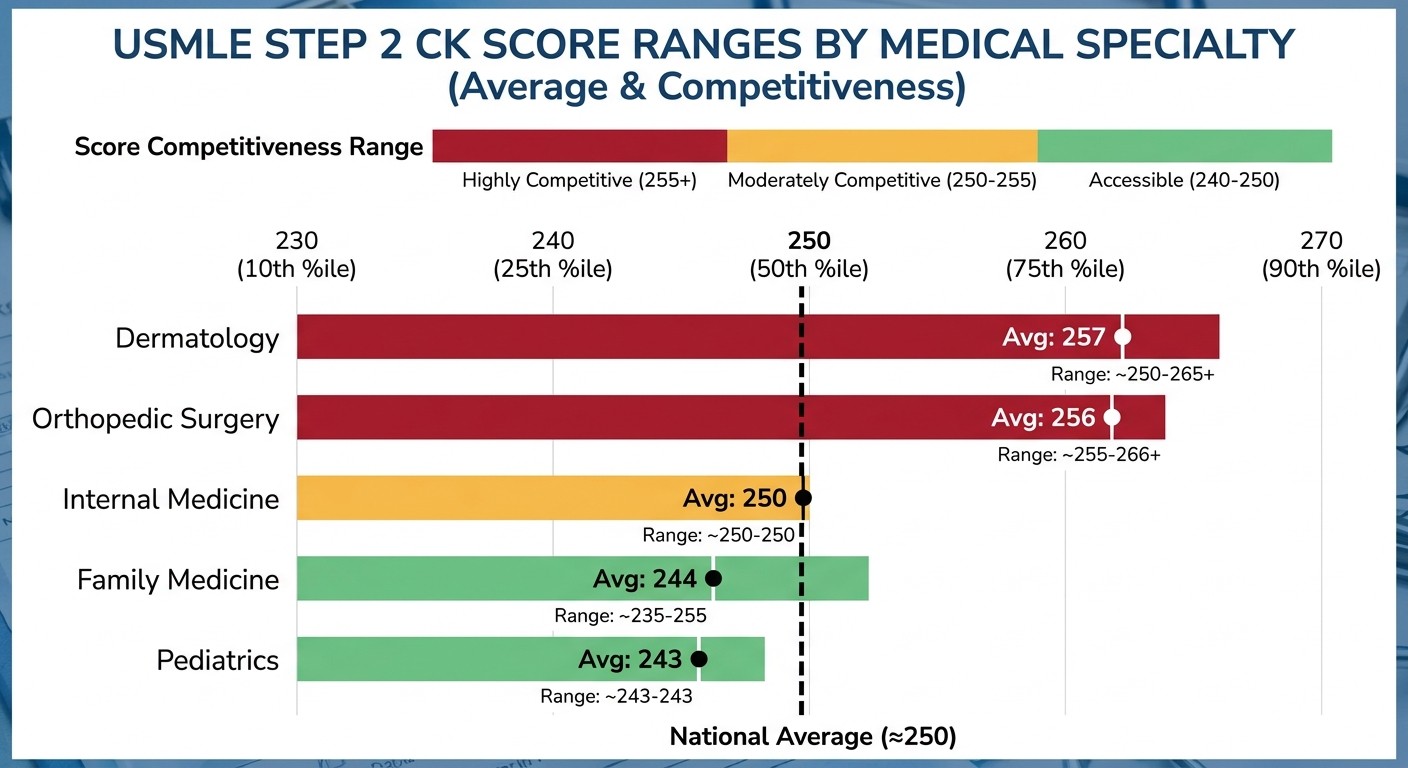
Average Step 2 CK Scores by Medical Specialty
Here's the complete breakdown of average scores for matched applicants by specialty, based on 2026 Match data:
Ultra-Competitive Specialties (255+ Average)
Dermatology: 257 — The holy grail of lifestyle specialties
Orthopedic Surgery: 257 — Procedural prestige with brutal hours
Diagnostic Radiology: 256 — High-tech, relatively good lifestyle
Plastic Surgery: 256 — Competitive beyond belief
Otolaryngology: 256 — ENT surgery with excellent work-life balance
Highly Competitive (250-254 Average)
Neurosurgery: 254 — Long training, high stakes
Radiation Oncology: 254 — Limited spots, high income
Urology: 253 — Competitive surgery subspecialty
General Surgery: 252 — Foundation for surgical careers
Vascular Surgery: 253 — Emerging high-demand field
Moderately Competitive (245-249 Average)
Anesthesiology: 250 — Procedural medicine with good hours
Internal Medicine: 250 — Gateway to numerous fellowships
Emergency Medicine: 249 — Shift work, high acuity
Obstetrics & Gynecology: 249 — Mix of surgery and primary care
Neurology: 249 — Growing field with aging population
Accessible Specialties (240-247 Average)
Physical Medicine & Rehab: 247 — Lifestyle-focused rehabilitation
Pediatrics: 247 — Primary care for children
Psychiatry: 246 — Mental health focus, increasing demand
Family Medicine: 244 — Broad primary care training
Understanding the Score Gaps
The 13-point spread between family medicine (244) and dermatology (257) represents more than numbers — it reflects preparation strategy differences. Students targeting ultra-competitive specialties typically:
Start Step 2 prep 6-8 months earlier
Complete 3,000+ practice questions (vs. 1,500 for accessible specialties)
Use multiple question banks plus AI-powered explanation systems
Focus heavily on weak-area remediation through adaptive learning
Step 2 CK Percentile Interpretation Guide
Raw scores mean nothing without percentile context. Here's how your three-digit score translates to competitive standing:
Percentile Breakdown (2026 Data)
270+: 95th+ percentile — Exceptional performance, any specialty within reach
265-269: 87th-94th percentile — Excellent score, competitive for top-tier programs
260-264: 76th-86th percentile — Very strong performance
255-259: 63rd-75th percentile — Above average, good for most specialties
250-254: 50th-62nd percentile — Around national average
245-249: 37th-49th percentile — Below average, limits competitive options
240-244: 26th-36th percentile — Concerning for competitive specialties
235-239: 18th-25th percentile — Focus on accessible specialties
230-234: 12th-17th percentile — May need score improvement
218-229: 3rd-11th percentile — Consider retake for competitive matching
Specialty-Specific Percentile Targets
If you are targeting dermatology with a 247, you are sitting at the 37th percentile while the average admitted student scores at the 75th percentile. That 10-point gap represents months of focused preparation difference.
For internal medicine, that same 247 puts you slightly below average but still very much in the running. Context changes everything.
How Score Deficits Impact Match Strategy
When your score falls below specialty averages, you have three strategic options:
Option 1: Score Improvement Through Retake
Timeline: 3-6 months additional preparation
Cost: $2,000+ (exam fees, study materials, opportunity cost)
Risk: Score could plateau or decrease
Rezzy advantage: Identifies exact weak areas to target efficiently
Option 2: Specialty Pivot
Timeline: Immediate application cycle adjustment
Strategy: Apply broadly to specialties matching your score range
Success rate: Higher match probability
Emotional cost: Letting go of original specialty goal
Option 3: Enhanced Application Strategy
Compensation: Exceptional research, clinical experience, connections
Timeline: Often requires gap year(s) for CV building
Success stories: Students matching competitive specialties 10+ points below average
Reality check: Increasingly rare in score-driven environment
Where Rezzy AI Tutor Changes the Game
Traditional Step 2 prep follows a predictable pattern: buy UWorld, grind through 3,000 questions, hope your weak areas improve naturally. This works fine if you have unlimited time and your baseline knowledge is already strong.
But what if you are an IMG with content gaps? Or a DO student competing against MDs with higher average scores? Or someone who needs to jump from 245 to 255 in 4 months? Thats where adaptive AI tutoring becomes transformational.
The Traditional Prep Problem
Standard question banks give you the same explanation whether you missed a cardiology question because you dont understand murmur characteristics or because you confused drug mechanisms. The explanation covers everything generically, wasting time on concepts you already know while glossing over your actual knowledge gap.
When you miss 20 questions on a practice block, you get 20 dense explanations to read. Maybe you understand 15 of them immediately, struggle with 3, and completely miss the point on 2. But the system treats all 20 identically.
How Rezzy Transforms This Process
Rezzy AI tutor analyzes your wrong answers differently. When you miss that cardiology question, it asks: "What specifically went wrong?" Then it delivers a targeted explanation addressing your exact gap. Scenario 1: You picked the wrong murmur because you confused timing (systolic vs. diastolic). Rezzy generates a focused timing comparison table, skipping the pathophysiology you already understand. Scenario 2: You knew the murmur but picked the wrong next step because you dont understand echo indications. Rezzy pivots to diagnostic algorithms, not murmur sounds. Scenario 3: You got lost in the clinical vignette and never identified the core condition. Rezzy teaches vignette parsing strategies specific to your reasoning gaps.
This targeted approach means each explanation directly addresses your learning need instead of providing generic content that may or may not help.
Explanation Chat: Real-Time Clarification
After Rezzy delivers a targeted explanation, you can chat for clarification:
You: "I understand the murmur timing now, but why wouldn't you get an echo immediately?" Rezzy: "Great question. In AS, echo is indicated when there's clinical suspicion, but this patient's murmur is grade 2/6 with no symptoms. The next step is usually..." You: "Create a comparison table for when to echo vs. monitor in aortic stenosis" Rezzy: [Generates custom table matching your learning style] You: "Give me 3 more similar cases to practice this concept" Rezzy: [Creates practice scenarios targeting this exact reasoning pattern]
This back-and-forth prevents the common problem of "reading an explanation but still feeling confused." You get clarification in real-time instead of moving on with partial understanding.
Adaptive Weak-Area Analytics
Traditional prep tracks overall percentage correct. Rezzy tracks why you get questions wrong and how those reasons cluster across subjects.
Instead of "Cardiology: 68% correct," you see:
Murmur identification: 45% correct — Major gap
Heart failure management: 78% correct — Solid
ECG interpretation: 82% correct — Strong
Drug mechanisms: 52% correct — Moderate gap
This granularity lets you spend time where it matters most. If you need a 10-point score boost, you dont improve equally across all topics — you eliminate your biggest gaps first.
Building Your Score Improvement Plan
Whether you are aiming for your target specialty average or trying to exceed it for safety, systematic preparation beats random question-grinding every time.
Phase 1: Diagnostic Assessment (Week 1-2)
Take a comprehensive practice exam to establish baseline performance. Rezzy analyzes results to identify subject-matter and reasoning-pattern weaknesses.
Focus areas typically include:
Content gaps: Missing knowledge in specific diseases/drugs/procedures
Reasoning errors: Consistently picking second-best answers due to decision-making flaws
Vignette parsing: Getting lost in clinical scenarios and missing key details
Time pressure: Running out of time due to overthinking or slow reading
Phase 2: Targeted Content Review (Week 3-8)
Rather than reviewing entire subjects linearly, focus on your identified weak areas. Use Step 2 CK lessons to build foundation knowledge, then immediately practice with questions targeting those concepts.
For example, if you are weak in pulmonology drug mechanisms:
1. Review beta-agonist, anticholinergic, and steroid mechanisms
2. Practice 50 questions mixing these drug classes
3. Use Rezzy to clarify any persistent confusion
4. Take a mixed pulmonology block to test improvement
Phase 3: Integrated Practice (Week 9-16)
Begin full-length practice exams while maintaining targeted weak-area work. As new gaps emerge, immediately address them with focused study rather than general review.
Rezzy helps maintain this balance by automatically adjusting question recommendations based on recent performance. If your cardiology scores start dropping, it increases cardiology representation in your daily practice.
Phase 4: Test-Taking Optimization (Week 17-20)
Focus on timing, stress management, and decision-making under pressure. Practice full-length exams under testing conditions. Use Rezzy's voice mode for verbal reasoning practice — explaining your thinking out loud often reveals decision-making errors you dont notice when reasoning silently.
Frequently Asked Questions
How accurate are average Step 2 scores by specialty?
The NRMP data represents matched applicants only, not all applicants. Unmatched students typically score 5-15 points lower depending on the specialty. These averages should be viewed as competitive benchmarks, not minimum requirements.
Can I match a competitive specialty with below-average Step 2 scores?
Yes, but its increasingly difficult. Strong research, clinical grades, connections, and fit can compensate for modest score deficits (5-10 points). However, programs often use score cutoffs for initial screening, so you may not get the chance to demonstrate other strengths.
Should I retake Step 2 CK if I score below my target specialty average?
Consider retaking if: (1) you scored 10+ points below your target specialty average, (2) you have time for 3-4 months of focused preparation, and (3) practice exams suggest significant improvement potential. Avoid retaking if you are within 5 points of the specialty average — use that time for application strengthening instead.
How much can AI tutoring realistically improve Step 2 scores?
Students using adaptive AI systems like Rezzy typically see 8-15 point improvements over traditional methods, particularly those with specific content gaps or reasoning pattern issues. The improvement comes from efficiency — spending study time on actual weaknesses rather than random review.
Does Step 2 timing matter for different specialties?
Ultra-competitive specialties (dermatology, ortho, radiology) often conduct interviews early. Taking Step 2 by June of application year ensures scores are available for early decision cycles. Less competitive specialties are more flexible with timing.
How do IMG scores compare to US MD scores by specialty?
IMG averages run 10-15 points lower across most specialties. For matched IMGs, internal medicine averages 244 (vs. 250 for US MDs), while competitive specialties see similar gaps. IMGs often need scores significantly above US MD averages to be competitive.
---
The Step 2 CK score landscape grows more competitive each year, but understanding specialty benchmarks gives you strategic clarity. Whether you are targeting family medicine at 244 or pushing for dermatology at 257, adaptive AI tutoring like Rezzy transforms preparation from generic review to precision targeting of your specific gaps.
Prepare smarter with Oncourse AI — adaptive MCQs, spaced repetition, and AI explanations built for USMLE Step 2 CK. Download free on Android and iOS.