Back
NExT Exam Study Plan: How MBBS Students Should Prepare for Clinical Reasoning and Final-Year Revision
Complete NExT exam study plan for MBBS students focusing on clinical reasoning, case-based learning, and final-year revision strategies. 6-month preparation guide with subject-wise approaches.

NExT Exam Study Plan: How MBBS Students Should Prepare for Clinical Reasoning and Final-Year Revision
You are probably staring at your Medicine textbook right now, wondering how to bridge the gap between memorizing disease classifications and actually thinking like a doctor for NExT. The National Exit Test isnt just another exam — it tests whether you can diagnose, reason, and manage real patients under pressure.
With NExT Step 1 targeting 540 questions focused 65% on problem-solving and clinical reasoning, your final-year revision strategy needs to flip from passive reading to active case-based thinking. Students who nail NExT dont just know more facts; they think differently about clinical scenarios.
This guide breaks down exactly how to transform your MBBS final-year preparation into NExT-ready clinical reasoning skills, with a practical 6-month study plan that builds diagnostic confidence across Medicine, Surgery, Pediatrics, and OB-GYN.
Understanding NExT Clinical Reasoning Requirements
What Makes NExT Different from Traditional MBBS Exams
NExT Step 1 emphasizes integrated clinical thinking over subject silos. Instead of separate Medicine and Surgery papers, you face 540 questions that test how these subjects interconnect in real patient care.
Key differences that matter:
65% analytical questions vs 35% recall
Case vignettes with multiple data points
Time pressure: 90 seconds per question
Integrated subjects within single scenarios
Emphasis on differential diagnosis and next-best-step reasoning
Clinical Reasoning Skills NExT Tests
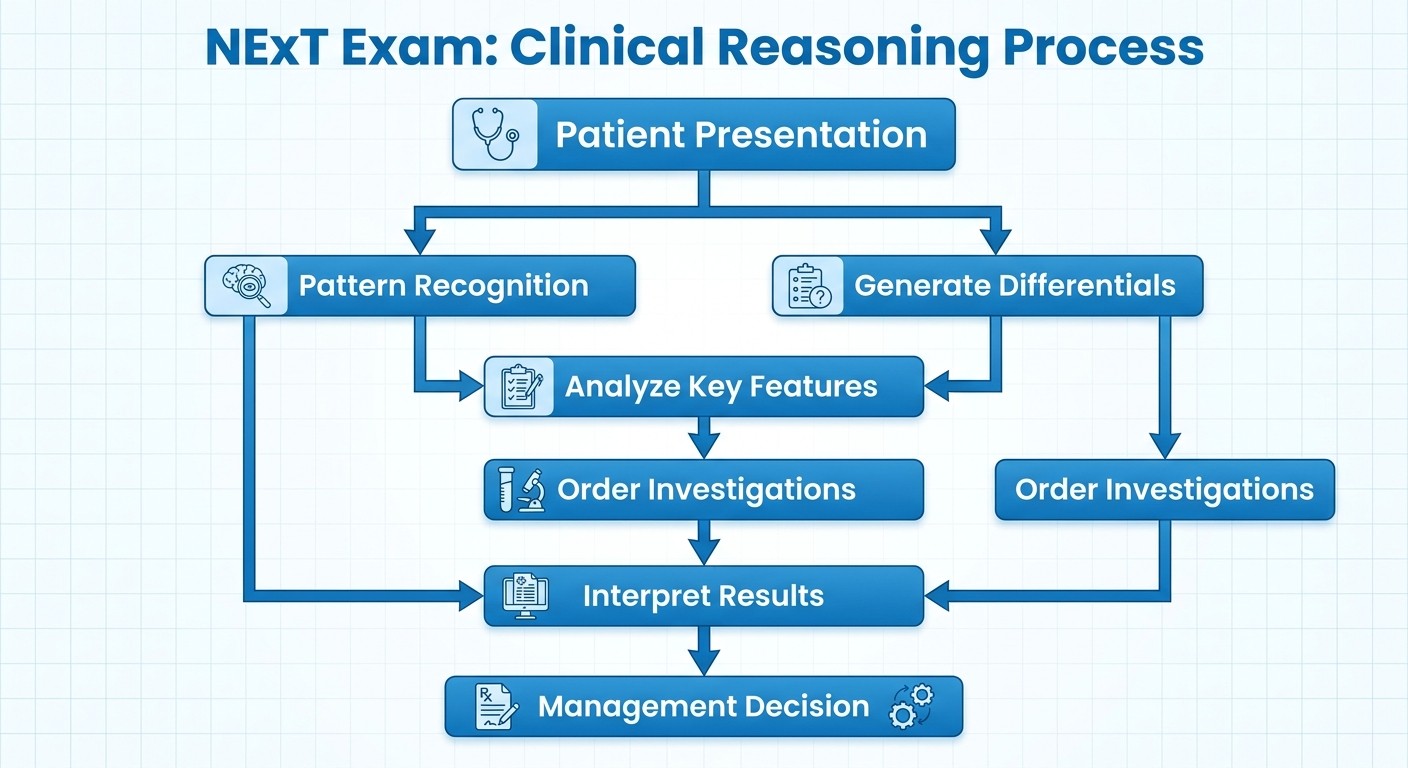
The exam evaluates five core reasoning competencies:
1. Pattern recognition — matching presenting complaints to disease patterns
2. Differential generation — systematically ruling in/out conditions
3. Data integration — combining history, examination, and investigation findings
4. Risk stratification — identifying red flags and urgent interventions
5. Management prioritization — choosing appropriate next steps
These skills cant be crammed. They require months of deliberate case-based practice during your final-year rotations.
The 6-Month NExT Study Plan for Clinical Reasoning
Months 1-2: Foundation Building and System Integration
Week 1-4: Core Concepts with Clinical Context
Start each system by understanding pathophysiology through clinical presentations. When studying cardiovascular system, dont just learn heart failure classifications — understand how a 65-year-old with SOB, pedal edema, and raised JVP presents differently from a 30-year-old with acute MI.
During your Medicine posting, actively connect ward patients to textbook concepts. For each case you encounter, ask yourself: What made this diagnosis obvious? What could have confused the picture?
Week 5-8: Cross-System Integration
Begin linking systems through common presentations. Chest pain involves cardiology, pulmonology, gastroenterology, and psychiatry. Practice generating comprehensive differentials that span multiple specialties.
Use Oncourse AI lessons to build strong conceptual foundations across clinical subjects. After reading a lesson on acute coronary syndromes, open Rezzy and ask it to explain why troponin elevation happens in different scenarios, then request a few differential diagnosis cases to test your reasoning.
Months 3-4: Case-Based Application and Weak Area Repair
Week 9-12: Diagnostic Reasoning Practice
This phase focuses on converting knowledge into diagnostic skills. For every clinical case you encounter:
1. Generate your differential before looking at investigations
2. Predict which tests would be most useful
3. Interpret results and revise your differential
4. Choose management based on most likely diagnosis
Practice 20-30 case-based MCQs daily, focusing on thinking process rather than just getting answers right. When you miss questions, identify whether the gap was knowledge-based or reasoning-based.
Week 13-16: Weak Area Identification and Repair
Use your MCQ performance data to identify consistent weak areas. Common weak spots for final-year students include:
Pediatric dose calculations and age-specific normal values
Obstetric emergency management sequences
Surgical decision-making and operative indications
Pharmacology in special populations (pregnancy, elderly, renal impairment)
For identified weak areas, go deeper than surface revision. If you struggle with pediatric fever management, dont just memorize guidelines — understand the physiologic differences that make children more vulnerable to dehydration and sepsis.
Months 5-6: Advanced Clinical Reasoning and Mock Testing
Week 17-20: Complex Case Analysis
Focus on multi-system cases and atypical presentations. NExT often presents cases where the obvious diagnosis is wrong, testing whether you can think beyond common patterns.
Practice cases where:
A young patient presents with "chest pain" but has aortic dissection
"Simple pneumonia" turns out to be pulmonary embolism
"Gastritis" symptoms mask acute MI in diabetic women
This is where Clinical Rounds becomes invaluable for practicing complex diagnostic scenarios that mirror NExT case complexity.
Week 21-24: Speed and Accuracy Under Pressure
Simulate exam conditions with timed practice sessions. Start with 2-hour blocks of 80 questions, building up to full-length 540-question mock tests.
During timed practice, track not just accuracy but reasoning speed. Can you generate a reasonable differential within 30 seconds? Can you eliminate wrong options quickly without second-guessing?
Use Oncourse AI's weak-area analytics to monitor your progress across different clinical domains. The platform tracks your performance patterns and suggests focused revision topics based on your mistake patterns.
Subject-Wise Clinical Reasoning Strategies
Medicine: From Symptoms to Systems Thinking
Medicine questions in NExT test your ability to work through complex medical cases systematically. Instead of asking "What is the treatment for diabetes?", expect scenarios like: "A 45-year-old diabetic presents with chest pain, normal ECG, but elevated troponin. Next best step?"
High-yield Medicine reasoning patterns:
Chest pain: Always consider ACS, PE, aortic dissection, pneumothorax
SOB: Heart failure vs respiratory vs anemia vs anxiety
Altered mental status: Hypoglycemia, stroke, infection, metabolic
Fever: Infection source, drug fever, autoimmune, malignancy
When studying Medicine cases, practice the "worst first" principle — always consider life-threatening conditions before benign ones, even if theyre less common.
Surgery: Decision Trees and Operative Indications
Surgical reasoning in NExT focuses on when to operate, when to observe, and when to refer. These arent memorization questions — they test clinical judgment.
Key surgical reasoning skills:
Acute abdomen: Differentiating surgical vs medical causes
Trauma: ATLS principles and damage control surgery
Oncology: Staging, operability, and multidisciplinary planning
Vascular: Emergency vs elective intervention timing
For surgical cases, always think: "Is this patient stable enough for surgery? What are the risks vs benefits? What would happen if we wait?"
Pediatrics: Age-Specific Reasoning and Development
Pediatric cases test whether you understand how diseases present differently across age groups. A febrile 3-month-old requires different reasoning than a febrile 3-year-old.
Critical pediatric reasoning points:
Neonatal: Think sepsis, metabolic disorders, congenital anomalies
Infant: Respiratory distress, failure to thrive, developmental delays
Child: Infectious diseases, trauma, behavioral concerns
Adolescent: Risk-taking behaviors, eating disorders, substance use
Practice pediatric clinical cases with emphasis on age-appropriate differential diagnosis and management.
Obstetrics & Gynecology: Time-Sensitive Decision Making
OB-GYN cases in NExT often involve emergency scenarios where timing matters. These questions test whether you can prioritize interventions and recognize when immediate delivery or surgery is needed.
Essential OB-GYN reasoning:
Antepartum bleeding: Placenta previa vs abruption vs other causes
Hypertensive disorders: Preeclampsia progression and timing of delivery
Labor complications: When to intervene vs when to observe
Gynecologic emergencies: Ectopic pregnancy, ovarian torsion, PID
For every OB-GYN scenario, ask: "Is mother stable? Is baby stable? What is the time-sensitive intervention needed?"
Converting Passive Reading into Active Clinical Reasoning
The Case-Based Study Method
Traditional MBBS study involves reading chapters sequentially. NExT preparation requires case-based learning where you encounter diseases through patient presentations.
How to transform your textbook reading:
1. Before reading: Look at the chapter title and create a mental patient who would have this condition
2. While reading: Connect every fact to how it would manifest in real patients
3. After reading: Create your own case scenarios testing the key concepts
For example, when studying pneumonia, dont just memorize causative organisms. Create mental cases: "65-year-old smoker with productive cough and fever" vs "30-year-old healthy adult with dry cough and fatigue" — different organisms, different treatments.
Using AI for Interactive Case Discussion
After studying a topic in your textbooks, open the relevant lesson on Oncourse AI and start a chat with Rezzy. Ask questions like "explain this pathology mechanism in simpler steps" or "quiz me on the key differentials for this presentation."
This converts passive reading into active dialogue. Instead of just rereading your notes, you can have a personalized discussion about why certain symptoms point to specific diagnoses and request follow-up cases to test your understanding.
Ward-Based Learning Integration
Your clinical postings are NExT preparation gold mines. Every patient you see is a potential exam question. For each patient:
1. Before entering: Based on the chief complaint, generate your differential
2. During history/examination: Note which findings support or refute your hypotheses
3. After seeing results: Understand why the final diagnosis was reached
4. Later that day: Create a similar case scenario and test a peer
The key is active engagement rather than passive observation during ward rounds.
Time Management and Question Selection Strategies
The 90-Second Rule for Case Analysis
NExT gives you roughly 90 seconds per question. For complex clinical scenarios, this breaks down to:
Reading/comprehension: 25-30 seconds
Analysis/differential thinking: 35-40 seconds
Option evaluation and selection: 20-25 seconds
Final check: 5-10 seconds
Practice this breakdown during your preparation. Use a timer during practice sessions to build speed without sacrificing accuracy.
Triage Approach for Difficult Questions
Not every NExT question will be solvable within 90 seconds. Develop a triage system:
Green (60-70% of questions): Clear pattern recognition, straightforward diagnosis Yellow (20-25% of questions): Requires some analysis but manageable within time limit Red (10-15% of questions): Complex or unfamiliar — make educated guess and move on
Never spend 5 minutes on one question at the cost of missing 3 easier ones later.
Managing Test Anxiety and Decision Fatigue
540 questions create significant mental fatigue. During months 5-6, practice endurance building:
Take full-length practice tests in single sittings
Practice deep breathing between difficult question blocks
Develop a consistent approach that doesnt require constant decision-making about method
Weak Area Identification and Targeted Revision
Using Performance Data for Strategic Study
Your practice MCQ results reveal patterns that textbooks cant. Common weak area patterns include:
Knowledge gaps: Consistently missing questions from specific topics Reasoning errors: Getting similar question types wrong despite knowing the content Test-taking mistakes: Misreading questions or falling for distractors Timing issues: Running out of time in specific sections
Track these patterns weekly and adjust your study focus accordingly.
The 80/20 Rule for Clinical Topics
Focus your revision energy on high-yield topics that appear frequently in clinical practice and exams:
Medicine (25% of questions): ACS, heart failure, diabetes, COPD, pneumonia Surgery (20% of questions): Acute abdomen, trauma, appendicitis, hernias Pediatrics (20% of questions): Respiratory infections, fever without focus, growth issues OB-GYN (20% of questions): Normal pregnancy, labor abnormalities, contraception Others (15% of questions): ENT, Ophthalmology, Dermatology, Psychiatry
While you need broad knowledge, spending 60% of your study time on these high-yield areas maximizes your score improvement.
Creating Personal Clinical Reasoning Checklists
Develop standardized approaches for common presentation categories:
Chest Pain Checklist:
Cardiac: ECG, troponin, risk factors
Pulmonary: CXR, D-dimer, oxygen saturation
GI: Response to antacids, endoscopy indications
MSK: Reproducible with palpation, improvement with rest
Shortness of Breath Checklist:
Cardiac: Echo, BNP, JVP assessment
Pulmonary: Spirometry, CXR, ABG
Systemic: CBC, metabolic panel, thyroid function
These checklists provide structure during high-pressure exam conditions when complex reasoning becomes difficult.
Frequently Asked Questions
How early should I start NExT preparation during MBBS?
Start integrating clinical reasoning practice during your final year clinical postings. While you cant begin intensive NExT prep until concepts are solid, you can develop reasoning skills throughout your clinical rotations. Use every patient encounter as practice for generating differentials and understanding disease presentations.
Can I prepare for NExT while managing final year MBBS exams?
Yes, but requires strategic integration. Use your MBBS exam preparation as NExT foundation building. When studying for Medicine finals, simultaneously practice case-based MCQs that test the same concepts. Your university exams become stepping stones rather than separate burdens.
How many practice questions should I solve daily?
Start with 20-30 case-based questions daily during months 1-4, increasing to 50-80 questions during months 5-6. Focus on quality over quantity — spending 5 minutes analyzing why you missed a question is worth more than rushing through 10 additional questions.
What if I have weak clinical exposure during MBBS?
Supplement limited clinical exposure with high-quality case-based learning platforms. Virtual patient scenarios, clinical reasoning games, and AI-powered case discussions can partially compensate for limited ward experience. Focus on pattern recognition through diverse case scenarios.
How do I balance Step 1 preparation with Step 2 practical skills?
Step 1 success creates the foundation for Step 2. Strong clinical reasoning and case analysis skills directly translate to better practical performance. During Step 1 prep, maintain hands-on clinical skills through regular patient interaction, OSCE practice, and procedural skill maintenance.
Should I focus more on breadth or depth in clinical subjects?
NExT rewards breadth with sufficient depth in high-yield areas. You need working knowledge across all clinical subjects, but deeper expertise in Medicine, Surgery, Pediatrics, and OB-GYN. Aim for 70% depth in major subjects and 40% depth in minor subjects.
The NExT exam represents a fundamental shift toward competency-based assessment in Indian medical education. Success requires more than knowledge accumulation — it demands clinical reasoning skills that will serve you throughout your medical career.
Your final-year MBBS preparation is the perfect time to develop these reasoning abilities through case-based learning, active ward participation, and systematic practice. The students who excel at NExT arent necessarily those who studied the most hours, but those who learned to think like doctors while others were still memorizing like students.
Prepare smarter with Oncourse AI — adaptive MCQs, spaced repetition, and AI explanations built for NExT exam success. Download free on Android and iOS.