Back
FMGE Mock Test Strategy 2026: How to Review Mistakes and Improve Before the Exam
Master your FMGE mock test strategy for 2026. Learn the 3-pass review system, classify mistakes into 5 categories, build error logs, and convert mock results into targeted revision plans.

FMGE Mock Test Strategy 2026: How to Review Mistakes and Improve Before the Exam
You probably think taking mock tests is the hard part. Actually, its what you do after hitting submit that makes or breaks your FMGE score.
Every June and December, thousands of foreign medical graduates sit through 300 questions in 5 hours, knowing they need just 150 correct answers to pass. Most walk out wondering if they made it. The ones who clear on first attempt? They dont just take more mocks — they extract more value from each one.
Here's the problem: scoring 140 feels promising, then you hit 138, then 142. You're stuck in the same range because you're making the same mistakes. The solution isnt more practice. Its smarter review.
Important: Always verify current FMGE exam dates, eligibility criteria, syllabus changes, and exam pattern updates from the latest NBE/NMC official bulletins, as these may change from the information referenced in this article.
Why Taking Mocks Isnt Enough
Most FMGE candidates treat mock tests like practice runs. Take the test, check the score, maybe glance at explanations for wrong answers, move on. This approach wastes 80% of each mock's learning potential.
Every incorrect answer contains data about your knowledge gaps, thinking patterns, and exam technique. When you skip detailed review, you're essentially taking the same test over and over — different questions, same underlying weaknesses.
Consider this: a 140-scorer typically gets Medicine questions right 65% of the time, but Surgery only 55%. Without tracking these patterns, they'll keep allocating equal study time to both subjects. Result? Scores plateau.
The students who jump from 140 to 160+ in 4-6 weeks dont suddenly become smarter. They become systematic about converting mock results into targeted action plans.
The 3-Pass Mock Review System
Effective mock review happens in three distinct passes, not one rushed session. Each pass has a specific purpose and timeline.
Pass 1: Immediate Reaction (Day 0, 30 minutes)
Right after your mock, while questions are fresh, do this quick scan:
Note your overall score and time usage
Identify 2-3 subjects where you clearly struggled
Flag questions where you knew the answer but selected wrong (careless errors)
Mark questions you spent over 2 minutes on
Dont dive into explanations yet. This pass captures your test-taking experience while its still accurate.
Pass 2: Deep Analysis (Day 1, 90-120 minutes)
This is where real learning happens. Review every single question — right and wrong. For each incorrect answer:
1. Read the explanation completely
2. Understand why your choice was wrong
3. Verify why the correct option is right
4. Note if this represents a knowledge gap or thinking error
For questions you got right, spend 30 seconds confirming you chose correctly for the right reasons. Sometimes you get lucky with educated guesses — mark these as knowledge gaps.
During this pass, you'll often find yourself thinking "I should have known this" or "I always confuse these two conditions." Write these insights down.
Pass 3: Strategic Review (Day 7, 45 minutes)
A week later, quickly revisit your analysis. This delayed review reveals whether the concepts stuck or if you need additional reinforcement.
Test yourself on 2-3 concepts you got wrong initially. If you still struggle, these become priority topics for your next study session.
Classifying Your Mistakes: The 5-Category System
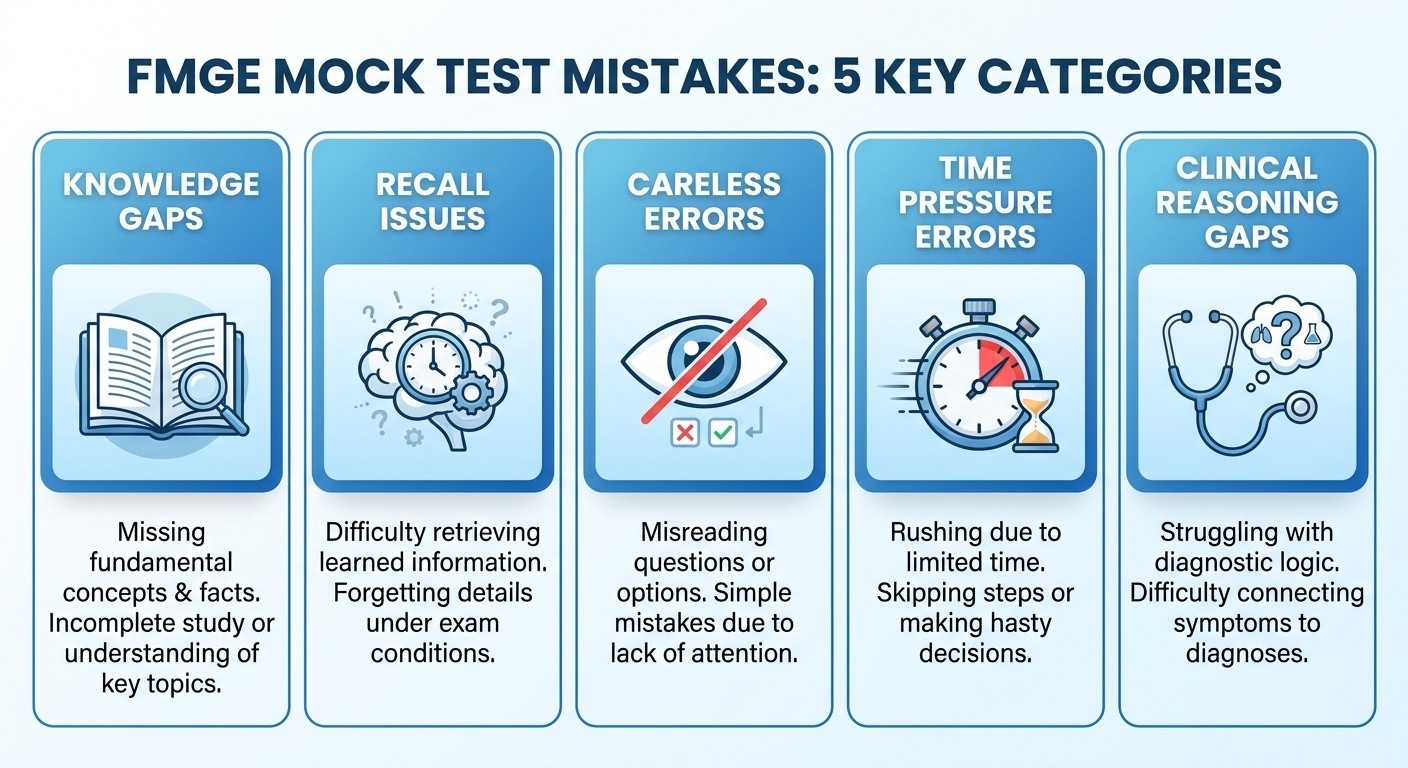
Not all mistakes are equal. A careless error needs different treatment than a knowledge gap. Use these five categories to sort every incorrect answer:
Category 1: Knowledge Gaps
You genuinely didnt know the concept. Maybe you've never encountered Henoch-Schönlein purpura or cant recall the stages of wound healing.
Review approach: Study the topic thoroughly, then practice 10-15 related MCQs.
Category 2: Recall Issues
You know the information but couldnt retrieve it under time pressure. Classic example: knowing diabetes complications but drawing a blank when asked about diabetic nephropathy stages.
Review approach: Focus on active recall techniques and spaced repetition. Oncourse's flashcard system works well here — quick, repeated exposure helps solidify retrieval pathways.
Category 3: Careless Errors
You knew the answer but marked wrong due to inattention. Misreading "not" in the stem, confusing similar-looking options, or simple clicking errors.
Review approach: Practice reading stems more carefully. Underline key words like "not," "except," "most likely."
Category 4: Time-Pressure Errors
You would have gotten it right with more time, but rushed due to clock pressure. Often happens in the last 50 questions when you're racing to finish.
Review approach: Work on time management and question prioritization strategies.
Category 5: Clinical Reasoning Gaps
You have the facts but struggle with application. Know that ACE inhibitors cause hyperkalemia but miss it in a complex case scenario.
Review approach: Practice more case-based questions and work on connecting factual knowledge to clinical contexts.
Track these categories across multiple mocks. If 40% of your errors are careless mistakes, you need different strategies than someone with 60% knowledge gaps.
Building Your Error Log System
An error log isnt just a list of wrong answers — its a strategic database that guides your study priorities. Here's how to build one that actually works:
Daily Error Tracking
After each mock or practice session, log:
Question topic/subject
Mistake category (from the 5 above)
Specific concept missed
Date attempted
Weekly Pattern Analysis
Every Sunday, review your error log for patterns:
Which subjects generate the most errors?
Are you making progress on previously identified weak areas?
What mistake category is most common?
Use your Oncourse daily plan to organize upcoming study sessions around these identified gaps. The platform tracks your practice accuracy across subjects, making it easier to spot repeated weak areas and adjust your focus accordingly.
Monthly Strategic Adjustments
Monthly review should answer: are my study methods working? If you logged 15 Pharmacology errors in Week 1 and still logging 12 in Week 4, your review approach needs tweaking.
Converting Mock Data into Weekly Revision Plans
Raw mock scores tell you where you stand. Mock analysis tells you where to go next. Here's how to turn your error patterns into actionable weekly plans:
The 70-20-10 Priority System
Based on your error log, divide your study time:
70% on subjects with highest error frequency
20% on moderate-weakness subjects
10% maintaining strong subjects
If your error log shows Medicine (25 errors), Surgery (18 errors), and Pediatrics (15 errors) as top three, they get priority allocation in next week's schedule.
Subject-Specific Action Plans
For each priority subject identified from mock analysis:
High error count (15+ mistakes): Dedicate 2-3 study sessions this week. Start with concept review, then targeted practice questions. Moderate errors (8-14 mistakes): One focused session plus daily quick reviews using flashcards. Low errors (1-7 mistakes): Maintain with 15-20 practice questions every few days.
When working through these targeted practice sessions, lean on Rezzy for instant explanations when you encounter confusing concepts. Quick AI clarification prevents small doubts from becoming bigger knowledge gaps.
Daily Plan Adjustments
Successful FMGE candidates dont stick rigidly to pre-made schedules. They adapt based on mock performance.
After each mock, adjust your upcoming 3-4 days:
Cancel or shorten sessions in strong subjects
Add extra time for newly identified weak areas
Schedule follow-up practice in mistake-heavy topics
Your study plan should feel dynamic, not predetermined. Mock results should directly influence tomorrow's priorities.
Mock Test Frequency by Preparation Phase
The right mock frequency changes as you progress through FMGE preparation. Taking too many too early wastes time; taking too few too late leaves gaps unaddressed.
Foundation Phase (Months 1-3)
Mock frequency: 1 full-length mock every 3 weeks Purpose: Baseline assessment and topic familiarization, not score optimization. Focus: Getting comfortable with 300-question format and computer interface. Dont stress about scores below 100 — you're still building knowledge base. Review emphasis: Heavy focus on knowledge gaps (Category 1). Most errors should fall here initially.
Revision Phase (Months 4-5)
Mock frequency: 1 full-length mock weekly, plus 2-3 subject-wise mocks Purpose: Identifying knowledge consolidation needs and improving test-taking efficiency. Focus: Scores should trend upward from 120s to 140s. Pay attention to time management patterns. Review emphasis: Balance between knowledge gaps and recall issues. Start tracking careless errors more carefully.
During this phase, explore relevant FMGE lessons for topics showing repeated errors. In-depth concept review becomes more targeted and efficient.
Final Month Phase
Mock frequency: 3-4 full-length mocks weekly Purpose: Score optimization, stamina building, and final weak area elimination. Focus: Fine-tuning rather than learning new concepts. Scores should consistently hit 150+ range. Review emphasis: Mostly careless errors and time-pressure issues. Knowledge gaps at this stage indicate critical revision needs.
Understanding Score Trends and What They Actually Mean
Mock scores fluctuate. Understanding why prevents panic and guides smart adjustments.
Normal Score Variations
Expect 10-15 point fluctuations between mocks due to:
Question difficulty variations
Subject mix differences
Your daily energy levels
Familiar vs unfamiliar topics
A 145-155-142-148 pattern suggests steady performance around your true level. Dont overreact to single low scores.
Concerning Score Patterns
Consistent decline: 155-148-142-135 indicates fatigue, burnout, or ineffective study methods. Plateau stagnation: 138-142-140-139 means current approach isnt addressing core weaknesses. Wild swings: 125-165-130-160 suggests inconsistent knowledge base or poor test-taking strategies.
Positive Score Trends
Steady climb: 135-142-148-152 shows effective learning and retention. Stable high range: 155-158-153-157 indicates exam readiness with minor fine-tuning needed.
When scores plateau, dig deeper into your error patterns. Often, breakthrough comes from addressing one specific weakness category rather than general "more practice."
Avoiding the Most Common Mock Review Traps
Even motivated candidates fall into these mock review mistakes that limit score improvement:
Trap 1: Reviewing Only Wrong Answers
Many students skip questions they got right, missing valuable learning opportunities.
Why this hurts: You might have guessed correctly or used flawed reasoning that happened to work. Better approach: Quick 30-second confirmation on correct answers. Did you choose right for right reasons?
Trap 2: Chasing Scores Without Analysis
Getting excited about a 160 or disappointed about a 135 without understanding what drove that performance.
Why this hurts: Emotions replace objective assessment. High scores from lucky guesses feel great but dont indicate readiness. Better approach: Focus on error categories and improvement trends, not absolute scores.
Trap 3: Skipping Weak Subjects
Avoiding Surgery mocks because "I always do poorly" or focusing only on comfortable topics.
Why this hurts: FMGE tests all subjects. You cant avoid major topics and still hit 150. Better approach: Take uncomfortable subject-wise mocks deliberately. Use poor performance as data for targeted improvement.
Trap 4: Delaying Full-Length Mocks
Practicing only topic-wise questions until feeling "ready" for full 300-question tests.
Why this hurts: Full-length stamina and time management are separate skills requiring practice. Better approach: Start full-length mocks by Month 2, even with incomplete syllabus. Early exposure builds endurance and realistic expectations.
Trap 5: Surface-Level Explanation Reading
Quickly reading why option C is correct without understanding why options A, B, and D are wrong.
Why this hurts: Misses opportunity to learn from wrong options and understand question construction. Better approach: For every question, understand all four options. This builds broader concept connections.
Turning Mock Mistakes into Revision Gold
The highest-value mock review happens when you transform specific mistakes into broader learning opportunities.
Cross-Topic Pattern Recognition
When you miss a Cardiology question about heart failure, dont just study heart failure. Ask: what other conditions present with similar symptoms? How do I differentiate them?
This approach turns single errors into comprehensive understanding across related topics.
Building Mental Frameworks
Instead of memorizing isolated facts from wrong answers, build decision trees and comparison frameworks.
Missed a question about chest pain causes? Create a systematic approach: onset, character, radiation, associated symptoms, risk factors. Apply this framework to practice questions until it becomes automatic.
Strategic Concept Linking
Use tools like Oncourse's mnemonic feature to connect related concepts that frequently appear in different questions. When you miss a pharmacology question about ACE inhibitors, review not just the specific mechanism but create memory links to related drug classes, contraindications, and clinical applications.
Active Application Practice
After identifying mistake patterns, seek out similar questions deliberately. Dont wait for them to appear randomly in future mocks.
If clinical reasoning gaps emerge around infectious disease cases, practice 20-30 similar scenarios within the next few days. Concentrated exposure accelerates improvement.
Building Exam-Day Resilience Through Smart Mock Practice
Mock tests arent just knowledge assessments — they're mental rehearsals for exam-day performance. Use them to build resilience against common exam-day challenges.
Simulating Pressure Situations
Deliberately practice under realistic stress:
Take mocks in noisy environments occasionally
Practice when slightly tired to simulate afternoon exam fatigue
Set strict time limits with no extensions
These controlled stress exposures build confidence for actual exam conditions.
Developing Recovery Strategies
During mocks, practice bouncing back from mistakes or difficult question streaks. When you encounter 3-4 hard questions in a row, how do you maintain composure?
Develop specific strategies: take three deep breaths, remind yourself that everyone faces hard questions, focus on the next answerable question. Practice these techniques during mocks so they become automatic.
Time Management Under Pressure
Use later-phase mocks to experiment with time allocation strategies:
Aim for first 100 questions in 90 minutes
Reserve 30 minutes for final review and uncertain questions
Practice identifying questions to skip quickly vs spend extra time on
Advanced Mock Analysis Techniques
Once basic error tracking becomes routine, add these sophisticated analysis methods:
Question Stem Analysis
Track how different question formats affect your performance:
Case scenarios vs direct knowledge questions
Questions with negative phrasing ("Which is NOT...")
Image-based vs text-only questions
Adjust your reading approach based on these patterns.
Option Elimination Tracking
For each wrong answer, note how many options you successfully eliminated before choosing incorrectly.
Getting down to two options before guessing wrong indicates different needs than having no idea among four choices.
Energy Level Correlation
Note your energy level before each mock (1-10 scale) and correlate with performance.
Some candidates perform better when slightly tired because they rely more on intuition and less on overthinking. Others need peak alertness.
Understanding your optimal energy state helps with exam scheduling and preparation timing.
Frequently Asked Questions
How many mocks should I take before FMGE 2026?
Minimum 15-20 full-length mocks across your preparation timeline. Start with 1 every 3 weeks in foundation phase, build to weekly mocks during revision, then 3-4 per week in the final month. Quality analysis matters more than total quantity.
What should I do if my mock scores keep fluctuating wildly?
Wild score swings (20+ point variations) usually indicate inconsistent knowledge base or poor test-taking strategies. Focus less on absolute scores and more on identifying your most common mistake categories. Stabilize your approach to reading questions and managing time before worrying about score trends.
Should I retake mocks I scored poorly on?
Retaking identical mocks isnt valuable — youll remember specific questions. Instead, take different mocks from the same source or find practice questions targeting your identified weak areas. Use poor performance as data for focused study, not grounds for repetition.
How long should I spend reviewing each mock test?
Plan 90-120 minutes for thorough analysis of each full-length mock — about half the time you spent taking it. Quick 30-minute reviews miss too much learning potential. Spread analysis over 2-3 sessions if needed, but dont skip the deep dive.
What if Im consistently scoring below 120 in mocks?
Scores below 120 indicate significant knowledge gaps that need systematic addressing. Reduce mock frequency temporarily and focus on targeted concept building. Review high-yield topics through structured lessons, then return to regular mock practice once foundational understanding improves.
How do I balance mock analysis time with new topic learning?
In foundation phase, prioritize new learning over extensive mock analysis. During revision phase, shift toward 60% review and 40% new content. Final month should be 80% analysis and weak area practice, 20% light concept reinforcement.
---
Mock tests reveal where you stand today. Smart mock analysis shows you exactly how to improve by tomorrow. The difference between FMGE success and repeated attempts often comes down to extracting maximum learning from each practice opportunity.
Your mock mistakes arent failures — they're data. Use them wisely.
Prepare smarter with Oncourse AI — adaptive MCQs, spaced repetition, and AI explanations built for FMGE success. Download free on Android and iOS.