FMGE Study Plan for the Last 60 Days: Revision, PYQs, and Mock Test Strategy
Complete 60-day FMGE study plan with phase-wise revision strategy, PYQ analysis methods, and mock test schedules. Turn your final weeks into scoring advantage.
FMGE Study Plan for the Last 60 Days: Revision, PYQs, and Mock Test Strategy
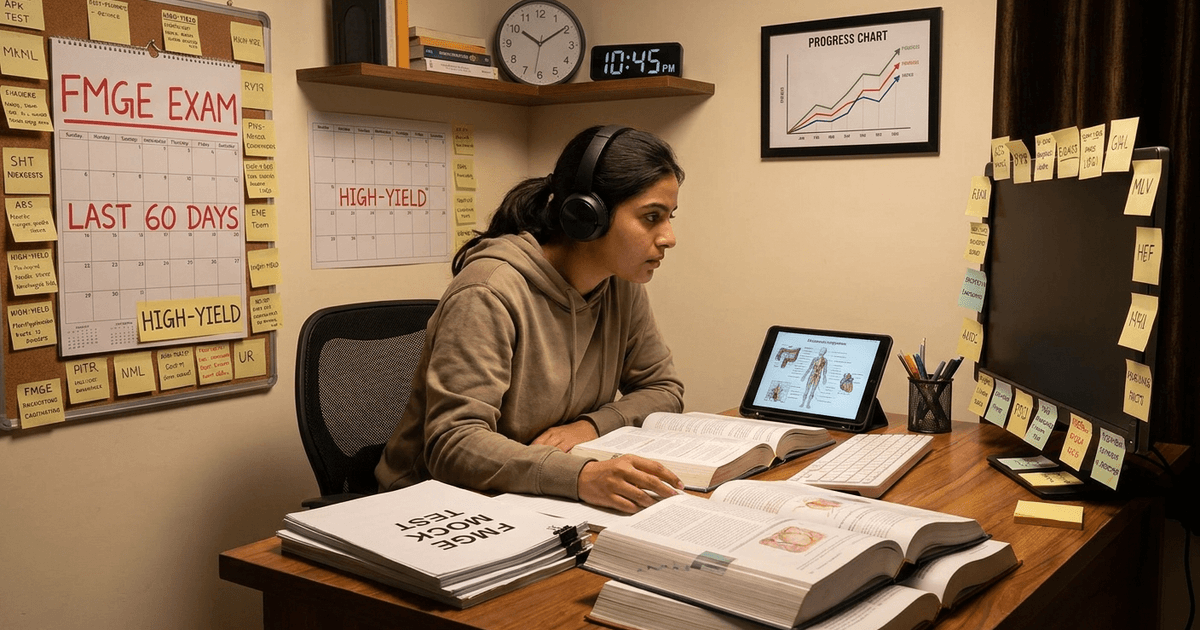
You are 60 days away from FMGE. The syllabus coverage phase is behind you — now comes the real test of converting knowledge into marks. This isnt about learning new topics anymore. These final 8 weeks are about recall speed, error correction, and building the exam temperament you need to tackle 300 questions in 5 hours.
Most FMGE aspirants make the mistake of treating the last 60 days like an extended study session. They keep reading new chapters, watching fresh videos, and collecting more notes. But NBEMS doesnt care how much you know — they care how quickly you can apply what you know under pressure.
The students who crack FMGE in this window shift their mindset entirely. They stop collecting information and start testing their recall. They stop avoiding weak areas and start attacking them systematically. They stop treating mock tests as practice rounds and start using them as diagnostic tools.
Here is your day-by-day blueprint to turn the next 60 days into your scoring advantage.
Why the Last 60 Days Are Different
FMGE is a recall-under-pressure exam, not a knowledge comprehension test. The final 60 days should focus entirely on:
Speed of recognition: Can you identify the answer within 60 seconds per question?
Error pattern correction: Why do you keep missing certain question types?
Stamina building: Can you maintain focus for 5 consecutive hours?
Volatile fact consolidation: Those drug dosages, cutoff values, and procedural steps that slip away
The shift happens when you realize FMGE success comes from eliminating mistakes faster than adding new knowledge. Every mock test, every PYQ session, and every revision block should serve that goal.
The 4-Phase 60-Day Framework
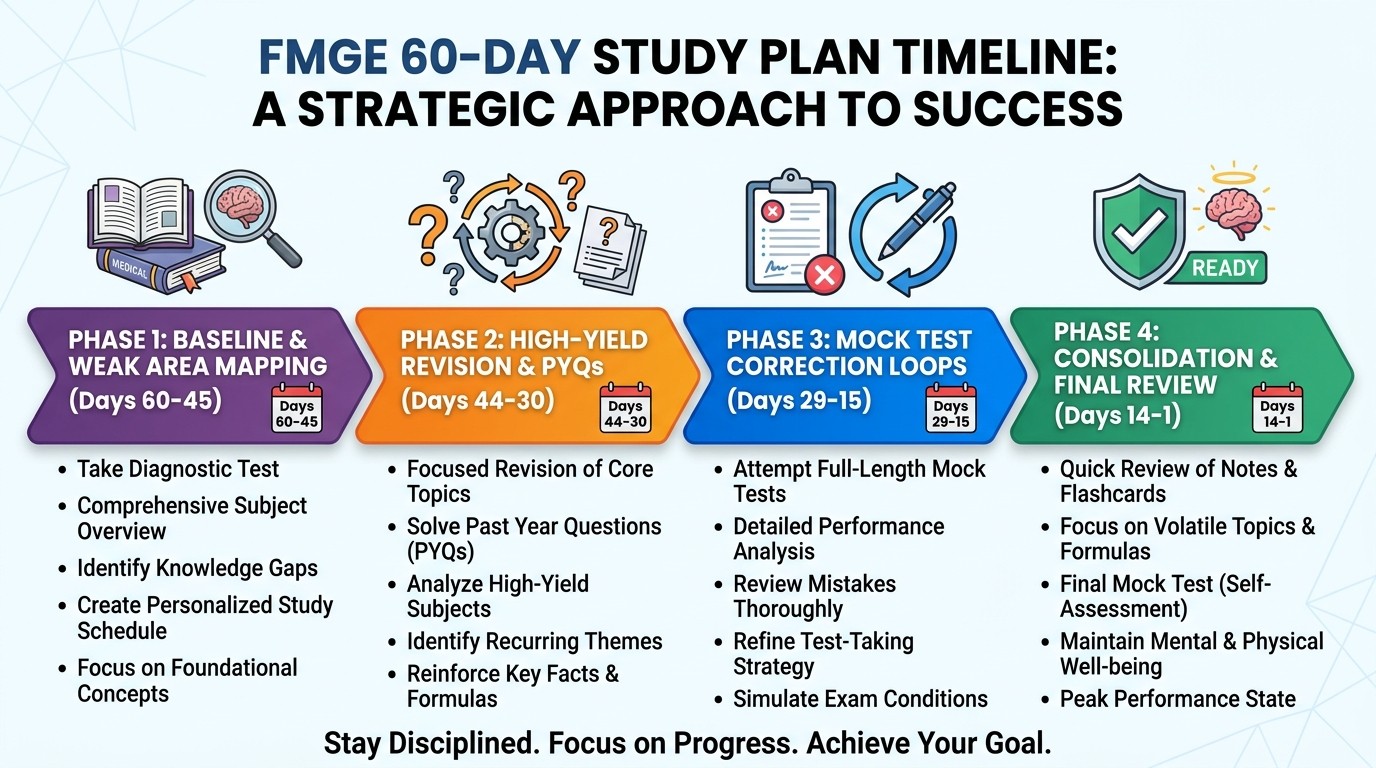
Phase 1: Baseline + Weak Area Mapping (Days 60-45)
Duration: 16 days Daily commitment: 8-10 hours Core objective: Map your current accuracy across all 19 subjects
Start with a comprehensive diagnostic. Take one full-length 300-question mock test on Day 60 under exam conditions. This baseline reveals your actual preparation level across subjects.
Daily structure:
6 AM - 10 AM: Subject-wise revision using condensed notes
10:30 AM - 1 PM: Topic-targeted PYQs (100-120 questions)
2 PM - 5 PM: Weak area focused study
5:30 PM - 7:30 PM: Mock analysis and error logging
8 PM - 10 PM: High-yield fact memorization
Week 1 focus (Days 60-54): Medicine, Surgery, OBG, Pediatrics Week 2 focus (Days 53-46): Pharmacology, Pathology, Microbiology, PSM Phase 1 checkpoint: By Day 45, you should have:
Completed 1,000+ PYQs across all subjects
Identified your 5 weakest topics
Built subject-wise error logs
Taken 2 additional full-length mocks
During this phase, I frequently used Oncourse's daily plan feature to convert my mock test results into targeted study blocks. After each practice session, the platform helped me identify which topics needed immediate attention and automatically scheduled focused revision sessions for the next day.
Phase 2: High-Yield Revision + PYQ Integration (Days 44-30)
Duration: 15 days Daily commitment: 10-12 hours Core objective: Master the 60/30/10 rule and eliminate knowledge gaps
The 60/30/10 rule: 60% time on clinical subjects (Medicine, Surgery, OBG, Pediatrics), 30% on predictable scorers (Pharmacology, Pathology, Microbiology, PSM), 10% on smaller specialties.
Daily structure:
5:30 AM - 9:30 AM: Clinical subjects rapid revision
10 AM - 1 PM: Subject-wise PYQs (150-180 questions)
2 PM - 4:30 PM: Predictable scorers focused study
5 PM - 7 PM: Mixed PYQ practice
8 PM - 10:30 PM: Volatile facts and formula memorization
Week 3 targets (Days 44-37):
Medicine: Focus on ECG interpretation, heart failure protocols, diabetic emergencies
Surgery: Trauma algorithms, wound management, GI bleeding protocols
Complete 1,200 PYQs with detailed error analysis
Week 4 targets (Days 36-30):
Pharmacology: Drug of choice lists, contraindications, ADR patterns
Pathology: Microscopy images, lab values, diagnostic criteria
Complete 1,000 PYQs with emphasis on image-based questions
For complex drug mechanisms and interactions, I regularly asked follow-up questions using Rezzy's explanation chat feature. This helped me understand not just the correct answer but why specific distractors were designed to confuse and how to avoid similar traps in future questions.
Phase 3: Mock Test Correction Loops (Days 29-15)
Duration: 15 days Daily commitment: 10-12 hours Core objective: Build exam stamina and perfect time management
This is your intensive mock test phase. Take one full-length mock every alternate day (7 mocks total) with dedicated analysis days between tests.
Mock test schedule:
Day 29, 27, 25, 23, 21, 19, 17: Full 300-question mocks
Day 28, 26, 24, 22, 20, 18, 16: Mock analysis + targeted revision
Day 15: Final phase transition
Post-mock analysis routine (2-3 hours per mock): 1. Score breakdown: Overall, subject-wise, Part A vs Part B performance 2. Error categorization: Knowledge gaps vs silly mistakes vs time pressure errors 3. Question type analysis: Factual vs clinical vs image-based accuracy 4. Time audit: Questions that took >90 seconds, questions rushed in final 30 minutes Daily structure on mock days:
6 AM - 11 AM: Full mock test (300 questions, 5 hours)
12 PM - 3 PM: Detailed analysis and error logging
4 PM - 7 PM: Targeted revision of missed topics
8 PM - 9:30 PM: High-yield facts review
Daily structure on analysis days:
6 AM - 10 AM: Focused study on previous mock weaknesses
10:30 AM - 1:30 PM: Topic-wise PYQs targeting error areas
2:30 PM - 5 PM: Clinical scenario practice
6 PM - 8 PM: Next mock preparation
Phase 3 targets:
Achieve consistent 160+ scores by Day 20
Reduce silly mistakes to <10 per mock
Complete 300 questions within 4.5 hours comfortably
Build error-free performance in your strongest 8 subjects
Phase 4: Consolidation (Days 14-1)
Duration: 14 days Daily commitment: 8-10 hours (reducing to 6 hours in final 3 days) Core objective: Peak performance and confidence building Week 7 (Days 14-8): Performance peaking
3 mocks total, spaced every 2-3 days
Focus on consistency rather than new learning
Daily review of error logs and weak area notes
Maintain physical fitness and sleep schedule
Week 8 (Days 7-1): Final preparation
Day 7: Last intensive mock + analysis
Days 6-4: Light revision, high-yield facts only
Days 3-2: Strategy rehearsal, exam logistics
Day 1: Rest day with light review
During the final week, I used Oncourse's spaced repetition system through Synapses to review volatile facts that I kept forgetting. The game format helped me quickly recall drug dosages and diagnostic criteria without the stress of traditional cramming.
How to Use Previous Year Questions (PYQs) Effectively
PYQs are your window into the NBEMS question-setting pattern. But solving them blindly without analysis is worse than not solving them at all.
The 4-Step PYQ Method
Step 1: Solve in timed conditions
Set 60 seconds per question. Mark answers without looking at explanations.
Step 2: Immediate review
Before checking answers, note which questions you felt uncertain about.
Step 3: Deep analysis (15-20 minutes per 50 questions)
Why is the correct answer correct?
Why are the distractors wrong?
What concept is being tested?
How could they modify this question?
Step 4: Spaced repetition
Review incorrect questions after 2 days, 1 week, and 2 weeks.
PYQ Targets by Phase
Phase 1: 100-120 PYQs daily, subject-wise Phase 2: 150-180 PYQs daily, mixed topics Phase 3: PYQs only for weak area reinforcement Phase 4: Review flagged questions only
Common PYQ Mistakes to Avoid
Memorizing answers: Focus on understanding the underlying concept
Speed obsession: Accuracy comes before speed in early phases
Single-pass solving: Review incorrect answers multiple times
Explanation skipping: Read explanations for both correct and incorrect answers
Mock Test Strategy: Analysis Over Quantity
Taking 20 mocks without proper analysis beats taking 5 mocks with thorough review every time. Here is how to maximize every mock test.
Mock Test Schedule
Phase 1: 3 mocks (Days 60, 52, 46) Phase 2: 4 mocks (Days 44, 37, 33, 30) Phase 3: 7 mocks (alternate days from Day 29) Phase 4: 3 mocks (Days 14, 10, 7) Total: 17 full-length mocks
The STAR Analysis Method
After every mock, use this framework:
S - Score Breakdown
Overall score and trend
Part A vs Part B performance
Subject-wise accuracy rates
Strong and weak quarters of the paper
T - Time Management
Questions completed in each hour
Time spent per question type
Questions left blank or rushed
Optimal pacing for your style
A - Answer Patterns
Types of mistakes (knowledge, silly, pressure)
Repeated error themes
Question formats where you excel/struggle
Distractor patterns that confuse you
R - Revision Targets
Immediate study priorities based on gaps
Topics needing conceptual clarity
Facts requiring memorization
Mock-specific learnings to carry forward
Mock Test Timing Strategy
Questions 1-100 (Part A): Target 2.2-2.3 hours
Aim for 55-60 correct answers
These are generally more straightforward
Build confidence and momentum
Questions 101-300 (Part B): Target 2.5-2.7 hours
Clinical scenarios need more time
Dont rush through complex cases
Focus on accuracy over speed
Time buffers: Keep 15-minute buffer for final review and difficult question revisits.
Building Your Daily Revision Template
Consistency beats intensity in the final 60 days. Here is your day-by-day template that adapts to each phase.
Morning Block (5:30 AM - 10 AM)
5:30-6:00 AM: Physical warm-up and planning review 6:00-8:30 AM: Primary subject revision OR mock test 8:30-9:00 AM: Break + breakfast 9:00-10:00 AM: High-yield facts review
Mid-Morning Block (10 AM - 1 PM)
10:00 AM-12:30 PM: PYQ practice (timed) 12:30-1:00 PM: PYQ analysis and error logging
Afternoon Block (2 PM - 5 PM)
2:00-4:00 PM: Weak area targeted study 4:00-4:15 PM: Break 4:15-5:00 PM: Clinical case practice
Evening Block (5:30 PM - 8 PM)
5:30-7:00 PM: Mock analysis OR secondary subject revision 7:00-7:30 PM: Dinner break 7:30-8:00 PM: Next day planning
Night Block (8 PM - 10:30 PM)
8:00-9:30 PM: Memorization (drugs, values, protocols) 9:30-10:00 PM: Light review and sleep preparation 10:00-10:30 PM: Relaxation and early sleep
Weekly Checkpoints
Every Sunday, conduct a weekly review:
Mock scores trend and target adjustments
Error log patterns and correction strategies
Physical and mental health check
Study plan modifications for the coming week
Weak area progress assessment
Handling Volatile Facts and High-Yield Data
FMGE tests a lot of specific values, cutoffs, and protocols that are easy to forget under pressure. Here is how to make them stick.
The 3-List System
List 1: Daily Review (50-70 items)
Critical values you must know: HbA1c cutoffs, BP classifications, GFR stages, vaccination schedules
List 2: Weekly Review (100-150 items)
Important but less critical: Drug doses, lab normals, procedure steps
List 3: Monthly Review (200+ items)
Good-to-know facts: Rare syndromes, specialized protocols, epidemiological data
Memory Techniques for FMGE Facts
Acronyms for drug lists: Create memorable phrases for drug classes Visual associations: Link numbers to familiar objects or dates Story chains: Connect related facts in logical sequences Comparison tables: Group similar conditions/treatments together
Example: For diabetes management
HbA1c <7% = Target for most adults (7 = lucky number)
Metformin 500mg BD = 5 fingers, 2 hands (500 BD)
DKA glucose >250 = 250cc motorcycle (high speed = high glucose)
Common Last-60-Days Mistakes to Avoid
Mistake 1: New Resource Addiction
What not to do: Keep buying new question banks, joining new test series, downloading fresh apps What to do: Stick to your current resources and maximize their value through repeated, analytical practice
Mistake 2: Perfectionism Paralysis
What not to do: Spend 3 hours analyzing one mock test or trying to understand every single question What to do: Focus on high-impact errors and move forward with 80% understanding
Mistake 3: Weak Area Avoidance
What not to do: Keep practicing subjects youre already good at because they feel comfortable What to do: Dedicate 40% of study time to your bottom 5 subjects
Mistake 4: Mock Test Burnout
What not to do: Take a mock test every single day in the final month What to do: Balance mock tests with focused revision and ensure quality analysis time
Mistake 5: All-or-Nothing Days
What not to do: Study 15 hours one day, then crash and study 3 hours the next What to do: Maintain consistent 8-10 hour study days with planned breaks
Your Final 7-Day Action Plan
Day 7: Last Mock Test
Take final full-length mock under exam conditions
Analyze performance but dont dwell on mistakes
Review your top 3 error patterns one final time
Organize all your revision materials
Days 6-5: Strategic Review
Review your error logs and weak area notes
Practice volatile facts using spaced repetition flashcards
Do light PYQ practice (50-75 questions daily)
Maintain normal sleep schedule
Days 4-3: Logistics and Light Study
Confirm exam center location and transport
Prepare all required documents
Do final review of high-yield facts only
Avoid learning anything completely new
Days 2-1: Rest and Mental Preparation
Very light revision (1-2 hours max)
Focus on relaxation and confidence building
Get adequate sleep (7-8 hours)
Prepare exam day essentials
Exam Day Strategy
Arrive 60 minutes early to handle any logistics
Start with easier questions to build momentum
Mark difficult questions and return if time permits
Attempt all 300 questions (zero negative marking)
Stay calm and trust your preparation
Frequently Asked Questions
How many mock tests should I take in the last 60 days?
Aim for 15-17 full-length mock tests spread across the 60 days. Quality of analysis matters more than quantity. Take 3 mocks in Phase 1, 4 in Phase 2, 7 in Phase 3, and 3 in Phase 4. Each mock should be followed by 2-3 hours of detailed analysis.
What if I am consistently scoring below 150 in mock tests?
Focus immediately on your strongest 8-10 subjects and aim for 90%+ accuracy there. Dont spread your effort across all 19 subjects. Target 120 marks from your strong areas and 30-40 marks from other subjects. Use targeted PYQ practice for weak areas rather than broad study.
Should I solve PYQs year-wise or topic-wise?
Start topic-wise in Phases 1-2 to build subject mastery. Switch to year-wise solving in Phase 3 to practice mixed question patterns. Always solve under timed conditions and analyze every incorrect answer.
How do I manage time during the 5-hour exam?
Practice the 2.2-2.7 hour split between Part A and Part B during mock tests. Spend maximum 90 seconds per question. Mark difficult questions and return only if time permits. Focus on accuracy in your strong subjects first.
What should I do if I get sick during the final weeks?
Reduce study intensity but maintain consistency. Do light PYQ practice and review high-yield facts only. Prioritize recovery over cramming. Maintain your mock test schedule even if you reduce daily study hours.
Is it worth studying new topics in the last 15 days?
Absolutely not. Focus only on consolidating what you already know and eliminating careless mistakes. New topics create confusion and reduce confidence. Stick to revision, PYQ practice, and error correction.
---
Important Note: This study plan is based on general FMGE preparation strategies. Always refer to the latest official NBEMS and NMC bulletins for current eligibility criteria, exam dates, pattern changes, and syllabus updates. Exam policies and requirements can change, and official sources should be your primary reference for administrative details.
Prepare smarter with Oncourse AI — adaptive MCQs, spaced repetition, and AI explanations built for FMGE. Download free on Android and iOS.