Back
NEET PG 2026 Last 2 Weeks Revision Strategy: Mock Tests, PYQs, and High-Yield Subjects
Strategic 14-day NEET PG revision plan for 2026 covering mock test analysis, PYQ patterns, high-yield subjects prioritization, and systematic mistake correction to maximize final scores.
NEET PG 2026 Last 2 Weeks Revision Strategy: Mock Tests, PYQs, and High-Yield Subjects
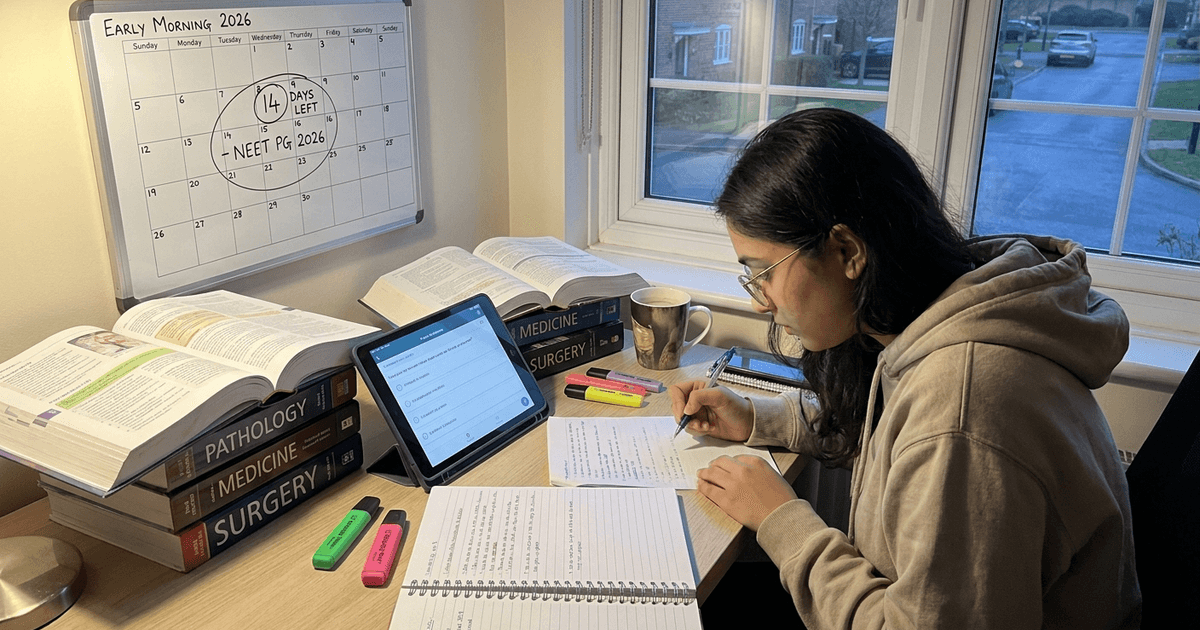
You are 14 days away from NEET PG 2026. Your brain is saturated with 18 months of preparation, your notebook margins are filled with last-minute formulas, and you are staring at your study schedule wondering if two weeks is enough to seal the deal.
Here's what happens in most aspirants' final fortnight: panic revision of weak subjects, random mock test marathons, and an attempt to memorize every single fact they might have missed. The result? Mental exhaustion on exam day and scores that dont reflect months of hard work.
The students who jump 50-80 marks in their final two weeks dont study more — they study strategically. They know that 14 days cant fix fundamental gaps, but it can absolutely optimize recall, sharpen test-taking reflexes, and convert volatile knowledge into exam-day confidence.
This isnt about cramming everything you missed. Its about precision: hitting the highest-leverage topics, drilling your weakest areas, and entering the exam hall with a mind that recalls facts instantly and solves MCQs on autopilot.
The Final 14 Days: What Changed Students Actually Do
The last two weeks before NEET PG 2026 aren't about learning new material. You are in maintenance and optimization mode. Every hour you spend needs to directly translate to marks on August 11, 2026.
Here's the brutal math: NEET PG has 200 questions across 19 subjects. If you are scoring 450-500 in mocks, you are getting roughly 112-125 questions correct. The difference between a decent rank and a top 1000 rank often comes down to 15-20 additional correct answers.
Your mission for these 14 days: identify and fix those 15-20 gettable questions through strategic revision, targeted weak-area repair, and optimized recall patterns.
What successful aspirants do differently in the final stretch:
80% revision, 20% gap filling: No new subjects. Complete any pending high-yield topics from the past 6 months, but dont touch low-yield areas you haven't seen before
Mock-driven revision: Every mock test becomes a diagnostic tool that directly drives your next study session
Spaced recall maintenance: Keep volatile facts (drug dosages, normal values, formulas) actively circulating through daily micro-reviews
Mistake archaeology: Convert every wrong answer from recent mocks into a targeted review session
Your 14-Day NEET PG Revision Plan
Week 1 (Days 1-7): Strategic Revision + Mock Diagnostic
Day 1-2: High-Yield Subject Blitz
Morning (4 hours): Internal Medicine rapid review - cardiology, gastroenterology, nephrology core concepts
Evening (3 hours): Surgery essentials - GI surgery, trauma, fluid management
Night (1 hour): Pharmacology drug-of-choice lists and emergency drugs
Include one mock test on Day 2 evening to establish your current baseline.
Day 3-4: Pathology + Mistakes Repair
Morning (4 hours): Pathology high-yield topics - neoplasia, inflammation, systemic pathology
Evening (2 hours): Review and analyze Day 2 mock test mistakes in detail
Night (2 hours): Convert mock mistakes into targeted topic revision
Oncourse's daily plan workflow helps route your revision time toward exactly these highest-leverage tasks and weak areas identified from your mock performance.
Day 5-6: PYQ Deep Dive
Morning (4 hours): Solve and review 2020-2024 NEET PG questions from your weakest 3 subjects
Evening (3 hours): Anatomy + Physiology rapid recall (neuroanatomy, CVS physiology, kidney function)
Night (1 hour): Create quick reference cards for volatile facts you keep forgetting
Day 7: Second Mock + Analysis
Morning: Full 200-question NEET PG mock test
Evening: Thorough mistake analysis and classification
Night: Light review of strong subjects for confidence building
Week 2 (Days 8-14): Precision Mode + Exam Readiness
Day 8-9: Weak Area Surgery
Morning (4 hours): Laser focus on your 2-3 weakest subjects identified from Week 1 mocks
Evening (3 hours): OBG + Pediatrics essential concepts and recent guidelines
Night (1 hour): Microbiology image-based questions and drug-bug combinations
When you hit a concept you cant recall during revision, Rezzy tutor can help you unpack it quickly with targeted explanations, turning knowledge gaps into short review loops instead of hour-long detours. Day 10-11: Pattern Recognition Training
Morning (3 hours): Community Medicine + Forensic Medicine rapid facts and recent updates
Afternoon: Third mock test
Evening (3 hours): Mock analysis + drilling specific question patterns you keep missing
Night (1 hour): Ophthalmology + ENT + Dermatology visual diagnosis practice
Day 12-13: Final Mock Series
Day 12 Morning: Fourth mock test
Day 12 Evening: Analysis and targeted revision of persistent weak spots
Day 13 Morning: Fifth mock test (your final full-length practice)
Day 13 Evening: Light revision of high-confidence subjects only
Use Synapses spaced repetition during these final days to keep volatile facts like normal lab values, drug dosages, and anatomy landmarks actively cycling through your memory. Day 14 (Exam Eve): Maintenance Mode
Morning (2 hours): Skim through your condensed notes and formula cards
Afternoon: Light physical activity, proper meal, hydration
Evening: Review your top 20 most-forgotten facts one final time
Night: Early sleep (target 8+ hours before exam)
Mock Test Strategy for Final 14 Days
Your mock test frequency and analysis approach needs to be surgical in the final stretch. Here's the precise cadence:
Mock Test Schedule
Week 1: 2 full-length mocks (Day 2 and Day 7)
Week 2: 3 full-length mocks (Day 10, Day 12, Day 13)
Total: 5 full-length mocks across 14 days
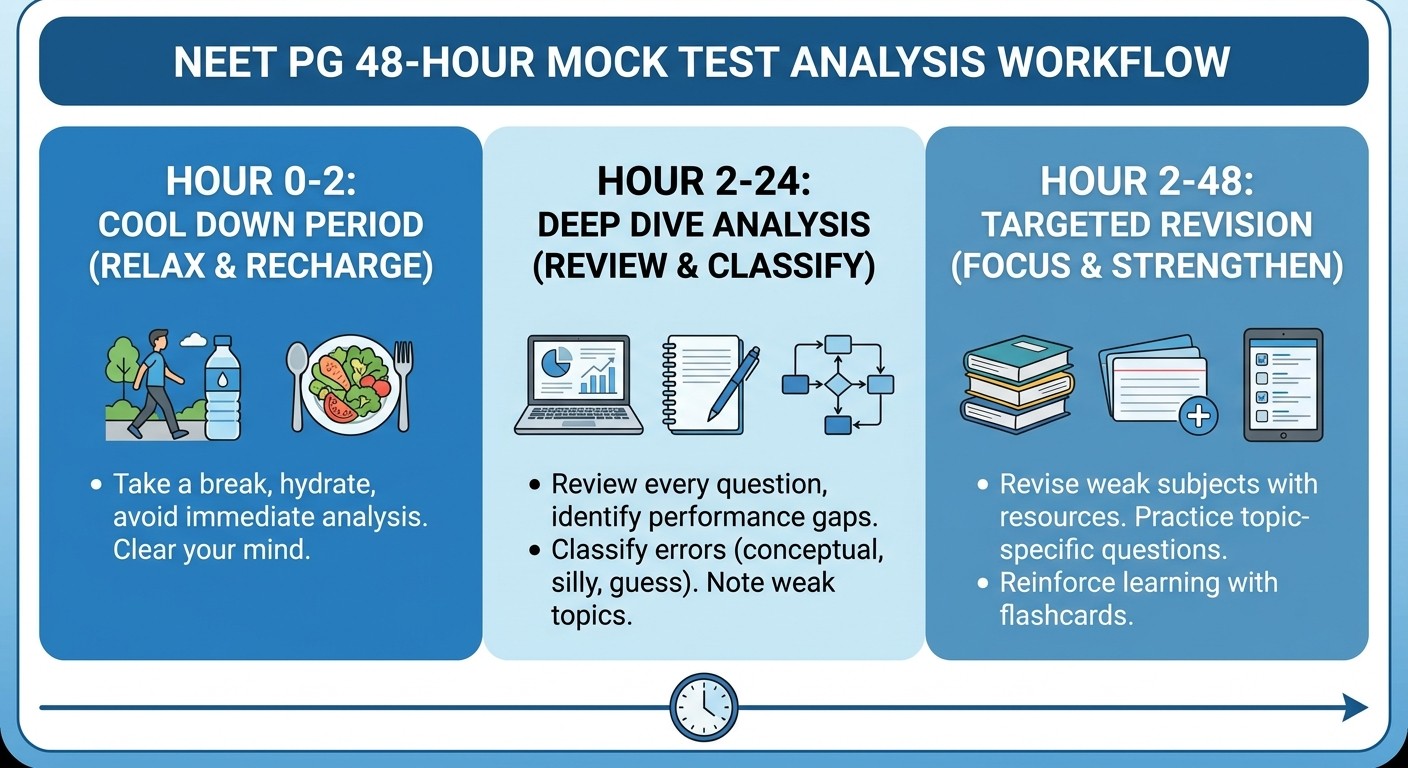
The 48-Hour Mock Analysis Protocol
Immediately after each mock:
1. Note your score and subject-wise breakdown
2. Take a 2-hour break (no reviewing, no checking answers)
3. Return with fresh eyes for deep analysis
During analysis session (3-4 hours): 1. Mistake taxonomy: Classify every wrong answer as:
- Knowledge gap (didnt know the concept)
- Recall failure (knew it once, couldnt retrieve under pressure)
- Misread error (misunderstood the question)
- Time pressure error (rushed and made silly mistake)
- Negative marking trap (shouldn't have attempted)
2. Pattern identification: Are you consistently weak in certain question types? Clinical vignettes vs direct recall vs image-based?
3. Time audit: Which subjects consumed disproportionate time? Where did you spend 3+ minutes on a single question?
4. Conversion to study plan: Every knowledge gap becomes a targeted review session. Every recall failure gets added to spaced repetition practice.
Mock Test Score Benchmarks for Final Weeks
By this stage, your mock scores should be stabilizing. Here's what different score ranges tell you about your final-week focus:
Mock Score Range | What It Means | Final Week Priority |
|---|---|---|
380-420 | Solid foundation, some gaps | Focus on 2-3 weakest subjects intensively |
420-480 | Good preparation, fine-tuning needed | Error correction + speed optimization |
480-520 | Strong performance, minor leaks | Maintain consistency + confidence building |
520+ | Excellent preparation | Light revision + avoid overconfidence |
PYQ Revision Strategy: The 3-Year Rule
Previous Year Questions aren't just practice — they are your window into NEET PG's question patterns, favorite topics, and repeat concepts. In your final 14 days, PYQs become a precision instrument.
The Strategic PYQ Approach
Days 1-7: Subject-wise PYQ Deep Dive
Focus on 2021-2024 questions from your 3 weakest subjects
Don't just solve and move on — understand why each option is right/wrong
Create a "repeat concepts" list: topics that appear multiple years
Days 8-14: Pattern Recognition Training
Mixed PYQ practice across all subjects
Time yourself: PYQ practice should mirror exam conditions
Focus especially on 2023-2024 questions for recent pattern shifts
High-Leverage PYQ Topics (Based on 2021-2024 Analysis)
From recent NEET PG patterns, these topics show up consistently and deserve extra attention:
Medicine: ACS management, heart failure guidelines, CKD staging, hepatitis management, sepsis protocols Surgery: Appendicitis complications, trauma ATLS, fluid management, surgical site infections Pathology: Breast cancer staging, lung cancer types, inflammatory markers, tumor markers Pharmacology: Antibiotic mechanisms, cardiovascular drug classes, chemotherapy protocols OBG: Pregnancy complications, contraception methods, menstrual disorders
When you encounter a PYQ question you cant solve, use Rezzy's explanation chat to break down not just the correct answer, but the reasoning behind why other options are incorrect — this builds pattern recognition faster than traditional explanation reading.
High-Yield Subject Prioritization for Final 2 Weeks
Not all subjects deserve equal attention in your final fortnight. Based on NEET PG 2026 weightage analysis, here's your strategic priority order:
Tier 1: Maximum Time Investment (60% of study hours)
1. Internal Medicine (22-25 questions): Cardiology, gastroenterology, nephrology, endocrinology 2. Surgery (20-23 questions): GI surgery, trauma, surgical infections, fluid management 3. Pathology (18-22 questions): Neoplasia, inflammation, systemic pathology 4. Pharmacology (16-20 questions): Drug mechanisms, drug-of-choice lists, adverse effects
Tier 2: Moderate Investment (25% of study hours)
5. OBG (15-18 questions): Pregnancy complications, gynecological disorders 6. Community Medicine (12-15 questions): Epidemiology, health programs, biostatistics 7. Anatomy (12-15 questions): Neuroanatomy, applied anatomy for clinical correlation 8. Microbiology (10-12 questions): Antibiotics, infectious diseases, lab diagnosis
Tier 3: Quick Review Only (15% of study hours)
9. Short subjects cluster: Ophthalmology, ENT, Dermatology, Forensic Medicine, Radiology, Orthopedics, Anesthesia, Psychiatry
Focus your limited time on Tier 1 subjects where small improvements yield maximum marks. For Tier 3 subjects, stick to high-yield facts, visual diagnosis, and drug lists only.
You can target specific weak areas within these subjects through NEET PG medicine lessons, surgery practice questions, and pathology flashcards for spaced repetition review.
The Mistakes Log: Converting Errors into Permanent Fixes
Every aspirant makes mistakes in mocks. The difference between average and top performers is what they do with those mistakes. Create a systematic mistakes log that becomes your most valuable study resource.
Setting Up Your Digital Mistakes Log
Create a simple spreadsheet or document with these columns:
Date: When you made the mistake
Question: Copy the full question text
Your Answer: What you chose and why
Correct Answer: The right option with explanation
Mistake Type: Knowledge gap, recall failure, misread, time pressure, or negative marking trap
Review Date: When you'll revisit this concept
Fixed?: Whether you can now solve similar questions correctly
The 3-Touch Rule for Mistake Remediation
Every mistake in your log gets exactly 3 touches:
Touch 1 (Day of mock): Understand the concept and add to log Touch 2 (3 days later): Quick review without looking at answer first Touch 3 (7 days later): Final reinforcement check
This spaced approach converts temporary understanding into permanent retention. After Touch 3, most aspirants can solve similar questions automatically.
What NOT to Do in the Final 2 Weeks
Knowing what to avoid is as crucial as knowing what to focus on. Here are the common mistakes that derail otherwise solid preparation:
Don't: Start New Subjects or Topics
If you haven't touched Radiology or Orthopedics seriously in the past 6 months, don't start now. These 14 days aren't enough to build foundational understanding in any subject.
Don't: Take More Than 5 Full-Length Mocks
Mock test fatigue is real. After 5 mocks in 2 weeks, you are just going through motions without meaningful analysis. Quality of review matters infinitely more than quantity of attempts.
Don't: Change Your Study Environment Drastically
This isn't the time to try new study locations, different sleep schedules, or untested productivity techniques. Stick to what's been working for months.
Don't: Ignore Sleep and Physical Health
Pulling all-nighters might feel productive, but cognitive performance drops significantly with sleep deprivation. Target 7-8 hours of sleep, especially in the final week.
Frequently Asked Questions
How many mock tests should I take in the final 2 weeks?
Take exactly 5 full-length mock tests spread across 14 days. More than this creates fatigue without meaningful improvement. Focus on thorough analysis of each mock rather than attempting more tests.
Should I revise weak subjects or focus on strong ones in the final stretch?
Follow the 70-30 rule: spend 70% of time on weak subjects that can yield quick improvements, and 30% on strong subjects to maintain confidence and prevent score drops.
Is it worth starting completely new topics 2 weeks before NEET PG?
Absolutely not. These 14 days are for optimization and recall strengthening, not new learning. Focus on completing any pending high-yield topics you've partially covered before.
How do I manage exam anxiety in the final week?
Maintain familiar routines, get adequate sleep, limit social media, and avoid conversations about preparation comparisons. Practice 5-minute breathing exercises if anxiety peaks.
Should I solve more PYQs or focus on theoretical revision?
Balance both: 60% active problem-solving (PYQs, MCQs) and 40% theoretical revision. Active recall through questions is more effective for retention than passive reading.
What if my mock scores are dropping in the final weeks?
This is often due to mental fatigue rather than knowledge loss. Reduce your daily study hours by 1-2 hours, ensure adequate sleep, and focus on confidence-building revision of your strongest topics.
---
The final 14 days before NEET PG 2026 aren't about miraculous transformations — they are about precision, optimization, and entering the exam hall with a mind that works like a well-tuned machine. Every hour you invest in strategic revision, systematic mock analysis, and targeted weak-area repair will translate directly into marks on August 11.
Your preparation over the past 18 months has built the foundation. These final two weeks are about polishing that foundation into a score that opens the door to your dream specialty.
Prepare smarter with Oncourse AI — adaptive MCQs, spaced repetition, and AI explanations built for NEET PG. Download free on Android and iOS.