Back
NEET PG Last 45 Days Revision Strategy: Mock Tests, PYQs and High-Yield Topics
Master the final 45-day countdown to NEET PG 2026 with this systematic revision strategy. Includes week-by-week mock test schedules, PYQ analysis methods, and high-yield topic priorities.

NEET PG Last 45 Days Revision Strategy: Mock Tests, PYQs and High-Yield Topics
Youre probably staring at your calendar right now, counting exactly 45 days until NEET PG 2026. The syllabus feels massive. Your mock scores arent where you want them. And everyone around you seems to have a different opinion about what works in these final weeks.
Heres the reality: 45 days is enough time to significantly improve your rank — if you execute the right strategy. Most students waste these critical weeks either panic-studying everything or getting paralyzed by overthinking. The students who jump 20,000-30,000 ranks in the final stretch follow a specific system that balances three elements: targeted mock test practice, strategic PYQ revision, and laser-focused high-yield topic drilling.
This isnt another generic "study hard" guide. Its the exact 45-day countdown system that consistently works for students crossing the 550+ mark, broken down week by week with daily execution blocks.
Quick Answer: Your 45-Day Framework
Before diving deep, heres your core strategy:
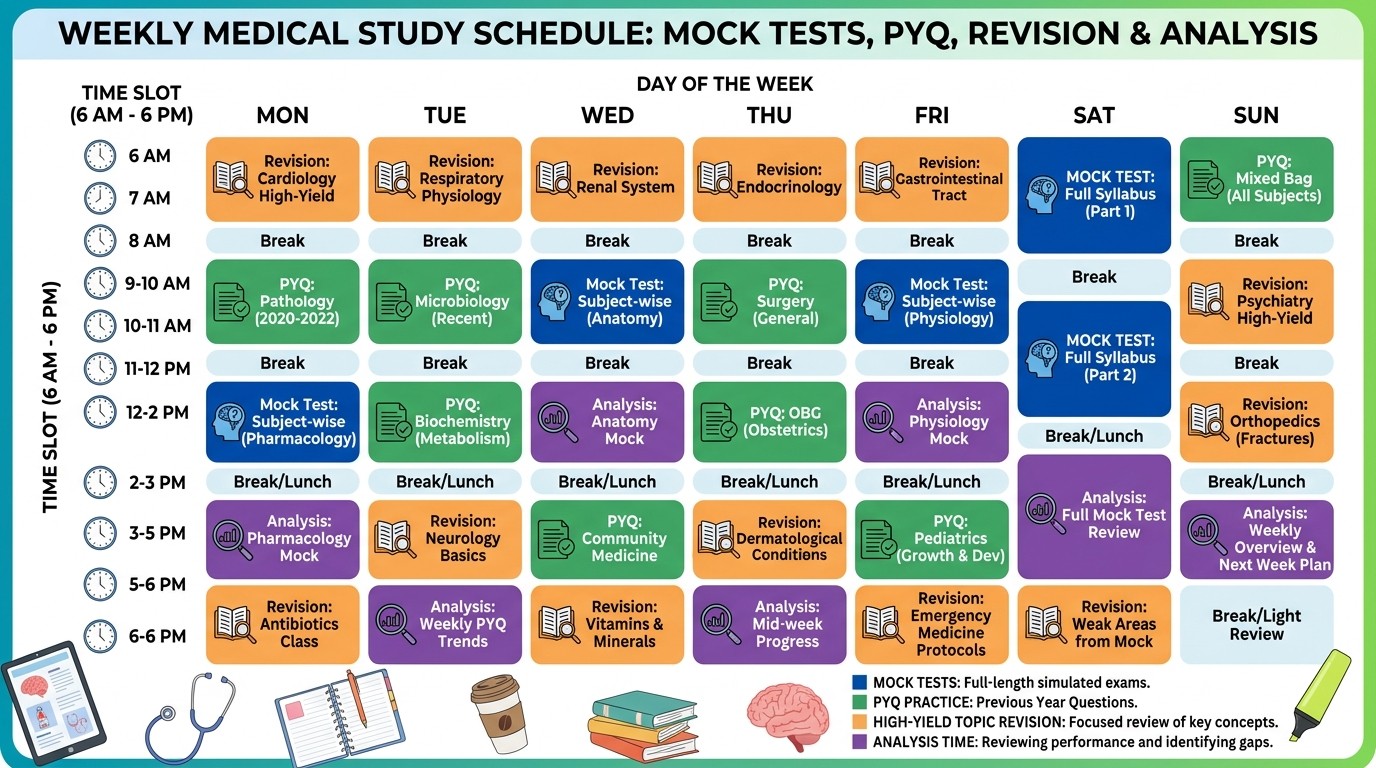
Weeks 1-2 (Days 1-14): Foundation strengthening with Medicine and Surgery revision, 3-4 mock tests per week, PYQ analysis for weak subjects Weeks 3-4 (Days 15-28): High-yield topic drilling based on mock performance, daily PYQ practice sessions, weak-area elimination Weeks 5-6 (Days 29-42): Peak practice mode with 5-6 full-length mocks weekly, rapid PYQ review cycles, clinical integration focus Final Week (Days 43-45): Confidence building with familiar topics, light mock practice, PYQ pattern recognition Mock frequency: Start at 3-4 per week, peak at 5-6, then taper to 2-3 in the final week PYQ target: 50-75 questions daily across all subjects, focusing on 2021-2025 papers Analysis time: Spend 2 hours analyzing every 1 hour of mock test time
Week-by-Week Execution Plan
Week 1: Foundation Reset (Days 1-7)
Your first week is about establishing baseline performance and identifying your biggest gaps.
Daily Structure:
6:00-8:00 AM: Medicine revision (Cardiology, Endocrinology focus)
8:00-10:00 AM: Full-length mock test (Mon/Wed/Fri) or Surgery revision (Tue/Thu/Sat)
10:00-12:00 PM: Mock analysis or high-yield Surgery topics
2:00-4:00 PM: PYQ session (50 questions across weak subjects)
4:00-6:00 PM: Pharmacology rapid review or weak topic drilling
Mock Tests This Week: 3-4 full-length tests PYQ Focus: Identify your bottom 3 subjects from baseline mocks Key Targets: Medicine accuracy >65%, Surgery accuracy >60%
During this week, Oncourses daily plan feature automatically adjusts your revision blocks based on your mock performance. After each test, the platform identifies which Medicine subtopics (like acute coronary syndromes or diabetic emergencies) need immediate attention, creating focused study sessions that align with your actual weak areas rather than generic topic lists.
Week 2: Pattern Recognition (Days 8-14)
Now that you understand your weak zones, this week is about drilling those specific areas while building mock test stamina.
Daily Structure:
6:00-8:00 AM: Weak subject drilling (identified from Week 1 mocks)
8:00-11:00 AM: Full-length mock + immediate analysis
11:00-12:00 PM: PYQ session targeting yesterday's mock mistakes
2:00-4:00 PM: High-yield topic revision (OBGYN emergencies, PSM formulas)
4:00-5:30 PM: Image-based question practice
5:30-6:00 PM: Error log review
Mock Tests This Week: 4 full-length tests PYQ Strategy: 75 questions daily, with 50% from your weakest subject Milestone: Identify your consistent mistake patterns
Week 3-4: High-Yield Drilling (Days 15-28)
These two weeks are your performance accelerator. You know your weak areas, now you systematically eliminate them.
Daily Structure:
6:00-8:00 AM: Targeted weak-area study (guided by analytics)
8:00-11:30 AM: Full-length mock + analysis
11:30-12:30 PM: Immediate mistake drilling (same topics, different questions)
2:00-4:00 PM: High-yield topic intensive (rotating daily)
4:00-5:00 PM: PYQ rapid fire (100 questions in 60 minutes)
5:00-6:00 PM: Clinical correlation and image review
Mock Tests These Weeks: 8-10 tests total (4-5 per week) High-Yield Focus: Rotate daily between Medicine (cardiac emergencies, diabetes), Surgery (trauma, GI bleeding), OBGYN (high-risk pregnancy), and Pharmacology (antimicrobials, cardiac drugs)
Your weak-area analytics become crucial here. After each mock, Oncourse automatically identifies not just which subjects you missed, but which specific subtopics within those subjects need drilling. Instead of broadly studying "cardiology," youll get targeted recommendations like "practice acute MI management" or "review heart failure drug protocols."
Week 5-6: Peak Performance (Days 29-42)
You enter peak practice mode. Your mock frequency increases, your analysis becomes faster, and youre operating at exam-level intensity.
Daily Structure:
6:00-8:30 AM: Full-length mock test
8:30-10:30 AM: Rapid mock analysis (2-hour limit)
10:30-11:00 AM: Immediate weak-topic drilling
2:00-4:00 PM: Second mock OR intensive PYQ session
4:00-5:00 PM: High-yield rapid review
5:00-6:00 PM: Image-based questions and clinical scenarios
Mock Tests These Weeks: 10-12 tests total (5-6 per week) PYQ Strategy: Shift to rapid recall — 150 questions in 90 minutes Key Metric: Track your negative marking rate and time per question
Final Week: Confidence Building (Days 43-45)
The final countdown. You shift from learning to confidence building and pattern reinforcement.
Daily Structure:
7:00-10:00 AM: One full-length mock (Mon/Wed only)
10:00-11:00 AM: Light analysis (familiar mistakes only)
11:00-12:00 PM: High-confidence topic revision
2:00-3:00 PM: PYQ rapid review (familiar patterns)
3:00-4:00 PM: Image-based quick review
4:00-5:00 PM: Relaxation and light reading
Mock Tests This Week: 2-3 tests maximum Focus: Reinforce strong areas, avoid new concepts Mindset: Confidence over cramming
Mock Test Frequency and Analysis Strategy
Optimal Mock Frequency by Phase
Week | Mock Tests | Primary Goal |
|---|---|---|
Week 1 | 3-4 tests | Baseline assessment |
Week 2 | 4 tests | Pattern recognition |
Week 3-4 | 8-10 tests | Weak area elimination |
Week 5-6 | 10-12 tests | Peak performance |
Final Week | 2-3 tests | Confidence building |
Total Target: 27-33 full-length mocks over 45 days
The 2:1 Analysis Rule
For every hour you spend taking a mock test, spend 2 hours on analysis and follow-up practice. A 3.5-hour mock should get 7 hours of analysis and drilling spread over 2-3 days.
Mock Analysis Framework:
1. Subject Accuracy Review (15 minutes): Identify subjects below 65%
2. Topic-Specific Drilling (45 minutes): Practice 30-50 questions on weakest topics
3. Mistake Pattern Analysis (30 minutes): Track recurring error types
4. Time Management Review (15 minutes): Analyze questions per minute
5. Follow-up Study Plan (15 minutes): Plan next day's weak-area focus
When reviewing your mock performance, Rezzy tutor helps you understand exactly why you missed specific questions. Instead of just seeing "incorrect," you get detailed explanations of the underlying concepts and follow-up questions to test your understanding. For a missed cardiology question, Rezzy might explain the pathophysiology, then immediately quiz you on related scenarios to ensure the concept sticks.
PYQ Strategy: Converting Past Papers into Score Gains
Daily PYQ Targets by Week
Weeks 1-2: 50-75 questions daily, focusing on subject-wise gaps Weeks 3-4: 75-100 questions daily, with cross-subject integration Weeks 5-6: 100-150 questions in rapid-fire mode Final Week: 50-75 questions from high-confidence topics only
PYQ Analysis System
The 24-Hour Rule: Every PYQ mistake gets reviewed within 24 hours The 3-Day Rule: Re-test the same concept after 3 days with different questions The Weekly Rule: Review all incorrect PYQs from the past week every Sunday High-Yield PYQ Sources:
NEET PG 2021-2025 papers (30% repeat rate)
AIIMS PG 2019-2023 papers (concept overlap)
FMGE papers for basic science integration
Converting PYQ Mistakes into Daily Targets
When you miss a PYQ, dont just read the explanation. Convert it into a focused study block:
1. Identify the core concept (e.g., "acute coronary syndrome management")
2. Find 5-10 related questions on the same concept
3. Study the topic for 15-20 minutes
4. Test yourself again with similar questions
5. Add to your weekly review list
The key is treating every mistake as a learning opportunity, not just a score deduction.
High-Yield Topics: The 70-20-10 Approach
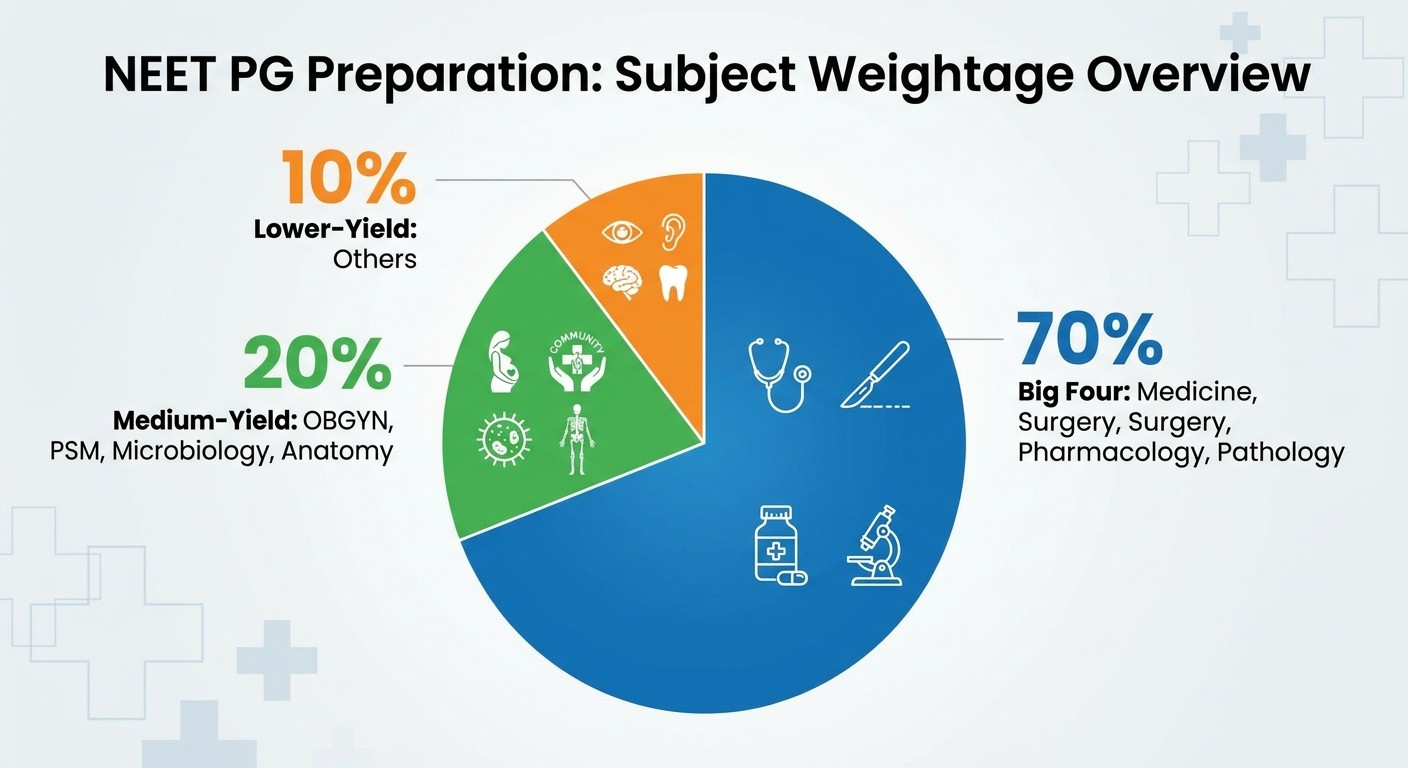
Based on NEET PG 2025 analysis and weightage data, focus your revision using the 70-20-10 rule:
70% Time: Big Four Subjects
Medicine (35% of total effort)
Cardiology: ACS management, heart failure, arrhythmias
Endocrinology: Diabetes complications, thyroid emergencies
Gastroenterology: GI bleeding, IBD management
Infectious diseases: Antimicrobial selection, sepsis protocols
Surgery (25% of total effort)
General surgery: Acute abdomen, trauma management
Orthopedics: Fracture management, joint disorders
Emergency medicine: Shock, polytrauma protocols
Pharmacology (15% of total effort)
Antimicrobials: Selection, resistance patterns
Cardiac drugs: ACE inhibitors, antiarrhythmics
Endocrine drugs: Insulin types, thyroid medications
Pathology (10% of total effort)
Hematological malignancies: AML subtypes, lymphomas
Cardiovascular pathology: Atherosclerosis, heart failure
Neoplasia: Tumor markers, staging systems
20% Time: Medium-Yield Subjects
OBGYN: High-risk pregnancy, labor complications, contraception PSM: Epidemiology formulas, national health programs Microbiology: Culture characteristics, antimicrobial susceptibility Anatomy: Clinical correlations, imaging anatomy
10% Time: Lower-Yield Subjects
Quick revision of Forensic Medicine, ENT, Ophthalmology, Anesthesiology, Radiology, and Pediatrics. Focus only on high-yield topics within these subjects.
Error Log to Daily Action System
The 5-Category Mistake Framework
Classify every mock test mistake into one of these categories:
1. Knowledge Gap (A): Didnt know the concept
2. Concept Confusion (B): Mixed up similar concepts
3. Silly Mistake (C): Knew the answer but chose wrong
4. Time Pressure (D): Rushed and made errors
5. Image/Clinical (E): Couldnt interpret the clinical scenario
Converting Mistakes to Daily Priorities
Category A (Knowledge Gaps):
Immediate action: Study the topic for 30 minutes
Daily drill: 10-15 questions on the same concept
Weekly review: Re-test after 7 days
Category B (Concept Confusion):
Create comparison charts for similar concepts
Practice differential diagnosis questions
Use mnemonics to differentiate concepts
Category C (Silly Mistakes):
Slow down during practice tests
Mark and review before submission
Practice reading questions twice
Category D (Time Pressure):
Practice speed tests (50 questions in 45 minutes)
Learn to quickly eliminate wrong options
Identify questions to skip and return to
Category E (Image/Clinical):
Dedicate 30 minutes daily to image-based questions
Practice clinical reasoning with case scenarios
Review diagnostic criteria and management protocols
Final 7-Day Strategy
Your final week should feel like a confidence-building ritual, not a cramming session.
Day 43: Confidence Booster Mock
Take one full-length mock focusing on your strongest subjects. Aim for 75%+ accuracy to build confidence.
Day 44: Rapid PYQ Review
Speed through 100 familiar PYQs in 90 minutes. Focus on pattern recognition, not deep analysis.
Day 45: High-Yield Rapid Fire
Review your strongest high-yield topics. Skip anything that creates doubt or confusion.
Day 46: Image and Clinical Review
Light review of image-based questions and clinical scenarios. Practice pattern recognition only.
Day 47: Rest and Mental Preparation
No new studying. Light review of familiar concepts. Focus on sleep and relaxation.
Day 48: Exam Day Prep
Review your exam day strategy, travel plans, and required documents. Light breakfast, arrive early.
Common Mistakes to Avoid in Final 45 Days
Mock Test Mistakes
Over-testing: Taking daily mocks without adequate analysis time reduces learning efficiency Score obsession: Focusing on mock scores instead of learning from mistakes limits improvement Pattern blindness: Not identifying recurring mistake types leads to repeated errors
PYQ Mistakes
Surface-level review: Reading explanations without understanding underlying concepts Scattered practice: Jumping between topics without systematic drilling of weak areas Timing neglect: Not practicing PYQs under timed conditions reduces exam readiness
High-Yield Topic Mistakes
Equal-time fallacy: Spending equal time on all subjects instead of focusing on high-weightage areas New concept trap: Learning new topics in final weeks instead of strengthening existing knowledge Detail overload: Getting lost in low-yield details instead of focusing on exam-relevant concepts
Frequently Asked Questions
How often should I take mock tests in the last 45 days?
Start with 3-4 mock tests per week in the first two weeks, increase to 4-5 in weeks 3-4, peak at 5-6 during weeks 5-6, then reduce to 2-3 in the final week. Total target: 27-33 full-length mocks. The key is balancing testing frequency with adequate analysis time.
Should I focus more on PYQs or new question banks?
Prioritize PYQs, especially from 2021-2025, as they have a 30% repeat rate in NEET PG. Spend 70% of your question practice time on PYQs and 30% on new questions for concept reinforcement. PYQs help you understand exam patterns and recurring high-yield topics.
What if my mock scores arent improving despite regular practice?
If scores plateau after 15-20 mocks, take a 3-4 day break from testing and focus intensively on your weakest 2-3 subjects. Then return to mocking with benchmark tests to measure improvement. Sometimes scores need time to reflect internal learning gains.
How do I balance revision with mock test practice?
Follow the 2:1 analysis rule — for every hour of mock testing, spend 2 hours on analysis and targeted revision. This typically means 3-4 hours daily for mocks and analysis, plus 2-3 hours for dedicated subject revision.
Is 45 days enough to significantly improve my NEET PG rank?
Yes, if executed correctly. Students commonly improve ranks by 20,000-30,000 positions in the final 45 days through systematic mock practice, targeted weak-area drilling, and strategic PYQ revision. The key is consistency and smart time allocation rather than just increased study hours.
Should I study new topics or only revise completed syllabus?
Focus 90% of your time on revising and strengthening already-studied topics. Only add new concepts if they are extremely high-yield and can be mastered quickly (like specific drug protocols or diagnostic criteria). Learning new subjects in the final stretch typically reduces overall performance.
---
The final 45 days before NEET PG 2026 can be your biggest performance accelerator — if you execute systematically rather than frantically. Your success depends on three elements: strategic mock test practice with rigorous analysis, targeted PYQ drilling that converts mistakes into learning, and laser-focused high-yield topic revision.
Remember, the students who make the biggest rank jumps in these final weeks dont study harder — they study smarter, with a system that converts every practice session into measurable improvement.
Prepare smarter with Oncourse AI — adaptive MCQs, spaced repetition, and AI explanations built for NEET PG. Download free on Android and iOS.