Back
NEET PG 2026 1 Month Revision Strategy: Mock Tests, PYQs and Weak Areas
Complete 30-day NEET PG revision plan with week-wise mock test strategy, PYQ analysis, and targeted weak area repair. Convert knowledge into maximum marks.

NEET PG 2026 1 Month Revision Strategy: Mock Tests, PYQs and Weak Areas
You are probably staring at your calendar right now, counting exactly 30 days until NEET PG 2026. Your brain is simultaneously racing with everything left to cover and shutting down from the pressure. Here's the truth: these final 30 days aren't about learning new concepts. They are about converting what you know into exam performance.
The students who jump 50-100 ranks in their final month don't magically learn more medicine. They get surgical about three things: mock test analysis, PYQ pattern recognition, and weak area triage. This isn't another generic "revise everything" plan. This is a systematic 30-day framework that turns your existing knowledge into maximum marks.
How the Final 30 Days Differ from Regular Preparation
The final month operates on completely different rules than your previous preparation. Regular prep is about absorption - reading, understanding, building foundation. Final month prep is about conversion - taking what's in your head and converting it into correct answers under pressure.
Your brain already contains 90% of what you need to clear NEET PG. The problem is retrieval speed and pattern recognition. When you see "young female with fatigue + joint pain + malar rash", can you instantly think SLE and move to the diagnostic workup? When you spot "elderly male + chest pain + ST elevation in V1-V4", does anterior STEMI flash immediately?
This month is about building those instant recognition patterns through targeted practice. Your Daily Plan becomes the execution layer that converts vague "study harder" intentions into focused daily sessions targeting your specific weak patterns.
The mock-to-analysis ratio flips completely. In regular prep, you spent 80% time studying, 20% testing. Final month: 60% targeted practice based on mock analysis, 40% rapid content review. Every mock test becomes a diagnostic tool revealing exactly which knowledge gaps are costing you marks.
Week-by-Week Breakdown: Days 30-22, 21-15, 14-8, Final 7
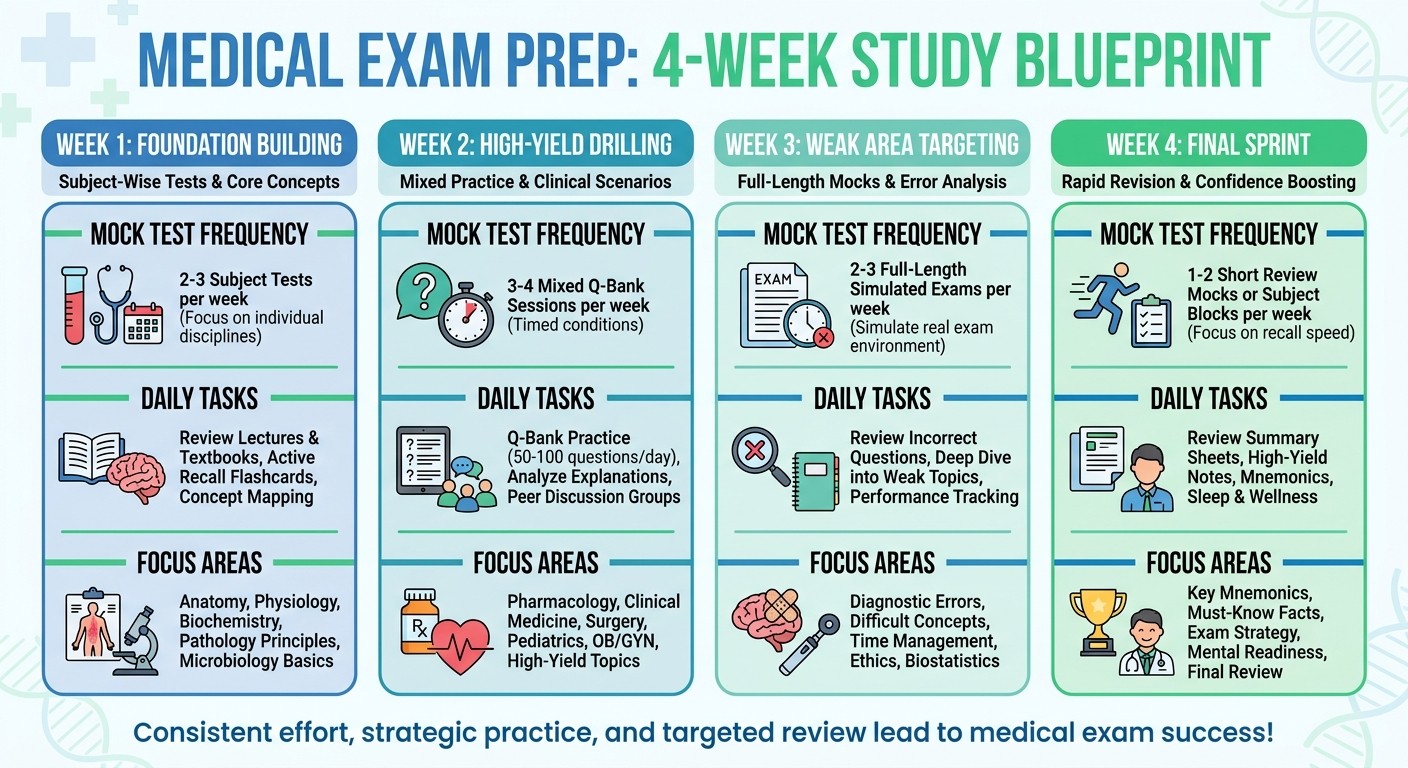
Week 1 (Days 30-22): Foundation Assessment
This week establishes your baseline and identifies the biggest leak points. No heroic 12-hour study marathons - disciplined assessment and targeted fixing.
Mock frequency: One subject-wise mock (50 questions) every alternate day. Take Medicine on Day 30, Surgery on Day 28, Pharmacology on Day 26, Pathology on Day 24, Community Medicine on Day 22. Daily structure: 3 hours mock + analysis, 2 hours targeted weak area practice based on yesterday's analysis, 2 hours rapid revision of high-yield topics, 1 hour image-based question practice. Key decisions this week: Which 3-4 subjects are bleeding the most marks? Medicine showing 45% while your Surgery is 70%? Time allocation for Week 2 gets determined by Week 1 analytics. Your weak-area analytics become the prioritization layer for everything that follows.
Week 2 (Days 21-15): High-Yield Drilling
The patterns from Week 1 guide everything. If Medicine ECG questions killed you, this week drills ECG recognition until it's automatic. If Pharmacology side effects are your blind spot, you hammer those until they stick.
Mock frequency: Full-length mock every 3rd day (Days 21, 18, 15). Two subject-wise mocks on the off days targeting your weakest areas from Week 1. Focus shift: Stop general revision. Everything is now targeted based on your specific error patterns. If you missed 6 Cardiology questions in Week 1, this week you solve 50 Cardiology MCQs and review every single mistake with Rezzy tutor until the concepts click. PYQ integration: Start solving 2019-2025 NEET PG papers, but don't memorize answers. Focus on pattern recognition - how do they phrase MI vs unstable angina questions? What language signals diabetic ketoacidosis vs HHS?
Week 3 (Days 14-8): Weak Area Surgery
This is where rank jumps happen. Week 1 identified your weak subjects. Week 2 targeted high-yield areas. Week 3 performs surgery on your biggest point-loss areas.
The 3-day rule: Pick your 3 weakest subjects from analytics. Spend Days 14-12 on Subject 1, Days 11-10 on Subject 2, Days 9-8 on Subject 3. Go deep, not broad. Mock frequency: One full-length mock on Day 14, then rapid 25-question focused tests daily on whatever subject you're fixing that day. Conversion focus: For each weak area, solve 50 questions, analyze every wrong answer, create quick reference notes, then test again. The goal is converting a 40% subject to 65%+. Don't try to convert weak subjects to strong - just stop the bleeding.
Week 4 (Days 7-1): Final Sprint
No new content. Pure optimization and confidence building. Your brain is primed - now focus on speed, accuracy, and exam temperament.
Mock frequency: Full-length mock on Days 7, 4, and 2. Light 15-question rapid tests on Days 6, 5, 3. Day 1 = complete rest or very light review. Time focus: Every mock this week is timed at 63 seconds per question. Practice the two-pass strategy: first pass answering definite knows, second pass tackling 50-50s with elimination. Confidence building: Review your error log from the past 3 weeks. You'll see the same mistakes appearing early in the month and disappearing later. This visual proof of improvement builds exam-day confidence.
Mock Test Frequency and Review Strategy
15-20 total mocks across 30 days, but the type and analysis depth changes weekly. Week 1: diagnostic subject-wise tests. Week 2: integration full-length tests. Week 3: targeted weak-area tests. Week 4: speed and confidence full-length tests.
The 48-Hour Analysis Protocol
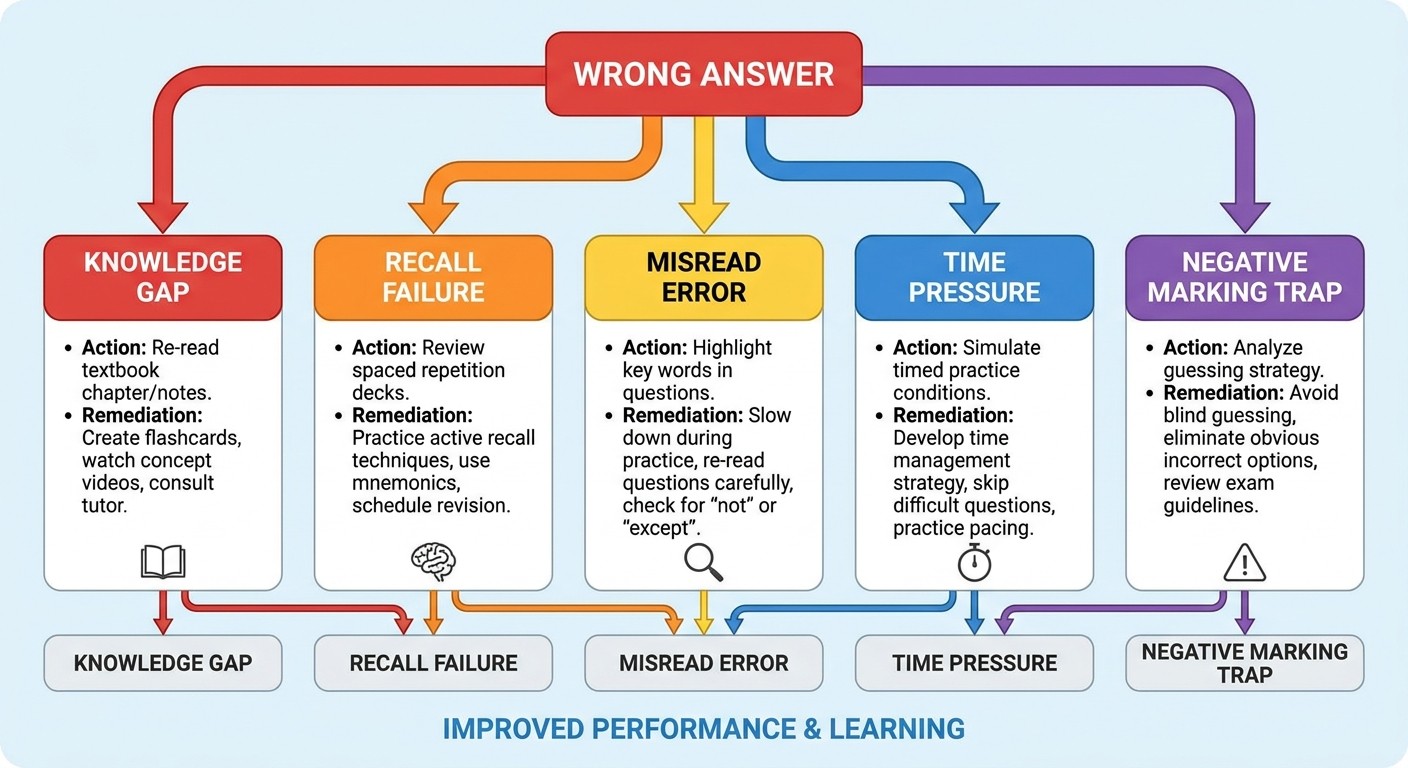
Every wrong answer gets classified within 48 hours:
Knowledge Gap: You genuinely dont know this concept. Action: 30-minute focused study session on this specific topic, create a flashcard, solve 10 more questions on the same concept. Recall Failure: You know this but couldn't retrieve it fast enough. Action: Create a mnemonic, practice rapid-fire questions on this topic, review the concept just before sleep for better consolidation. Misread Error: You misunderstood the question or mixed up answer choices. Action: Practice elimination technique, slow down on reading, highlight key words in questions. Time Pressure Error: You knew it but ran out of time. Action: Practice timed mini-tests, work on two-pass strategy, identify which questions to skip quickly. Negative Marking Trap: You guessed wrong when you should have skipped. Action: Practice the two-option elimination rule - only guess if you can eliminate at least 2 options.
The analysis takes 2-3 hours per mock. This isn't optional extra work - this IS the work. A well-analyzed mock teaches you more than 10 poorly analyzed ones.
Mock Review by Error Type
Track your error patterns across mocks. If Week 1 shows 60% Knowledge Gap errors but Week 3 shows 70% Recall Failure errors, you are progressing correctly. Knowledge gaps get filled, then retrieval speed becomes the bottleneck.
Create a simple tracker: Date, Subject, Error Type, Action Taken, Retest Result. After 2 weeks, you'll see patterns. Maybe you consistently miss Anatomy questions due to time pressure, or Pharmacology questions due to negative marking traps. These patterns guide your final week strategy.
Using PYQs Without Blind Memorization
PYQs aren't about memorizing 2,000 questions. They are about understanding the language and patterns of NEET PG. The examiners have preferred ways of asking about MI, diabetes complications, pneumonia types. PYQs teach you this language.
The 3-Layer PYQ Strategy
Layer 1: Pattern Recognition (Days 30-22)
Don't solve PYQs to test knowledge. Solve them to recognize patterns. How do they ask about heart failure? What words signal chronic kidney disease vs acute kidney injury? Create pattern notes, not answer keys.
Layer 2: Trap Identification (Days 21-15)
Every PYQ has 3 wrong options designed as traps. Study the wrong options as carefully as the right ones. Why is "pulmonary edema" wrong when "acute heart failure" is right? Understanding traps prevents elimination errors.
Layer 3: Speed Building (Days 14-8)
Now solve PYQs under time pressure. Goal: recognize the pattern and eliminate wrong options within 30-40 seconds. This isn't about memorizing specific answers - it's about building pattern recognition speed.
Never solve the same PYQ twice within a week. If you solved 2023 Medicine questions on Monday, don't touch them again until next Monday. Your brain needs time to consolidate patterns without creating false familiarity.
Weak Area Triage: What to Fix vs What to Protect
Not all weak areas deserve equal attention. Some are high-yield repair opportunities. Others are low-yield time sinks that can actually hurt your performance if you obsess over them.
The ROI Matrix for Weak Areas
High Impact, Achievable (Priority 1): Pharmacology mechanisms you partially know, ECG interpretation basics, common surgery procedures. These can jump from 50% to 75% with focused effort. High Impact, Difficult (Priority 2): Complex Medicine syndromes, detailed Pathology mechanisms. Worth attempting if you have time after Priority 1. Low Impact, Achievable (Priority 3): Anatomy details, rare Forensic Medicine facts. Easy to fix but won't dramatically change your score. Low Impact, Difficult (Priority 4): Obscure syndromes, detailed Biochemistry pathways. Ignore completely in final month.
Your weak-area analytics should guide this triage. If Community Medicine is scoring 35% but only contributes 20 marks, dont spend a week trying to raise it to 60%. If Medicine is scoring 50% and contributes 50+ marks, that's where you focus.
The 2-Week Rule
Any weak area that doesn't show 15-20% improvement within 2 weeks of focused effort gets abandoned. You cannot afford to chase stubborn weak areas when other subjects can be improved more efficiently.
Track improvement weekly: "Cardiology went from 45% to 62% this week." If next week shows minimal improvement (62% to 64%), shift focus to another weak area with better improvement potential.
Subject Rotation: Balancing High-Yield and Weak Subjects
The final month isn't about equal time allocation. It's about strategic time allocation based on marks distribution and your individual weak areas.
The 60-25-15 Rule
60% of your time goes to Medicine, Surgery, and your worst-performing major subject. These contribute 110+ marks out of 200.
25% goes to Pharmacology, Pathology, Community Medicine - high-yield subjects with good return on investment.
15% goes to everything else - Anatomy, Physiology, Biochemistry, Forensic Medicine. Just maintain what you know, don't try to master weak areas here.
Daily Subject Rotation Strategy
Instead of doing all subjects daily (which leads to shallow coverage), focus deeply on 2-3 subjects per day:
Day 1: Medicine (Cardiology + Pulmonology) + Community Medicine Day 2: Surgery (General + Orthopedics) + Pharmacology Day 3: Medicine (Gastro + Nephrology) + Pathology Day 4: Medicine (Endocrine + Neurology) + Weakest subject from analytics
This rotation ensures you touch high-yield subjects frequently while giving adequate depth to weak areas. Your Daily Plan can optimize this rotation based on your performance data.
Formula, Image, and Table Revision
The final month requires different revision techniques for different content types. Facts need repetition, images need recognition practice, formulas need application practice.
High-Yield Formula List
Create a 2-page formula sheet covering:
Pharmacology: Loading doses, clearance calculations, bioavailability
Community Medicine: Rates, ratios, screening test calculations
Physiology: GFR calculations, cardiac output, respiratory parameters
Medicine: MELD score, CHA2DS2-VASc score, Wells score
Review this sheet every 3rd day. Don't memorize blindly - practice application questions using these formulas.
Image Recognition Practice
NEET PG 2026 will have 40+ image-based questions. Spend 30 minutes daily on:
ECG interpretation (20+ expected questions)
X-ray and CT findings (15+ expected questions)
Clinical photographs (skin, eye, neurological signs)
Pathology slides and gross specimens
Use spaced repetition for image practice. If you correctly identify pneumothorax on CXR today, review it again in 3 days, then 7 days, then 14 days.
Volatile Facts Consolidation
Some facts are inherently unstable in memory - drug dosages, normal values, classification criteria. These need daily touch-up, not weekly revision.
Create a volatile facts list of 100-150 items that you review for 15 minutes every morning. Normal hemoglobin levels, Apgar score components, Glasgow Coma Scale, common drug dosages, diagnostic criteria for major diseases.
Sleep, Burnout, and Exam Week Pacing
The final month is a marathon, not a sprint. Poor sleep in Week 3 destroys Week 4 performance. Burnout in Week 2 ruins Week 3 weak area surgery. Sustainable pacing matters more than heroic effort.
The 7-6-5-4 Sleep Rule
Week 1: 7 hours sleep minimum (brain needs rest to process mock analysis)
Week 2: 6 hours sleep (higher intensity, but still adequate recovery)
Week 3: 5 hours sleep (peak effort week, but not sustainable long-term)
Week 4: 6-7 hours sleep (recovery for peak exam performance)
Never sacrifice sleep for extra study time. A rested brain scoring 70% beats a exhausted brain scoring 60% every time.
Burnout Warning Signs
Watch for: inability to concentrate during mocks, feeling overwhelmed by simple questions, physical symptoms like headaches or stomach issues, extreme mood swings, loss of appetite.
If you hit burnout, take a complete rest day. One lost day won't hurt your preparation. Continuing while burnt out loses you a week of effective study.
Exam Week Strategy
The week before NEET PG 2026, your brain should be primed, not crammed. Light revision only - review your error log, practice a few easy questions for confidence, organize exam day logistics.
Most importantly, trust your preparation. You have solved 1000+ questions, analyzed dozens of mocks, targeted your weak areas. Your brain contains the knowledge - exam day is about retrieval, not learning.
Critical Mistakes to Avoid in the Final Month
Mistake 1: Trying to Cover Everything
You cannot revise all 19 subjects equally in 30 days. Strategic coverage based on marks weightage and your weak areas beats comprehensive coverage every time.
Mistake 2: Taking Too Many Mocks Without Analysis
20 poorly analyzed mocks won't help. 10 thoroughly analyzed mocks can jump your rank by 1000+. Quality of analysis matters infinitely more than quantity of attempts.
Mistake 3: Starting New Resources
This is not the time for new question banks, new video courses, or new textbooks. Work with what you have, optimize based on analytics, focus on conversion rather than acquisition.
Mistake 4: Ignoring Time Management Practice
Knowing medicine isn't enough - you need to demonstrate knowledge under time pressure. Every mock this month should be strictly timed at 63 seconds per question.
Mistake 5: Perfectionism in Weak Areas
Don't try to convert 30% subjects to 80%. Converting 30% to 55% often provides better ROI than perfecting a 70% subject to 85%. Focus on stopping the bleeding, not achieving perfection.
Frequently Asked Questions
How many mocks should I take in the final month?
15-20 mocks total: 8-10 subject-wise in Weeks 1-2, 6-8 full-length in Weeks 3-4. More important than quantity is the 2-3 hour analysis after each mock. Never take consecutive mocks without analysis in between.
Should I continue reading textbooks or focus only on MCQs?
MCQs only for final month. Every textbook session should be targeted - if you missed a specific concept in a mock, read about that concept for 20-30 minutes, then immediately solve 10 related MCQs. No general reading.
What if my mock scores are dropping instead of improving?
Normal for Week 1-2 as you attempt harder questions. Focus on error-type analysis rather than absolute scores. If Knowledge Gap errors are decreasing but Recall Failure errors are increasing, you are progressing correctly.
How much time should I spend on subjects I'm already strong in?
Maximum 25% of your daily time on strong subjects, just for maintenance. If you're scoring 75% in Surgery, don't try to push it to 85%. Use that time to convert a 45% subject to 60%.
Should I solve the same PYQs multiple times?
Never solve the same PYQ within 7 days. Your brain needs time to forget the specific answers and focus on recognizing patterns. Solving 2023 Medicine PYQs every few days creates false familiarity without real learning.
What should I do if I encounter a completely new topic in a mock?
Note it down but don't panic. In final month, focus on topics you partially know rather than completely new areas. A 2-hour investment in clarifying a partially understood concept gives better returns than 8 hours learning something completely new.
The final month before NEET PG 2026 isn't about cramming more knowledge into your brain. It's about optimizing retrieval, building pattern recognition, and converting what you already know into maximum marks under exam conditions.
Your mock tests become diagnostic tools revealing exactly where marks are bleeding. PYQs teach you the examiner's language and preferred question patterns. Weak area analysis shows you where strategic intervention can yield the highest returns. Rezzy tutor helps convert missed questions into understandable concepts, especially when you keep repeating the same error patterns.
The students who gain 50-100 ranks in their final month don't study harder - they study smarter. They use data to guide decisions, focus effort where it matters most, and trust their preparation as exam day approaches.
Prepare smarter with Oncourse AI — adaptive MCQs, spaced repetition, and AI explanations built for NEET PG 2026. Download free on Android and iOS.