Back
NEET PG Genetics & Molecular Biology 2026: High-Yield Topics, Mnemonics & MCQ Strategy
Master NEET PG genetics with high-yield topics, mnemonics for chromosomal disorders, Hardy-Weinberg calculations, and MCQ strategies. Complete 2026 guide covering inheritance patterns, molecular biology techniques, and common exam traps.
NEET PG Genetics & Molecular Biology 2026: High-Yield Topics, Mnemonics & MCQ Strategy
You are staring at a genetics MCQ, and three of the four options look exactly like what you studied. The fourth option has some unfamiliar syndrome name that makes you second-guess everything. Sound familiar?
NEET PG genetics consistently appears with 5-8 questions per paper, and the pattern is predictable: half the questions test basic Mendelian inheritance and chromosomal disorders, while the other half focus on molecular biology techniques and Hardy-Weinberg calculations. The catch? Examiners love using similar-sounding syndrome names and molecular technique variations to test whether you truly understand the concepts or just memorized surface-level facts.
This guide breaks down the exact high-yield topics that appear year after year, the mnemonics that stick when exam pressure hits, and the specific MCQ traps that derail even well-prepared students. Every section targets the patterns NEET PG actually tests — not the entire genetics textbook.
Understanding NEET PG Genetics Question Distribution
NEET PG genetics questions follow a consistent pattern across the 5-8 questions that appear annually:
Mendelian genetics & inheritance patterns: 2-3 questions
Chromosomal disorders: 2-3 questions
Molecular biology techniques: 1-2 questions
Population genetics (Hardy-Weinberg): 1 question
The key insight? Examiners recycle the same core concepts but dress them up with different syndrome names, gene locations, or technique variations. Master the fundamental patterns, and you can tackle any variation they throw at you.
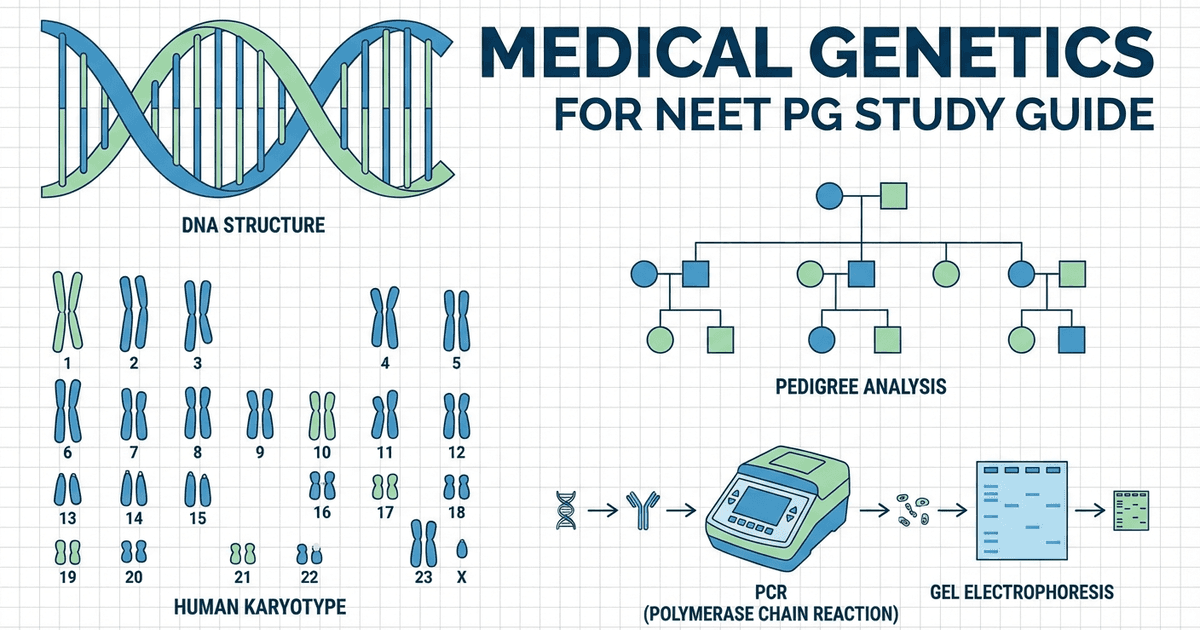
When reviewing genetics and disease concepts, focus on understanding why certain inheritance patterns produce specific pedigree shapes rather than memorizing isolated facts.
Mendelian Genetics: The Foundation That Matters
Autosomal Dominant vs Recessive Patterns
The most reliable way to distinguish autosomal dominant from recessive inheritance in pedigree questions:
Autosomal Dominant (AD) - "Every Generation" Rule:
Affected individuals appear in every generation
Male-to-male transmission occurs
Affected person usually has one affected parent
50% risk for each child of affected parent
Autosomal Recessive (AR) - "Skipping Generations" Rule:
Often skips generations
Both parents typically unaffected but carriers
Horizontal pattern (siblings affected, parents normal)
25% risk when both parents are carriers
Memory Hook for AD conditions:
"HACH-ME" - Huntington's, Achondroplasia, Café-au-lait (NF1), Hypertrophic cardiomyopathy, Marfan, Ehlers-Danlos
Memory Hook for AR conditions:
"CF-SCAT" - Cystic Fibrosis, Sickle cell, Cystic fibrosis, Albinism, Tay-Sachs
X-Linked Inheritance Patterns
X-linked recessive shows two key patterns that NEET PG tests repeatedly:
1. No male-to-male transmission (fathers cant pass X-linked traits to sons)
2. Affected males through carrier mothers (diagonal pattern in pedigree)
Classic X-linked conditions for MCQs:
Hemophilia A & B
Duchenne muscular dystrophy
Color blindness
Glucose-6-phosphate dehydrogenase deficiency
Practice with genetics MCQs helps you spot pedigree patterns quickly under time pressure — the Oncourse adaptive question bank surfaces inheritance pattern questions ranked by your weak zones, so you drill the exact concepts most likely to trip you up.
High-Yield Chromosomal Disorders
Autosomal Trisomies
Down Syndrome (Trisomy 21) - 95% of genetics disorder questions:
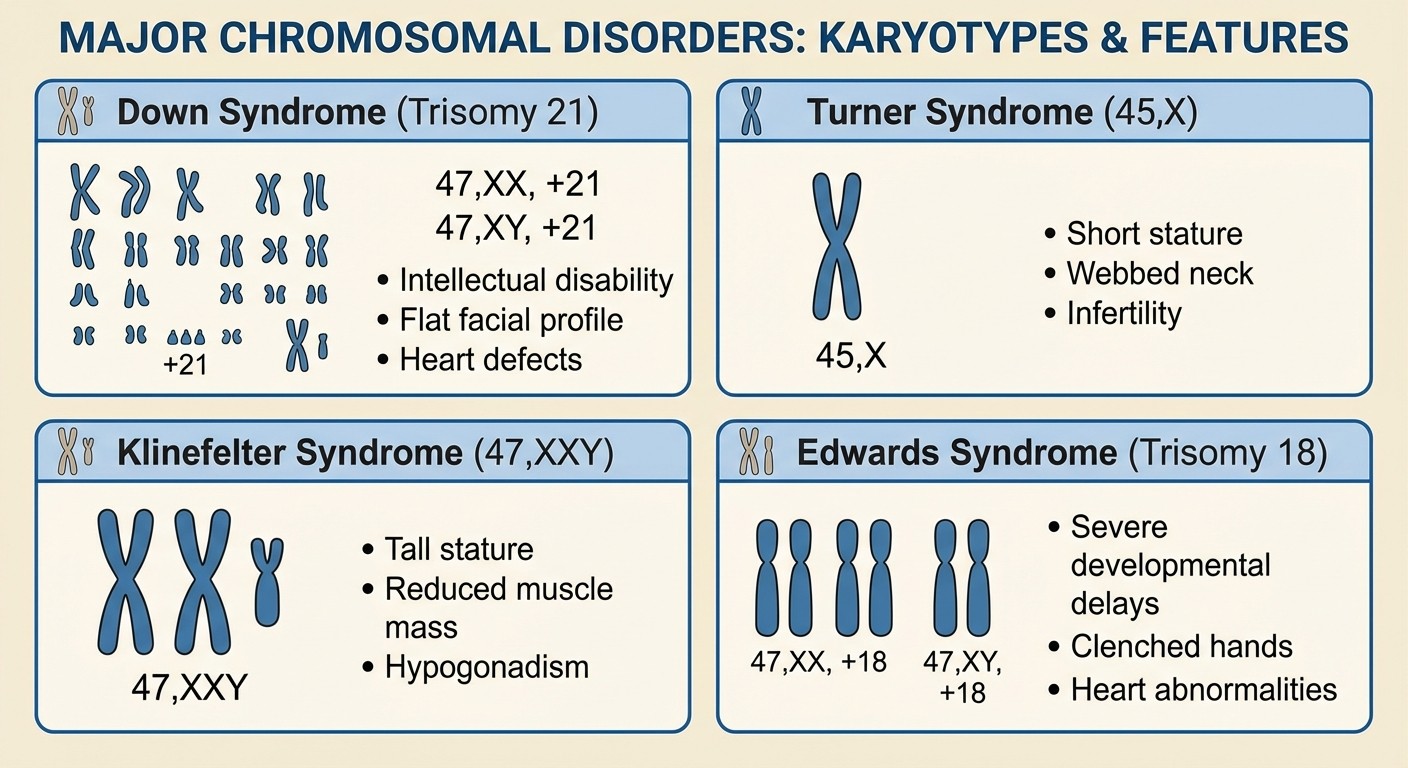
Karyotype: 47,XX,+21 or 47,XY,+21
Clinical triad: Intellectual disability + cardiac defects + characteristic facies
Associated findings: Duodenal atresia, Hirschsprung disease, early-onset Alzheimer's
Screening: First trimester combined test, NIPT
Edwards Syndrome (Trisomy 18):
Karyotype: 47,XX,+18 or 47,XY,+18
Key features: Overlapping fingers, rocker-bottom feet, severe intellectual disability
Prognosis: Most die within first year
Patau Syndrome (Trisomy 13):
Karyotype: 47,XX,+13 or 47,XY,+13
Key features: Holoprosencephaly, cleft lip/palate, polydactyly
Prognosis: Severe, most die within first year
Sex Chromosome Disorders
Turner Syndrome (45,X):
Classic tetrad: Short stature + webbed neck + coarctation of aorta + ovarian dysgenesis
Mnemonic: "SHOX gene" - Short stature, Heart defects (coarctation), Ovarian dysgenesis, X-chromosome missing
Klinefelter Syndrome (47,XXY):
Classic features: Tall stature + small firm testes + gynecomastia + infertility
Intelligence: Usually normal, may have learning difficulties
Treatment: Testosterone replacement therapy
Microdeletion Syndromes
DiGeorge Syndrome (22q11.2 deletion):
Mnemonic "CATCH-22": Cardiac defects, Abnormal facies, Thymic aplasia, Cleft palate, Hypocalcemia, chromosome 22
Immunology: T-cell deficiency due to thymic hypoplasia
Cri-du-chat Syndrome (5p deletion):
Key feature: High-pitched cat-like cry in infancy
Other findings: Microcephaly, intellectual disability, characteristic facies
When studying chromosomal disorders using concept flashcards with spaced repetition, focus on the specific karyotype numbers and key clinical triads — these flashcards use spaced repetition to lock in karyotype mnemonics before exam day.
Hardy-Weinberg Equilibrium: The Math That Matters
Hardy-Weinberg problems appear in 90% of NEET PG papers, always testing the same calculation pattern with different disease frequencies.
The Formula Framework
Basic equation: p² + 2pq + q² = 1
Where:
p = frequency of dominant allele
q = frequency of recessive allele
p + q = 1
p² = homozygous dominant frequency
2pq = heterozygous (carrier) frequency
q² = homozygous recessive (disease) frequency
Step-by-Step Calculation Strategy
Step 1: Identify what you're given (usually disease frequency) Step 2: Determine if the disease is dominant or recessive Step 3: Apply the correct part of the equation Step 4: Calculate carrier frequency (always 2pq) Classic NEET PG Hardy-Weinberg Question Pattern:
"If cystic fibrosis (autosomal recessive) occurs in 1 in 2500 births, what is the carrier frequency?"
Solution approach:
Disease frequency = q² = 1/2500 = 0.0004
q = √0.0004 = 0.02
p = 1 - q = 1 - 0.02 = 0.98
Carrier frequency = 2pq = 2 × 0.98 × 0.02 = 0.0392 ≈ 1 in 25
Hardy-Weinberg Assumptions (MCQ Trap Alert)
Questions often ask which condition violates Hardy-Weinberg equilibrium:
Large population size (small populations = genetic drift)
No mutations
No migration (gene flow changes allele frequencies)
Random mating (consanguinity violates this)
No natural selection
Most common wrong answer trap: Students pick "random mating" when the question describes a population with cultural preferences but no actual consanguinity.
Essential Molecular Biology Techniques
PCR (Polymerase Chain Reaction)
What it does: Amplifies specific DNA sequences Key components: Template DNA, primers, DNA polymerase (Taq), dNTPs Temperature cycle:
Denaturation: 94-95°C
Annealing: 50-65°C
Extension: 72°C
NEET PG MCQ focus: Questions often ask about primer design or which step would be affected by specific mutations.
FISH (Fluorescence In Situ Hybridization)
What it does: Localizes specific DNA sequences on chromosomes using fluorescent probes Clinical applications:
Detecting chromosomal rearrangements
Confirming microdeletion syndromes
Prenatal diagnosis
MCQ trap: FISH detects sequence location, not gene expression levels.
RFLP (Restriction Fragment Length Polymorphism)
What it does: Detects DNA sequence variations using restriction enzymes Clinical use: Genetic linkage analysis, paternity testing Key concept: Different individuals have different restriction sites, creating different fragment patterns
When practicing molecular biology techniques, focus on what each technique can and cannot detect — NEET PG loves testing the limitations of each method.
Southern, Northern, and Western Blotting
Memory device - "SNooW":
Southern: DNA detection
Northern: RNA detection
Western: Protein detection
Process memory trick: All three follow the same basic pattern:
1. Separation (gel electrophoresis)
2. Transfer (to membrane)
3. Hybridization (with labeled probe)
4. Detection
Special Inheritance Patterns
Mitochondrial Inheritance
Key features for NEET PG:
Maternal inheritance only (no paternal contribution)
All children of affected mother are affected
Variable expression due to heteroplasmy
Classic examples: MELAS syndrome, Leber hereditary optic neuropathy
MCQ trap: Questions show pedigrees with only maternal transmission and ask about inheritance pattern — students often confuse this with X-linked dominant.
Genomic Imprinting Disorders
Prader-Willi Syndrome (paternal 15q11-q13 deletion):
Memory hook: "PWS = Paternal Want to eat (hyperphagia), Short"
Features: Hyperphagia, obesity, short stature, intellectual disability
Angelman Syndrome (maternal 15q11-q13 deletion):
Memory hook: "Angel = Always happy (inappropriate laughter), Maternal"
Features: Inappropriate laughter, ataxia, intellectual disability, seizures
The same chromosomal region causes different syndromes depending on which parent's chromosome is affected — this concept appears in 60% of imprinting questions.
Uniparental Disomy
Definition: Both chromosomes in a pair inherited from one parent Mechanism: Can cause imprinting disorders even without deletions Example: Maternal UPD15 can cause Prader-Willi syndrome
After each genetics practice session, Oncourse performance analytics shows your accuracy per sub-topic (PCR vs FISH vs RFLP), letting you identify and close specific gaps rather than reviewing entire chapters.
MCQ Strategy and Common Traps
Pattern Recognition for Quick Elimination
Pedigree questions - Look for these patterns first: 1. Male-to-male transmission present = Rules out X-linked 2. Every generation affected = Autosomal dominant 3. Horizontal pattern (siblings affected, parents normal) = Autosomal recessive 4. Only maternal transmission = Mitochondrial
Classic Trap Scenarios
Trap 1: Similar syndrome names
Example: "Cri-du-chat vs Prader-Willi vs Angelman"
Strategy: Focus on the one distinctive feature (cat cry, hyperphagia, inappropriate laughter)
Trap 2: Molecular technique confusion
PCR amplifies, FISH localizes, RFLP detects polymorphisms
If the question asks "which technique would amplify", only PCR fits
Trap 3: Hardy-Weinberg assumption violations
Questions often describe scenarios that seem like they violate assumptions but actually dont
Key: Look for actual numerical evidence of non-random mating or selection
Time Management for Genetics MCQs
Average time per question: 45 seconds Quick elimination strategy: 1. Pedigree questions (15 seconds): Identify the pattern, eliminate 2-3 options 2. Calculation questions (30 seconds): Set up Hardy-Weinberg equation, solve 3. Syndrome recognition (10 seconds): Match one key feature, pick answer 4. Molecular biology (20 seconds): Focus on what the technique detects/does
When you encounter unfamiliar syndrome names or molecular technique variations, stick to the fundamental patterns youve mastered rather than second-guessing your preparation.
High-Yield Mnemonics That Stick
Chromosomal Disorders
Sex chromosome disorders - "TK-45":
Turner: 45,X (note the 45)
Klinefelter: 47,XXY (47 = K sounds like "Kay-seven")
Microdeletion syndromes locations:
"Will Catch 22 Angels at 15": Williams (7q), Catch-22 (22q), Angelman (15q)
Molecular Biology Techniques
Blotting techniques - "SNooW Runs":
Southern - DNA
Northern - RNA
Western - Protein
"Runs" = all use gel electrophoresis
PCR temperature mnemonics - "DNA Needs Air at Nearly Extreme":
Denaturation: Ninety-four (94°C)
Annealing: Around sixty (60°C)
Nearly: seventy-two for Extension (72°C)
Inheritance Pattern Memory Hooks
X-linked recessive diseases - "He Can't Go Dance":
Hemophilia
Color blindness
G6PD deficiency
Duchenne muscular dystrophy
Autosomal dominant conditions with variable expressivity - "MARCH":
Marfan syndrome
Achondroplasia
RetinoBlastoma (heritable form)
Café-au-lait spots (NF1)
Huntington disease
Exam Day Strategy and Final Review
48 Hours Before Exam
Focus on these high-yield review areas:
1. Chromosome numbers: 21, 18, 13, X, Y combinations
2. Hardy-Weinberg formula: Practice 2-3 calculation examples
3. Molecular technique matrix: What each method detects
4. Imprinting disorders: Prader-Willi vs Angelman distinction
Day of Exam - Quick Reference
Keep these patterns in your head as you start the genetics section:
Pedigree patterns:
AD = Every generation
AR = Horizontal (siblings)
XR = No male-to-male
Syndrome key features:
Down = Heart + duodenal atresia
Turner = Short + coarctation + ovarian dysgenesis
Klinefelter = Tall + small testes + gynecomastia
Hardy-Weinberg quick check:
Given disease frequency → q²
Want carrier frequency → Always 2pq
The genetics section tests pattern recognition more than detailed memorization. Trust the patterns youve learned, eliminate obviously wrong answers first, and dont overthink questions with unfamiliar terminology.
When revising genetics concepts using molecular biology and genomics lessons, focus on active recall of the specific patterns and calculations rather than passive reading — this builds the quick recognition skills that genetics MCQs demand.
Frequently Asked Questions
How many genetics questions appear in NEET PG 2026?
Genetics consistently appears with 5-8 questions per NEET PG paper. The distribution typically includes 2-3 Mendelian inheritance questions, 2-3 chromosomal disorder questions, 1-2 molecular biology technique questions, and 1 Hardy-Weinberg calculation.
Which chromosomal disorders are most high-yield for NEET PG?
Down syndrome (trisomy 21), Turner syndrome (45,X), and Klinefelter syndrome (47,XXY) appear in 80% of papers. DiGeorge syndrome and cri-du-chat are also frequently tested microdeletion syndromes.
How should I approach Hardy-Weinberg calculation questions?
Start by identifying the given information (usually disease frequency), determine if the condition is autosomal recessive (most common), then use q² for disease frequency and 2pq for carrier frequency. Practice the formula p² + 2pq + q² = 1 until the calculations become automatic.
What's the best way to distinguish X-linked from autosomal inheritance patterns?
Look for male-to-male transmission first — if present, it rules out X-linked inheritance. X-linked recessive shows affected males through carrier mothers (diagonal pattern), while autosomal dominant affects every generation with 50% risk per child.
Which molecular biology techniques are most important for NEET PG?
Focus on PCR (amplifies DNA), FISH (localizes sequences on chromosomes), RFLP (detects sequence variations), and the blotting techniques (Southern for DNA, Northern for RNA, Western for proteins). Know what each technique can and cannot detect.
How can I avoid common genetics MCQ traps?
The most frequent traps involve similar syndrome names and molecular technique confusion. Focus on one distinctive feature per syndrome (like cat cry for cri-du-chat) and remember the specific function of each molecular technique. Don't second-guess your preparation when you see unfamiliar terminology.
---
Prepare smarter with Oncourse AI — adaptive MCQs, spaced repetition, and AI explanations built for NEET PG. Download free on Android and iOS.