Back
USMLE Step 2 CK Timing for IMGs: When to Take It, How to Score 250+, and Why It's Your Residency Lifeline in 2026
Strategic Step 2 CK timing guide for IMGs: optimal scheduling relative to rotations and ERAS, proven 250+ score strategies, and 2026 residency program requirements.

USMLE Step 2 CK Timing for IMGs: When to Take It, How to Score 250+, and Why It's Your Residency Lifeline in 2026
You are staring at your ERAS timeline, clinical rotation schedule, and Step 2 CK study plan spread across three different tabs. The pressure is real — with Step 1 now pass/fail, Step 2 CK carries the entire weight of your numeric differentiation as an IMG.
Here's what changed everything: Step 2 CK is no longer just another exam. It's your residency lifeline. The difference between a 230 and 250+ can determine whether you get interviews at your target programs or watch the match cycle slip away.
This isnt theoretical advice from someone who hasnt been through the process. This is your strategic roadmap — when exactly to schedule Step 2 CK relative to your clinical rotations, how to engineer a 250+ score, and what residency programs actually filter on in 2026.
Why Step 2 CK Timing Makes or Breaks Your Match
Step 2 CK timing isnt just about being "ready" — it's about strategic positioning in a competitive landscape where programs receive 1,000+ IMG applications for 3 open spots.
The new reality: With Step 1 pass/fail since January 2022, residency programs shifted their filtering criteria entirely to Step 2 CK scores. Internal medicine programs that previously screened at Step 1 ≥220 now filter Step 2 CK at ≥240. Family medicine programs moved their cutoffs from 210 to 230+. Critical timing windows:
Early September ERAS submission: Your Step 2 CK score needs to be available by September 1st for maximum interview invitations
Late November application updates: Programs review updated scores through November, but interview spots are already 70% filled
December deadline reality: Taking Step 2 CK in December means your score arrives after most interview decisions are made
The math is brutal but simple: IMGs who submit ERAS with Step 2 CK scores ≥245 receive 3x more interview invitations than those who submit without scores or with scores <235.
The IMG Step 2 CK Timeline That Actually Works
Option 1: The Power Move Timeline (Recommended)
Target exam date: July 15-August 15
This timeline positions your score for early ERAS submission with maximum interview potential.
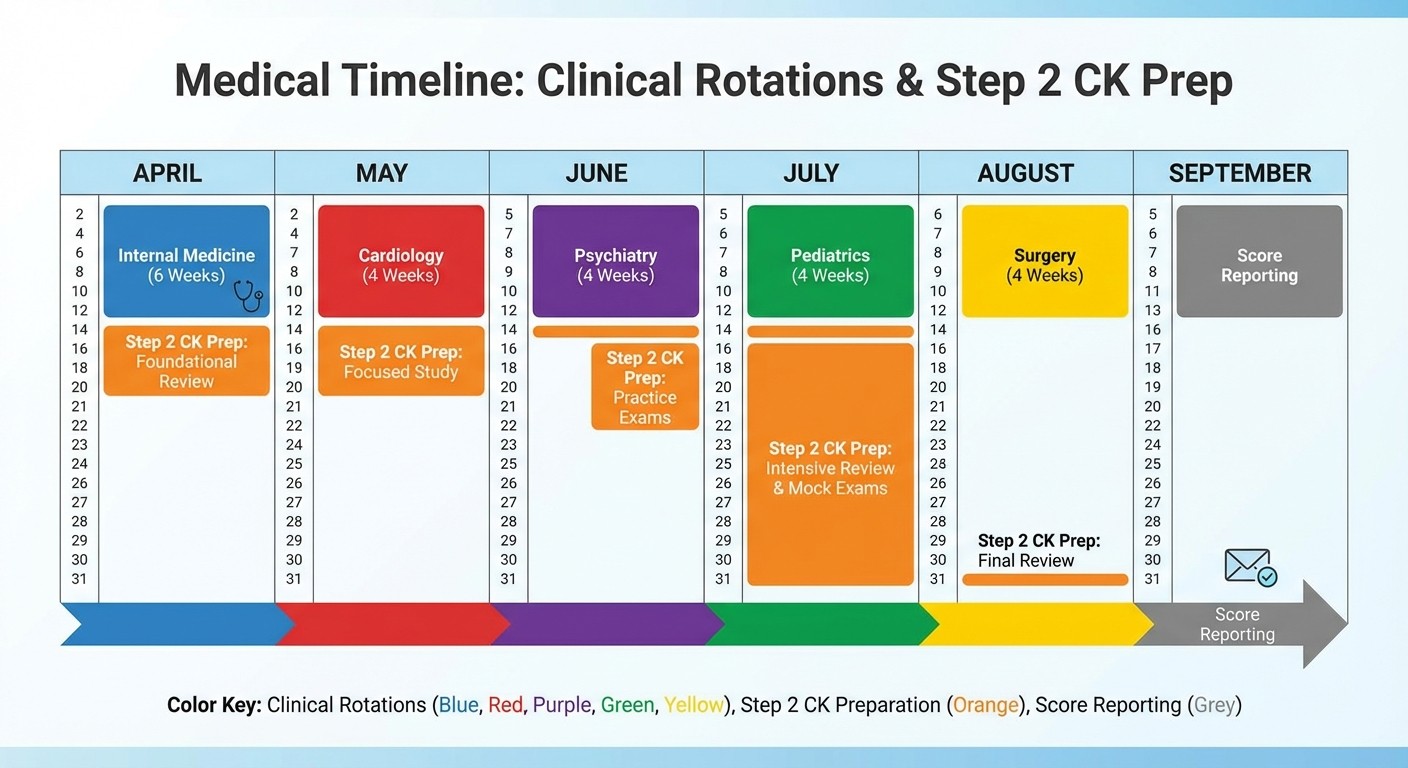
Preparation phase (April-July):
April-May: Complete clinical rotations while doing passive review (30 min/day)
June 1-July 15: Dedicated study period (8-10 weeks, full-time)
July 15-August 15: Exam window
August 15-September 1: Score reporting and ERAS preparation
Why this works: Your score arrives before programs start serious application review. You avoid the October rush when everyone realizes they needed their score earlier.
Option 2: The Clinical-Heavy Timeline
Target exam date: September 1-15 Preparation phase (May-September):
May-July: Clinical rotations with targeted Step 2 CK integration
August: Dedicated study sprint (4 weeks)
September 1-15: Exam window
Trade-off: Later submission means some programs have already started interview selections, but you get more clinical experience before the exam.
Option 3: The Recovery Timeline (Score Improvement)
Target exam date: October 1-15
Only viable if you're retaking after a suboptimal first attempt. Most programs will still consider updated scores through November, but interview slots are limited.
Clinical Rotations: Your Step 2 CK Performance Multiplier
The sequence and timing of your clinical rotations can add 10-15 points to your Step 2 CK score if planned strategically.
High-Impact Rotation Sequence
Phase 1 (Months 1-3): Foundation Building 1. Internal Medicine (4 weeks): Core diagnostic reasoning framework 2. Emergency Medicine (2 weeks): Acute presentation patterns 3. Ambulatory Care (2 weeks): Outpatient management algorithms Phase 2 (Months 4-6): Specialization 4. Cardiology elective (2 weeks): High-yield Step 2 CK content area 5. Psychiatry (4 weeks): 15% of Step 2 CK questions, often undertested 6. Obstetrics/Gynecology (4 weeks): Integration with internal medicine concepts Integration strategy: During each rotation, dedicate 30 minutes daily to Step 2 CK questions specifically related to that specialty. Use Oncourse's adaptive question bank to target your current rotation — the AI adjusts question difficulty in real time based on your clinical rotation focus, helping you connect theoretical knowledge with practical application faster than studying these specialties separately.
The Rotation-Study Integration System
Week 1-2 of each rotation: Focus 80% on clinical learning, 20% on Step 2 CK integration Week 3-4 of each rotation: Shift to 60% clinical, 40% Step 2 CK consolidation
This approach transforms clinical rotations from separate experiences into integrated Step 2 CK preparation, rather than competing priorities.
How to Engineer a 250+ Step 2 CK Score
The Score Trajectory System
Baseline assessment (Week 1): Take a full-length NBME exam to establish your starting point
<200: 12-16 week preparation needed
200-220: 10-12 week preparation needed
220-235: 8-10 week preparation needed
235+: 6-8 week focused improvement
The 250+ Study Architecture
Phase 1: Knowledge Consolidation (Weeks 1-4)
Daily target: 80 practice questions + review
Focus areas: High-yield clinical reasoning patterns
Tool optimization: Use Oncourse's performance analytics to track accuracy trends by subject and difficulty tier — this removes guesswork from knowing when you're ready to schedule
Phase 2: Pattern Recognition (Weeks 5-7)
Daily target: 120 practice questions + targeted weak area review
Advanced strategy: Timed question blocks under exam conditions
Clinical integration: Apply rotation experiences to practice questions
Phase 3: Score Optimization (Weeks 8-10)
Daily target: 160 practice questions (2 full blocks) + spaced repetition review
Score prediction: Your practice test average should be 15-20 points above your target score
Weak area elimination: Use spaced repetition to surface missed concepts at optimal intervals — critical for retaining high-volume clinical reasoning across cardiology, internal medicine, and psychiatry content over long prep windows
The 230→250+ Score Jump Strategy
Most IMGs plateau around 230-235. Here's how to break through:
Common plateau causes: 1. Time management: Spending >2 minutes per question 2. Clinical reasoning gaps: Missing subtle diagnostic clues 3. Test-taking strategy: Not eliminating wrong answers systematically Breakthrough techniques: 1. The 90-second rule: Force yourself to answer questions in 90 seconds during practice 2. Diagnostic reasoning maps: Create flowcharts for high-yield presentations (chest pain, shortness of breath, abdominal pain) 3. Wrong answer analysis: Spend equal time reviewing why wrong answers are wrong, not just why right answers are correct
Residency Program Score Requirements: The 2026 Reality Check
Internal Medicine IMG Score Expectations
Tier 1 Programs (Top 20): Step 2 CK ≥250
Examples: Mayo, Johns Hopkins, MGH
Additional requirements: Research experience, strong LORs from US physicians
Tier 2 Programs (Regional Academic): Step 2 CK ≥240
Examples: University programs in major cities
Balanced emphasis on scores + clinical experience
Tier 3 Programs (Community-Based): Step 2 CK ≥230
Focus on clinical skills and fit over pure score optimization
Family Medicine Landscape
Competitive Programs: Step 2 CK ≥235 Mid-Tier Programs: Step 2 CK ≥225 IMG-Friendly Programs: Step 2 CK ≥215 with strong clinical performance
Specialty-Specific Cutoffs
Specialty | Minimum Score | Competitive Score |
|---|---|---|
Internal Medicine | 230 | 245+ |
Family Medicine | 215 | 235+ |
Psychiatry | 220 | 240+ |
Pediatrics | 225 | 240+ |
Emergency Medicine | 240 | 250+ |
General Surgery | 245 | 255+ |
Geographic Considerations
East Coast competitive markets: Add 5-10 points to baseline requirements Midwest/South: More emphasis on clinical experience, scores can be 5 points lower West Coast: Extremely competitive, often requires research + high scores
ERAS Submission Strategy: Score vs. No Score
Submit With Score (Recommended if ≥240)
Advantages:
Immediate filtering through program screening systems
Higher interview invitation rates
Demonstrated competency before application review
Timeline requirement: Score must be available by August 25th for September 1st ERAS submission
Submit Without Score (Risk Assessment)
When to consider:
Practice scores consistently <235
Need more preparation time
Clinical rotation schedule conflicts with early exam dates
Mitigation strategy:
Strong personal statement explaining timeline
Early score update commitment in application
Exceptional clinical experience to offset score delay
Practice Test Strategy: Predicting Your Real Score
NBME vs. UWorld Self-Assessments
NBME Practice Exams (most predictive):
Take NBME 9, 10, 11 in final 4 weeks
Average score typically within 5-10 points of real score
Focus on form-specific weak areas between attempts
UWorld Self-Assessments:
Generally 10-15 points higher than real score
Use for knowledge gaps, not score prediction
Excellent detailed explanations for learning
The 3-Test Prediction System
Test 1 (Week 6): Baseline measurement + major weak area identification Test 2 (Week 8): Progress tracking + fine-tuning study plan Test 3 (Week 10): Final readiness assessment Scheduling rule: Only schedule your real exam when your practice average exceeds your target by 15+ points for 2 consecutive tests.
Common IMG Timing Mistakes (And How to Avoid Them)
Mistake 1: The "I'll Be Ready by Then" Fallacy
What happens: Scheduling exam date based on hopes rather than practice test performance Solution: Data-driven scheduling based on concrete score trajectory
Mistake 2: Rotation Schedule Conflicts
What happens: Trying to study during demanding rotations (surgery, ICU) Solution: Plan dedicated study periods around lighter rotations or electives
Mistake 3: Late Score Submission
What happens: Taking exam in October-November, missing early interview waves Solution: Target July-August exam dates for optimal ERAS positioning
Mistake 4: Inadequate Practice Test Frequency
What happens: Taking 1-2 practice tests, missing knowledge gaps Solution: Minimum 4 full-length practice tests with detailed review
Score Improvement Strategies for Retakers
First Attempt Analysis
Score breakdown review:
Identify your lowest-performing organ systems
Analyze time management patterns
Review missed question categories
Common retaker improvements:
Knowledge gaps: +10-15 points with targeted review
Test strategy: +5-10 points with better time management
Clinical reasoning: +10-20 points with rotation integration
The 8-Week Retaker Protocol
Weeks 1-2: Comprehensive weak area review using spaced repetition Weeks 3-5: High-volume practice (150+ questions daily) Weeks 6-7: Full-length practice tests + performance analytics review Week 8: Final review + test-taking strategy optimization
Building Your Score Insurance Policy
The Multiple Attempt Strategy
Attempt 1: Target your realistic best score with adequate preparation Backup plan: If needed, second attempt scheduled 8-10 weeks later Financial planning: Budget for potential second attempt ($995 + preparation costs) Timeline buffer: Ensure second attempt score arrives before application deadlines
Score Reporting Considerations
Score choice policy: You can choose which Step 2 CK attempt to report to residency programs Strategic reporting: Most IMGs report their highest score only Transparency requirements: Some programs require all attempt disclosure
Frequently Asked Questions
How long should I study for USMLE Step 2 CK as an IMG?
Most successful IMGs study 8-12 weeks full-time. Your baseline practice score determines length: <200 needs 12+ weeks, 200-220 needs 10-12 weeks, 220+ needs 8-10 weeks. Use practice test performance, not calendar time, to determine readiness.
Should I take Step 2 CK before or after clinical rotations?
Take it after completing at least 12 weeks of clinical rotations. The clinical experience significantly improves diagnostic reasoning and question interpretation. IMGs who complete rotations first score an average 15-20 points higher than those who take it purely based on book study.
What's a competitive Step 2 CK score for IMG residency match in 2026?
For internal medicine: 240+ is competitive, 250+ for top programs. Family medicine: 225+ competitive, 235+ for competitive programs. Psychiatry and pediatrics: 230+ competitive. These thresholds increased 10-15 points since Step 1 became pass/fail.
Can I take Step 2 CK multiple times as an IMG?
Yes, but plan strategically. Most programs see all attempts unless you use score choice reporting. Take your first attempt when practice scores are within 10-15 points of your target. If you need to retake, wait 8-10 weeks for adequate improvement time.
When is the latest I can take Step 2 CK for ERAS submission?
For optimal interview invitations: July-August exam dates. For acceptable positioning: September exam dates with scores available by October 1st. Taking it in November-December significantly reduces interview opportunities as most programs have already made initial screening decisions.
How do I balance Step 2 CK prep with clinical rotations?
Integrate rather than separate. During rotations, do 30-50 practice questions daily focused on that specialty. Use clinical cases to reinforce Step 2 CK concepts. Plan dedicated study blocks during lighter rotations or electives, not during surgery or ICU months.
Prepare smarter with Oncourse AI — adaptive MCQs, spaced repetition, and AI explanations built for USMLE Step 2 CK. Download free on Android and iOS.