Back
Acute Kidney Injury: Clinical Approach, Diagnostic Reasoning & High-Yield Pearls for USMLE Step 2 CK
Master AKI diagnosis and management for USMLE Step 2 CK. Learn prerenal vs intrinsic vs postrenal classification, key lab findings, clinical vignette patterns, and high-yield mnemonics.
Acute Kidney Injury: Clinical Approach, Diagnostic Reasoning & High-Yield Pearls for USMLE Step 2 CK
You are staring at a 68-year-old woman with diabetes who comes to the ED with nausea and decreased urine output for 2 days. Her creatinine is 2.8 mg/dL (baseline 1.2). BUN is 56. You have 90 seconds to work through this vignette. Is this prerenal azotemia from dehydration? Acute tubular necrosis from contrast? Or something else entirely?
AKI shows up in about 12% of USMLE Step 2 CK questions — not because it's rare, but because it tests your clinical reasoning under pressure. The examiners love AKI because it forces you to synthesize history, physical exam, labs, and timeline into a coherent diagnosis. Miss the pattern, and you will pick the wrong answer every time.
This guide breaks down exactly how to approach AKI on Step 2 CK. We will cover the classification system that matters, the lab values that differentiate causes, and the clinical patterns you need to recognize in 90 seconds.
Understanding AKI: Definition and Clinical Significance
Acute kidney injury is defined by a rapid decline in kidney function over hours to days. On Step 2 CK, this translates to specific criteria you need to memorize:
KDIGO Definition (High-Yield for Step 2 CK):
Serum creatinine increase ≥0.3 mg/dL within 48 hours, OR
Serum creatinine increase ≥1.5x baseline within 7 days, OR
Urine output <0.5 mL/kg/hour for 6+ hours
The timeline matters. AKI develops over days, not weeks. If the vignette mentions "gradually worsening" over months, think chronic kidney disease instead.
Step 2 CK Pearl: The test writers often give you both a baseline creatinine and current value. Calculate the ratio immediately. If current/baseline ≥1.5, you have AKI by definition.
The Three-Category Classification System
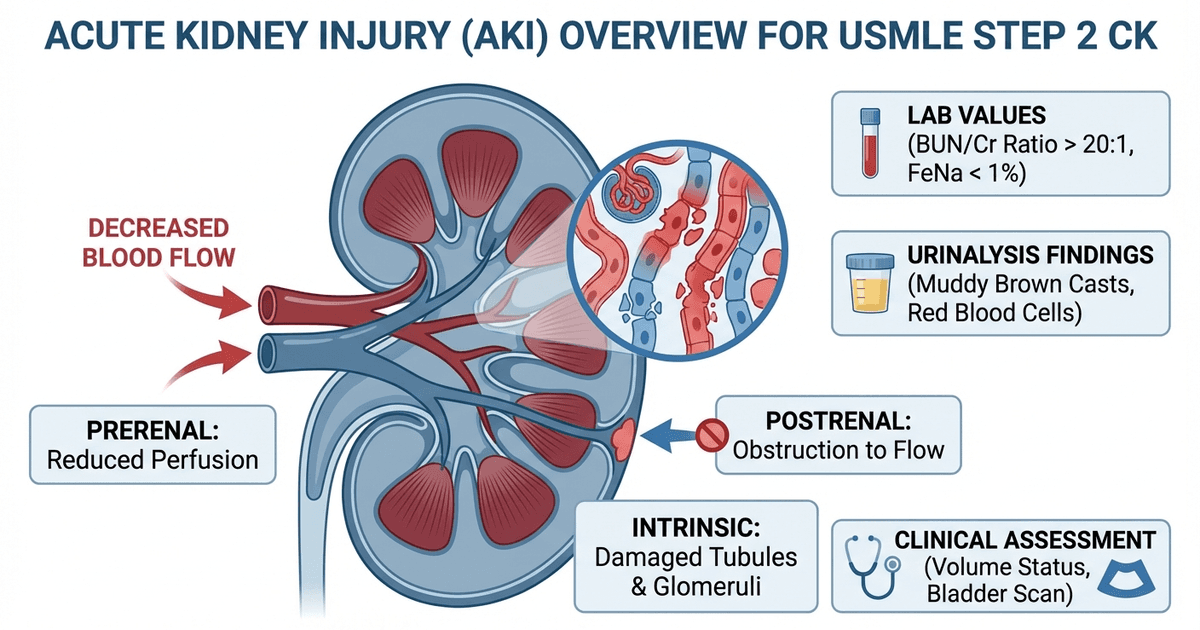
Every AKI question on Step 2 CK fits into one of three categories. Master this framework and you will never miss an AKI question again.
Prerenal AKI (60-70% of cases)
Prerenal AKI results from decreased effective circulating volume. The kidneys are structurally normal but receiving inadequate perfusion. Think of this as "thirsty kidneys."
Common Step 2 CK Scenarios:
Volume depletion: diarrhea, vomiting, diuretic overuse
Heart failure with decreased cardiac output
Cirrhosis with third-spacing
Sepsis with distributive shock
ACE inhibitor initiation in bilateral renal artery stenosis
Key Lab Pattern:
BUN/Creatinine ratio >20:1 (kidneys reabsorb urea to preserve volume)
FENa <1% (kidneys holding onto sodium)
Urine osmolality >500 mOsm/kg (concentrated urine)
Bland urinalysis (maybe hyaline casts)
The clinical reasoning: when kidneys sense low perfusion, they activate every conservation mechanism. They reabsorb sodium aggressively (low FENa), concentrate urine maximally (high osmolality), and preferentially reabsorb urea over creatinine (high BUN/Cr ratio).
Oncourse's adaptive qbank has dozens of prerenal AKI scenarios, and the AI explanations walk through this exact physiologic reasoning step by step, helping you build the framework rather than memorize isolated facts.
Intrinsic AKI (25-40% of cases)
Intrinsic AKI involves direct kidney injury. The most common cause on Step 2 CK is acute tubular necrosis (ATN), but you also need to recognize glomerular and interstitial patterns.
Acute Tubular Necrosis (ATN):
Ischemic ATN: prolonged hypotension, cardiac arrest
Nephrotoxic ATN: contrast dye, aminoglycosides, NSAIDs, rhabdomyolysis
Key Lab Pattern for ATN:
BUN/Creatinine ratio <20:1 (both rise proportionally)
FENa >2% (damaged tubules cant reabsorb sodium)
Urine osmolality <350 mOsm/kg (cant concentrate)
Muddy brown casts on urinalysis (pathognomonic for ATN)
Acute Interstitial Nephritis (AIN):
Causes: NSAIDs, proton pump inhibitors, antibiotics, autoimmune
Urinalysis: white cell casts, eosinophiluria
Often presents with rash, fever, eosinophilia (but not always)
Acute Glomerulonephritis:
Urinalysis: red cell casts, proteinuria, hematuria
Think post-infectious GN, RPGN, lupus nephritis
Step 2 CK High-Yield Point: Muddy brown casts = ATN. Red cell casts = glomerulonephritis. White cell casts = interstitial nephritis. The urinalysis tells the story.
Postrenal AKI (5-10% of cases)
Postrenal AKI results from urinary tract obstruction. Bilateral obstruction (or unilateral in a single functioning kidney) is required for significant creatinine elevation.
Common Causes:
Benign prostatic hyperplasia (most common in elderly men)
Cervical cancer with ureteral compression
Bilateral kidney stones
Neurogenic bladder
Retroperitoneal fibrosis
Key Clinical Clues:
Anuria (complete obstruction) or alternating oliguria/polyuria
Bladder distension on exam
Hydronephrosis on renal ultrasound
Relief with foley catheter (for bladder outlet obstruction)
Whenever you see an elderly man with AKI and difficulty voiding, think BPH causing postrenal obstruction. The diagnostic test of choice is renal ultrasound to assess for hydronephrosis.
Diagnostic Approach: Labs That Make the Diagnosis
The USMLE Step 2 CK loves testing your ability to interpret lab combinations. Here's the systematic approach that works every time.
Step 1: Calculate BUN/Creatinine Ratio
Normal ratio: 10-20:1
>20:1 suggests prerenal (kidneys reabsorbing urea)
<20:1 suggests intrinsic (both rise proportionally)
Variable in postrenal (depends on degree/duration of obstruction)
Clinical Pearl: GI bleeding can artificially elevate BUN (protein breakdown), giving a high ratio that mimics prerenal azotemia. Look for melena or hematemesis in the vignette.
Step 2: Calculate Fractional Excretion of Sodium (FENa)
FENa = (UNa × PCr) / (PNa × UCr) × 100
Most Step 2 CK questions will give you the calculated value, but knowing the formula shows clinical reasoning.
<1% = prerenal (kidneys conserving sodium)
>2% = intrinsic (tubular dysfunction)
1-2% = equivocal (use other factors)
Important Caveat: FENa is unreliable if the patient is on diuretics. In that case, use fractional excretion of urea (FEUrea), which remains accurate:
FEUrea <35% = prerenal
FEUrea >50% = intrinsic
Step 3: Examine Urinalysis
The urinalysis is often the most informative test for determining AKI cause.
Prerenal:
Bland urinalysis (normal or hyaline casts)
Specific gravity >1.020 (concentrated)
ATN:
Muddy brown casts (granular casts)
Specific gravity ~1.010 (isosthenuric)
Glomerulonephritis:
Red cell casts (pathognomonic)
Proteinuria, hematuria
Dysmorphic RBCs
Interstitial Nephritis:
White cell casts
Eosinophiluria (not always present)
Postrenal:
Variable findings
May see crystals if stone-related
When working through AKI questions, Oncourse's AI explanations break down the urinalysis findings and connect them to the underlying pathophysiology, making these patterns stick for exam day.
Clinical Vignette Patterns on Step 2 CK
USMLE Step 2 CK tests AKI through specific clinical scenarios that repeat year after year. Recognizing these patterns saves precious time during the exam.
Pattern 1: Post-Operative AKI
Typical Vignette: 72-year-old man undergoes major abdominal surgery. Receives IV contrast for CT scan on postop day 2. Develops oliguria and rising creatinine. Key Teaching Point: Post-op patients are at high risk for both prerenal (volume depletion, hypotension) and intrinsic AKI (contrast nephropathy). Look for:
Timeline: contrast nephropathy peaks 24-48 hours post-exposure
Risk factors: diabetes, CKD, volume depletion
Prevention: IV saline hydration before and after contrast
Pattern 2: Heart Failure with ACE Inhibitor
Typical Vignette: 65-year-old woman with heart failure starts lisinopril. Creatinine rises from 1.1 to 1.8 mg/dL over 1 week. Key Teaching Point: ACE inhibitors can precipitate AKI in patients with:
Bilateral renal artery stenosis
Severe heart failure (dependent on efferent arteriole constriction)
Volume depletion
Management: Hold ACE inhibitor, optimize volume status, consider renal artery stenosis workup.
Pattern 3: Rhabdomyolysis-Induced AKI
Typical Vignette: 22-year-old athlete found down after heat stroke. Dark urine, elevated CK >15,000, rising creatinine. Key Teaching Point: Myoglobin is directly nephrotoxic. Look for:
Extremely elevated CK (>5,000)
Dark urine (myoglobinuria)
Hyperkalemia, hyperphosphatemia
Treatment: aggressive IV fluids, alkalinization if no contraindication
Using Oncourse's performance analytics, you can track your accuracy specifically on rhabdomyolysis questions — many students miss the connection between muscle breakdown and kidney injury.
Pattern 4: Medication-Induced AKI
Common Culprits on Step 2 CK:
NSAIDs: especially in elderly, dehydrated patients
Aminoglycosides: dose-dependent, non-oliguric
Contrast agents: more likely in diabetics with baseline CKD
Calcineurin inhibitors: cyclosporine, tacrolimus
The vignette will usually provide subtle clues about recent medication changes or dosing errors.
High-Yield Mnemonics for USMLE Step 2 CK
AEIOU: Indications for Emergent Dialysis
Acidosis (pH <7.15)
Electrolyte abnormalities (hyperkalemia >6.5 mEq/L)
Ingestion (methanol, ethylene glycol, salicylates, lithium)
Overload (pulmonary edema refractory to diuretics)
Uremia (pericarditis, encephalopathy, bleeding)
Step 2 CK Application: When a vignette mentions any of these findings in a patient with AKI, dialysis is the answer — not just supportive care.
HARDSHIPS: Causes of ATN
Hypotension/shock
Aminoglycosides
Rhabdomyolysis
Dye (contrast agents)
Sepsis
Heavy metals
Ischemia
Phenytoin/other drugs
Solvents
POSTCARD: Causes of Postrenal AKI
Prostate enlargement (BPH, cancer)
Ovarian cancer
Stones (bilateral)
Tumor (cervical, bladder, retroperitoneal)
Cervical cancer
Adhesions/fibrosis
Retroperitoneal fibrosis
Drugs (acyclovir crystals, indinavir stones)
These mnemonics work because they group similar mechanisms together. When you see an elderly man with AKI and hesitancy, you immediately think "POSTCARD" and consider BPH.
Management Principles for Step 2 CK
Step 2 CK management questions focus on initial stabilization and specific interventions rather than long-term care.
Prerenal AKI Management
First-Line: Volume resuscitation with normal saline
Goal: restore effective circulating volume
Monitor response: urine output, creatinine improvement
Avoid nephrotoxic drugs (NSAIDs, ACE inhibitors if volume-depleted)
Step 2 CK Pearl: If a patient has prerenal AKI from heart failure, the answer is NOT aggressive fluid resuscitation — its optimization of cardiac output (inotropes, diuretics as appropriate).
Intrinsic AKI Management
ATN:
Supportive care (no specific treatment)
Avoid nephrotoxins
Optimize volume status
Monitor for complications (hyperkalemia, metabolic acidosis)
AIN:
Remove offending agent
Consider corticosteroids if severe and recent onset (<2 weeks)
Glomerulonephritis:
Specific treatment depends on cause
ACE inhibitors for proteinuria reduction (once AKI resolves)
Immunosuppression for autoimmune causes
Postrenal AKI Management
Immediate: Relieve obstruction
Foley catheter for bladder outlet obstruction
Nephrostomy tubes for ureteral obstruction
α-blockers for BPH-related obstruction
Post-Obstruction Diuresis: Monitor for excessive urine output after relief — may need careful fluid replacement.
The key for Step 2 CK is recognizing that postrenal AKI is immediately reversible IF you remove the obstruction quickly.
Common Step 2 CK Traps and How to Avoid Them
Trap 1: Normal Creatinine with AKI
Scenario: Young, muscular patient with decreased urine output but creatinine only 1.2 mg/dL. Teaching Point: Young patients with high baseline muscle mass may have "normal" creatinine despite significant kidney injury. Look for decreased urine output and calculate from baseline if given.
Trap 2: CKD vs AKI
Scenario: Patient with creatinine 4.2 mg/dL and small kidneys on ultrasound. Teaching Point: Small kidneys suggest chronic process. AKI may be superimposed on CKD (acute-on-chronic), but management priorities differ.
Trap 3: Diuretic Use Confounding FENa
Scenario: Patient on furosemide with AKI and FENa 2.5%. Teaching Point: Diuretics artificially elevate FENa. Use FEUrea instead, or rely more heavily on BUN/Cr ratio and urinalysis.
Trap 4: Contrast Nephropathy Timeline
Scenario: Patient gets contrast and creatinine rises immediately. Teaching Point: True contrast nephropathy peaks at 24-48 hours. Immediate rise suggests prerenal azotemia from volume depletion during the procedure.
Laboratory Values: Reference Ranges for Step 2 CK
Memorize these normal ranges — they appear frequently:
Serum Values:
Creatinine: 0.7-1.3 mg/dL
BUN: 7-20 mg/dL
Sodium: 136-145 mEq/L
Potassium: 3.5-5.0 mEq/L
Urine Values:
Osmolality: 300-900 mOsm/kg
Specific gravity: 1.003-1.030
Protein: <150 mg/24 hours
Calculated Values:
BUN/Cr ratio: 10-20:1
FENa: <1% (normal kidney function)
Creatinine clearance: 90-120 mL/min
Practice with Oncourse's US nephrology question bank to drill these reference ranges until they're automatic. When you're under time pressure, you cant afford to second-guess normal values.
Putting It All Together: The 90-Second Approach
When you encounter an AKI vignette on Step 2 CK, use this systematic approach:
Seconds 0-15: Confirm AKI diagnosis
Calculate creatinine ratio from baseline
Check timeline (days vs weeks vs months)
Seconds 15-45: Classify the AKI
Calculate BUN/Cr ratio (>20 = prerenal, <20 = intrinsic)
Check FENa if given (<1% = prerenal, >2% = intrinsic)
Examine urinalysis (casts tell the story)
Seconds 45-75: Consider clinical context
Recent procedures or medications?
Signs of volume depletion or heart failure?
Elderly man with voiding symptoms?
Seconds 75-90: Pick management
Prerenal: fluid resuscitation (unless heart failure)
Intrinsic: supportive care, avoid nephrotoxins
Postrenal: relieve obstruction
This framework works because it mirrors how attendings think through AKI cases in real clinical practice. The key is pattern recognition — after seeing enough cases, you will identify the category within seconds.
To build this pattern recognition, explore our comprehensive AKI lessons that break down dozens of clinical scenarios with detailed explanations.
Frequently Asked Questions
How do you differentiate prerenal azotemia from ATN in a dehydrated patient?
The key is response to fluid resuscitation. Prerenal AKI improves within 24-48 hours of adequate volume replacement, while ATN does not. Lab values help: prerenal typically shows BUN/Cr >20, FENa <1%, and concentrated urine. ATN shows muddy brown casts and poor concentrating ability.
When should you suspect contrast-induced nephropathy?
Consider contrast nephropathy when AKI develops 24-48 hours after contrast exposure, especially in patients with diabetes, baseline CKD, or volume depletion. Prevention with IV saline hydration is more effective than treatment after the fact.
What are the absolute indications for emergency dialysis in AKI?
Remember AEIOU: severe Acidosis (pH <7.15), dangerous Electrolyte abnormalities (K+ >6.5), toxic Ingestions, volume Overload with pulmonary edema, and symptomatic Uremia. Any one of these requires urgent dialysis regardless of creatinine level.
How do you calculate FENa and what does it mean?
FENa = (UNa × PCr) / (PNa × UCr) × 100. Values <1% suggest prerenal azotemia (kidneys conserving sodium), while >2% indicates intrinsic kidney disease (impaired sodium reabsorption). The 1-2% range is indeterminate.
Can NSAIDs cause AKI in healthy patients?
NSAIDs primarily cause AKI in patients with compromised renal perfusion — elderly patients, those with heart failure, volume depletion, or baseline CKD. In healthy young patients with normal kidneys, short-term NSAID use rarely causes significant AKI.
What urinalysis findings are pathognomonic for specific AKI causes?
Red cell casts are pathognomonic for glomerulonephritis. Muddy brown granular casts indicate ATN. White cell casts suggest interstitial nephritis. Eosinophiluria, while not always present, strongly suggests drug-induced AIN when found.
---
Prepare smarter with Oncourse AI — adaptive MCQs, spaced repetition, and AI explanations built for USMLE Step 2 CK. Download free on Android and iOS.