Back
NEET PG 2026 Last Month Revision Strategy: High-Yield Topics, Subject Priority Order and What to Skip
Complete last month revision strategy for NEET PG 2026. Get subject priority order, high-yield topics list, strategic skipping guide and 30-day study schedule for final exam preparation.

NEET PG 2026 Last Month Revision Strategy: High-Yield Topics, Subject Priority Order and What to Skip
You are probably feeling the time crunch right now. NEET PG 2026 is 30 days away, and you are wondering whether your preparation is enough. Here's the reality: 200 questions, 3 hours 20 minutes, 1 minute per question. Everything you have learned in the past year comes down to these crucial final weeks.
The last month isnt about learning new concepts — its about weaponizing what you already know. This means ruthless prioritization, strategic skipping, and laser focus on high-yield topics that consistently show up in NEET PG. Most students make the mistake of trying to cover everything. Smart students focus on what actually gets asked.
In this final push, every hour counts. You cant afford to waste time on low-yield topics or subjects that wont move your score. This guide gives you the exact roadmap: which subjects to prioritize, what topics to drill, and most importantly, what to confidently skip.
Why Last Month Strategy is Different from Regular Preparation
Regular preparation is about building knowledge. Last month revision is about exam optimization. The difference is critical.
During regular prep, you learn concepts thoroughly. In the final month, you practice retrieval. Your brain has the information — now you need to access it quickly under pressure. This means switching from textbooks to NEET PG practice questions and spaced repetition flashcards.
The scoring pattern in NEET PG 2026 follows predictable weightages: Medicine (50-55 questions), Surgery (35-40 questions), PSM (20-25 questions), and clinical subjects making up the rest. You cant ignore any major subject, but you can definitely optimize your time allocation based on question density and your current strength.
Most importantly, last month revision is about confidence building. You need to walk into the exam knowing you can handle 80% of the questions. Oncourse's Smart Practice Mode adapts to your weak subjects identified during revision, serving targeted high-yield MCQs in Surgery, Medicine, and PSM rather than random questions, maximizing your revision ROI in these critical weeks.
Subject Priority Order: Data-Driven Approach
Here's your priority order based on NEET PG question patterns and score impact:
Tier 1: Medicine (35-40% of your time)
Cardiology: 8-10 questions guaranteed
Pulmonology: 6-8 questions
Gastroenterology: 6-8 questions
Nephrology: 4-6 questions
Endocrinology: 4-6 questions
Medicine consistently gives maximum questions. Focus here first.
Tier 2: Surgery (25-30% of your time)
General Surgery: 8-12 questions
Orthopedics: 6-8 questions
Ophthalmology: 4-5 questions
ENT: 4-5 questions
Surgery questions are usually straightforward if you know the basics. High ROI for time invested.
Tier 3: PSM/Community Medicine (15-20% of your time)
Epidemiology & Biostatistics: 8-10 questions
MCH: 4-6 questions
Nutritional disorders: 3-4 questions
PSM gives predictable questions. Master the PSM lessons for easy marks.
Tier 4: Clinical Subjects (15-20% of your time)
Pediatrics: 8-10 questions
OB-GYN: 8-10 questions
Psychiatry: 3-4 questions
These subjects have focused, pattern-based questions.
High-Yield Topics by Subject
Medicine: Focus Areas
Cardiology must-knows:
ECG interpretation (5 patterns: MI, arrhythmias, blocks, axis deviation, LVH/RVH)
Heart failure management (drugs, stages, NYHA classification)
Hypertension drugs and contraindications
Acute coronary syndrome protocols
Rheumatic heart disease and prophylaxis
Pulmonology essentials:
Asthma vs COPD (spirometry, drugs, acute management)
Pneumonia types and antibiotics
Pleural effusion (Light's criteria, causes)
Lung cancer staging and treatment
Interstitial lung disease basics
Gastroenterology priorities:
Viral hepatitis (HAV, HBV, HCV markers and interpretation)
Cirrhosis complications (ascites, varices, encephalopathy)
IBD vs IBS (clinical features, drugs)
GI bleeding approach (upper vs lower)
Pancreatitis (acute vs chronic, enzymes, imaging)
Practice these with Medicine MCQs to reinforce pattern recognition. Oncourse's Performance Analytics gives you a clear subject-wise score breakdown to identify which Medicine topics are ready vs need last-minute focus, replacing guesswork with data-driven priority for your final push.
Surgery: High-Impact Topics
General Surgery core:
Acute abdomen (appendicitis, cholecystitis, perforation, obstruction)
Wound healing and surgical site infections
Shock types and management
Fluid and electrolyte balance
Breast lumps (benign vs malignant features)
Orthopedics must-haves:
Common fractures (Colles, NOF, supracondylar)
Joint dislocations (shoulder, hip)
Bone tumors (osteosarcoma, Ewing's)
Spine injuries and red flags
Compartment syndrome
Ophthalmology essentials:
Glaucoma types and IOP management
Cataract surgery complications
Diabetic retinopathy staging
Red eye differential (acute vs chronic)
Visual field defects
PSM: Formula-Based Success
PSM questions follow formulas. Get these right for guaranteed marks:
Epidemiology formulas:
Sensitivity = TP/(TP+FN) × 100
Specificity = TN/(TN+FP) × 100
PPV = TP/(TP+FP) × 100
NPV = TN/(TN+FN) × 100
Biostatistics basics:
Standard deviation and normal distribution
Chi-square test applications
Correlation vs causation
Study designs (case-control, cohort, RCT)
MCH high-yield:
Immunization schedule (new updates)
Growth monitoring (WHO charts)
IMNCI protocols
Family planning methods
Use PSM flashcards to drill these formulas until they become automatic.
What to Skip: Strategic Elimination
Time is limited. Skip these low-yield areas:
Skip Completely:
Anatomy details beyond clinical correlation: Skip embryology, detailed anatomical variations
Physiology mechanisms: Focus on clinical applications, skip detailed biochemical pathways
Pharmacology mechanisms: Know drug names, indications, contraindications. Skip detailed MOA unless asked frequently
Pathology detailed classification: Know major types, skip rare subtypes
Skim Only:
Forensic Medicine: Cover basics of autopsy, DNA, toxicology. Skip detailed procedures
Radiology: Focus on common X-ray/CT findings, skip rare patterns
Dermatology: Know common conditions (eczema, psoriasis, infections). Skip rare diseases
Subject-Specific Skips:
Medicine: Skip rare endocrine syndromes, detailed metabolism pathways, exotic infectious diseases Surgery: Skip detailed surgical techniques, rare complications, complex reconstructive procedures Pediatrics: Skip detailed developmental milestones beyond red flags, rare genetic syndromes
Remember: You need 50% to qualify, not 100%. Strategic skipping can save 40-50 hours that you can invest in high-yield topics.
30-Day Revision Schedule Template
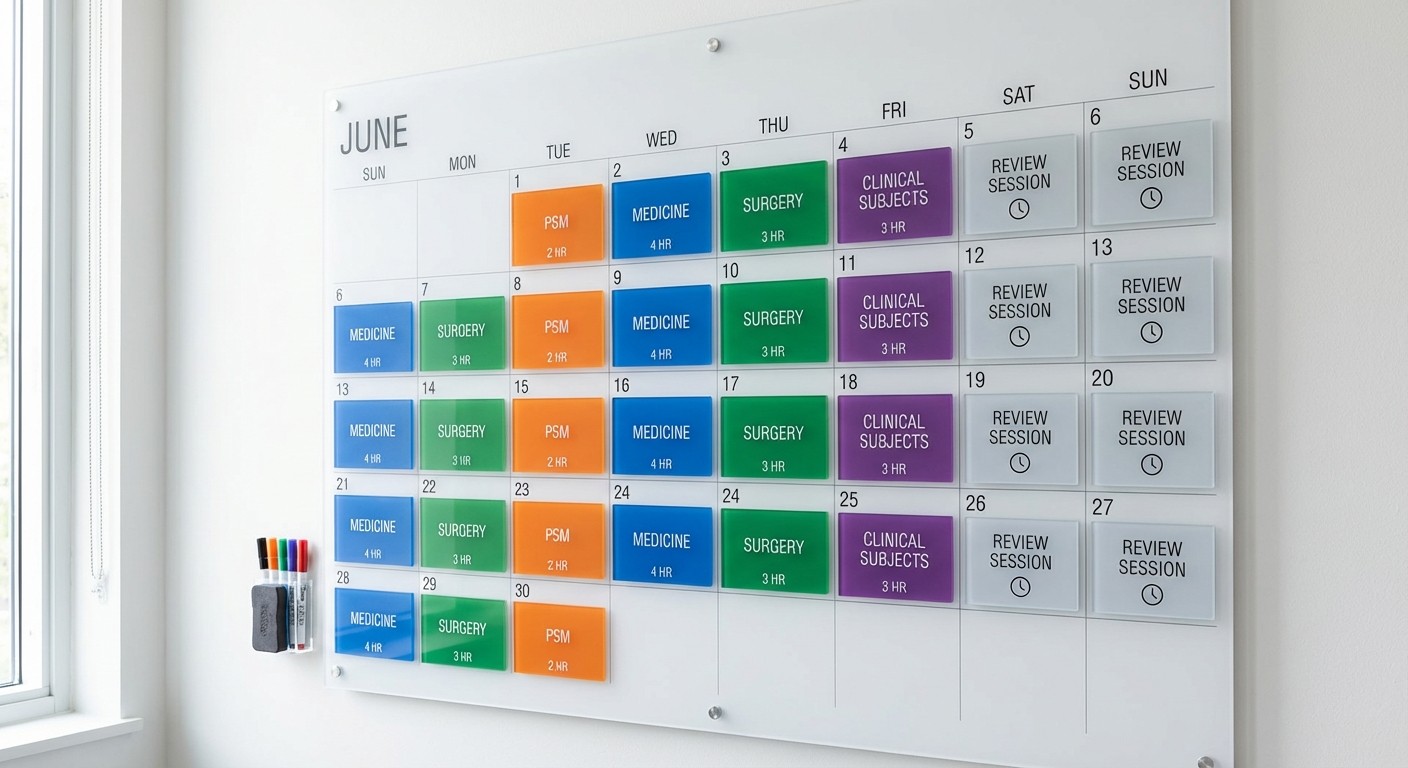
Week 1 (Days 1-7): Foundation Strengthening
Days 1-3: Medicine focus (Cardiology + Pulmonology)
Days 4-5: Surgery basics (General Surgery + Orthopedics)
Days 6-7: PSM formulas and MCH
Week 2 (Days 8-14): High-Yield Drilling
Days 8-10: Medicine continuation (GI + Nephrology + Endocrinology)
Days 11-12: Surgery specialties (Ophthalmology + ENT)
Days 13-14: Pediatrics + OB-GYN core topics
Week 3 (Days 15-21): Weak Area Targeting
Days 15-17: Your lowest-scoring subjects (use analytics to identify)
Days 18-19: Medicine revision + mock tests
Days 20-21: Surgery revision + image-based questions
Week 4 (Days 22-30): Final Sprint
Days 22-24: All-subject mixed practice
Days 25-27: Quick revision using flashcards only
Days 28-29: Final mock tests + error analysis
Day 30: Light review + confidence building
Daily Schedule Structure:
6:00-9:00 AM: Primary subject study (3 hours)
10:00-12:00 PM: MCQ practice (2 hours)
2:00-4:00 PM: Secondary subject (2 hours)
5:00-7:00 PM: Flashcard revision (2 hours)
8:00-9:00 PM: Previous day error analysis (1 hour)
Total: 10 hours focused study per day.
Oncourse's Rapid Recall flashcards are perfect for the 5:00-7:00 PM slot — they help consolidate key facts in high-density subjects like Pharmacology flashcards and Microbiology flashcards without re-reading full chapters.
Smart Practice During Final Month
The final month isnt about passive reading. Active recall is everything. Here's your practice strategy:
MCQ Practice Protocol:
Target: 100-150 questions daily
Time limit: 45 seconds per question (faster than exam pace)
Focus: Subject-wise practice for weak areas, mixed practice for strong areas
Analysis: Spend 2x time on analysis than on solving
Mock Test Strategy:
Week 1-2: Subject-wise tests (50 questions each)
Week 3: Full-length mocks (200 questions)
Week 4: Rapid revision tests (25-30 questions, 15 minutes)
Error Analysis Framework:
1. Knowledge gap: Didnt know the concept → Add to flashcard pile 2. Recall failure: Knew it but couldnt remember → Practice more 3. Silly mistake: Knew the answer but marked wrong → Slow down technique 4. Exam strategy error: Got confused between options → Pattern practice
Smart students use Oncourse's adaptive question system during this phase because it automatically adjusts difficulty based on your performance, ensuring you are always working at the optimal challenge level rather than wasting time on questions that are too easy or impossibly hard.
How to Handle Exam Day Pressure
NEET PG 2026 brings unique pressures. Here's your exam day strategy:
Question Attempt Order:
1. First pass (60 minutes): Answer questions you are 100% confident about 2. Second pass (60 minutes): Work through questions requiring calculation/analysis 3. Third pass (40 minutes): Educated guesses on remaining questions 4. Final review (20 minutes): Check marked questions and ensure no blanks
Time Management Tricks:
Skip image-heavy questions initially (they take longer to process)
Do PSM calculations first when your mind is fresh
Save long case scenarios for the middle when you are in flow
Use elimination technique aggressively — remove obviously wrong options first
Stress Management During Exam:
Take 30-second breathing breaks after every 50 questions
If you get stuck on a question, mark it and move on within 2 minutes
Dont let one difficult question affect your confidence for the next 10 questions
Remember: Everyone finds some questions difficult. The key is speed and accuracy on questions you do know, not perfection on everything.
Frequently Asked Questions
How many hours should I study in the final month?
Study 8-10 hours daily with focused sessions. Quality matters more than quantity — 8 hours of targeted practice beats 12 hours of unfocused reading.
Should I start new topics in the last month?
No. Stick to revision of topics you have already covered. Starting new topics creates confusion and reduces confidence.
How many mock tests should I take in the final month?
Take 15-20 mock tests total: 10 subject-wise tests in weeks 1-2, 8-10 full-length tests in weeks 3-4.
What if I am scoring low in mocks during the final month?
Focus on error analysis, not the score. Mocks are for learning, not evaluation. Each wrong answer teaches you something specific to avoid on exam day.
Is it normal to feel underprepared in the final month?
Absolutely. Every NEET PG topper feels this way. The syllabus is vast, and feeling underprepared is normal. Trust your preparation and focus on execution.
Should I revise weak subjects or strengthen strong subjects?
Strengthen strong subjects first (higher ROI), then gradually work on weak areas. Dont sacrifice your strong subjects for marginal gains in weak ones.
The final month is about smart execution, not perfect preparation. Focus on high-yield topics, practice consistently, and trust your preparation. Your goal isnt to know everything — its to maximize your score with what you know.
Prepare smarter with Oncourse AI — adaptive MCQs, spaced repetition, and AI explanations built for NEET PG. Download free on Android and iOS.