Back
Last 30 Days of INICET Preparation: High-Yield Strategy, Revision Plan and Topper Tips
Master the crucial final 30 days of INICET preparation with this week-by-week strategy guide. Includes high-yield topics, mock test analysis, and topper-backed revision plans.
Last 30 Days of INICET Preparation: High-Yield Strategy, Revision Plan and Topper Tips
You have exactly 30 days left for INICET 2026. Your prep isn't perfect, gaps still exist, and panic is setting in. Here's the truth: these final 30 days matter more than the previous 6 months combined.
INICET isn't about who studied the most — it's about who executed smartest in these crucial weeks. The exam has 200 questions in 180 minutes, giving you just 54 seconds per question. Every mark counts when 815 seats are at stake across 11 premier institutes.
This isn't generic advice. This is the exact 30-day blueprint that toppers used to crack INICET, refined from analyzing successful strategies and common failure patterns. Let's turn your next month into a rank-changing sprint.
Why the Last 30 Days Matter Most (And the 3 Biggest Mistakes)
The final month isn't just revision time — it's strategic warfare. INICET rewards precision over perfection, and these 30 days are when you build that precision.
The 3 Fatal Mistakes Most Aspirants Make
Mistake #1: Trying to Learn New Topics
You see a gap in Forensic Medicine toxicology and spend 3 days mastering it. Wrong move. Those same 3 days could've cemented 50 high-yield Medicine protocols that appear in every INICET paper.
Mistake #2: Mock Test Addiction Without Analysis
Taking 20 mocks feels productive. But if you don't analyze why you're getting Pharmacology MOA questions wrong, you'll repeat the same mistakes in the actual exam.
Mistake #3: Equal Time for All Subjects
Giving 2 hours each to Surgery and Dermatology makes no sense when Surgery yields 30-35 questions and Dermatology barely gets 8-10.
Why These 30 Days Are Different
Your brain is primed for pattern recognition after months of study. The final 30 days leverage this by focusing on:
Converting loose knowledge into exam-ready recall
Building speed through targeted practice
Identifying and plugging only the highest-yield gaps
Week-by-Week Breakdown: Your 30-Day Battle Plan
Week 1 (Days 1-7): Diagnostic and Foundation
Primary Goal: Identify weak spots and strengthen high-yield subjects Daily Schedule (6-8 hours):
Morning (3 hours): One major clinical subject (Medicine/Surgery/OBG)
Afternoon (2 hours): Targeted practice questions (100-150 MCQs)
Evening (2 hours): Quick revision of para-clinical subjects
Key Activities:
Take one diagnostic full-length mock to baseline performance
Create subject-wise weakness lists from mock analysis
Focus 60% time on Medicine and Surgery (they're 40% of your total marks)
Use INICET medicine practice questions to identify knowledge gaps
What to Prioritize:
Medicine: ACS protocols, ECG interpretation, heart failure management, COPD staging, DM complications
Surgery: Trauma protocols, acute abdomen, GI emergencies, fracture classifications
Pathology: Cell injury, inflammation patterns, neoplasia basics
Pharmacology: MOA of common drugs, side effects, contraindications
Week 2 (Days 8-14): High-Yield Topic Blitz
Primary Goal: Master the topics that appear in 70% of INICET papers Daily Schedule:
Morning (4 hours): Deep dive into one high-yield topic per day
Afternoon (2 hours): Practice questions specific to morning's topic
Evening (2 hours): Quick hits on low-yield subjects for easy scoring
This week, Oncourse's adaptive question bank becomes crucial. With limited time, every practice session must target exactly what you're weak in — Surgery instruments, OBG complications, or Pharmacology dosing. The adaptive engine surfaces these precise gaps instead of random question sets.
Topic Rotation:
Day 8: Cardiovascular Medicine + Pharmacology
Day 9: GI Surgery + Emergency Protocols
Day 10: Respiratory Medicine + Microbiology
Day 11: Obstetrics Complications + Pathology
Day 12: Endocrinology + Biochemistry
Day 13: Orthopedics + Anatomy
Day 14: Comprehensive revision + catch-up
Spaced Repetition Integration:
High-yield facts need systematic reinforcement. INICET tests dense factual recall — drug doses, embryology landmarks, surgical anatomy. Oncourse's flashcard engine schedules reviews at optimal intervals, ensuring nothing slips through during these intense weeks.
Week 3 (Days 15-21): Mock Test Mastery
Primary Goal: Build exam temperament and identify final weak areas Daily Schedule:
Morning (3 hours): Full-length mock test
Afternoon (3 hours): Detailed mock analysis and targeted practice
Evening (2 hours): Quick revision of identified weak topics
Mock Test Strategy:
Take 6-7 full-length mocks this week, but here's the key — spend more time analyzing than attempting. For every 3-hour mock, spend 3 hours on analysis.
Oncourse's timed mock tests mirror INICET's exact format and time pressure. More importantly, the post-test analytics break down your accuracy by subject and difficulty level, revealing patterns you'd miss otherwise.
Analysis Framework: 1. Subject-wise accuracy: Where are you consistently losing marks? 2. Difficulty pattern: Are you missing easy questions due to overconfidence? 3. Time management: Which subjects slow you down? 4. Mistake categories: Conceptual gaps vs careless errors vs time pressure Red Flags to Watch:
Accuracy dropping below 65% (target 70%+)
Timing issues in any single subject area
Repeated mistakes in the same topic across multiple mocks
Week 4 (Days 22-30): Polish and Peak
Primary Goal: Light revision, maintain peak performance, and mental preparation Daily Schedule:
Morning (2 hours): Light revision using notes/flashcards
Afternoon (2 hours): Selective practice (weak areas only)
Evening (2 hours): Relaxed reading of current affairs + general medicine updates
What to Review:
Your personal weakness notes from Week 1
High-yield mnemonics and formulas
Recent advances in Medicine/Surgery (last 2-3 years)
Quick anatomy refresher for those guaranteed 15-20 marks
What to Avoid:
New topics or textbook chapters
Excessive mock tests (max 2-3 this week)
All-nighters or cramming sessions
Comparing your prep with others
High-Yield Subjects for INICET: What to Prioritize
Based on INICET 2023-2025 analysis, here's your priority matrix:
Tier 1: Must-Master Subjects (60% of paper)
Medicine (18-22% weightage) Expected questions: 35-44
High-yield areas:
Cardiology: ACS management, ECG patterns, heart failure staging
Respiratory: COPD protocols, pneumonia classification, TB treatment
Gastroenterology: IBD management, liver function interpretation, PUD protocols
Endocrinology: DM complications, thyroid disorders, adrenal pathology
Nephrology: CKD staging, electrolyte disorders, dialysis indications
Practice with medicine clinical scenarios to build protocol-based thinking.
Surgery (15-18% weightage) Expected questions: 30-36
High-yield areas:
Emergency Surgery: Trauma protocols, acute abdomen, shock management
GI Surgery: Appendicitis variants, bowel obstruction, GI bleeding
Orthopedics: Fracture classifications, joint disorders
Urology: Stone disease, BPH protocols, UTI management
Surgical Anatomy: Anatomical relations, operative landmarks
Tier 2: Solid Foundation Subjects (25-30% of paper)
Obstetrics & Gynecology (12-15% weightage) Expected questions: 24-30
Focus areas:
High-risk pregnancy protocols
Obstetric emergencies (APH, PPH, eclampsia)
Contraception methods and complications
Gynecological oncology basics
Pathology (10-12% weightage)
Expected questions: 20-24
High-yield topics:
Cell injury and adaptation
Inflammation and healing
Neoplasia classification and staging
Hematological disorders
Pharmacology (8-10% weightage)
Expected questions: 16-20
Priority areas:
Drug mechanisms and side effects
Antimicrobial selection protocols
CNS and CVS pharmacology
Toxicology and antidotes
Tier 3: Quick Wins Subjects (15-20% of paper)
Microbiology, Anatomy, Biochemistry, Pediatrics
These subjects offer straightforward questions if you know the basics. Don't skip them, but don't over-invest time either.
Use specialized practice questions for rapid topic coverage.
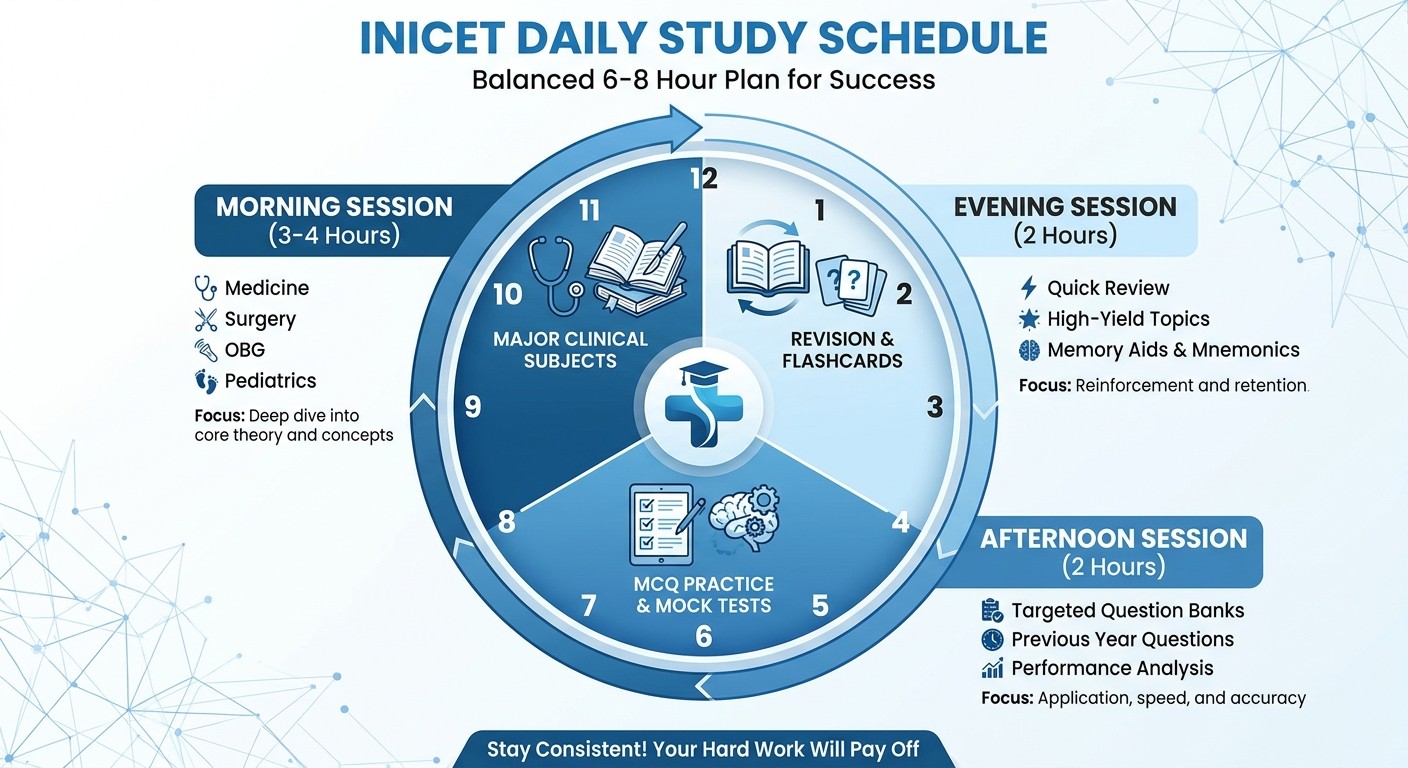
Daily Study Schedule Template (6-8 Hours)
The Optimal 8-Hour Split
Morning Block (4 hours): 7:00 AM - 11:00 AM
Your brain's peak performance window
Tackle the heaviest subjects: Medicine, Surgery, OBG
Mix theory with immediate practice questions
Take 10-minute breaks every hour
Afternoon Block (2 hours): 2:00 PM - 4:00 PM
Post-lunch energy dip period
Perfect for MCQ practice sessions
Use adaptive question sets targeting morning's subject
Analyze mistakes immediately
Evening Block (2 hours): 6:00 PM - 8:00 PM
Light revision time
Quick subjects: Anatomy, Biochemistry, Microbiology
Use flashcards for rapid recall of factual content
End with positive reinforcement (topics you know well)
6-Hour Compressed Version
For those balancing other commitments:
Morning: 3 hours (major subject + practice)
Afternoon: 1.5 hours (MCQs only)
Evening: 1.5 hours (revision + weak area practice)
Energy Management Tips
Peak hours: Use for subjects requiring maximum concentration (Surgery protocols, Medicine guidelines)
Low-energy periods: Perfect for flashcard revision and easy recall topics
Never study past 10 PM: Sleep quality matters more than extra hours
Exercise 30 minutes daily: Improved focus beats longer study hours
How Toppers Use Spaced Repetition and Active Recall
Traditional revision fails because forgetting happens faster than you think. Within 24 hours, you lose 67% of new information unless it's actively reinforced.
The Science Behind Spaced Repetition
Spaced repetition schedules reviews just before you're about to forget. For INICET's dense factual content, this is non-negotiable:
Day 1: Learn Pharmacology MOAs Day 3: Quick review (prevents 50% forgetting) Day 7: Second review (locks in long-term memory) Day 21: Final review (permanent retention)
During crunch time, the flashcard system handles this automatically. Instead of random revision, you review exactly what's about to slip from memory. For a drug's side effect you learned last week, it surfaces just when forgetting begins.
Active Recall Techniques for INICET
1. Question-First Method
Instead of reading "Myocardial Infarction Management," start with the question: "A 55-year-old presents with chest pain for 2 hours. Next step?"
2. Teach-Back Technique
Explain Surgery protocols to an imaginary junior. If you can't teach it simply, you don't know it well enough.
3. Case Scenario Building
Convert every topic into a patient scenario. "Diabetes" becomes "A 45-year-old with polyuria and polydipsia..."
Memory Palace for High-Yield Facts
Create mental locations for frequently tested content:
Your bedroom: Cardiovascular drug doses
Kitchen: GI pathology classifications
Bathroom: Renal function parameters
Living room: Respiratory therapy protocols
Link each fact to a specific object in these familiar spaces.
The Mock Test Trap: Analysis Over Attempts
Most aspirants attempt 50+ mocks and wonder why scores plateau. The problem isn't quantity — it's analysis quality.
The 3:1 Analysis Rule
For every 3-hour mock test, spend 3 hours analyzing. Here's the breakdown:
Hour 1: Immediate Review (within 30 minutes of test)
Note gut feelings: which questions felt tricky?
Mark topics where you guessed vs. knew
Identify time management issues
Hour 2: Deep Analysis (same day)
Categorize mistakes: conceptual gaps, careless errors, time pressure
Research correct answers and understand reasoning
Note patterns: are you weak in specific clinical scenarios?
Hour 3: Strategic Planning (next day)
Update your weakness list
Plan focused study sessions for identified gaps
Adjust upcoming study schedule based on findings
Oncourse Mock Analytics Advantage
Post-test analytics break down performance by:
Subject-wise accuracy trends
Question difficulty vs. your performance
Time spent per subject area
Comparison with other test-takers
This data reveals patterns invisible to manual analysis. Maybe you're missing 60% of medium-difficulty Surgery questions while acing hard ones — indicating a specific knowledge gap, not general weakness.
Red Flag Patterns to Watch
1. Declining accuracy over time: Indicates fatigue or overconfidence
2. Consistent weakness in specific topics: Needs targeted practice
3. Random error patterns: Suggests test-taking strategy issues
4. Time distribution problems: Some subjects taking disproportionate time
Last 48 Hours: What to Do and What Not to Do
The final 48 hours can make or break your performance. This isn't study time — it's performance optimization.
48 Hours Before: Final Review
Do This:
Light revision of your personal weakness notes
Practice 25-30 questions maximum (just to stay sharp)
Review high-yield mnemonics and formulas
Organize documents and exam logistics
Get a full night's sleep (8+ hours)
Don't Do This:
Attempt new mock tests
Learn any new topics
Stay up late "cramming"
Compare your prep with others
Panic about what you haven't covered
24 Hours Before: Mental Preparation
Do This:
Quick glance through flashcards (30 minutes max)
Light physical activity or walk
Prepare exam day items (ID, admit card, stationery)
Eat familiar, light foods
Practice relaxation techniques
Don't Do This:
Intensive study sessions
Heavy meals or new foods
Excessive caffeine
Social media or news consumption
Discuss difficult topics with peers
Exam Day Morning
The Perfect Routine:
Wake up at your regular time (don't oversleep)
Light breakfast with complex carbs
Quick shower to feel fresh
Brief 10-minute review of easiest topics for confidence
Reach exam center 30 minutes early
Avoid discussing answers with other candidates
Frequently Asked Questions
Can I really improve my rank in just 30 days?
Absolutely. INICET performance depends on recall speed and accuracy, not deep conceptual mastery. Focused practice in the final month typically improves scores by 15-25 marks, which can jump you 200+ ranks.
Should I skip low-yield subjects completely?
No, but allocate time proportionally. Dermatology might have only 8-10 questions, but they're often straightforward if you know basics. Spend 2-3 hours total, not 2-3 days.
How many mock tests should I take in the last month?
Maximum 10-12 full-length mocks across 4 weeks. Quality of analysis matters more than quantity. Each mock should teach you something new about your preparation gaps.
What if I'm consistently scoring below 60% in mocks?
Focus on high-yield topics only. Target Medicine, Surgery, and OBG ruthlessly. Skip detailed Biochemistry pathways and focus on clinical applications. Sometimes strategic skipping improves overall performance.
Should I revise textbooks in the last week?
Never. Use only your notes, flashcards, and focused question practice. Textbooks create information overload when you need confidence and clarity.
How do I handle exam anxiety during these 30 days?
Regular sleep schedule, daily exercise, and meditation help more than extra study hours. Anxiety often comes from feeling unprepared — structured daily goals create confidence.
Prepare smarter with Oncourse AI — adaptive MCQs, spaced repetition, and AI explanations built for INICET. Download free on Android and iOS.