Back
NEET PG Preparation 2026: Month-by-Month Study Plan, High-Yield Subjects and Topper Strategy
Complete 12-month NEET PG preparation roadmap for 2026. Phase-wise study plan covering high-yield subjects like Pathology, Pharmacology with topper strategies.

NEET PG Preparation 2026: Month-by-Month Study Plan, High-Yield Subjects and Topper Strategy
You are staring at NEET PG 2026, and every senior is telling you something different. "Start early." "Focus on high-yield." "Do more questions." But nobody is telling you exactly what to study in month 8 versus month 3, or why Pathology gets 47 questions while Dermatology gets 6.
NEET PG has 200 questions. You have 200 minutes. That is 60 seconds per question — including time to think, eliminate options, and mark answers. The difference between a 600+ score and settling for whatever comes your way isnt talent. Its knowing which 47 Pathology concepts show up every year, and which Anatomy chapters you can skip entirely.
This guide breaks down exactly what toppers do differently, month by month. Not vague advice — a concrete roadmap from 12 months out to exam day.
The NEET PG Reality: What the Numbers Actually Show
NEET PG isnt equally distributed across subjects. Here are the hard numbers based on consistent exam patterns:
Subject | Questions | Percentage | Priority Level |
|---|---|---|---|
Pathology | 47 | 23.5% | Maximum |
Pharmacology | 31 | 15.5% | Maximum |
Medicine | 28 | 14% | High |
Surgery | 25 | 12.5% | High |
OB-GYN | 22 | 11% | High |
Anatomy | 18 | 9% | Medium |
Physiology | 15 | 7.5% | Medium |
Others | 14 | 7% | Low |
The math is brutal. Pathology + Pharmacology alone give you 78 questions — nearly 40% of the exam. Medicine, Surgery, and OB-GYN add another 75. That is 153 questions from just 5 subjects.
Most students treat all subjects equally. Toppers dont.
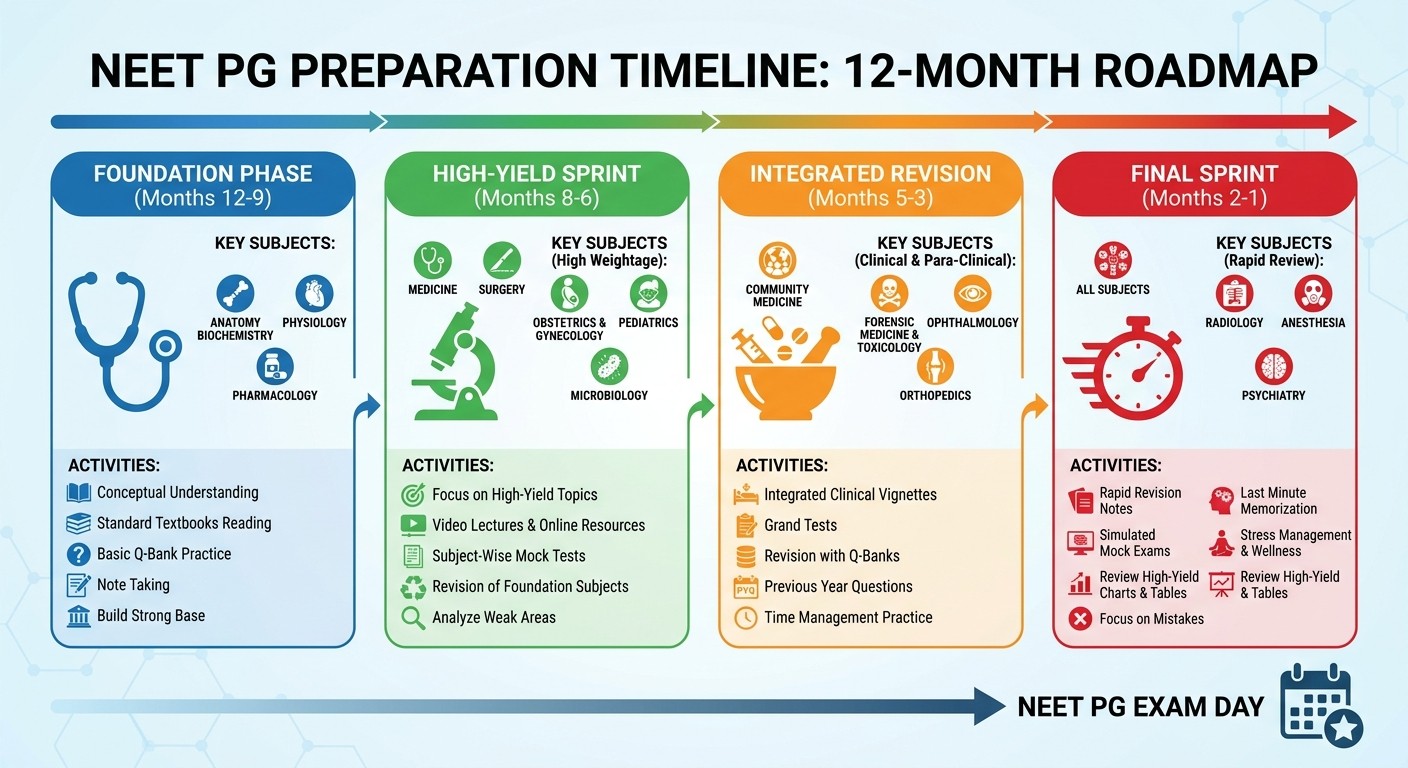
The 4-Phase Topper Strategy: Foundation to Final Sprint
Phase 1: Foundation Building (Months 12-9)
What Toppers Do: Build rock-solid basics in the big 3 — Pathology, Pharmacology, Medicine. What Average Students Do: Try to cover everything equally, get overwhelmed, quit by month 10. Your Action Plan:
Month 12: Pathology foundation — General Pathology, cell injury, inflammation. Start with Oncourse Pathology lessons and use the Daily Plan on Full 60m mode to build momentum.
Month 11: Pathology systems — CVS, respiratory, GI pathology. The inflammation and repair module is particularly high-yield here.
Month 10: Pharmacology basics — PK/PD, autonomic drugs, CVS drugs. Daily Synapses games help with drug classification patterns.
Month 9: Medicine fundamentals — cardiology, pulmonology basics.
Foundation Phase Rule: 70% time on Pathology + Pharmacology, 30% on Medicine. Ignore low-yield subjects entirely.
Phase 2: High-Yield Sprint (Months 8-6)
What Toppers Do: Attack the highest-return subjects with surgical precision. Month-by-Month Breakdown:
Month 8: Complete Pharmacology — finish all drug classes, focus on mechanisms. Oncourse's mnemonic engine becomes critical here for remembering drug lists.
Month 7: Surgery essentials — trauma, GI surgery, orthopedics basics. Start question practice alongside theory.
Month 6: OB-GYN foundation — menstrual disorders, pregnancy complications, contraception.
Sprint Phase Strategy: 50% new content, 50% active recall through questions and flashcards. Switch your Daily Plan to Regular 30m slots focused on weak areas to maintain momentum without burnout.
Phase 3: Integrated Revision (Months 5-3)
What Toppers Do: Stop learning new things. Start connecting dots across subjects.
Month 5: First complete revision of Pathology + Pharmacology. Focus on cross-connections — how heart failure pathology links to diuretic pharmacology.
Month 4: Medicine + Surgery revision with heavy question practice. Target 100 questions daily.
Month 3: OB-GYN + Pediatrics revision. Add remaining subjects (Anatomy, Physiology) but dont go deep.
Integration Rule: Every concept should connect to at least 2 other subjects. Heart failure connects pathology (mechanism), pharmacology (treatment), and medicine (clinical presentation).
Phase 4: Final Sprint (Months 2-1)
What Toppers Do: Mock tests + targeted weak-area firefighting.
Month 2: Daily mock tests. Identify weak areas and attack them with focused revision.
Month 1: Maintain strong areas, emergency fixes for weak subjects only.
Final 2 weeks: Previous year questions, quick revision notes, maintain confidence.
Subject-Wise Topper Strategy
Pathology (47 Questions — Your Highest ROI)
High-Yield Gold:
Neoplasia (8-10 questions guaranteed)
Inflammation and healing (6-7 questions)
Cell injury and death (4-5 questions)
Hemodynamics (3-4 questions)
Topper Approach: Master general pathology first, then systemwise. Focus on mechanisms, not just memorization. Study Tip: Every pathology concept should have a mental flowchart — cause → pathogenesis → morphology → clinical features. Pathology lessons on Oncourse follow this exact structure.
Pharmacology (31 Questions — Maximum Return per Hour)
High-Yield Gold:
Autonomic nervous system (6-7 questions)
CVS drugs (5-6 questions)
Antimicrobials (4-5 questions)
CNS drugs (4-5 questions)
Topper Secret: Group drugs by mechanism, not by system. All ACE inhibitors behave similarly whether used for hypertension, heart failure, or diabetic nephropathy. Memory Hack: Use classification games daily. Sort 16 drug names into 4 categories — exactly what Synapses does. This active sorting builds the pattern recognition NEET PG tests.
Medicine (28 Questions — Clinical Reasoning Hub)
High-Yield Focus:
Cardiology (7-8 questions)
Pulmonology (5-6 questions)
Gastroenterology (4-5 questions)
Endocrinology (3-4 questions)
Topper Strategy: Learn medicine through cases, not isolated facts. Every condition should have investigation approach + management protocol.
Surgery (25 Questions — High but Targeted)
Maximum Return Areas:
GI surgery (6-7 questions)
Trauma (4-5 questions)
Orthopedics (4-5 questions)
Urology basics (3-4 questions)
Focus Rule: Know indications, contraindications, and complications. Skip detailed surgical techniques.
OB-GYN (22 Questions — Concept-Heavy)
Core Topics:
Menstrual disorders (5-6 questions)
Pregnancy complications (4-5 questions)
Contraception (3-4 questions)
Infertility (2-3 questions)
What Toppers Do Differently: The Mental Game
1. They Track Question Accuracy by Subject
Average students practice randomly. Toppers maintain subject-wise accuracy logs:
Pathology: Target 85%+
Pharmacology: Target 80%+
Medicine: Target 75%+
Surgery: Target 70%+
2. They Use Active Recall, Not Passive Reading
Instead of reading the same chapter 5 times, toppers:
Read once thoroughly
Create mental flowcharts
Test recall immediately
Practice classification games daily
The Daily Plan on Oncourse automates this by mixing lessons, flashcards, and games — you get active recall built into every study session.
3. They Build Mnemonics Progressively
Most students cram mnemonics 2 weeks before exams. Toppers build one mnemonic anchor per day across 12 months. The mnemonic engine in Oncourse surfaces a daily memory puzzle — solving it gives you a 25% discount on premium features, but more importantly, it builds 300+ recall anchors by exam day.
4. They Simulate Exam Pressure Early
From month 6 onwards, toppers practice under time pressure. 60 seconds per question, no exceptions. This isnt about knowing facts — its about rapid pattern recognition under stress.
The 60-Second Question Strategy
NEET PG gives you 60 seconds per question. Heres how toppers use them:
Seconds 1-10: Read question stem, identify the subject and concept Seconds 11-25: Analyze options, eliminate obvious wrong answers Seconds 26-45: Apply concept, narrow to 2 best options Seconds 46-60: Make final choice, mark answer Common Mistake: Spending 2 minutes on difficult questions, then rushing through easy ones. Toppers do the opposite — lock easy answers quickly, use saved time for challenging questions.
Mock Test Strategy: The 2-Month Intensive
Months 3-2: Weekly mocks for pattern recognition Month 2: Daily mocks for stamina building Month 1: Every alternate day, with focused revision between tests Mock Analysis Protocol:
1. Subject-wise accuracy tracking
2. Time per question analysis
3. Weak topic identification
4. Immediate focused revision of missed concepts
Red Flag: If accuracy drops below 65% in any mock, emergency-revise that subject immediately.
Final Month: Maintain, Dont Overhaul
The final month isnt for learning new concepts. Its for:
Week 4: Last complete revision + daily mocks
Week 3: Previous year questions + weak area patches
Week 2: Quick revision notes only + maintain confidence
Week 1: Light revision + relaxation
Topper Mindset: By the final month, 80% of your score is already locked in. The remaining 20% comes from staying calm and not making silly mistakes.
Common Preparation Mistakes That Kill Scores
Mistake 1: Starting with Low-Yield Subjects
Students spend months on Microbiology (12 questions) while ignoring Pathology (47 questions). Always start with maximum-return subjects.
Mistake 2: Passive Revision Loops
Reading the same notes repeatedly creates false confidence. Active recall through questions and flashcards is the only way to build exam-ready knowledge.
Mistake 3: Not Tracking Progress
You cant manage what you dont measure. Track subject-wise accuracy weekly, not just overall scores.
Mistake 4: Perfectionism in Low-Yield Areas
Trying to score 100% in Anatomy while scoring 60% in Pathology is backward strategy. Get the big subjects right first.
Technology Integration: Making Prep Efficient
Modern NEET PG prep requires smart technology use:
Daily Study Flow:
1. Start with adaptive Daily Plan scheduling your priority subjects
2. Use active learning — questions, flashcards, classification games
3. Track progress through accuracy metrics
4. End with mnemonic building for long-term retention
Pattern Recognition Training: The Probe game sharpens rapid decision-making under time pressure — exactly what NEET PG demands. Play it daily during the final 3 months to build exam reflexes.
Subject Integration Strategy
Toppers dont study subjects in isolation. Every topic connects:
Example: Myocardial Infarction
Pathology: Coagulative necrosis, reperfusion injury
Pharmacology: Aspirin, clopidogrel, statins, ACE inhibitors
Medicine: Clinical presentation, ECG changes, cardiac enzymes
Surgery: When to refer for angioplasty
Study MI once, but from 4 different angles. This integration is what separates 700+ scorers from the rest.
The Numbers Game: Expected Attempt Strategy
NEET PG success isnt about attempting all 200 questions perfectly. Heres the realistic math:
Target Attempts by Score Range:
600+ Target: Attempt 180+ questions with 85% accuracy
550+ Target: Attempt 170+ questions with 80% accuracy
500+ Target: Attempt 160+ questions with 75% accuracy
Strategic Skipping: Better to skip 20 questions confidently than guess randomly on all 200. Wrong answers carry negative marking.
Frequently Asked Questions
How many hours should I study daily for NEET PG?
Toppers average 8-10 hours during foundation phase (months 12-9), 10-12 hours during sprint phase (months 8-6), and 12-14 hours during final months. Quality matters more than quantity — 6 focused hours beat 10 distracted hours.
Which books are essential for NEET PG preparation?
For Pathology: Robbins (concepts) + Harsh Mohan (Indian context). For Pharmacology: KD Tripathi + Lippincott. For Medicine: Harrison (reference) + API textbook (exam-focused). But honestly, most toppers now rely on curated digital content that covers exactly what NEET PG tests.
Should I join coaching classes or prepare self-study?
Depends on your discipline level. Self-study works if you can stick to a structured plan and have access to quality content. Coaching provides structure but often covers too much low-yield material. The middle path — structured online platforms with personalized study plans — often works best.
When should I start taking mock tests?
Start weekly mocks from month 6, daily mocks from month 2. Earlier mocks are for learning gaps, later mocks are for building stamina and exam temperament.
How important are previous year questions?
Critical, but not sufficient. PYQs show the pattern but new questions test the same concepts differently. Use PYQs for final month revision, not as your primary practice source throughout preparation.
Is 6 months enough for NEET PG preparation?
Possible for toppers from medical college who maintained subject knowledge. Risky for average students or those with knowledge gaps. 12-month preparation has much higher success rates for most students.
Prepare smarter with Oncourse AI — adaptive MCQs, spaced repetition, and AI explanations built for NEET PG. Download free on Android and iOS.