Back
Oncourse Image Rush Game: How Image-Based MCQ Practice Builds Visual Diagnostic Speed for NEET PG, USMLE and FMGE (2026)
Master visual diagnosis with Image Rush - Oncourse's high-speed image identification game. Build rapid recognition skills for radiology, pathology, and anatomy questions in NEET PG, USMLE, and FMGE exams through timed practice.
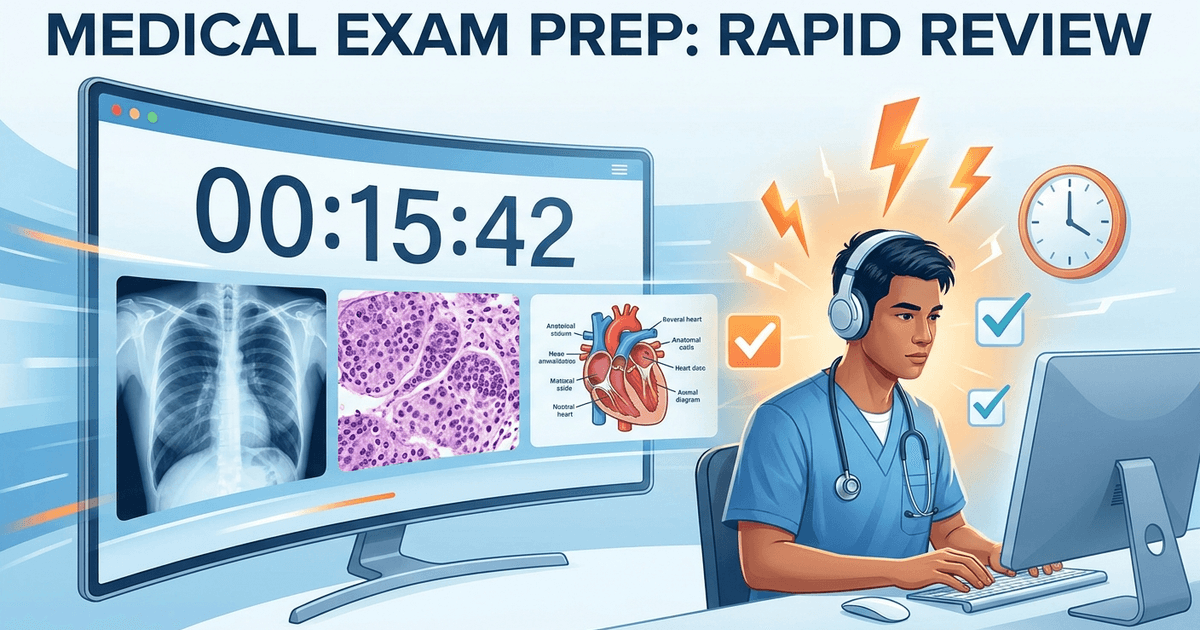
Oncourse Image Rush Game: How Image-Based MCQ Practice Builds Visual Diagnostic Speed for NEET PG, USMLE and FMGE (2026)
You're looking at a chest X-ray on your NEET PG screen. The timer is ticking. 63 seconds to identify pneumothorax vs. pleural effusion vs. consolidation. Your brain freezes.
This scenario repeats across NEET PG, USMLE Step 1, Step 2 CK, and FMGE. These exams dont just test what you know — they test how fast you can recognize what you're looking at. Yet most students spend months memorizing text while never drilling the one skill that separates fast scorers from slow ones: visual diagnostic speed.
The problem isnt knowledge. You probably know the difference between bacterial and viral pneumonia. But when that histology slide appears on screen, do you identify the inflammatory pattern in 15 seconds, or do you stare for 45 seconds trying to recall which textbook page had a similar image?
That's where Image Rush comes in. It's Oncourse's high-speed image identification challenge that forces rapid visual diagnosis under live countdown pressure — exactly like the real exam condition, but with one twist: every correct answer extends your timer, rewarding accuracy with more time to keep playing.
Why Most Students Fail Image-Based Questions
Medical exams have shifted toward image-heavy formats. NEET PG includes radiology, pathology slides, and gross anatomy specimens. USMLE Step 1 tests histopathology recognition. FMGE combines clinical images with diagnostic reasoning.
The pattern is clear: passive reading doesnt build active recognition speed.
Traditional study methods create this gap:
Textbook images: Static, labeled, no time pressure
Standard MCQ banks: Text-heavy questions with occasional images as supplements
Video lectures: You watch someone else identify images
Flashcards: Flip-and-reveal format without speed drilling
None of these simulate the exam reality: unlabeled medical image + countdown timer + immediate decision required.
Students who score high on image based questions medical exam sections dont just know more — they recognize faster. They've trained their visual processing speed alongside their knowledge base.
How Image Rush Works: Speed Meets Accuracy
Image Rush flips the script on traditional image review. Instead of leisurely studying labeled images, you're thrown into rapid-fire identification under a live countdown.
Here's the game flow:
Setup Phase: Select your target subjects (radiology, pathology, histology, anatomy, or all mixed). Optionally enable Voice Mode if you prefer speaking answers instead of typing. Tap PLAY NOW. Game Start: 15 medical images preload before the timer begins — no lag between questions. Your initial time starts counting down immediately. The Core Mechanic: Each correct identification extends your timer by the image's score value. Wrong answers dont reduce time, but the clock keeps ticking. Timer hits zero = game over. Fuzzy Matching: The system accepts minor spelling variants (using Fuse.js with 0.4 threshold). Type "pneumothorax" or "pneumothorx" — both work. Auto-submit triggers 300ms after a correct match, keeping the flow fast. Hints and Skips: Each image can offer a hint (costs 1 second). Stuck completely? Skip the image (recorded as wrong) and keep moving. Batch Loading: When you're down to 10 images in queue, more load in the background. You never see a loading break.
The genius is the timer extension mechanic. Unlike traditional timed quizzes where wrong answers penalize you, Image Rush rewards accuracy by literally giving you more time to practice. Get 5 images right quickly, earn extra seconds to tackle harder ones. This creates positive reinforcement for speed + accuracy.
Visual Diagnosis Practice: Training Your Recognition Speed
The difference between reading about a disease and recognizing it instantly is the difference between knowledge and diagnostic skill.
Take pneumothorax identification. You know the textbook description: "absence of lung markings, pleural line visible." But when you see an actual chest X-ray with subtle pneumothorax, does your brain instantly flag the pleural line, or do you scan the entire film trying to remember what you're looking for?
Image Rush forces pattern recognition under time pressure. After 50 rapid chest X-ray identifications, your brain stops consciously searching for "pleural lines" and starts automatically flagging pneumothorax within 3-4 seconds of image load.
This is the same mental muscle tested in NEET PG radiology sections, USMLE Step 1 histology, and FMGE diagnostic imaging. The exam timer doesnt care how well you understand pneumothorax pathophysiology if you take 60 seconds to recognize what you're looking at.
Consider this progression:
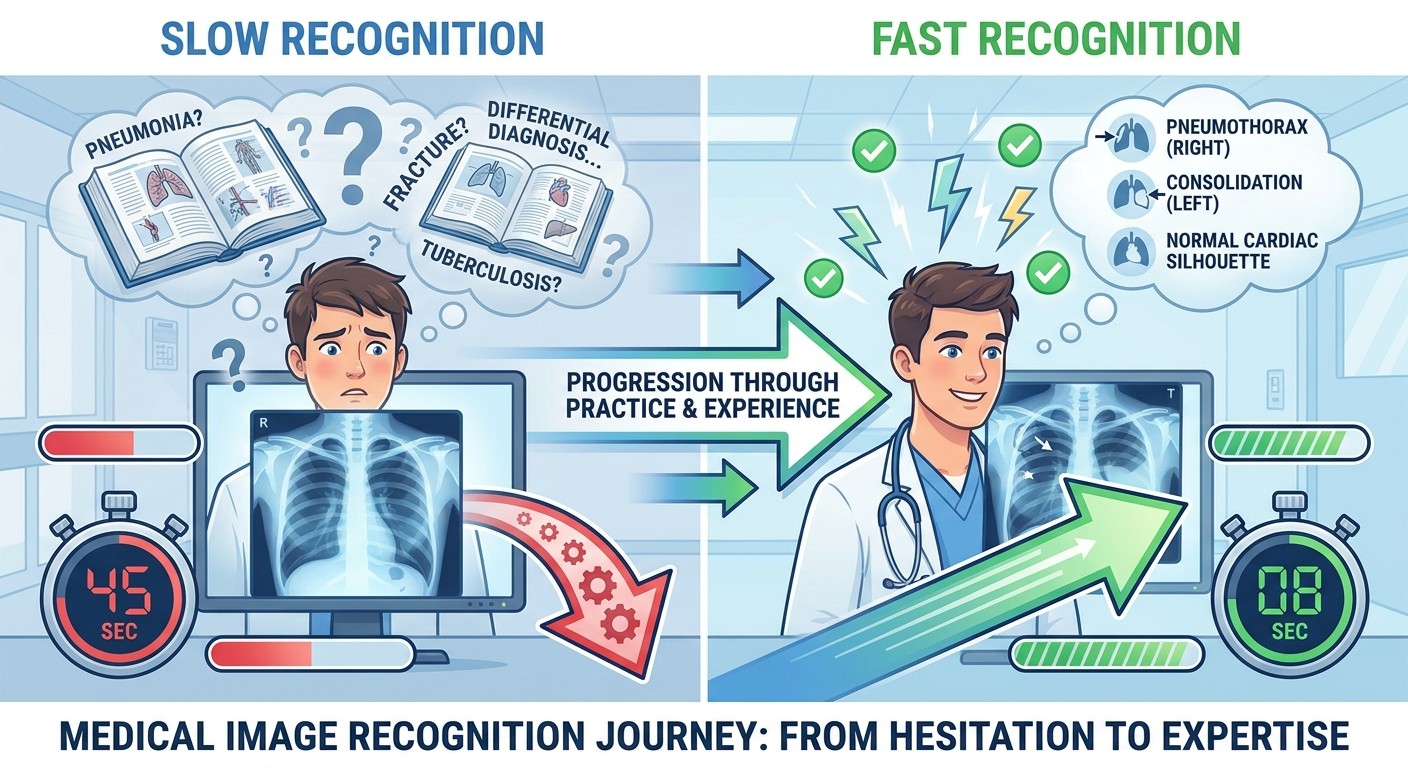
1. First attempt: See pneumothorax → think "what am I looking for?" → remember textbook description → search image systematically → identify (45 seconds)
2. After 20 Image Rush drills: See pneumothorax → instant recognition pattern match → confirm with quick scan → identify (8 seconds)
That 37-second difference per image compounds across an entire exam section.
Medical Image MCQ Success: Subject-Specific Applications
Different medical specialties require different visual recognition skills. Image Rush adapts to your target exam needs.
Radiology MCQ Practice
NEET PG radiology questions often show unlabeled X-rays, CT scans, or MRIs with 4 differential diagnoses. The student who identifies consolidation vs. collapse vs. pleural effusion in 10 seconds has 53 extra seconds for clinical reasoning.
Image Rush radiology mode drills chest X-rays, abdominal films, CT cross-sections, and MRI sequences under countdown pressure. After identifying "pulmonary edema," you immediately see the next image — building recognition speed across hundreds of cases.
For USMLE Step 2 CK radiology, the same principle applies but with different case mix: more emergency radiology, pediatric films, and interventional imaging.
Histology Image Quiz Training
USMLE Step 1 histology requires instant tissue identification. Is that liver, kidney, or lung tissue? Normal vs. pathological? Inflammatory vs. neoplastic changes?
Traditional histology study involves staring at labeled atlas images. Image Rush histology mode throws unlabeled slides at you rapid-fire: "chronic inflammation," "squamous cell carcinoma," "normal cardiac muscle."
The magic happens around image 30-40. Your brain stops consciously analyzing cell shapes and starts pattern-matching tissue architecture. This is exactly the visual processing speed needed when Step 1 shows you an unlabeled kidney biopsy and asks about the underlying pathology.
Students preparing for histology questions often struggle with speed, not accuracy. They know what chronic inflammation looks like but take too long to identify it under exam pressure.
Gross Anatomy Recognition
NEET PG anatomy includes prosected specimens, cross-sectional images, and anatomical variants. Image Rush anatomy mode drills rapid structure identification: "ascending aorta," "middle cerebral artery," "psoas muscle."
The timer pressure simulates OSCE stations where you have 30 seconds per specimen. Unlike textbook diagrams with labels and arrows, Image Rush shows raw anatomical images requiring instant identification.
For students working through anatomy practice questions, the speed element is often overlooked. You might know every muscle origin and insertion but freeze when shown an unlabeled prosected arm.
Pathology Slide Recognition
FMGE pathology sections combine gross specimens with microscopic slides. Image Rush pathology mode mixes both: macroscopic lesions and histopathological patterns under the same speed pressure.
A typical sequence might be: kidney infarct (gross) → chronic pyelonephritis (microscopic) → normal glomerulus (microscopic) → polycystic kidney (gross). This mixed format matches real exam patterns better than studying gross and microscopic pathology separately.
When you're reviewing pathology questions later, the visual recognition speed you built carries over to text-based MCQs that include pathology images.
Identify Medical Images: The Learning Pipeline
Image Rush isnt meant to be your first exposure to medical imaging. It's the speed-building component of a complete visual learning pipeline.
The optimal sequence:
1. Concept Learning: Understand the disease process, anatomy, or pathology through lessons and textbooks
2. Visual Learning: Study labeled images, understand what you're looking for, learn distinguishing features
3. Speed Drilling: Use Image Rush to build rapid recognition under time pressure
4. MCQ Application: Apply your speed + knowledge to full-length practice exams
Students often skip step 3 entirely, jumping from labeled textbook images directly to timed MCQ practice. This creates the recognition gap: you know what pneumothorax is but cant identify it fast enough when it appears on screen.
Smart Lens, Oncourse's image-based learning tool, handles steps 1-2. You explore labeled images, zoom into histological features, and understand diagnostic markers. Then Image Rush handles step 3: speed drilling. Finally, you tackle radiology MCQ practice with both knowledge and recognition speed.
This pipeline approach separates high scorers from average ones. Most students have the knowledge. Fewer have trained the recognition speed.
Game Mechanics That Drive Learning
Image Rush uses game design principles that optimize learning retention and motivation.
Timer Extension Reward System
Every correct answer extends your playing time. This creates positive reinforcement for accuracy. Instead of feeling penalized for mistakes, you're rewarded for getting things right.
The psychological impact: students naturally want to keep playing longer, which means more image exposure, more pattern recognition, more speed building. A 20-image session becomes 40 images because you kept earning timer extensions.
Adaptive Difficulty Batching
The backend tracks your answer accuracy and adjusts subsequent image batches. Struggling with chest X-rays? You might get more basic cases before advanced ones. Crushing histology? The system serves more challenging tissue samples.
This keeps the challenge level in your optimal learning zone — hard enough to push your speed, easy enough to maintain accuracy and timer extensions.
Leaderboard Competition
Daily and all-time leaderboards show images_correct counts. Your rank appears after each game session. New personal bests trigger confetti animations.
The competitive element adds motivation for repeat practice. Checking the leaderboard becomes a daily habit, and each session becomes an attempt to climb rankings.
Voice Mode Option
Some students think faster than they type. Voice Mode lets you speak answers instead of typing them. This removes the typing bottleneck and focuses purely on recognition speed.
Voice Mode particularly helps with complex terms like "pseudostratified ciliated columnar epithelium" or "lymphoplasmacytic infiltrate" — easier to speak than spell under time pressure.
Post-Game Learning: Review and Chat Explanations
The game ends when your timer hits zero, but the learning continues on the Review screen.
Every image you attempted appears with your answer (correct/wrong/skipped). This isnt just a score summary — it's a focused study session.
For any image you got wrong, Explanation Chat opens an AI-powered discussion about why that X-ray shows consolidation vs. your answer of "pleural effusion." The chat explains distinguishing features, common pitfalls, and recognition shortcuts.
This post-game review pattern creates concentrated learning moments. You're most motivated to understand mistakes immediately after making them, while the visual memory is fresh.
Students often discover that their "mistakes" follow patterns. Maybe you consistently confuse acute vs. chronic inflammation in histology slides, or miss subtle pneumothorax on chest films. These patterns become targeted practice areas for your next Image Rush session.
Integration with Broader Exam Preparation
Image Rush works best as part of a comprehensive study strategy, not as a standalone tool.
For NEET PG preparation:
Use Image Rush to drill radiology practice speed after studying imaging principles
Build histology recognition speed, then tackle pathology MCQs with confidence
Speed-drill anatomical identification before attempting anatomy question banks
For USMLE Step 1:
Combine Image Rush histology drilling with First Aid image review
Use pathology image speed training alongside UWorld explanations
Build gross anatomy recognition for anatomy-heavy Step 1 questions
For FMGE:
Focus on mixed pathology (gross + microscopic) recognition speed
Drill radiology identification for internal medicine images
Practice anatomy specimens relevant to Indian medical curriculum
The common thread: Image Rush builds the speed component while traditional resources build the knowledge component. Neither alone is sufficient for high scores on image based questions medical exam sections.
Measuring Progress: Metrics That Matter
Image Rush tracks several metrics, but focus on these three:
1. Images Correct per Session: Raw speed measure. Goal: steady increase over 2-4 weeks of regular practice.
2. Accuracy Percentage: Precision measure. Aim for 70-80% in your target subjects. Higher accuracy means better timer extensions and longer practice sessions.
3. Personal Best Streaks: Consistency measure. Your longest correct streak indicates sustained recognition performance under pressure.
Daily leaderboard rank is motivating but less important than personal progress metrics. Focus on beating your own scores rather than comparing to others.
Track these metrics across subjects. You might excel at chest radiology (85% accuracy) but struggle with histology (60% accuracy). This guides your study focus: more histology drilling, less radiology time.
Common Mistakes and Optimization Tips
Students often approach Image Rush incorrectly, reducing its effectiveness.
Mistake 1: Starting Too Early
Don't jump into speed drilling before understanding basic concepts. If you cant identify pneumothorax on a labeled X-ray, speed drilling unlabeled ones wont help.
Fix: Use Smart Lens or textbooks first, then speed-drill with Image Rush. Mistake 2: Perfectionist Paralysis
Some students restart games if they miss early images. This defeats the purpose of speed training.
Fix: Accept mistakes as learning opportunities. Focus on extending timer through accuracy, not avoiding all errors. Mistake 3: Single Subject Focus
Drilling only radiology or only histology misses the mixed format of actual exams.
Fix: Rotate subjects or use "All Mixed" mode to simulate exam-day variety. Mistake 4: Ignoring Post-Game Review
Many students check their score and start a new game without reviewing mistakes.
Fix: Spend 2-3 minutes on Review screen after each session. Use Explanation Chat for unclear mistakes. Mistake 5: Inconsistent Practice
Weekend marathon sessions dont build visual recognition as effectively as daily short sessions.
Fix: 10-15 minutes daily beats 2-hour weekend sessions for building recognition speed.
Frequently Asked Questions
How many images should I aim for in each Image Rush session?
Start with 20-30 correct identifications per session. As your speed improves, you'll naturally reach 40-50 through timer extensions. Focus on consistency over raw numbers.
Is Image Rush suitable for beginners or only advanced students?
It works for both, but timing matters. Complete beginners should understand basic concepts first through lessons or textbooks. Once you can identify 60-70% of images without time pressure, Image Rush becomes valuable for speed building.
Which subjects benefit most from Image Rush practice?
Radiology, pathology, histology, and gross anatomy see the biggest improvement. These subjects rely heavily on pattern recognition rather than memorization. Clinical images and case-based questions also benefit from faster visual processing.
How does Image Rush compare to traditional flashcards for medical images?
Traditional flashcards build knowledge through spaced repetition. Image Rush builds recognition speed through time pressure. Both are valuable — flashcards for retention, Image Rush for exam-day performance speed.
Can I use Image Rush for OSCE preparation?
Yes, especially for anatomy and pathology stations. OSCE stations often have 30-60 second time limits per specimen. Image Rush trains the same rapid identification skills under countdown pressure.
How long does it take to see improvement in visual diagnostic speed?
Most students notice faster recognition after 5-7 consistent sessions (1-2 weeks of daily practice). Significant speed gains typically appear after 15-20 sessions, when pattern recognition becomes more automatic.
Prepare smarter with Oncourse AI — adaptive MCQs, spaced repetition, and AI explanations built for NEET PG, USMLE and FMGE. Download free on Android and iOS.