Back
USMLE Step 2 CK Study Plan 2026: Week-by-Week Schedule, High-Yield Resources and Score Strategy
Complete 12-week USMLE Step 2 CK study plan with week-by-week breakdown, high-yield resources, score strategies for 230+/240+/250+, and timed practice schedules for 2026 exam windows.

USMLE Step 2 CK Study Plan 2026: Week-by-Week Schedule, High-Yield Resources and Score Strategy
You are staring at your Step 2 CK registration confirmation. 280 questions. 9 blocks. Clinical vignettes that test everything from pediatric emergencies to psychiatric assessments. The exam that determines your residency competitiveness is now 12 weeks away.
Step 2 CK isnt Step 1. This exam rewards clinical thinking over memorization. Pattern recognition over pathophysiology minutiae. The students who score 240+ dont just know more facts — they approach patient vignettes systematically and practice under timed pressure religiously.
Here's your complete usmle step 2 ck study plan. No fluff. Just the week-by-week breakdown that works, backed by resources that deliver results and score strategies calibrated to your target.
Understanding USMLE Step 2 CK Format
Step 2 CK contains 280 multiple-choice questions across 9 blocks of approximately 31 questions each. You get 45 minutes per block with optional 15-minute breaks between blocks. Total test time: 8 hours.
Each question presents a clinical vignette — patient cases ranging from straightforward presentations to complex multi-system scenarios. The exam tests clinical knowledge across 8 major areas:
Internal Medicine (25-30%)
Surgery (15-20%)
Pediatrics (15-20%)
Obstetrics/Gynecology (10-15%)
Psychiatry (10-15%)
Preventive Medicine/Public Health (5-10%)
Emergency Medicine (integrated throughout)
Ethics/Patient Safety (integrated throughout)
Unlike Step 1's focus on basic sciences, Step 2 CK emphasizes diagnosis, management, and next-best-step clinical reasoning. Questions often include lab values, imaging findings, and treatment response scenarios.
Recommended Study Duration
Your baseline determines your timeline:
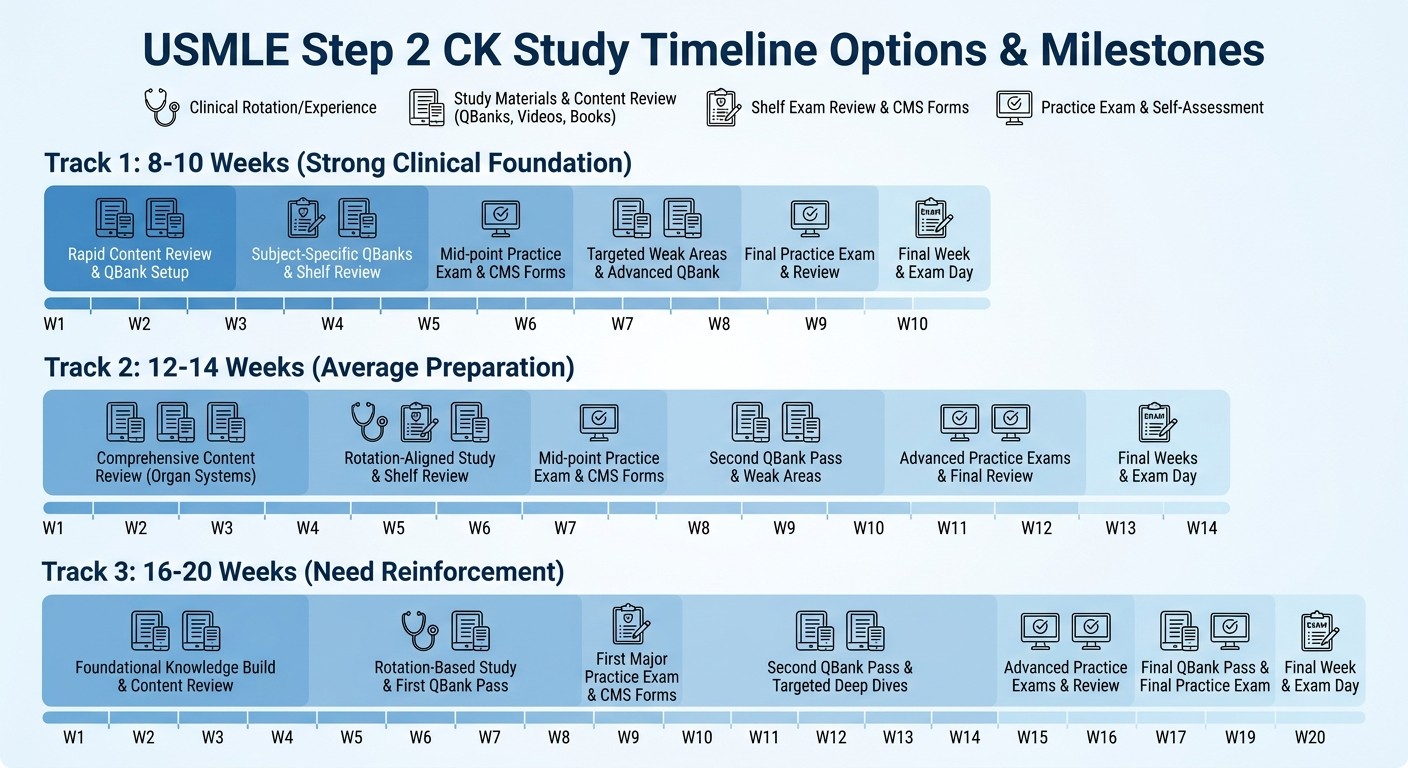
Strong clinical foundation (completed core rotations, consistently 75%+ on shelf exams): 8-10 weeks Average preparation (some rotation experience, 65-75% shelf performance): 12-14 weeks Need significant reinforcement (limited clinical exposure, <65% shelf scores): 16-20 weeks
Most successful candidates dedicate 10-12 weeks with 6-8 hours daily. Shorter timelines risk inadequate practice question volume. Longer periods often lead to burnout and diminishing returns.
Week-by-Week Study Schedule
Weeks 1-2: Foundation and System Review
Goals: Establish baseline performance, review high-yield concepts, begin systematic practice Daily Schedule (6-8 hours):
Morning (3 hours): Read First Aid Step 2 CK or equivalent review book
Afternoon (2-3 hours): Complete 40-50 practice questions (mixed systems)
Evening (1-2 hours): Review incorrect answers, create weakness list
Start with untimed practice blocks to assess knowledge gaps without pressure. Oncourse's adaptive qbank personalizes question selection based on your performance history, automatically targeting weak clinical systems without manual tracking. Focus on understanding question stems and eliminating wrong answers systematically.
Key Activities:
Complete diagnostic practice test (80-120 questions)
Identify 3-4 weakest clinical areas
Establish daily question target (aim for 80-100 questions by week 2)
Begin ethics and patient safety review
Weeks 3-4: Internal Medicine Deep Dive
Goals: Master cardiology, pulmonology, gastroenterology, nephrology, endocrinology, infectious disease
Internal Medicine comprises 25-30% of Step 2 CK. These two weeks determine your score foundation.
System Rotation Schedule:
Days 1-3: Cardiology (acute coronary syndromes, heart failure, arrhythmias)
Days 4-6: Pulmonology (asthma, COPD, pneumonia, pleural disease)
Days 7-9: Gastroenterology (IBD, liver disease, GI bleeding)
Days 10-12: Nephrology (AKI, CKD, electrolyte disorders)
Days 13-14: Endocrinology and infectious disease review
Daily Structure:
Morning: System-specific reading (2-3 hours)
Afternoon: 60-80 targeted questions for that system
Evening: Weak topic reinforcement, spaced repetition
Oncourse's daily practice mode structures these system-focused sessions, assigning clinically relevant questions matched to each week's focus area while maintaining timed block pressure.
Weeks 5-6: Surgery and Subspecialties
Goals: Surgery fundamentals, orthopedics, ENT, ophthalmology, dermatology, urology
Surgery questions test decision-making: operative vs non-operative management, pre/post-op care, emergency presentations.
System Focus:
General Surgery: appendicitis, cholecystitis, hernias, bowel obstruction
Trauma: ATLS protocols, imaging decisions, damage control
Orthopedics: fractures, joint pain, sports injuries
Subspecialties: cataracts, hearing loss, urinary retention, skin lesions
Increase question volume to 100+ daily. Begin incorporating timed 31-question blocks to simulate exam conditions. Target 2-3 timed blocks per day with thorough review sessions.
Weeks 7-8: Pediatrics and OB/GYN
Goals: Age-specific presentations, growth/development, reproductive health, pregnancy complications
Pediatrics and OB/GYN require distinct clinical reasoning. Dosing calculations, age-appropriate vaccines, pregnancy physiology, and emergency scenarios dominate these sections.
Key Topics:
Pediatrics: Well-child visits, developmental milestones, pediatric emergencies, genetic disorders
OB/GYN: Prenatal care, labor complications, contraception, menstrual disorders, gynecologic cancers
Practice questions should now be 80% timed blocks. Your question bank completion should reach 60-70%. Performance analytics help identify late-breaking weak spots with enough time for targeted review.
Weeks 9-10: Psychiatry and Ethics Integration
Goals: Psychiatric diagnoses, crisis management, medical ethics, patient communication
Psychiatry requires pattern recognition for mood disorders, psychotic disorders, and substance abuse. Ethics questions test professional judgment and patient autonomy principles.
Focus Areas:
Major depressive disorder vs bipolar vs adjustment disorders
Schizophrenia spectrum and psychotic episodes
Anxiety disorders and panic attacks
Substance use disorders and withdrawal syndromes
Informed consent, capacity, confidentiality, end-of-life care
Maintain 100+ questions daily across all systems. Complete your first NBME self-assessment to gauge progress and identify remaining gaps.
Weeks 11-12: Integration and Timed Practice
Goals: Peak performance simulation, weakness remediation, exam logistics
These final weeks focus entirely on timed practice and rapid review. No new content learning.
Daily Structure:
Morning: Two timed 31-question blocks (2 hours)
Afternoon: Review session with detailed explanations (2-3 hours)
Evening: Rapid review of persistent weak areas (1 hour)
Complete second NBME self-assessment. Review Oncourse's USMLE Step 2 preparation strategy for additional clinical pattern recognition.
Schedule practice sessions using Oncourse's performance analytics dashboard to identify per-system accuracy trends and time-per-question benchmarks — this data-driven approach beats gut-feel cramming during final preparation.
Week 13+: Final Review and Exam Week
Goals: Maintain peak performance, avoid burnout, logistics preparation Final Week Schedule:
Days 1-4: Light review (50 questions daily), weakness flashcards
Days 5-6: Complete rest or very light review
Day 7: Exam day
Review high-yield clinical buzzwords, ensure exam center logistics, and trust your preparation.
High-Yield Resources for Step 2 CK
Question Banks (Essential)
UWorld Step 2 CK — Gold standard question bank with detailed explanations. Complete 100% with 65%+ accuracy target. Second pass for weak areas. Amboss — Excellent supplemental questions with library integration. Use for additional practice in identified weak systems. Oncourse AI — Adaptive question selection and AI-powered explanations for rapid concept reinforcement. The adaptive algorithm identifies knowledge gaps automatically, making it ideal for efficient weakness targeting throughout your 12-week plan.
Review Materials
First Aid Step 2 CK — Concise review covering all systems. Essential for initial content review and rapid revision. Master the Boards Step 2 CK — Conrad Fischer's practical approach to clinical decision-making. Excellent for ethics and patient management scenarios. OnlineMedEd — Video-based learning for visual learners. Good for complex topics like cardiology and surgery.
Audio Resources
Divine Intervention Podcasts — Ryan Orwig's high-yield reviews perfect for commute time or workout sessions. Episodes 1-200 cover all major Step 2 CK topics. Sketchy Internal Medicine — Visual mnemonics for complex medicine concepts. Particularly helpful for infectious disease and pharmacology integration.
Self-Assessments
NBME Forms — Take one at week 10-11 and another at week 12-13. These predict actual performance within 10-20 points when taken under strict timed conditions. UWorld Self-Assessments — Two forms available. More detailed explanations than NBME but less predictive for actual score.
Score Strategy by Target Range
Targeting 230+ (Above Average)
Characteristics: Solid clinical foundation, good test-taking skills, aiming for competitive specialties Strategy Focus:
Complete 80-100% of primary question bank with 60%+ accuracy
Master high-yield topics: cardiology, infectious disease, ethics
Emphasize timed practice — simulate exam conditions religiously
NBME self-assessments should predict 220+ by week 11
Time Allocation: 60% questions, 30% review, 10% weakness remediation
Targeting 240+ (High Performance)
Characteristics: Strong clinical knowledge, excellent pattern recognition, top-tier residency goals Strategy Focus:
Complete primary question bank + 50% of secondary bank
Master low-yield but high-impact topics (rare diseases, complex ethics)
Achieve 70%+ accuracy on practice questions consistently
NBME predictions should reach 230+ by week 11
Time Allocation: 70% questions, 20% advanced review, 10% esoteric topics
Targeting 250+ (Elite Performance)
Characteristics: Exceptional clinical acumen, perfect test-taking skills, academic medicine goals Strategy Focus:
Complete multiple question banks with 75%+ accuracy
Study beyond typical resources — journal articles, clinical guidelines
Perfect timing: finish practice blocks with 5-10 minutes remaining
NBME predictions consistently 240+ in final weeks
Time Allocation: 80% questions, 15% advanced materials, 5% timing optimization
NBME Self-Assessment Strategy
Self-assessments provide crucial performance feedback but must be used strategically.
Timing: Take your first NBME at week 10-11 when you've completed 60-70% of your question bank. This establishes a realistic baseline for final preparation adjustments. Frequency: Limit to 2-3 total NBMEs. Over-testing creates anxiety and wastes valuable study time. Score Interpretation: NBME scores typically underpredict actual performance by 5-15 points. Focus on content areas showing consistent weakness rather than absolute score predictions. Post-Assessment Action: Dedicate 2-3 days reviewing missed topics before returning to regular question practice. Dont let a disappointing score derail your entire plan.
Common Study Plan Mistakes
Starting Timed Practice Too Late
Many students spend weeks doing untimed questions, then panic when they cant finish blocks. Begin timed practice by week 3-4, even if accuracy suffers initially.
Over-Reading, Under-Practicing
Step 2 CK rewards pattern recognition over theoretical knowledge. Limit reading to 20-30% of total study time. Questions teach clinical reasoning better than passive review.
Ignoring Weak Systems
Its tempting to practice your strongest subjects. Force yourself to address weaknesses early. Use spaced repetition for persistent problem areas — Oncourse's adaptive algorithm handles this automatically, ensuring weak topics resurface until mastered.
Marathon Study Sessions Without Breaks
8-hour cramming sessions lead to diminishing returns and burnout. Structure your day with 2-3 hour focused blocks separated by breaks.
Neglecting Physical and Mental Health
Step 2 CK preparation is a marathon requiring sustained performance. Maintain exercise routine, adequate sleep (7+ hours), and social connections. Burnout destroys test performance.
Rest and Pacing for Sustained Performance
Daily Structure Recommendations
Morning (Peak Energy): Tackle your most challenging content — new system reviews or difficult question sets. Cognitive performance peaks 2-4 hours after waking. Afternoon: Routine practice questions and review sessions. Maintain steady progress without exhausting mental reserves. Evening: Light review, flashcards, or audio resources. Avoid intensive learning 2 hours before sleep.
Weekly Pacing
Monday-Friday: Intensive study schedule (6-8 hours daily) Saturday: Moderate study (4-5 hours) with recreational activities Sunday: Light review only (2-3 hours) or complete rest
Burnout Prevention Signs
Watch for these warning indicators:
Declining question accuracy despite increased study time
Difficulty concentrating during practice blocks
Physical symptoms: headaches, insomnia, appetite changes
Irritability or anxiety about exam performance
When burnout signs appear, take 1-2 complete rest days immediately. Returning refreshed outweighs cramming while exhausted.
Technology Integration for Efficiency
Modern Step 2 CK preparation benefits from intelligent technology integration beyond traditional resources.
Adaptive learning platforms adjust question difficulty and topic selection based on individual performance patterns. Instead of manually tracking weak areas across multiple systems, these tools automatically surface knowledge gaps requiring attention.
Performance analytics reveal time-per-question trends and accuracy patterns across clinical systems. Data-driven insights help identify whether slow emergency medicine processing or weak pediatric knowledge is limiting score potential.
Spaced repetition algorithms ensure previously missed concepts resurface at optimal intervals for long-term retention. This systematic approach prevents the common problem of forgetting cardiology while focusing on psychiatry during later study weeks.
Frequently Asked Questions
How many practice questions should I complete for Step 2 CK?
Most successful candidates complete 3,000-4,000 practice questions total. This includes 2,500+ from a primary question bank (UWorld) plus 500-1,500 from supplemental sources. Quality matters more than quantity — focus on understanding explanations rather than rushing through high volumes.
When should I take my Step 2 CK if I'm applying for residency match?
Take Step 2 CK by August-September of your application year to ensure scores release before October 1st ERAS submission deadline. Scores typically release 2-4 weeks after your test date. Plan backwards from match timeline requirements.
Should I postpone Step 2 CK if my NBME scores are below target?
Only postpone if NBME scores are 20+ points below your minimum acceptable score AND you have adequate time for additional preparation. Last-minute postponements often indicate inadequate initial planning rather than temporary performance dips.
How do I balance Step 2 CK prep with clinical rotations?
Integrate Step 2 CK preparation with rotation learning. Complete questions related to your current rotation during downtime. Use shelf exam preparation as Step 2 CK practice. Maintain 20-30 questions daily even during busy rotation months.
Can I rely primarily on question banks without review books?
Strong students can succeed with question bank-focused preparation, but most benefit from systematic review materials. Use review books for initial content mastery, then transition to question-heavy practice. Avoid pure memorization approaches.
What if my practice question accuracy is consistently low?
Focus on systematic question analysis rather than accuracy percentages. Review explanation for every question — correct and incorrect answers. Identify whether mistakes stem from knowledge gaps, poor test-taking skills, or timing pressure. Address root causes specifically.
Prepare smarter with Oncourse AI — adaptive MCQs, spaced repetition, and AI explanations built for USMLE Step 2 CK. Download free on Android and iOS.