Back
USMLE Step 2 CK Resources 2026: The Complete Study Toolkit for US Medical Students (Books, Question Banks, and What Actually Works)
Complete guide to USMLE Step 2 CK resources for 2026 — comparing UWorld, AMBOSS, Kaplan, and other question banks, essential books, and study strategies that actually work for US medical students.
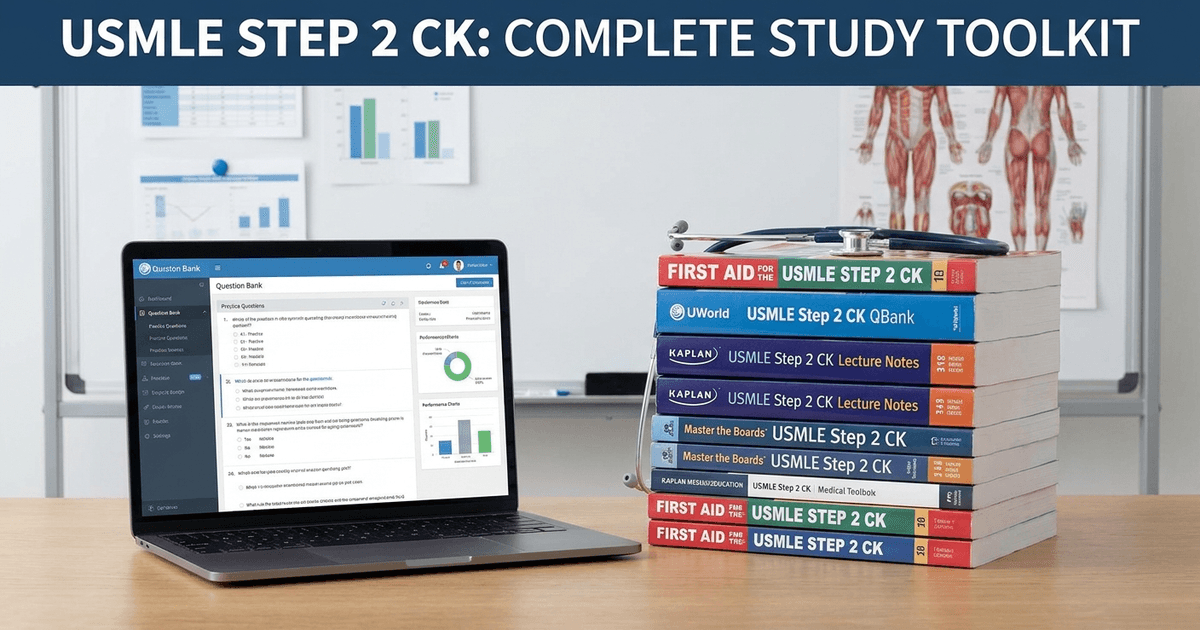
USMLE Step 2 CK Resources 2026: The Complete Study Toolkit for US Medical Students (Books, Question Banks, and What Actually Works)
You are staring at a 280-question exam that determines your residency fate. USMLE Step 2 CK isnt just another test — its 9 hours of clinical vignettes that separate the residents from the reapplicants. With the passing score jumping from 214 to 218 in 2026, "just getting by" wont cut it anymore.
The resource landscape is overwhelming. UWorld costs $560. AMBOSS promises integrated libraries. Kaplan throws around 3,100+ questions. BoardVitals guarantees a pass. Every platform claims to be "essential" — but which ones actually move your three-digit score?
After analyzing performance data from thousands of Step 2 CK test-takers and diving deep into what separates 250+ scorers from the pack, here's your complete resource toolkit for 2026. No fluff, no affiliate-driven recommendations — just what works when you are sitting in that Prometric center.
Question Banks: Your Primary Engine
1. Oncourse AI Platform
What it is: AI-powered adaptive question bank that surfaces high-yield clinical vignettes in your weakest specialties while skipping topics you already know. Key features:
Adaptive questioning algorithm that identifies weak areas in real time
Performance analytics dashboard breaking down scores by organ system and clinical domain
Integrated explanations with cross-linked concepts for connected clinical reasoning
1 lakh+ practice questions with AI-generated explanations
Mobile-optimized for studying during rotations
Pros:
Efficient study sessions — no time wasted on topics you've mastered
Granular analytics showing exactly where you're losing points
Free tier available with premium subscription plans
Cross-referenced explanations build clinical reasoning vs. isolated fact memorization
Best for: Students who want AI-driven personalization and efficient weak-area targeting
2. UWorld Step 2 CK
What it is: The gold standard question bank with 4,250+ clinical vignettes designed to mirror the actual exam format. Key features:
Realistic clinical scenarios with detailed visual explanations
Shelf Review and Step 2 CK Review study paths
New Medical Library with peer-reviewed articles
ReadyDecks (2,500+ premade flashcards) and custom SmartCards
Pros:
Most exam-like interface and vignette style
Excellent correlation between UWSA scores and actual Step 2 CK performance
Comprehensive explanations for all answer choices
Cons:
Expensive ($560 for 1-year access, $600 with Medical Library)
Can be overwhelming for students early in clinical rotations
Best for: Students who want the most realistic exam simulation and don't mind premium pricing
3. AMBOSS Qbank
What it is: Question bank integrated with comprehensive medical reference library for on-the-fly learning. Key features:
Built-in medical library with hyperlinked explanations
Knowledge gaps identified through question performance
Anki integration for spaced repetition
Study plans and score predictor tools
Pros:
More affordable (~$428/year for full access)
Integrated reference reduces need for external resources
Strong for building foundational knowledge gaps
Best for: Students who prefer integrated learning and comprehensive reference material
4. Kaplan Step 2 CK Qbank
Key features:
3,100+ practice questions with 2 full-length practice exams
2,000+ images, algorithms, and diagnostic tools
Strategy tab with step-by-step question approach
Competitive pricing starting at $159
Best for: Budget-conscious students who want strategy guidance alongside practice questions
5. BoardVitals Step 2 CK
Key features:
Over 1,400 practice questions with adaptive learning
Full-length practice exam (305 questions)
100% pass guarantee
Mobile app with offline access
Best for: Students who want adaptive learning with a safety net guarantee
Essential Books and Review Materials
Master the Boards USMLE Step 2 CK (8th Edition, 2026)
Author: Conrad Fischer
High-yield clinical concepts using the Fischer Method (most likely diagnosis, best initial test, most accurate test, best initial treatment). The 2026 edition includes updated guidelines on DM management, lung cancer comorbidities, stroke protocols, and new medications.
How to use it: Read alongside question practice. When you miss cardiology questions consistently, review the cardiology section immediately. Oncourse's adaptive question algorithm surfaces your weak areas — use this book to fill those gaps efficiently.
Step Up to Medicine (5th Edition)
Bridges basic science knowledge with clinical application. Strong on pathophysiology and diagnostic reasoning — exactly what Step 2 CK tests. Use during internal medicine rotation and for targeted review of weak organ systems.
First Aid for the USMLE Step 2 CK (11th Edition)
High-yield facts, clinical images, and rapid review tables across all Step 2 CK domains. Organized exactly like the exam blueprint. Perfect for final review and quick reference during rotations.
Practice Exams and Self-Assessments
NBME Clinical Science Mastery Series
Subject-specific practice exams for Internal Medicine, Surgery, Pediatrics, OBGYN, and Psychiatry. Created by the same organization that writes Step 2 CK. Take one NBME exam 6-8 weeks out to establish baseline, then use subject-specific exams during targeted review phases.
UWorld Self-Assessments (UWSA 1 & 2)
UWSA 2 taken within 1-2 weeks of the exam shows strong correlation with actual scores (typically within 10-15 points). Take UWSA 1 at 50% UWorld completion, UWSA 2 one week before your exam.
Resource Integration Strategy
Phase 1: Foundation Building (Months 1-2)
Read relevant sections of Step Up to Medicine for each rotation
Begin question practice on easier platforms (AMBOSS tutor mode)
Use spaced repetition flashcards for high-yield facts
Phase 2: Active Practice (Months 3-5)
Primary focus on UWorld or Oncourse adaptive questions in timed mode
Take NBME subject exams after completing each rotation
Review missed concepts immediately using Master the Boards
Phase 3: Final Polish (Month 6)
Complete second pass of most challenging questions
Take UWSA 1 and 2 within final 3 weeks
Use First Aid for rapid review of weak areas identified by practice exams
What Actually Moves Your Score
Quality Over Quantity
Students who score 250+ average 2,500-3,000 practice questions total — not 5,000+. The difference: they review every incorrect answer immediately and understand why each wrong choice was tempting.
When Oncourse's AI explanations with coreference show you how missed cardiology concepts connect to previously learned pathophysiology, youre building clinical reasoning rather than memorizing isolated facts.
Timing and Rhythm
Step 2 CK gives you 63 seconds per question. Students who practice exclusively in tutor mode (unlimited time) often run out of time on test day.
Recommendation: 70% timed practice, 30% tutor mode for concept building.
Subject-Specific Weak Areas
Internal Medicine: 40% of the exam. If your IM performance is consistently below 70%, delay your exam until this improves. Surgery: Focus on pre/post-operative management and complications rather than operative techniques. Pediatrics: Growth charts, vaccination schedules, and developmental milestones are high-yield and easily improvable. OBGYN: Normal pregnancy physiology and common complications (preeclampsia, gestational diabetes) appear frequently. Psychiatry: DSM-5 criteria for major disorders, especially mood and psychotic disorders.
Budget-Conscious Approach
Minimum Viable Stack ($200-300)
Oncourse AI with premium features for adaptive practice
Master the Boards Step 2 CK (8th Edition)
One NBME practice exam for score prediction
Anki with premade decks
Comprehensive Stack ($500-700)
UWorld Step 2 CK (1-year subscription)
Master the Boards + Step Up to Medicine
NBME subject exams + UWorld Self-Assessments
First Aid Step 2 CK for final review
Premium Stack ($800-1000)
UWorld + Medical Library
AMBOSS full access for integrated reference
Complete NBME exam series
Kaplan Live Online sessions for structured review
The 2026 Reality Check
With the Step 2 CK passing score raised to 218, the margin for error has shrunk. Programs now scrutinize Step 2 CK scores more heavily since Step 1 went pass/fail.
Target score: 240+ for competitive specialties, 220+ for most others. The resources above can get you there — if you use them strategically rather than collecting them obsessively.
Your residency application depends on clinical competence demonstrated through this exam. Choose resources that build diagnostic reasoning, not just fact recognition. Practice under time pressure. Review mistakes immediately.
The exam tests what you would do for a patient, not what you memorized from a book.
Frequently Asked Questions
How many months should I dedicate to Step 2 CK preparation?
Most successful students spend 4-6 months of dedicated preparation, typically during their final year of medical school. Students scoring 240+ average 5-6 hours daily across 4-5 months. Starting too early (8+ months) often leads to burnout; starting too late (2-3 months) doesnt allow sufficient practice question exposure.
Should I take Step 2 CK before or after clinical rotations?
Take it after completing at least your core rotations (Internal Medicine, Surgery, Pediatrics, OBGYN, Psychiatry). The clinical exposure makes question stems more intuitive. Students who take it too early often struggle with practical management decisions that come naturally after hands-on patient care.
Is UWorld enough, or do I need multiple question banks?
UWorld alone is sufficient for most students if used properly (2+ passes, all explanations reviewed). Adding a second question bank like Oncourse or AMBOSS can help if you have specific weak areas or learn better with different explanation styles. Avoid using 3+ question banks — it creates confusion rather than clarity.
How predictive are practice exam scores compared to the actual Step 2 CK?
UWSA 2 taken within 1-2 weeks of your exam is typically within ±15 points of your actual score. NBME exams tend to underpredict by 10-20 points. Oncourse analytics and other adaptive platforms provide ongoing performance tracking but save formal score predictions for dedicated practice exams.
What should I do if my practice scores are consistently below my target?
First, identify your specific weak areas using detailed analytics — are you missing diagnostic questions, management decisions, or specific organ systems? Then target those areas with focused question practice and reading. If you are consistently scoring 15+ points below your target on multiple practice exams, delay your exam date rather than hoping for test-day luck.
How important are shelf exams for Step 2 CK preparation?
Shelf exams provide excellent preparation since they use similar question styles and clinical vignettes. Strong shelf performance (85th percentile+) typically correlates with Step 2 CK scores above 240. Use shelf preparation as step 2 CK foundation building rather than separate study processes.
Prepare smarter with Oncourse AI — adaptive MCQs, spaced repetition, and AI explanations built for USMLE Step 2 CK. Download free on Android and iOS.