How to Study ENT for NEET PG 2026: High-Yield Topics, Image-Based Questions & Exam Strategy
Master ENT for NEET PG 2026 with this focused study guide. Learn high-yield topics, image-based question strategies, and one-week revision plan for maximum marks.
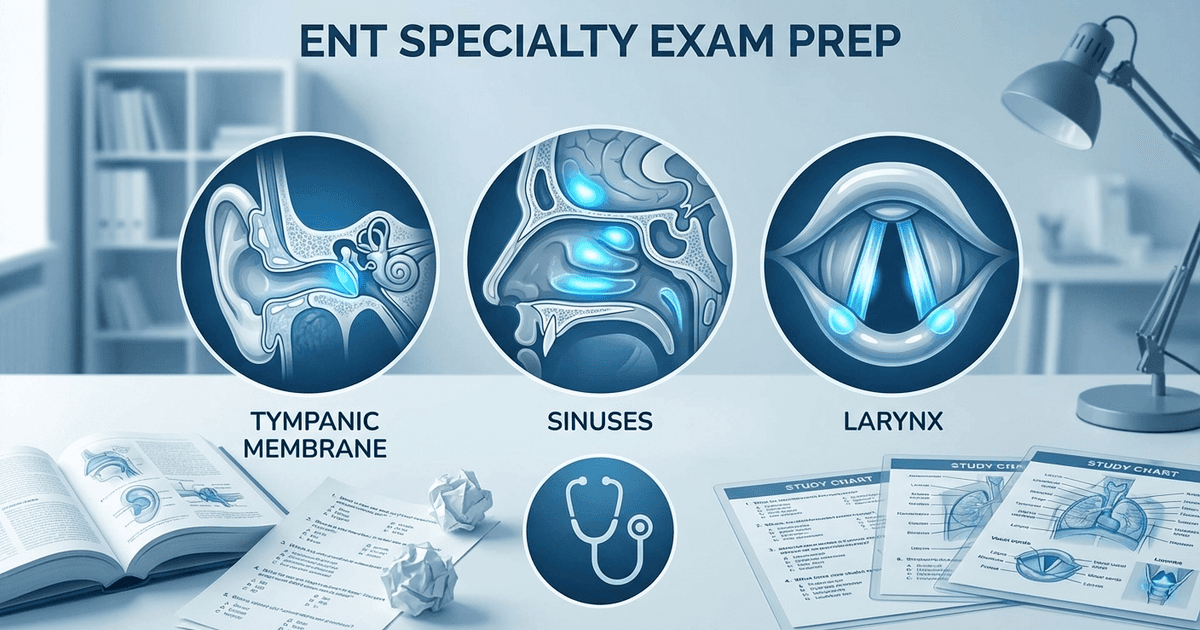
How to Study ENT for NEET PG 2026: High-Yield Topics, Image-Based Questions & Exam Strategy
You're probably staring at ENT thinking it's a small subject that won't matter much for NEET PG 2026. Wrong move. ENT carries 6-8 questions consistently, and here's the kicker — these questions are heavily image-based. Miss the high-yield visual patterns, and you're throwing away 20+ marks.
NEET PG 2026 has shifted toward more clinical vignettes and image interpretation. ENT fits this pattern perfectly. You'll see tympanic membrane photos, audiograms, CT scans of sinuses, and endoscopic views. The good news? ENT has fewer topics than medicine or surgery, but each topic appears predictably.
This guide breaks down which ENT topics carry maximum weightage, how to tackle image-based questions without memorizing every variation, and a focused one-week revision strategy that works when you're short on time.
ENT Weightage Analysis for NEET PG 2026
ENT consistently contributes 6-8 questions out of 200 total questions in NEET PG. That's 3-4% of your total score. Here's the mark distribution pattern:
Topic | Questions/Year | Weightage | Question Type |
|---|---|---|---|
Ear disorders | 2-3 | High | Clinical + Images |
Nose & sinuses | 1-2 | High | Images + Anatomy |
Throat & larynx | 1-2 | Medium | Clinical scenarios |
Head & neck tumors | 1-2 | Medium | Staging + Management |
Pediatric ENT | 0-1 | Low | Clinical |
The pattern is clear: Ear disorders dominate. Within ear topics, chronic otitis media, hearing loss classification, and tympanic membrane findings appear most frequently.
Start with ear — it gives you maximum return on time invested. Once you've mastered tympanic membrane findings and audiogram interpretation, move to nasal pathology and sinus imaging. Our ENT question bank surfaces these high-yield patterns through adaptive routing, showing you which subtopics need more attention based on your accuracy data.
High-Yield ENT Topics for NEET PG 2026
Ear (60% of ENT questions)
Chronic Otitis Media (MUST-KNOW)
Tubotympanic vs atticotympanic types
Complications: cholesteatoma, facial nerve palsy, brain abscess
Surgical management: tympanoplasty vs mastoidectomy
Hearing Loss Classification
Conductive vs sensorineural patterns on audiometry
Weber and Rinne test interpretations
Presbycusis characteristics
Tympanic Membrane Findings (Image-heavy)
Normal vs pathological appearances
Perforation types and locations
Retraction pocket identification
Vertigo Syndromes
BPPV vs Meniere's vs vestibular neuritis
Dix-Hallpike maneuver findings
Treatment protocols
The ENT flashcards use spaced repetition to cement these tympanic membrane patterns — you'll see normal, perforated, and retracted drums until pattern recognition becomes automatic.
Nose & Paranasal Sinuses (25% of ENT questions)
Rhinosinusitis
Acute vs chronic criteria
Complications: orbital cellulitis, intracranial extension
CT scan findings and interpretation
Nasal Polyps
Unilateral vs bilateral significance
Associated conditions: aspirin sensitivity, cystic fibrosis
Management approach
Epistaxis
Anterior vs posterior bleeding sources
Little's area anatomy
Step-wise management
Throat & Larynx (15% of ENT questions)
Laryngeal Tumors
Supraglottic vs glottic vs subglottic locations
TNM staging essentials
Voice changes and their significance
Pharyngeal Infections
Peritonsillar vs retropharyngeal abscess
Ludwig's angina presentation
Emergency airway management
Image-Based Questions Strategy
ENT questions in NEET PG 2026 are 70% image-based. You need a systematic approach to decode visual findings quickly.
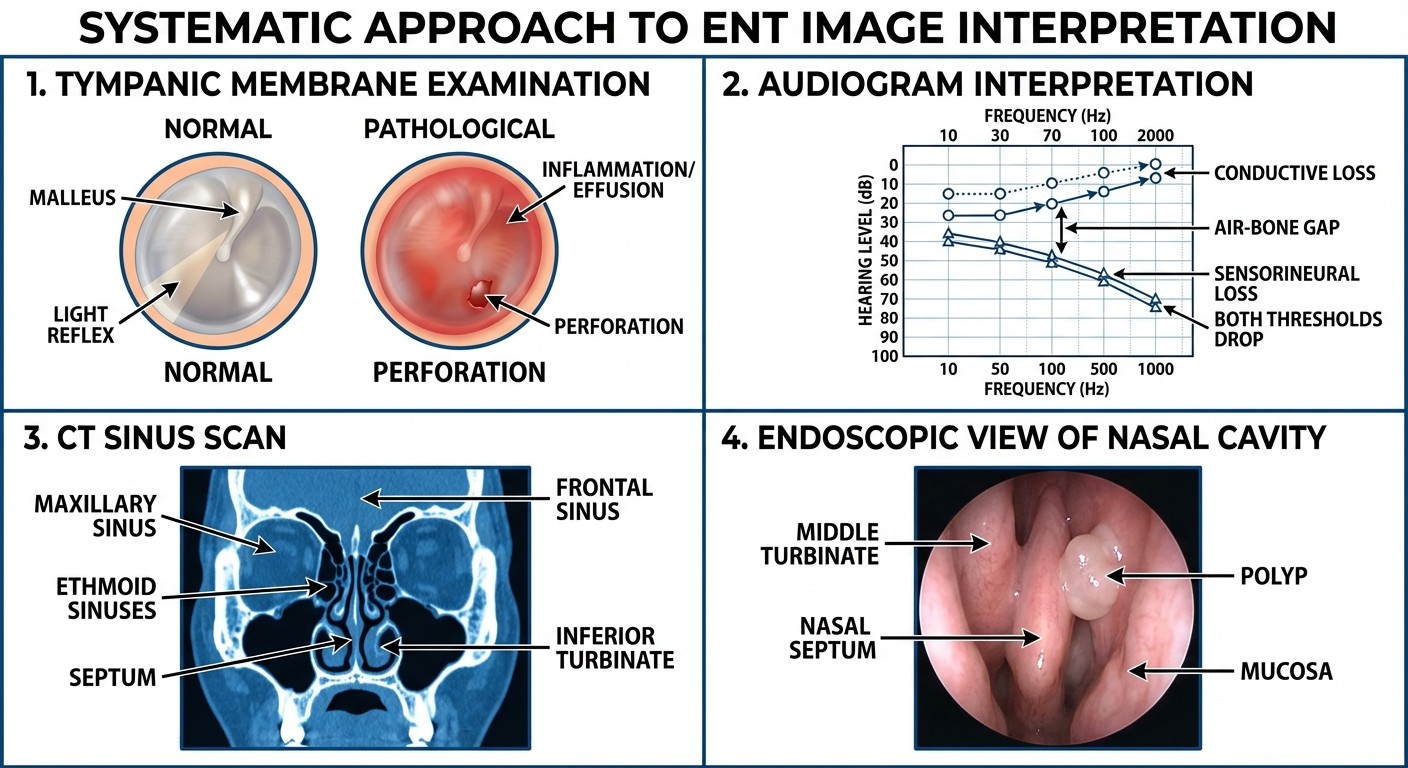
Tympanic Membrane Images (Most Common)
Step 1: Locate the landmarks
Malleus handle (should be visible and positioned correctly)
Light reflex (cone-shaped, pointing anteroinferiorly)
Pars tensa vs pars flaccida regions
Step 2: Assess the membrane
Color: normal (pearly gray) vs inflamed (red) vs infected (bulging)
Position: retracted vs normal vs bulging
Integrity: perforation location and size
Step 3: Look for pathology
Cholesteatoma: white mass behind membrane
Fluid levels: in middle ear space
Scarring: white patches or thickening
Audiogram Interpretation
Conductive Loss Pattern:
Air conduction thresholds elevated (>25 dB)
Bone conduction normal or near-normal
Air-bone gap >10 dB
Sensorineural Loss Pattern:
Both air and bone conduction elevated
Air-bone gap <10 dB
High-frequency loss in noise-induced hearing loss
The question bank automatically tracks your accuracy on audiogram questions specifically, helping you identify whether you need more practice with conductive vs sensorineural patterns.
CT Scan Interpretation
Sinus opacification patterns:
Complete opacification: suggests acute sinusitis or polyps
Air-fluid levels: acute infection
Mucosal thickening: chronic changes
Bone erosion:
Critical in cholesteatoma cases
Look for ossicular chain disruption
Assess facial nerve canal integrity
Clinical Vignette Patterns
ENT clinical vignettes in NEET PG follow predictable patterns. Recognizing these setups saves time and improves accuracy.
Pattern 1: Progressive Hearing Loss
Setup: "A 45-year-old man presents with gradually worsening hearing loss over 6 months..." What they're testing: Otosclerosis vs presbycusis vs acoustic neuroma Key differentiators:
Age of onset (otosclerosis: 20-40 years, presbycusis: >50 years)
Laterality (otosclerosis: bilateral, acoustic neuroma: unilateral)
Associated symptoms (tinnitus, vertigo, family history)
Pattern 2: Acute Ear Pain
Setup: "A 7-year-old child with fever and severe ear pain for 2 days..." What they're testing: Acute otitis media complications Red flags to spot:
Facial weakness (facial nerve involvement)
Severe headache (intracranial extension)
Neck stiffness (meningitis)
Post-auricular swelling (mastoiditis)
Pattern 3: Nasal Obstruction
Setup: "Unilateral nasal obstruction with bloody discharge in a middle-aged man..." What they're testing: Nasal tumors vs polyps Decision points:
Unilateral = high suspicion for malignancy
Bilateral = likely benign (polyps, chronic sinusitis)
Epistaxis pattern and associated symptoms
Our ENT lessons break down these clinical patterns with specific examples, making pattern recognition faster during exam pressure.
One-Week ENT Revision Strategy
When you have one week left before NEET PG 2026, this focused approach maximizes your ENT score potential:
Day 1-2: Ear Focus
Memorize tympanic membrane findings (normal, perforated, retracted, cholesteatoma)
Practice 50 audiogram interpretations
Review chronic otitis media complications
Day 3-4: Image Pattern Recognition
Go through 100 ENT images from previous years
Focus on CT sinus interpretations
Practice endoscopic findings
Day 5-6: Clinical Integration
Solve 200+ ENT MCQs with clinical vignettes
Time yourself: 45 seconds per question maximum
Review incorrect answers immediately
The adaptive daily plan automatically allocates more ENT revision time if your accuracy drops below target levels, ensuring this subject doesn't get crowded out by larger subjects like medicine during final week preparation.
Day 7: Quick Review
Flashcard rapid fire: 15 minutes
One final practice test: 20 ENT questions in 15 minutes
Review only weak areas identified by your performance dashboard
Common ENT Mistakes in NEET PG
Mistake 1: Ignoring the clinical context
Students focus so much on the image they miss crucial clinical details. A retracted tympanic membrane in a child with recurrent ear infections suggests different management than the same finding in an adult with no symptoms.
Mistake 2: Over-thinking audiograms
Audiogram interpretation is pattern recognition, not calculation. If you find yourself doing mental math during the exam, you're overthinking. The patterns should be instantly recognizable.
Mistake 3: Confusing cholesteatoma locations
Cholesteatoma can occur in different locations with different implications. Attic cholesteatoma behaves differently from posterior-superior quadrant involvement. Know the surgical approaches for each.
Mistake 4: Missing red flags in vignettes
ENT questions often test your ability to recognize when conservative management isn't enough. Unilateral nasal symptoms, sudden hearing loss, and cranial nerve involvement need urgent evaluation.
The performance dashboard tracks your accuracy across ear, nose, throat, and head & neck subtopics separately, helping you identify exactly which mistake patterns you're making most frequently.
Mock Test Integration
Practice ENT questions within full-length mock tests, not in isolation. ENT questions appear scattered throughout NEET PG, often after mentally demanding medicine or surgery blocks.
Strategy during mocks:
Flag image-based ENT questions if they appear early — return to them when fresh
Budget 60 seconds for clinical vignettes, 45 seconds for pure image questions
If you don't recognize a tympanic membrane finding immediately, eliminate clearly wrong options first
Post-mock analysis:
Track which ENT subtopic caused maximum time wastage
Identify if you're consistently missing ear vs nose vs throat questions
Note whether fatigue affects your image interpretation accuracy
Technology Integration for ENT Preparation
ENT benefits uniquely from digital study tools because of its heavy image component.
Image libraries: Create a personal collection of high-yield images you've gotten wrong. Review these daily in the final month. Spaced repetition: Use flashcards specifically for ENT image patterns. The spaced intervals help cement visual recognition better than cramming. Video resources: 3D anatomy videos help understand spatial relationships, especially for sinus anatomy and middle ear structures.
The ENT-specific question bank with image-based questions on tympanic membrane findings, audiograms, and nasal pathology ensures you see the exact question types that appear in NEET PG, with adaptive routing that surfaces the highest-yield subtopics based on your performance data.
Frequently Asked Questions
How many ENT questions typically appear in NEET PG?
ENT consistently contributes 6-8 questions out of 200 total questions. This translates to roughly 20-30 marks, making it a high-value subject for focused preparation.
Which ENT topic yields maximum marks in NEET PG?
Ear disorders, particularly chronic otitis media and hearing loss, contribute 60% of all ENT questions. Focus your initial study time here for maximum return.
How do I improve at ENT image interpretation?
Practice systematic image analysis daily. Start by identifying normal landmarks, then look for specific pathological changes. The question bank's image-focused ENT questions help build this pattern recognition systematically.
Is one week enough for ENT revision before NEET PG?
Yes, if you focus on high-yield topics. Spend 60% of time on ear disorders, 25% on nose/sinus pathology, and 15% on throat conditions. Skip low-yield pediatric ENT topics if time is limited.
Should I memorize all tympanic membrane variations?
Focus on 5 key patterns: normal, acute otitis media, chronic perforation, retraction pocket, and cholesteatoma. These cover 90% of NEET PG tympanic membrane questions.
How important are ENT surgical procedures for NEET PG?
Surgical details are low-yield for NEET PG. Focus on indications for surgery and basic procedure names rather than detailed surgical steps. Complications of common procedures are more frequently tested.
ENT might seem like a small subject, but it punches above its weight in NEET PG 2026. The combination of predictable topics, image-heavy questions, and focused revision potential makes it ideal for score maximization. Master the ear disorders first, practice image interpretation daily, and use the one-week strategy when time runs short.
Prepare smarter with Oncourse AI — adaptive MCQs, spaced repetition, and AI explanations built for NEET PG. Download free on Android and iOS.