How to Study Dermatology for NEET PG 2026: High-Yield Topics, Image-Based Questions and Mnemonics
Master dermatology for NEET PG 2026 with high-yield topics, systematic image analysis approach, and proven mnemonics. Score 80+ marks with focused preparation strategy.
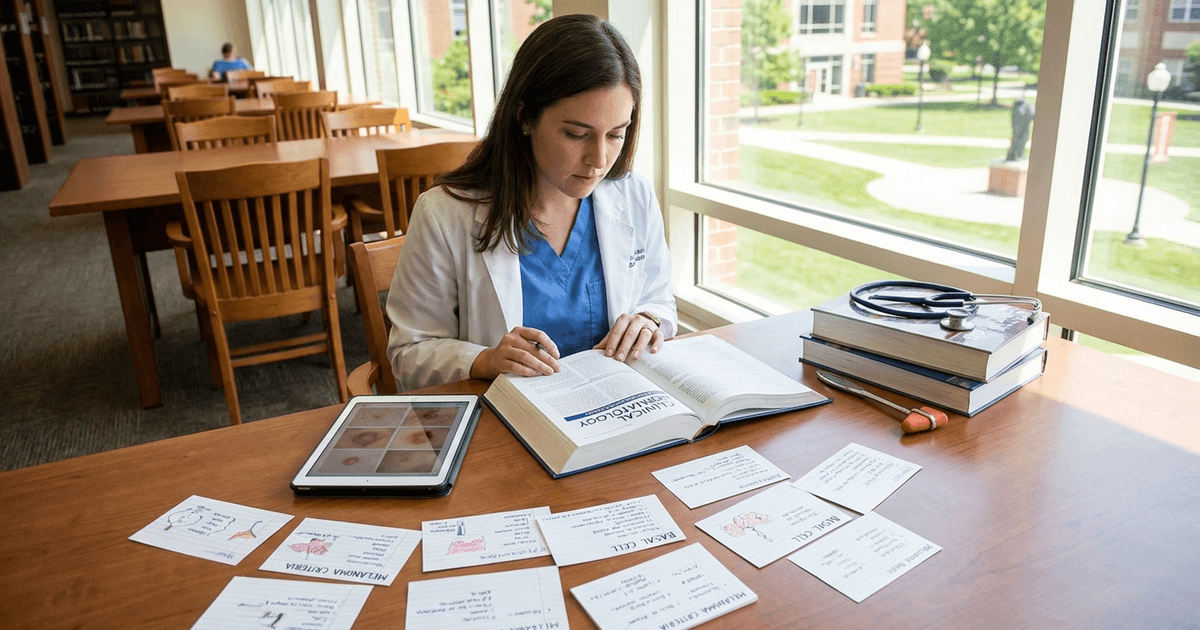
How to Study Dermatology for NEET PG 2026: High-Yield Topics, Image-Based Questions and Mnemonics
You are probably staring at another dermatology atlas, wondering how you will memorize hundreds of skin conditions that all look similar. NEET PG dermatology has 15-20 questions worth 80 marks, but here's what most students miss: 70% of these questions are image-based, and they test pattern recognition, not rote memorization.
The difference between a 550+ dermatology score and average marks isnt studying harder — its knowing which lesions actually appear in exams and having instant visual recall. Most students waste months memorizing rare syndromes while missing high-yield bread-and-butter conditions that show up every year.
This guide breaks down exactly which dermatology topics yield maximum marks, how to tackle image-based questions systematically, and the specific mnemonics that stick when you are under exam pressure.
Understanding NEET PG Dermatology Pattern
NEET PG dermatology follows a predictable pattern. Out of 15-20 questions annually, image-based questions make up 12-14 questions. The remaining are concept-based, testing drug mechanisms, treatment protocols, and associations.
High-Yield Topic Distribution
Topic Category | Questions Per Year | Weightage |
|---|---|---|
Infections (bacterial, viral, fungal) | 4-6 | 30% |
Inflammatory dermatoses | 3-4 | 20% |
Pigmentary disorders | 2-3 | 15% |
Dermatological pharmacology | 2-3 | 15% |
Acne and related disorders | 1-2 | 10% |
Miscellaneous (tumors, genetic) | 1-2 | 10% |
The pattern is consistent: infections dominate, followed by inflammatory conditions. Rare genetic syndromes rarely appear, despite taking up significant textbook space.
For systematic coverage of all dermatology fundamentals, check our comprehensive dermatology lessons that cover these high-yield topics in detail.
High-Yield Topics That Guarantee Marks
1. Bacterial Skin Infections (Must-Know)
These appear in 2-3 questions annually and are often straightforward if you know the visual patterns.
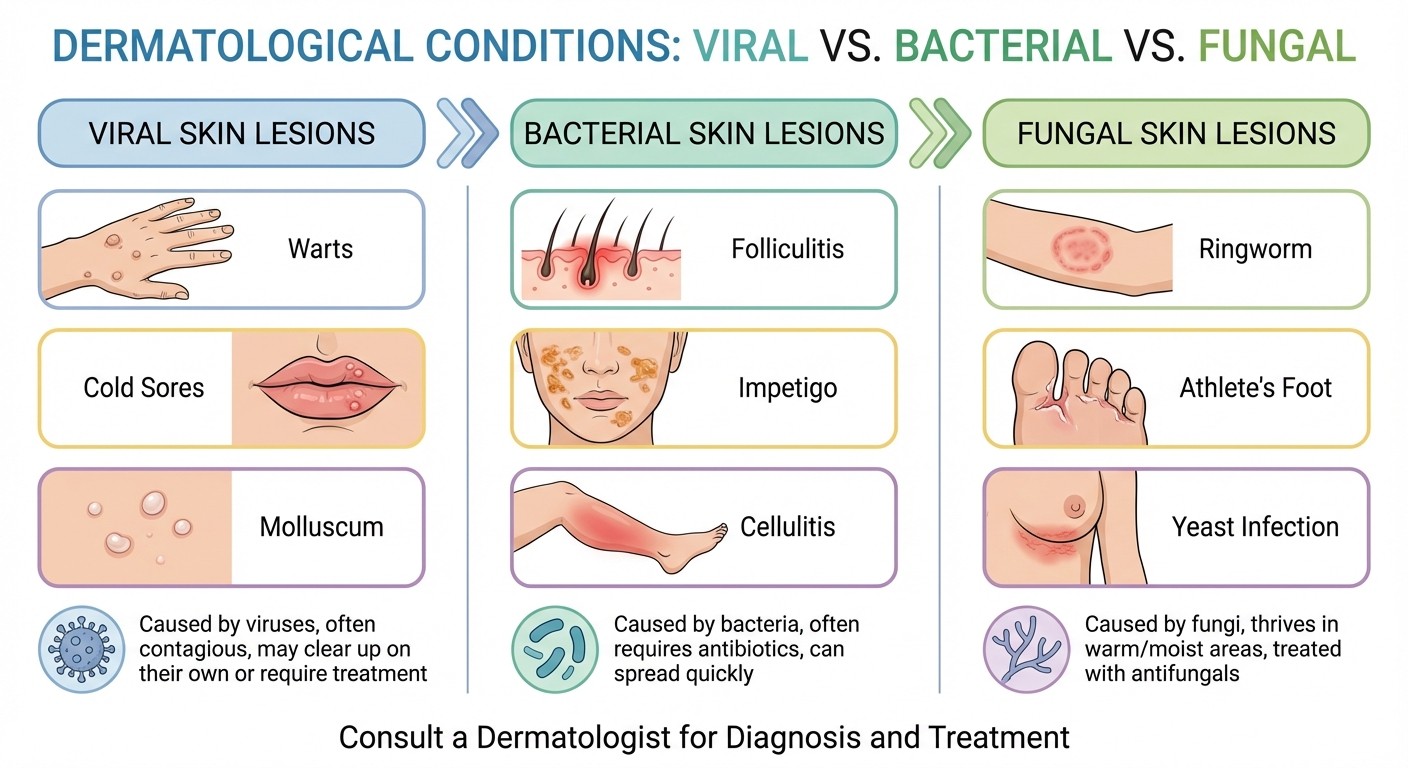
Impetigo: Golden-yellow crusting, honey-crusted lesions. Remember "Golden Staph" for Staphylococcus aureus. Cellulitis vs Erysipelas: Cellulitis has ill-defined borders; erysipelas has sharp, raised edges. Mnemonic: "Cellulitis = Cell-u-loose (ill-defined), Erysipelas = Ery-sharp" Folliculitis patterns: Superficial vs deep. Hot tub folliculitis (Pseudomonas) has the characteristic green nail syndrome association.
Oncourse's Synapses includes visual mnemonics for bacterial infection patterns that helped thousands of students score perfectly on these image-based questions.
2. Viral Skin Infections (Visual Goldmine)
HSV-1 vs HSV-2 distribution: HSV-1 above the waist, HSV-2 below. But remember: either can cause either location. Varicella vs Herpes Zoster: Varicella = centripetal (trunk to periphery), Zoster = dermatomal. Mnemonic: "Varicella = Varies all over, Zoster = Zone-specific" Molluscum contagiosum: Central umbilication is pathognomonic. If you see dimpling, its molluscum.
Practice identifying these conditions with our viral skin infections flashcards designed specifically for rapid visual recognition.
3. Fungal Infections (Pattern Recognition)
KOH positivity is tested frequently. Know these patterns:
Tinea capitis: Hair shaft involvement, endothrix vs ectothrix patterns Tinea corporis: Ring-like lesions with central clearing Tinea versicolor: "Spaghetti and meatball" appearance on KOH
The Image Rush game specifically drills fungal infection recognition under time pressure, mimicking actual exam conditions.
4. Inflammatory Dermatoses
Psoriasis: Silvery scales on erythematous plaques. Auspitz sign (bleeding on scale removal). Eczema types:
Atopic: flexural involvement
Contact: depends on allergen pattern
Seborrheic: greasy scales in sebum-rich areas
Lichen planus: Purple, polygonal, pruritic papules. "6 P's" mnemonic still works.
5. Pigmentary Disorders
Vitiligo: Complete depigmentation with sharp borders Melasma: Symmetric facial hyperpigmentation, pregnancy association Post-inflammatory hyperpigmentation: Follows inflammatory lesions
Mastering Image-Based Questions
Image-based dermatology questions test pattern recognition in 90 seconds per question. Here's the systematic approach that works:
Step 1: Location Analysis (15 seconds)
Ask these questions immediately:
Face, trunk, or extremities?
Flexural or extensor surfaces?
Symmetric or asymmetric?
Single lesion or multiple?
Step 2: Morphology Description (30 seconds)
Use this framework:
Size: Small (papule) vs large (plaque)
Surface: Smooth, scaly, or crusted
Color: Erythematous, hyperpigmented, or normal
Border: Well-defined or ill-defined
Step 3: Pattern Recognition (30 seconds)
Look for pathognomonic signs:
Central umbilication (molluscum)
Dimple sign (dermatofibroma)
Nikolsky sign (pemphigus)
Auspitz sign (psoriasis)
Step 4: Clinical Context (15 seconds)
Consider:
Age group (pediatric vs adult)
Associated symptoms mentioned
Drug history if given
Family history clues
When you encounter tricky image-based questions during practice, Rezzy can walk you through the visual differential diagnosis step-by-step, helping you develop this systematic approach.
Essential Mnemonics That Actually Work
For Drug Mechanisms
Retinoids mechanism: "Retinoids Regulate Reproduction" (of keratinocytes) Corticosteroid potency: "Very High = Clobetasol, High = Betamethasone, Medium = Triamcinolone, Low = Hydrocortisone"
For Clinical Associations
Acanthosis nigricans causes: "HAIR" - Hyperinsulinemia, Acromegaly, Internal malignancy, Racial (benign) Erythema migrans differential: "LIME" - Lyme disease, Inflammatory bowel disease, Malignancy, Erythema chronicum migrans
For Morphology
Vesicle vs Pustule: "Vesicles = Very clear, Pustules = Pus-filled" Macule vs Papule: "Macules = Merely flat, Papules = Prominent raised"
Strategic Study Schedule
Phase 1: Foundation (Weeks 1-2)
Master basic morphology and terminology
Complete basic dermatology lessons
Focus on pattern recognition basics
Phase 2: High-Yield Topics (Weeks 3-6)
Infections (bacterial, viral, fungal) - 2 weeks
Inflammatory dermatoses - 1 week
Pigmentary disorders - 1 week
Phase 3: Integration (Weeks 7-8)
Image-based question practice
Rapid recall drills
Weak topic revision
Test your progress with our comprehensive dermatology practice questions that mirror actual NEET PG patterns.
Common Mistakes That Cost Marks
Mistake 1: Overanalyzing Images
Students spend too much time looking for rare findings. Focus on obvious morphology first.
Mistake 2: Ignoring Clinical Context
The question stem often contains crucial clues. Age, occupation, and drug history matter.
Mistake 3: Memorizing Rarities
Spending weeks on rare genetic syndromes while missing common infections.
Mistake 4: Not Practicing Under Time Pressure
Dermatology requires instant pattern recognition. Practice with timers.
Pharmacology Integration
Dermatological pharmacology appears in 2-3 questions and often integrates with clinical scenarios.
High-Yield Drug Categories
Topical Corticosteroids: Know potency classification and side effects Retinoids: Mechanism, teratogenicity, monitoring requirements Antifungals: Systemic vs topical, drug interactions Antibiotics: Resistance patterns, first-line choices
Our dermatological pharmacology section covers these integrations with clinical correlations.
Image Database Building
Create a personal image collection for revision:
Category 1: Classic Presentations
Save perfect textbook examples of each condition
Category 2: Atypical Presentations
Collect variants that might appear in exams
Category 3: Differential Diagnosis
Side-by-side comparisons of similar conditions
Category 4: Progress Tracking
Before/after treatment images
Technology Integration for Better Learning
Modern dermatology preparation benefits from smart technology use. Visual learning tools specifically designed for medical education can significantly improve pattern recognition speed.
The dermatology flashcards use spaced repetition algorithms to ensure you review images at optimal intervals, preventing the forgetting curve that affects visual memory.
For real-time doubt resolution during image analysis practice, having an AI tutor that understands dermatological visual patterns can accelerate your learning curve significantly.
Final Month Strategy
Week 1: Rapid Review
Go through all high-yield images once daily
Focus on instant recognition
Time yourself: 30 seconds per image
Week 2: Weak Areas
Identify consistently missed topics
Extra practice on these areas
Pattern analysis of mistakes
Week 3: Integration
Mixed topic practice
Full-length mock tests
Speed optimization
Week 4: Maintenance
Light review only
Confidence building
Avoid new topics
Frequently Asked Questions
How many dermatology questions appear in NEET PG?
NEET PG typically has 15-20 dermatology questions worth 4 marks each, totaling 60-80 marks. About 70% are image-based questions testing pattern recognition.
Which dermatology topics have the highest yield for NEET PG?
Bacterial, viral, and fungal skin infections account for 40% of questions. Inflammatory dermatoses like psoriasis and eczema contribute another 20%. Focus on these before rare syndromes.
How should I practice image-based dermatology questions?
Practice systematic approach: analyze location (15s), describe morphology (30s), identify patterns (30s), consider clinical context (15s). Use timer to build speed. Visual recognition improves with repeated exposure.
What are the most important dermatology mnemonics for NEET PG?
Focus on practical mnemonics: "HAIR" for acanthosis nigricans causes, "6 P's" for lichen planus features, "Varicella Varies, Zoster Zones" for distribution patterns. Avoid complex mnemonics that confuse under pressure.
How long does dermatology preparation take for NEET PG?
With focused approach, 6-8 weeks covers all high-yield topics. Spend 2 weeks on infections, 2 weeks on inflammatory conditions, 1 week each on pigmentary disorders and pharmacology, plus 2 weeks integration practice.
Should I buy a dermatology atlas for NEET PG preparation?
A good atlas helps, but focus on NEET PG-specific image collections. Most atlases include rare conditions that dont appear in exams. Prioritize images from previous years and standard textbooks over expensive specialized atlases.
Dermatology might seem overwhelming with its visual complexity, but the NEET PG pattern is predictable. Focus on the high-yield topics covered here, master the systematic approach to image questions, and use technology smartly to accelerate your pattern recognition.
Your dermatology score depends on instant visual recall under pressure, not theoretical knowledge depth. Build that skill systematically, and dermatology becomes one of your strongest subjects.
Prepare smarter with Oncourse AI — adaptive MCQs, spaced repetition, and AI explanations built for NEET PG. Download free on Android and iOS.