Back
High-Yield Anatomy Topics for NEET-PG 2026: Complete Study Guide
Master NEET-PG 2026 anatomy with our comprehensive guide covering high-yield topics, weightage analysis, and strategic preparation tips for maximum scoring.
High-Yield Anatomy Topics for NEET-PG 2026: Complete Study Guide
Anatomy forms the foundation of medical knowledge and constitutes approximately 15-18% of the NEET-PG question paper, making it one of the highest-weightage subjects. With 30-35 questions consistently appearing in recent NEET-PG exams, mastering high-yield anatomy topics is crucial for achieving a competitive rank in 2026.
The National Board of Examinations has maintained anatomy's significance in the NEET-PG pattern, with questions increasingly focusing on clinical correlations, cross-sectional anatomy, and applied aspects rather than pure descriptive anatomy. This comprehensive guide will help you prioritize your anatomy preparation and maximize your scoring potential.
Understanding NEET-PG Anatomy Pattern and Weightage
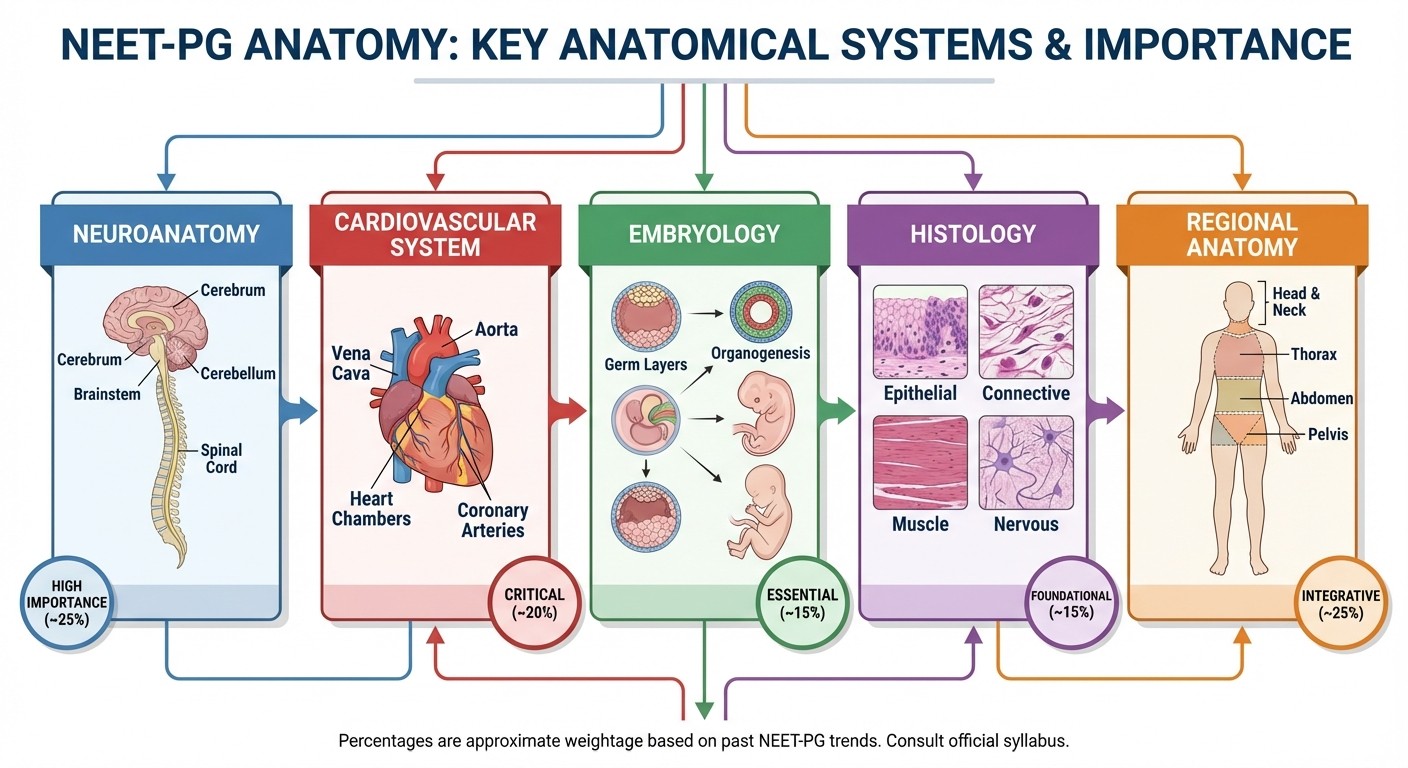
Recent NEET-PG analysis reveals that anatomy questions follow a predictable pattern across major topic areas:
Topic Area | Weightage | Typical Questions | Focus Areas |
|---|---|---|---|
Neuroanatomy | 25-30% | 8-10 questions | Brain stem, cranial nerves, spinal tracts |
Embryology | 20-25% | 6-8 questions | CVS development, neural tube defects |
Histology | 15-20% | 5-6 questions | Tissue identification, organ histology |
Regional Anatomy | 20-25% | 6-8 questions | Head & neck, thorax, abdomen |
Applied Anatomy | 10-15% | 3-5 questions | Clinical correlations, imaging |
Understanding this distribution helps you allocate study time effectively. Oncourse's NEET-PG preparation platform provides topic-wise question analysis and performance tracking to help you focus on high-yield areas.
1. Neuroanatomy: The Highest-Yield Topic
Brain Stem Anatomy
Brain stem anatomy consistently yields 3-4 questions every year, making it the most important neuroanatomy topic:
Key High-Yield Areas:
Medulla oblongata: Pyramid, olive, cranial nerve nuclei (9th, 10th, 11th, 12th)
Pons: Facial colliculus, pontine nuclei, cranial nerve nuclei (5th, 6th, 7th, 8th)
Midbrain: Superior and inferior colliculi, cerebral peduncle, cranial nerve nuclei (3rd, 4th)
Clinical Correlations to Focus On:
Brain stem reflexes (corneal, gag, pupillary)
Locked-in syndrome
Weber's syndrome, Benedikt's syndrome
Wallenberg syndrome
Cranial Nerves
Expect 2-3 questions on cranial nerve anatomy, particularly:
Most Important Cranial Nerves for NEET-PG: 1. Trigeminal nerve (CN V): All three divisions, pterygoid fossa relations 2. Facial nerve (CN VII): Course through temporal bone, branches 3. Glossopharyngeal nerve (CN IX): Tympanic plexus, carotid sinus innervation 4. Vagus nerve (CN X): Cardiac, pulmonary, and abdominal branches 5. Hypoglossal nerve (CN XII): Course and relations
Spinal Cord and Tracts
Focus on functional anatomy rather than pure morphology:
High-Yield Tracts:
Corticospinal tract: Decussation, UMN vs LMN lesions
Spinothalamic tract: Pain and temperature pathway
Dorsal column: Position and vibration sensation
Spinocerebellar tracts: Unconscious proprioception
Explore comprehensive neuroanatomy lessons to master these concepts with interactive content and clinical correlations.
2. Embryology: Development-Focused Questions
Cardiovascular System Development
This topic alone contributes 2-3 questions annually:
Critical Developmental Milestones:
Heart tube formation: Days 20-28
Cardiac septation: Atrial and ventricular septum development
Great vessel development: Aortic arch derivatives
Fetal circulation: Ductus arteriosus, foramen ovale, ductus venosus
Common Congenital Anomalies to Study:
Tetralogy of Fallot
Ventricular septal defects
Patent ductus arteriosus
Transposition of great vessels
Neural Tube Development
Expect 1-2 questions on neural development:
Key Concepts:
Neural tube formation: Primary and secondary neurulation
Neural crest cell derivatives: Peripheral nerves, adrenal medulla
Brain vesicle development: Prosencephalon, mesencephalon, rhombencephalon
Spinal cord development: Zone formation, oligodendrocyte migration
Important Anomalies:
Anencephaly
Spina bifida
Arnold-Chiari malformation
Dandy-Walker syndrome
Urogenital System Development
Focus on kidney and reproductive system development:
High-Yield Topics:
Kidney development: Pronephros, mesonephros, metanephros
Reproductive system: Müllerian and Wolffian duct derivatives
External genitalia: Differentiation timeline
Descent of testes: Timing and mechanism
Access detailed embryology and development lessons for systematic preparation with visual aids and mnemonics.
3. Histology: Tissue Identification and Function
Basic Tissue Types
Master microscopic identification of:
Epithelial Tissues:
Simple squamous: Locations and functions
Stratified squamous: Keratinized vs non-keratinized
Pseudostratified ciliated columnar: Respiratory tract
Transitional epithelium: Urinary bladder
Connective Tissues:
Loose vs dense connective tissue
Cartilage types: Hyaline, elastic, fibrocartilage
Bone: Compact vs spongy, osteocyte lacunae
Blood: Cell types and functions
Organ-Specific Histology
Focus on organs with distinctive histological features:
Gastrointestinal System:
Stomach: Gastric glands, parietal cells, chief cells
Small intestine: Villi, crypts of Lieberkühn, Paneth cells
Liver: Hepatocytes, portal triad, space of Disse
Pancreas: Acinar cells, islets of Langerhans
Respiratory System:
Lungs: Type I and Type II pneumocytes
Bronchi: Smooth muscle, cartilage distribution
Alveolar-capillary barrier: Surfactant production
Reproductive System:
Ovary: Follicular development stages
Testis: Seminiferous tubules, Sertoli cells, Leydig cells
Prostate: Glandular structure, stromal components
Enhance your understanding with comprehensive histology lessons featuring microscopic images and identification techniques.
4. Regional Anatomy: Clinical Applications
Head and Neck
This region yields 3-4 questions with emphasis on:
Skull and Scalp:
Cranial fossae: Boundaries and contents
Scalp layers: SCALP mnemonic
Skull foramina: Foramina and their transmitted structures
Paranasal sinuses: Relations and drainage
Neck Triangles:
Anterior triangle: Submental, digastric, carotid, muscular
Posterior triangle: Supraclavicular, occipital triangles
Fascias of neck: Deep cervical fascia compartments
Thorax
Focus on clinically relevant structures:
Heart:
Cardiac chambers: Relations and openings
Coronary circulation: Right and left coronary artery distribution
Cardiac conduction system: SA node, AV node, bundle of His
Pericardium: Layers and clinical significance
Lungs and Pleura:
Lung segments: Bronchopulmonary segments
Pleural recesses: Costodiaphragmatic, costomediastinal
Surface anatomy: Lung borders and fissures
Mediastinum: Superior and inferior mediastinum contents
Abdomen and Pelvis
High-yield abdominal anatomy includes:
Peritoneum:
Greater sac: Compartments and recesses
Lesser sac: Boundaries and openings
Peritoneal folds: Mesenteries, omenta, ligaments
Gastrointestinal Tract:
Stomach: Parts, relations, blood supply
Duodenum: Parts and relations
Liver: Segments, porta hepatis
Portal circulation: Portal-systemic anastomoses
Access comprehensive systemic anatomy lessons for detailed regional coverage.
5. Applied and Clinical Anatomy
Cross-Sectional Anatomy
Increasingly important for modern medical practice:
Key Cross-Sections to Study:
Brain: Basal ganglia level, brainstem sections
Thorax: Level of T4, T8, T10 vertebrae
Abdomen: Transpyloric plane, transtubercular plane
Pelvis: Pelvic inlet and outlet
Radiological Anatomy
Focus on structures visible on imaging:
Plain Radiographs:
Chest X-ray: Normal anatomy, cardiac borders
Skull X-ray: Cranial sutures, paranasal sinuses
Spine X-ray: Vertebral anatomy, joint spaces
CT and MRI Correlations:
Brain imaging: Gray matter, white matter differentiation
Abdominal CT: Organ enhancement patterns
Cardiac MRI: Chamber anatomy and function
Strategic Preparation Tips for NEET-PG 2026 Anatomy
1. Topic Prioritization Strategy
Based on recent NEET-PG analysis, follow this study sequence:
Phase 1 (Weeks 1-4): High-weightage topics
Neuroanatomy (brain stem, cranial nerves)
Cardiovascular embryology
Basic histology
Phase 2 (Weeks 5-8): Medium-weightage topics
Regional anatomy (head, neck, thorax)
Reproductive system embryology
Applied anatomy
Phase 3 (Weeks 9-12): Consolidation and revision
Cross-sectional anatomy
Clinical correlations
Previous year question practice
2. Active Learning Techniques
Diagram drawing: Practice anatomical diagrams daily
Mnemonics: Create memorable associations for complex information
Group study: Discuss clinical cases with peers
Digital tools: Use anatomy apps and 3D models
3. Question Practice Strategy
Focus on question types that frequently appear:
Question Categories by Frequency: 1. Direct factual questions (30%): Basic anatomical facts 2. Clinical correlation questions (40%): Applied anatomy 3. Image-based questions (20%): Histology, radiology 4. Developmental questions (10%): Embryological sequences
Use Oncourse's adaptive question bank which provides personalized questions based on your weak areas and tracks your progress across all anatomy topics.
Recommended Study Resources and Timeline
Essential Textbooks
1. Primary reference: Snell's Clinical Anatomy by Regions 2. Neuroanatomy: Vishram Singh Textbook of Clinical Neuroanatomy 3. Embryology: Langman's Medical Embryology 4. Histology: Junqueira's Basic Histology
Digital Resources
3D anatomy apps: Complete Anatomy, Essential Anatomy
Video lectures: Trusted YouTube channels for visual learning
Practice platforms: Regular mock tests and topic-wise assessments
Monthly Preparation Timeline
Month 1: Foundation Building
Week 1-2: Neuroanatomy basics
Week 3-4: Embryology foundations
Month 2: System-wise Study
Week 1-2: Cardiovascular and respiratory systems
Week 3-4: Gastrointestinal and urogenital systems
Month 3: Applied Learning
Week 1-2: Clinical correlations and imaging
Week 3-4: Revision and question practice
Supplement your preparation with comprehensive anatomy revision strategies for optimal time management.
Common Mistakes to Avoid
1. Over-Emphasis on Descriptive Anatomy
Modern NEET-PG focuses on clinical applications rather than pure descriptive anatomy. Avoid spending excessive time on:
Detailed muscle attachments without clinical relevance
Exhaustive vessel distributions
Non-clinically relevant anatomical variations
2. Ignoring Recent Trends
NEET-PG anatomy questions increasingly include:
Imaging-based questions
Clinical case scenarios
Functional anatomy concepts
Cross-sectional anatomy
3. Inadequate Revision Cycles
Anatomy requires multiple revision cycles due to its vast scope:
First revision: Within 2 weeks of initial study
Second revision: Before attempting practice tests
Final revision: 1-2 weeks before exam
Integration with Other Subjects
Anatomy-Physiology Connections
Link anatomical structures with their physiological functions:
Cardiovascular anatomy → Cardiac physiology
Renal anatomy → Kidney function
Neuroanatomy → Neurophysiology
Anatomy-Pathology Correlations
Understand how anatomical knowledge applies to pathology:
Normal histology → Pathological changes
Anatomical variants → Disease predisposition
Developmental anatomy → Congenital anomalies
Clinical Medicine Applications
Connect anatomy with clinical subjects:
Regional anatomy → Surgery
Neuroanatomy → Neurology
Embryology → Pediatrics and Genetics
Exam Day Strategy for Anatomy Questions
Time Management
Allocate 1.5-2 minutes per anatomy question
Prioritize high-confidence questions first
Use elimination technique for image-based questions
Image-Based Question Approach
1. Identify the imaging modality (X-ray, CT, MRI, histology) 2. Orient yourself (anatomical position, plane of section) 3. Look for obvious landmarks (bones, organs, distinctive features) 4. Apply anatomical knowledge systematically 5. Eliminate wrong options before selecting the answer
Clinical Correlation Questions
Read the clinical scenario carefully
Identify the anatomical structure involved
Apply relevant anatomical knowledge
Consider developmental, functional, or pathological correlations
Technology-Enhanced Learning
Modern anatomy preparation benefits significantly from technology integration:
AI-Powered Study Tools
Oncourse's AI-powered platform offers several advantages:
Personalized learning paths based on your strengths and weaknesses
Adaptive questioning that adjusts difficulty based on performance
AI study partner (Rezzy) for instant doubt resolution
Visual aids generation for complex anatomical concepts
Interactive Learning Features
3D anatomical models for spatial understanding
Virtual dissection tools for hands-on learning
Augmented reality applications for immersive experience
Spaced repetition algorithms for optimal retention
Measuring Your Progress
Weekly Assessment Strategy
Track your anatomy preparation progress systematically:
Week 1-4 Targets:
Complete basic neuroanatomy: 70% accuracy
Cardiovascular embryology: 65% accuracy
Basic histology identification: 60% accuracy
Week 5-8 Targets:
Regional anatomy questions: 75% accuracy
Applied anatomy concepts: 70% accuracy
Cross-sectional anatomy: 65% accuracy
Week 9-12 Targets:
Overall anatomy accuracy: 80%+
Speed: 1.5 minutes per question
Weak topic identification and remedial action
Performance Analytics
Use data-driven approaches to optimize your preparation:
Topic-wise accuracy tracking
Time per question analysis
Difficulty level progression
Retention rate measurement
Final Preparation Checklist
Two Weeks Before Exam
[ ] Complete final revision of high-yield topics
[ ] Attempt full-length anatomy mock tests
[ ] Review incorrect answers and identify patterns
[ ] Focus on weak topics identified through practice
One Week Before Exam
[ ] Quick revision of mnemonics and diagrams
[ ] Practice image-based questions
[ ] Review clinical correlations
[ ] Maintain confidence and avoid new topics
Day Before Exam
[ ] Light revision of key concepts only
[ ] Review important diagrams and flowcharts
[ ] Relax and maintain positive mindset
[ ] Ensure all exam logistics are arranged
Conclusion
Mastering anatomy for NEET-PG 2026 requires a strategic approach that balances comprehensive coverage with focused high-yield preparation. By prioritizing neuroanatomy, embryology, and clinically relevant topics while maintaining regular practice and revision cycles, you can significantly improve your anatomy scores.
Remember that anatomy forms the foundation for all clinical subjects. A strong anatomical foundation not only helps in NEET-PG but also proves invaluable throughout your medical career. The key to success lies in consistent effort, strategic preparation, and regular assessment of your progress.
Start your focused anatomy preparation today with Oncourse's comprehensive NEET-PG program, which offers personalized learning paths, AI-powered study assistance, and extensive question banks designed specifically for NEET-PG success. With the right approach and consistent effort, you can master anatomy and move closer to achieving your NEET-PG goals in 2026.
The anatomy portion of NEET-PG may seem overwhelming, but with systematic preparation using the strategies outlined in this guide, you'll be well-equipped to tackle any anatomy question that comes your way. Focus on understanding concepts rather than rote memorization, and always connect anatomical knowledge to its clinical applications for lasting retention and better performance.