Back
FMGE Microbiology High-Yield Guide 2026: Bacteriology, Virology, Parasitology and Immunology for Foreign Medical Graduates
Master FMGE microbiology with this comprehensive high-yield guide covering bacteriology, virology, parasitology, and immunology. Strategic focus on exam-weighted topics for foreign medical graduates.
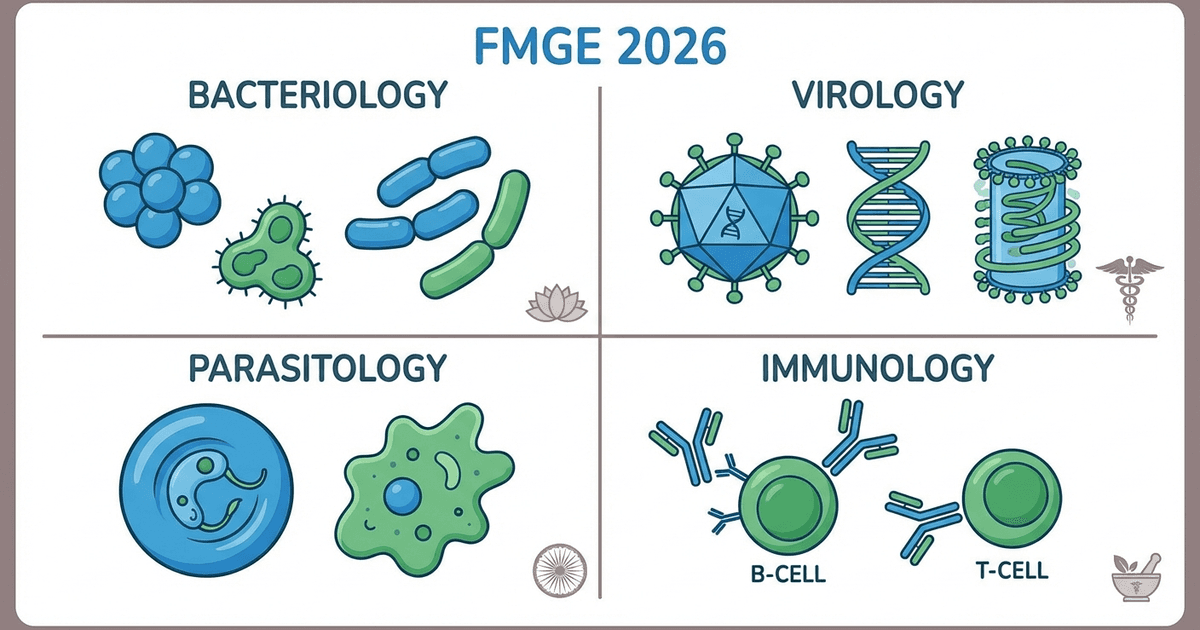
FMGE Microbiology High-Yield Guide 2026: Bacteriology, Virology, Parasitology and Immunology for Foreign Medical Graduates
You're staring at your FMGE syllabus, and microbiology feels overwhelming. 13% of your exam marks come from this single subject — that's roughly 26 questions out of 200. Most foreign medical graduates underestimate microbiology, thinking it's just memorization. They're wrong.
Microbiology is your golden ticket to boosting your FMGE score. When you know which bacteria cause what, which viruses have DNA vs RNA, and how immunity actually works, these 26 questions become free points. The problem? Most study materials treat all micro topics equally. They dont prioritize based on what actually shows up in FMGE.
This guide changes that. We'll cover the four major domains — bacteriology, virology, parasitology, and immunology — with laser focus on high-yield topics that repeatedly appear in NMC screening tests. No random factoids. No low-yield organisms that show up once every five years.
Ready to turn microbiology from your weak point into your strength?
Why Microbiology Matters for FMGE Success
The NMC screening test has a predictable pattern. Certain bacteria, viruses, and parasites appear every single year. Others show up rarely or never. Smart FMGE preparation means focusing your limited time on the organisms and concepts that actually matter.
Here's what most aspirants miss: microbiology questions in FMGE aren't just recall-based. They test clinical correlation. You'll see questions like "A 35-year-old presents with fever and rose spots. Most likely organism?" rather than "What is the morphology of Salmonella typhi?"
This clinical integration makes microbiology both challenging and high-yield. Master the big players in each domain, understand their disease patterns, and you'll score consistently in this section.
High-Yield Bacteriology for FMGE
Bacteriology forms the backbone of FMGE microbiology. Focus on these organism categories that appear in 70% of bacterial questions.
Gram-Positive Cocci: Your Top Priority
Staphylococci dominate FMGE questions. Know these cold:
Staph aureus: Coagulase positive, causes skin infections, pneumonia, endocarditis. Golden pigment, beta-hemolysis on blood agar
Staph epidermidis: Coagulase negative, biofilm formation, prosthetic device infections
MRSA identification: Methicillin resistance, vancomycin treatment
Streptococci appear in clinical scenarios:
Group A Strep (S. pyogenes): Beta-hemolytic, causes pharyngitis, cellulitis, necrotizing fasciitis. Bacitracin sensitive
Group B Strep (S. agalactiae): Neonatal sepsis, meningitis. CAMP test positive
Strep pneumoniae: Alpha-hemolytic, pneumonia, meningitis. Optochin sensitive, bile soluble
Practice with our bacteriology MCQs to drill these high-yield organisms. The question bank targets exactly these concepts that show up repeatedly in FMGE.
Gram-Positive Bacilli: Focus on Spore Formers
Clostridium species are FMGE favorites:
C. tetani: Tetanus, lockjaw, rose thorn injury scenarios
C. botulinum: Flaccid paralysis, canned food, honey in infants
C. perfringens: Gas gangrene, double zone hemolysis, lecithinase positive
C. difficile: Antibiotic-associated diarrhea, pseudomembranous colitis
Bacillus anthracis: Woolsorter's disease, medusa head colonies, bamboo stick appearance.
Acid-Fast Bacilli: Mycobacterium
Mycobacterium tuberculosis concepts that matter:
Ziehl-Neelsen staining, cord factor
Primary vs secondary tuberculosis patterns
Extrapulmonary TB presentations (meningeal, skeletal, genitourinary)
Drug resistance patterns (MDR-TB, XDR-TB)
Atypical mycobacteria: M. leprae (leprosy patterns), M. avium-intracellulare (AIDS patients).
Gram-Negative Enteric Bacteria
Enterobacteriaceae that show up consistently:
E. coli: UTI, traveler's diarrhea, neonatal meningitis
Salmonella: Typhoid fever (S. typhi), gastroenteritis (non-typhi)
Shigella: Dysentery, person-to-person spread
Klebsiella: Pneumonia in alcoholics, mucoid colonies
Non-fermenters: Pseudomonas (blue-green pigment, grape odor), Acinetobacter (nosocomial infections). Our spaced repetition flashcards surface these bacterial characteristics at optimal intervals, so you remember gram staining, colony morphology, and disease patterns without cramming.
High-Yield Virology for FMGE
Virology questions focus on major virus families and their clinical presentations. DNA vs RNA classification appears frequently.
DNA Viruses: The Big Four
Herpes Family Viruses:
HSV-1: Oral herpes, encephalitis
HSV-2: Genital herpes, neonatal infections
VZV (HHV-3): Chickenpox, shingles
EBV (HHV-4): Mononucleosis, Burkitt lymphoma
CMV (HHV-5): Congenital infections, retinitis in AIDS
Hepatitis B: HBsAg, HBeAg, anti-HBc markers. Chronic hepatitis, cirrhosis risk. Pox Viruses: Smallpox (eradicated), molluscum contagiosum. Papillomaviruses: HPV types 16, 18 (cervical cancer), types 6, 11 (genital warts).
RNA Viruses: Focus on Clinical Syndromes
Orthomyxoviruses:
Influenza A, B: Antigenic drift vs shift, pandemic potential
Influenza C: Mild respiratory illness
Paramyxoviruses:
Measles: Koplik spots, pneumonia complications
Mumps: Parotitis, orchitis, meningitis
RSV: Bronchiolitis in infants
Parainfluenza: Croup in children
Retroviruses:
HIV: CD4 count stages, opportunistic infections, HAART therapy
HTLV-1: T-cell leukemia, tropical spastic paraparesis
Hepatitis Viruses: A (fecal-oral), C (chronic hepatitis), E (pregnancy complications). Arboviruses: Dengue (four serotypes), Chikungunya (joint pains), Japanese encephalitis.
When studying virology, our AI question bank clusters questions by virus family, so you can drill DNA viruses separately from RNA viruses and identify which viral concepts you're missing.
High-Yield Parasitology for FMGE
Parasitology in FMGE focuses on India-endemic parasites and their life cycles. These organisms cause major morbidity in tropical countries, making them high-yield for testing.
Blood and Tissue Parasites
Plasmodium Species (Malaria):
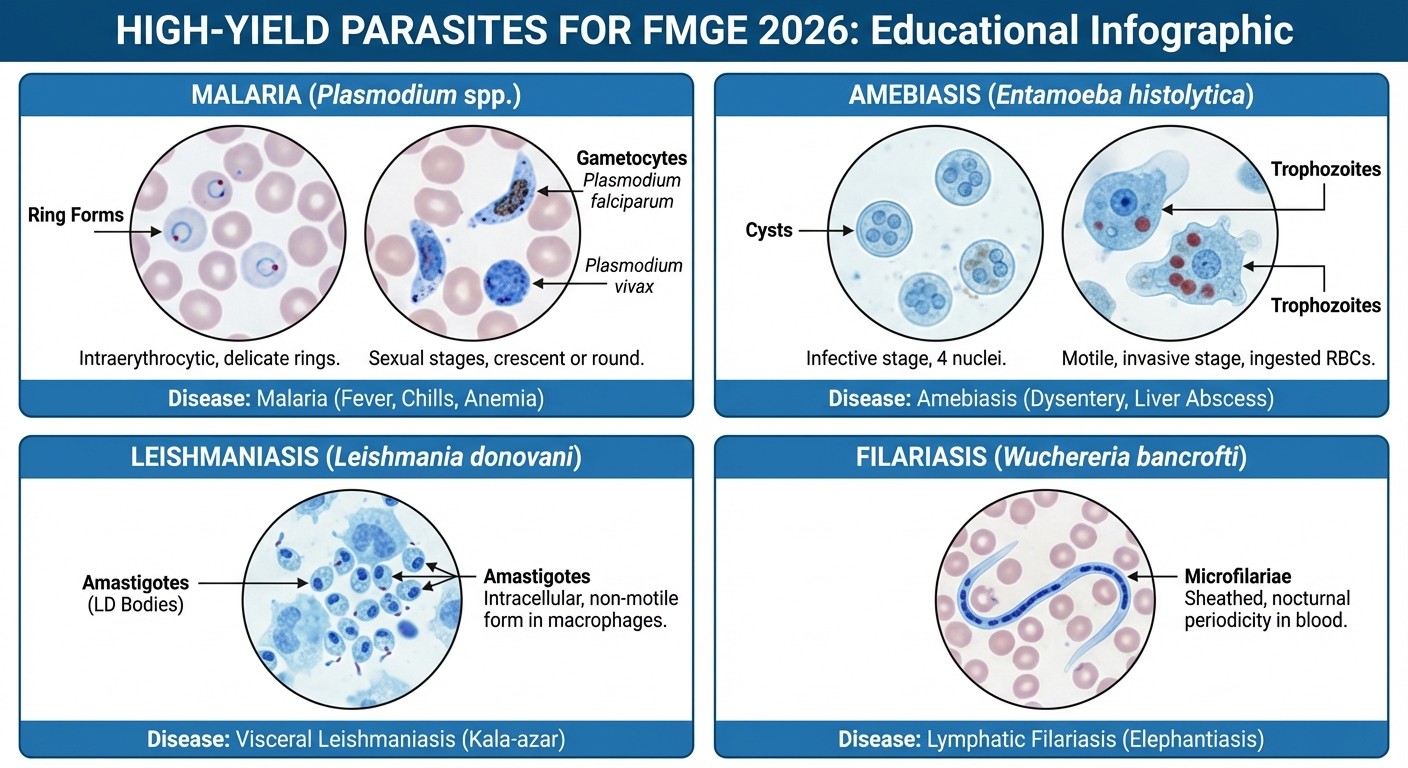
P. falciparum: Severe malaria, cerebral complications, banana-shaped gametocytes
P. vivax: Tertian fever, oval RBCs, dormant hypnozoites in liver
P. malariae: Quartan fever, rosette forms, kidney complications
P. ovale: Similar to vivax, oval RBCs with fimbriated edges
Know the diagnostic stages: ring forms, trophozoites, schizonts, gametocytes. Practice identifying these with our parasitology flashcards — they use spaced repetition to help you distinguish morphological features without mixing up the species. Leishmania:
Visceral leishmaniasis: L. donovani, kala-azar, splenomegaly
Cutaneous leishmaniasis: L. tropica, skin ulcers, amastigotes in macrophages
Trypanosoma: African sleeping sickness (T. brucei), Chagas disease (T. cruzi).
Intestinal Parasites
Protozoa:
Entamoeba histolytica: Dysentery, liver abscess, quadrinucleate cysts
Giardia lamblia: Steatorrhea, trophozoites with "falling leaf" motility
Cryptosporidium: Watery diarrhea in immunocompromised patients
Cyclospora: Cyclosporiasis, autofluorescent oocysts
Helminths:
Ascaris lumbricoides: Largest roundworm, intestinal obstruction
Ancylostoma/Necator: Hookworms, iron deficiency anemia
Trichuris trichiura: Whipworm, rectal prolapse in heavy infections
Strongyloides: Autoinfection cycle, hyperinfection syndrome
Tissue Helminths
Filaria:
Wuchereria bancrofti: Elephantiasis, sheathed microfilariae, nocturnal periodicity
Onchocerca volvulus: River blindness, skin nodules
Cestodes:
Taenia solium: Pork tapeworm, cysticercosis, neurocysticercosis
Echinococcus granulosus: Hydatid disease, sheep-dog cycle
The key to parasitology success is recognizing diagnostic forms under microscopy and connecting them to clinical presentations. Drill parasitology MCQs that emphasize these morphological identifications alongside geographic distributions.
Immunology Essentials for FMGE
Immunology concepts in FMGE focus on basic immune mechanisms and their clinical applications. Dont get lost in molecular details — stick to high-yield fundamentals.
Innate vs Adaptive Immunity
Innate Immunity Components:
Physical barriers (skin, mucosa)
Cellular components (neutrophils, macrophages, NK cells)
Humoral factors (complement, acute phase proteins)
Recognition patterns (PAMPs, DAMPs)
Adaptive Immunity:
B cells → antibody production
T cells → cellular immunity (CD4+ helper, CD8+ cytotoxic)
Memory formation and secondary responses
Hypersensitivity Reactions
This is a guaranteed FMGE topic. Master all four types:
Type I (IgE-mediated):
Mechanism: IgE binds mast cells, histamine release
Examples: Anaphylaxis, allergic asthma, food allergies
Timeline: Immediate (minutes)
Type II (Cytotoxic):
Mechanism: Antibodies target cell surface antigens
Examples: Hemolytic disease of newborn, drug-induced hemolysis
Timeline: Hours
Type III (Immune Complex):
Mechanism: Antigen-antibody complexes deposit in tissues
Examples: SLE, post-streptococcal glomerulonephritis
Timeline: Hours to days
Type IV (Cell-mediated):
Mechanism: T-cell mediated, delayed reaction
Examples: TB skin test, contact dermatitis
Timeline: Days
Our immunology lessons break down each hypersensitivity type with clinical examples that mirror FMGE question styles.
Vaccines and Vaccination
Live Attenuated Vaccines:
Examples: MMR, varicella, oral polio
Contraindications: Immunocompromised patients, pregnancy
Storage: Cold chain requirements
Inactivated/Killed Vaccines:
Examples: IPV, hepatitis A, influenza (injection)
Safety: Safe in immunocompromised
Response: May need boosters
Toxoid Vaccines:
Examples: Tetanus, diphtheria
Mechanism: Target bacterial toxins
Subunit Vaccines:
Examples: Hepatitis B, HPV, pneumococcal
Composition: Purified antigens
Complement System Basics
Know the two pathways that matter for FMGE:
Classical Pathway: Antibody-antigen complexes → C1 activation Alternative Pathway: Direct pathogen recognition → C3 activation
Both lead to: membrane attack complex (MAC), cell lysis, inflammation.
Strategic Study Approach for FMGE Microbiology
Topic Prioritization Based on FMGE Patterns
Not all microbiology topics carry equal weight. Based on analysis of past FMGE papers, prioritize your time this way:
High Priority (60% of questions):
Staphylococci and Streptococci
Mycobacterium tuberculosis
Plasmodium species
Hypersensitivity reactions
Major DNA and RNA viruses
Medium Priority (25% of questions):
Enteric bacteria (E. coli, Salmonella, Shigella)
Intestinal parasites
Vaccine types and schedules
Basic immunology concepts
Low Priority (15% of questions):
Rare bacteria and fungi
Detailed molecular mechanisms
Research-only organisms
After each study session, check your progress with our performance analytics — the platform shows exactly which microbiology domains need more attention based on your practice test results.
Memory Techniques for Microbiology
For Bacterial Characteristics:
Create systematic charts linking organism → morphology → disease → treatment. For example:
Organism | Gram Stain | Shape | Disease | Key Feature |
|---|---|---|---|---|
S. aureus | Positive | Cocci | Pneumonia | Coagulase + |
S. pyogenes | Positive | Cocci | Pharyngitis | Beta-hemolytic |
E. coli | Negative | Rod | UTI | Lactose fermenter |
For Viral Classifications:
Group by nucleic acid type first, then by disease syndrome:
DNA viruses → Herpes family, Hepatitis B, HPV
RNA viruses → Respiratory (influenza, RSV), GI (hepatitis A), systemic (HIV)
For Parasite Life Cycles:
Focus on diagnostic stages and geographic patterns rather than complete cycles. Know when to find ring forms vs gametocytes in malaria, cysts vs trophozoites in amebiasis.
Clinical Correlation Practice
FMGE questions embed microbiology in clinical scenarios. Practice connecting organisms to presentations:
"Rose spots on abdomen" → Salmonella typhi
"Rice water stools" → Vibrio cholerae
"Koplik spots in mouth" → Measles virus
"Bamboo stick gram stain" → Bacillus anthracis
The more you practice these clinical correlations, the faster you'll recognize patterns during the exam.
Common FMGE Microbiology Mistakes to Avoid
Mistake 1: Equal Time on All Topics
Many aspirants spend equal time on all microorganisms. This tanks your efficiency. Rare bacteria like Nocardia or Actinomyces appear once every few years, while Staphylococcus shows up in multiple questions every exam.
Fix: Use the 80/20 rule. Spend 80% of your micro time on the high-yield organisms listed in this guide.
Mistake 2: Memorizing Without Understanding
Rote memorization fails in FMGE because questions test application. You might memorize that "Clostridium tetani causes tetanus" but miss the clinical scenario about a farmer with lockjaw after a puncture wound.
Fix: Always link organisms to their clinical presentations and diagnostic features.
Mistake 3: Ignoring Morphological Details
FMGE loves testing bacterial morphology and staining characteristics. Questions often hinge on gram stain results, spore formation, or colony appearance.
Fix: Create visual memory aids for morphology. Sketch or find images of key organisms under microscopy.
Mistake 4: Weak Parasite Differentiation
Many aspirants confuse similar parasites — P. vivax vs P. ovale, different Entamoeba species, or various filarial worms. These distinctions matter for FMGE scoring.
Fix: Make comparison charts highlighting the 2-3 key differences between similar organisms.
Frequently Asked Questions
How many microbiology questions appear in FMGE?
FMGE typically has 25-30 microbiology questions out of 200 total questions. This represents about 13% of your total score, making it one of the higher-weighted subjects.
Which microbiology domain carries the most marks in FMGE?
Bacteriology typically accounts for 40-45% of microbiology questions, followed by parasitology (25-30%), virology (20-25%), and immunology (10-15%). Focus your time proportionally.
Should I study all bacterial species mentioned in textbooks?
No. FMGE has a predictable pattern focusing on clinically important organisms. The high-yield bacteria covered in this guide represent 80% of bacterial questions. Studying rare organisms wastes valuable time.
How detailed should my virus classification knowledge be?
Focus on major virus families, their nucleic acid type (DNA vs RNA), and associated diseases. Detailed molecular mechanisms rarely appear in FMGE. Clinical presentations and basic characteristics matter more.
Is parasitology really important for foreign medical graduates?
Yes, especially if you studied in countries with different endemic parasites. Indian medical licensing heavily emphasizes tropical parasites like Plasmodium, Leishmania, and filaria. Dedicate adequate time to this domain.
When should I start focusing on microbiology in my FMGE preparation?
Start microbiology after completing anatomy and physiology fundamentals. Microbiology builds on basic knowledge of human systems. Most successful candidates begin serious micro preparation 3-4 months before their exam date.
Master FMGE Microbiology with Strategic Focus
Microbiology doesnt have to be your weak spot. The organisms and concepts that matter for FMGE are predictable and manageable. Focus on the high-yield bacteria, viruses, parasites, and immunology basics covered in this guide.
Remember: FMGE rewards clinical understanding over rote memorization. Connect each organism to its disease patterns, diagnostic features, and treatment approaches. Practice with questions that mirror the actual exam format rather than just reading theory.
Your 26 microbiology questions can become 26 correct answers with the right strategy.
Prepare smarter with Oncourse AI — adaptive MCQs, spaced repetition, and AI explanations built for FMGE. Download free on Android and iOS.