Cognitive Load Theory for Medical Students: How to Study Smarter for USMLE, NEET PG and UKMLA (2026)
Learn how cognitive load theory explains why your brain hits a wall during study sessions. Science-backed strategies to reduce mental overload and build lasting knowledge for USMLE, NEET PG, and UKMLA.
Cognitive Load Theory for Medical Students: How to Study Smarter for USMLE, NEET PG and UKMLA (2026)
You are 4 hours into your study session. Pharmacokinetics, renal physiology, and cardiac pathophysiology are swimming around your head like alphabet soup. Your eyes are glazed over, highlighting the same line for the third time. Your brain feels like it just hit a brick wall.
Sound familiar?
That mental shutdown you experience isnt laziness or lack of motivation. Its cognitive overload — and understanding why it happens is the key to studying smarter for USMLE, NEET PG, and UKMLA.
Medical students face a unique challenge: absorbing massive amounts of interconnected information where anatomy, physiology, pathology, and pharmacology must integrate seamlessly. When NEET PG has 200 questions in 3.5 hours and USMLE Step 1 tests 7-8 integrated disciplines simultaneously, your brain needs more than just willpower — it needs strategy.
Cognitive Load Theory (CLT), developed by John Sweller in 1988, explains exactly why medical studying feels so mentally exhausting and what to do about it. More importantly, it reveals why some study methods leave you feeling drained while others build lasting knowledge efficiently.
Heres what every medical student should know about how their brain actually processes complex medical information — and how to work with it, not against it.
What is Cognitive Load Theory?
Cognitive load theory centers on one fundamental limitation: your working memory can only handle 2-4 new elements at once. Think of it as your brains RAM — when you overload it, everything slows down or crashes entirely.
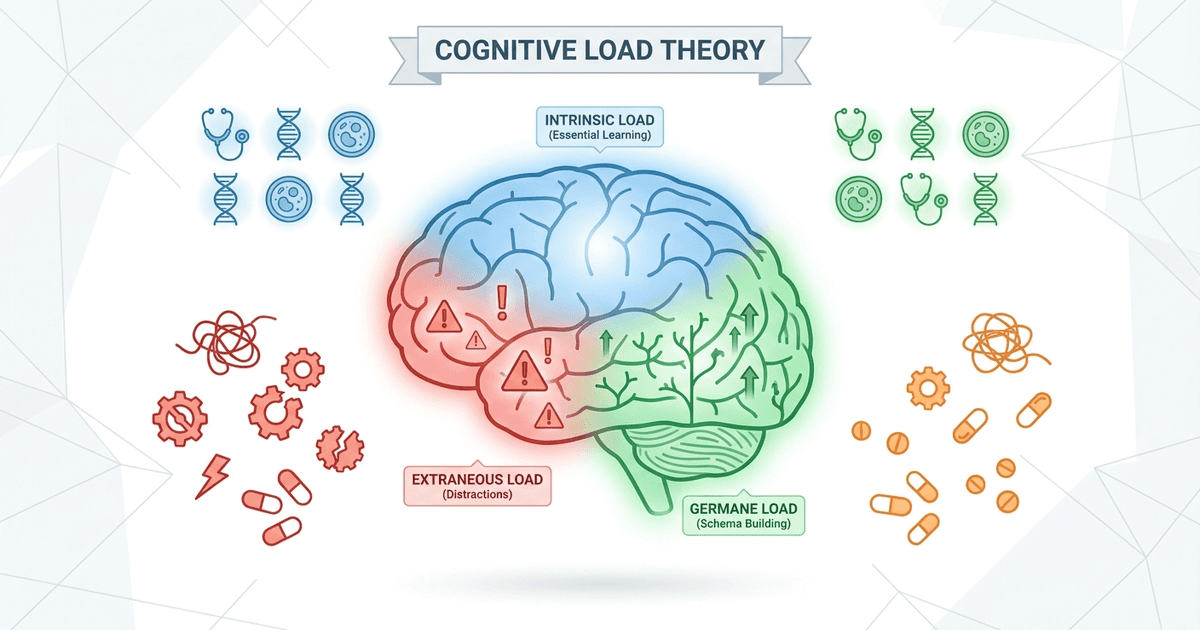
CLT identifies three types of cognitive load that compete for your limited mental resources:
1. Intrinsic Load: The Unavoidable Complexity
This is the inherent difficulty of the material itself. Learning the Krebs cycle has high intrinsic load because of its multiple interconnected steps and enzymatic reactions. Memorizing a drug name has low intrinsic load.
You cant eliminate intrinsic load — complex medical concepts are complex for good reason. But you can manage when and how you tackle high-load material.
2. Extraneous Load: The Hidden Brain Drain
This is mental effort wasted on poorly designed learning environments, distracting study setups, or inefficient methods. Extraneous load includes:
Switching between multiple textbooks for the same topic
Studying in noisy environments that require constant refocusing
Using dense, poorly formatted resources
Multitasking during study sessions
Passive re-reading without structure
Extraneous load is the silent killer of medical studying. It masquerades as "being busy" while actually preventing learning.
3. Germane Load: The Goal of All Learning
This is mental effort directed toward building schemas — organized knowledge structures that connect related concepts. When you understand how ACE inhibitors affect both cardiac preload AND renal function AND blood pressure regulation, thats germane load at work.
Germane load is what transforms isolated facts into integrated medical knowledge. This is what allows seasoned doctors to rapidly diagnose complex cases — they have robust schemas, not just memorized facts.
Why Medical Studying Creates Cognitive Overload
Medical education is uniquely demanding on cognitive resources for several reasons:
Dense, Interconnected Concepts: Understanding heart failure requires simultaneous knowledge of cardiac anatomy, Frank-Starling mechanism, neurohormonal regulation, and pharmacological interventions. Each topic has high intrinsic load individually — combining them pushes working memory to its limits. Time Pressure: With NEET PG requiring 63 seconds per question and USMLE Step 1 demanding rapid pattern recognition across disciplines, students often resort to cramming methods that maximize extraneous load. Integration Requirements: Unlike undergraduate courses where topics exist in isolation, medical knowledge must integrate. Oncourse AI's adaptive question bank recognizes this challenge, surfacing questions that test interconnected concepts rather than isolated facts, reducing the extraneous load of hunting through thousands of unrelated questions. Volume vs. Depth Dilemma: With 15,000+ potential USMLE topics and 19 subjects in NEET PG, students face constant pressure to cover everything superficially rather than building deep schemas.
Evidence-Based Strategies to Optimize Cognitive Load
1. Eliminate Extraneous Load First
Before optimizing your learning, eliminate what's working against you:
Single-Source Learning: Choose one primary resource per topic instead of juggling multiple textbooks. This reduces the mental effort spent reconciling different explanations and formats. Distraction-Free Environment: Your phone notifications, background music, and study group chatter all create extraneous load. Studies show that even having your phone visible reduces cognitive performance by 10%. Organized Information Architecture: Use consistent note-taking formats and organize subjects logically. When Oncourse's spaced repetition engine presents information in predictable, clean layouts, it eliminates the cognitive effort spent parsing visual chaos. Stop Passive Re-reading: Highlighting and re-reading textbooks feels productive but creates massive extraneous load. Your brain works harder to extract meaning from passive text than from active recall prompts.
2. Manage Intrinsic Load Through Chunking
Break complex medical concepts into digestible components before attempting integration:
Start with Foundation Schemas: Master basic anatomy before pathophysiology. Understand normal cardiac cycle before diving into heart failure mechanisms. This scaffolding approach reduces intrinsic load of advanced concepts. Use Progressive Disclosure: When learning a complex pathway like steroid synthesis, master the major steps before memorizing every enzyme and cofactor. Layer complexity gradually rather than attempting everything simultaneously. Leverage Prior Knowledge: Connect new concepts to existing schemas. When learning nephrology, explicitly link back to cardiovascular physiology concepts you already understand.
3. Maximize Germane Load Through Active Construction
Focus your mental effort on building robust, interconnected knowledge schemas:
Elaborative Interrogation: Ask "why" and "how" questions that force integration. "Why does furosemide cause hyponatremia?" requires connecting diuretic mechanisms with electrolyte physiology — exactly the type of germane processing that builds lasting understanding. Case-Based Integration: Instead of studying pharmacology and pathology separately, work through clinical cases that require both. This mirrors real medical thinking and builds practical schemas. Concept Mapping: Visually connect related ideas. Draw out how diabetes affects cardiovascular, renal, neurological, and immune systems. This explicit connection-building is pure germane load.
When you encounter difficult questions on Oncourse's adaptive platform, the AI-powered explanations build on concepts you already understand rather than introducing completely new frameworks — scaffolding new information onto existing schemas exactly as germane load theory prescribes.
4. Use Spaced Retrieval to Automate Schema Access
Spaced repetition serves two cognitive load purposes: Reduces Future Intrinsic Load: Well-rehearsed concepts move from working memory to long-term memory, freeing up cognitive resources for new learning. Automates Schema Activation: When renal physiology concepts become automatically accessible, you can dedicate working memory to integrating new pathology concepts rather than struggling to remember basic kidney function. Optimizes Review Timing: Reviewing material too soon wastes cognitive effort on concepts already well-learned. Reviewing too late requires re-learning from scratch. Optimal spacing maximizes the return on cognitive investment.
5. Interleave Related Concepts
Instead of blocked practice (studying all cardiology, then all pulmonology), mix related topics within study sessions:
System-Based Interleaving: Study cardiac pathophysiology, then related pharmacology, then diagnostic imaging findings. This forces active comparison and builds stronger schemas. Question-Based Mixing: Use question banks that mix disciplines within sessions rather than subject-specific blocks. This mirrors exam conditions and strengthens flexible recall. Cross-System Integration: When studying endocrinology, include questions about endocrine effects on cardiac, renal, and neurological systems. Medical thinking is inherently interdisciplinary.
6. Leverage Testing Effects for Schema Strengthening
Active recall through testing isn't just about memory — it's about schema development: Retrieval Practice: Forcing yourself to recall information strengthens neural pathways and makes schemas more robust. This is why practice questions are more effective than passive review. Error-Based Learning: When you get questions wrong, the cognitive effort required to understand the correct answer creates strong germane load. The Probe Game on Oncourse leverages this by providing immediate feedback that builds on your existing knowledge base. Progressive Testing: Start with cued recall (fill-in-the-blank), advance to free recall (essay questions), then move to application (clinical scenarios). Each level builds more sophisticated schemas.
The Schema-Building Approach to Medical Studying
Instead of cramming isolated facts, focus on building robust knowledge schemas:
Start with Core Frameworks: Master fundamental physiological processes before memorizing every exception and variation. A solid understanding of normal renal function supports learning about kidney diseases, diuretics, and electrolyte disorders. Build Connections Explicitly: When learning new concepts, actively connect them to existing knowledge. "This drug mechanism relates to the pathway I learned last week because..." Practice Integration: Use clinical cases and comprehensive question banks that test multiple disciplines simultaneously. This mirrors real medical thinking and strengthens schema flexibility. Review for Maintenance, Not Relearning: Once schemas are built, brief review sessions maintain access rather than rebuilding from scratch. This is why spaced repetition is so effective for medical knowledge retention.
Common Cognitive Load Mistakes Medical Students Make
Mistake 1: Multitasking During Study
Checking phones, listening to music, or studying multiple subjects simultaneously creates massive extraneous load. Your brain cant build schemas while managing distractions.
Mistake 2: Video Marathon Sessions
Watching 6-hour lecture playlists feels productive but creates cognitive overload. Passive video consumption generates high extraneous load with minimal schema building.
Mistake 3: Highlight-Heavy Reading
Excessive highlighting while reading textbooks creates the illusion of active learning while actually increasing extraneous load. Your working memory is managing highlighting decisions rather than building understanding.
Mistake 4: Cramming Before Exams
Last-minute cramming attempts to force-feed information into already overloaded working memory. This approach maximizes extraneous load while preventing schema formation.
Mistake 5: Isolated Subject Studying
Learning pharmacology completely separately from pathophysiology prevents schema integration. Medical knowledge requires cross-system connections to be clinically useful.
Implementing Cognitive Load Theory in Your Study Schedule
Daily Study Session Structure
20-minute high-load concept introduction: tackle one new, complex topic with full attention 10-minute schema integration: connect new concept to previously learned material 30-minute active recall practice: test your understanding through questions or case scenarios 5-minute spaced review: brief review of concepts from previous days
Weekly Integration Sessions
Dedicate one study session per week to cross-system integration. Review how endocrine disorders affect cardiac function, how cardiac medications impact renal physiology, and how kidney disease influences drug dosing.
Monthly Schema Assessment
Test your ability to integrate knowledge across disciplines. Work through complex clinical cases that require drawing on multiple organ systems and knowledge domains.
How Modern AI Tools Apply Cognitive Load Principles
The most effective medical education platforms now incorporate cognitive load theory into their design:
Adaptive Question Selection: Instead of overwhelming students with thousands of random questions, intelligent systems present questions matched to current knowledge gaps, optimizing cognitive load distribution. Contextual Explanations: When you miss a question about beta-blockers, effective AI explains the concept by building on your existing cardiovascular knowledge rather than starting from scratch — exactly what germane load optimization looks like. Spaced Repetition Automation: Modern platforms track your forgetting curve and resurface concepts at optimal intervals, ensuring cognitive effort is directed toward maintaining long-term schemas rather than constant relearning. Integrated Question Banks: The best platforms present questions that test multiple disciplines simultaneously, forcing the schema integration that makes medical knowledge clinically useful.
Frequently Asked Questions
How long should study sessions be to avoid cognitive overload?
For high-complexity medical material, 25-45 minute focused sessions work best. After 45 minutes, working memory becomes overloaded and learning efficiency drops significantly. Take 10-15 minute breaks to reset cognitive resources.
Why do I feel more tired studying medicine than other subjects?
Medical studying requires constant integration of multiple complex systems — anatomy, physiology, pathology, and pharmacology simultaneously. This creates higher intrinsic cognitive load than subjects where topics exist in isolation.
Should I study multiple subjects in one day or focus on one?
For schema building, interleaving related subjects (cardiology and cardiac pharmacology) works better than blocked practice. However, avoid jumping between completely unrelated subjects (anatomy and behavioral science) in single sessions.
How can I tell if Im experiencing cognitive overload?
Signs include: re-reading the same paragraph multiple times, inability to connect concepts, feeling mentally "foggy" after short study periods, and decreased comprehension despite increased effort.
Is it better to cover more topics superficially or fewer topics deeply?
For medical exams, depth-first learning builds stronger schemas that transfer better to clinical scenarios. Master core concepts thoroughly before adding complexity. Surface-level coverage of many topics creates weak schemas that dont integrate effectively.
How does spaced repetition reduce cognitive load?
Spaced repetition moves frequently accessed concepts from working memory to long-term memory, freeing up cognitive resources for learning new material. When basic physiology becomes automatic, you can focus working memory on pathology integration.
---
Prepare smarter with Oncourse AI — adaptive MCQs, spaced repetition, and AI explanations built for USMLE, NEET PG, and UKMLA. Download free on Android and iOS.