How to Use Question Banks Effectively for PLAB 1: A Complete MCQ Practice Strategy
Master PLAB 1 with strategic question bank practice. Learn active recall techniques, spaced repetition for MCQs, and how to identify weak areas for targeted revision.
How to Use Question Banks Effectively for PLAB 1: A Complete MCQ Practice Strategy
You are probably staring at hundreds of PLAB 1 questions right now, wondering if you are actually learning anything. Most candidates treat question banks like Netflix — they scroll through, read the explanation when they get it wrong, and move on. Six weeks later, they make the same mistakes.
PLAB 1 has 180 questions. You have exactly 60 seconds per question. The pass rate hovers around 70%, which means 30% of candidates fail despite having access to the same question banks you do. The difference isnt the questions — its how you use them.
This isnt about finding the "best" question bank. This is about turning whatever MCQ practice material you have into a diagnostic tool that identifies your weak spots, builds your clinical reasoning, and creates a spaced revision cycle that actually sticks. By the end of this guide, you will know exactly how to transform passive question reading into active PLAB 1 preparation that gets results.
Why Passive Question Practice Fails
Most PLAB 1 candidates approach question banks backwards. They read a clinical vignette, pick an answer, check if they were right, scan the explanation, and immediately move to the next question. This feels productive because you are "covering" lots of questions, but it creates an illusion of progress.
Here is what actually happens in your brain during passive practice:
When you read the explanation immediately after answering, you are not testing recall — you are just confirming what you already knew or adding new information while the question context is still fresh in your working memory. This creates recognition, not retrieval. On exam day, you wont have explanations to confirm your thinking.
The real problem: you never find out what you actually dont know until its too late. You might get cardiology questions right during practice but freeze when you see the same concepts tested differently on the actual PLAB 1. The passive approach doesnt expose the gaps in your clinical reasoning — it papers over them.
Think about it this way: if you consistently got ethics questions wrong during practice but kept reading explanations without changing your approach, would you suddenly perform better on PLAB 1 ethics questions? Of course not. You would just have read more explanations.
The Active Recall Approach: Cold Attempts First
Active recall means attempting each question without any external help, exactly as you would during the real exam. No textbooks, no notes, no second-guessing. Just you, the clinical vignette, and your current understanding.
Here is the step-by-step process:
Step 1: Attempt Cold
Read the question stem once. Choose your answer based purely on what you know right now. Dont overthink or second-guess — your first instinct often reveals your true knowledge level. This discomfort of not being sure is exactly what builds stronger neural pathways.
Step 2: Mark Your Confidence
Before checking the answer, rate your confidence: Certain (90%+), Likely (70-89%), Guess (50-69%), or Random (under 50%). This self-assessment becomes crucial data later.
Step 3: Deep Dive the Explanation
Only after committing to your answer should you read the explanation. But dont just confirm if you were right or wrong — understand why each distractor was included and what clinical reasoning led to the correct answer. If it is a NICE guideline question, look up the actual threshold. If it involves UK drug names, note the BNF reference.
When you get it wrong, identify the root cause: Did you misunderstand the clinical presentation? Did you not know the UK-specific guideline? Was it a knowledge gap about pharmacology? This diagnostic step turns every wrong answer into actionable study information.
For PLAB 1 specifically, wrong answers often fall into predictable categories: unfamiliarity with NICE thresholds, confusion between UK and home country drug names, or missing the "most appropriate next step" versus "definitive treatment" distinction that UK medicine emphasizes.
Timed vs Untimed Practice: The Strategic Sequence
The timing of your practice sessions should match your preparation phase, not your anxiety level. Most candidates rush into timed practice too early, then wonder why they keep running out of time.
Untimed Phase (First 4-6 Weeks)
During initial learning, turn off the timer completely. Focus entirely on understanding clinical reasoning patterns. Take as long as you need to work through complex pharmacology calculations or multi-step diagnostic workups. This phase builds accuracy before speed.
Untimed practice lets you develop systematic approaches to common PLAB 1 question types. For instance, when you see "chest pain in a 45-year-old man," you learn to work through the UK-specific risk stratification (NICE guidelines for acute coronary syndrome) without time pressure. You internalize the logic: ECG changes, troponin timing, when to use GRACE score.
During this phase, aim for 30-40 questions per day with thorough review. Quality over quantity — one deeply understood question is worth more than five rushed attempts.
Timed Phase (Final 2-3 Weeks)
Once you consistently score above 70% in untimed practice, introduce timed sessions. PLAB 1 gives you 60 seconds per question, but you need buffer time for difficult questions. Aim to complete easier questions in 45-50 seconds, saving extra time for complex clinical scenarios.
Start with 60-question timed blocks (1 hour), then progress to full 180-question mock exams. The goal isnt just speed — its maintaining accuracy under time pressure while managing the cognitive fatigue that comes with 3-hour concentration.
Use Oncourse's adaptive daily plan to automatically balance untimed learning with timed practice based on your performance metrics across different clinical systems.
Weak Area Identification: Data-Driven Study Decisions
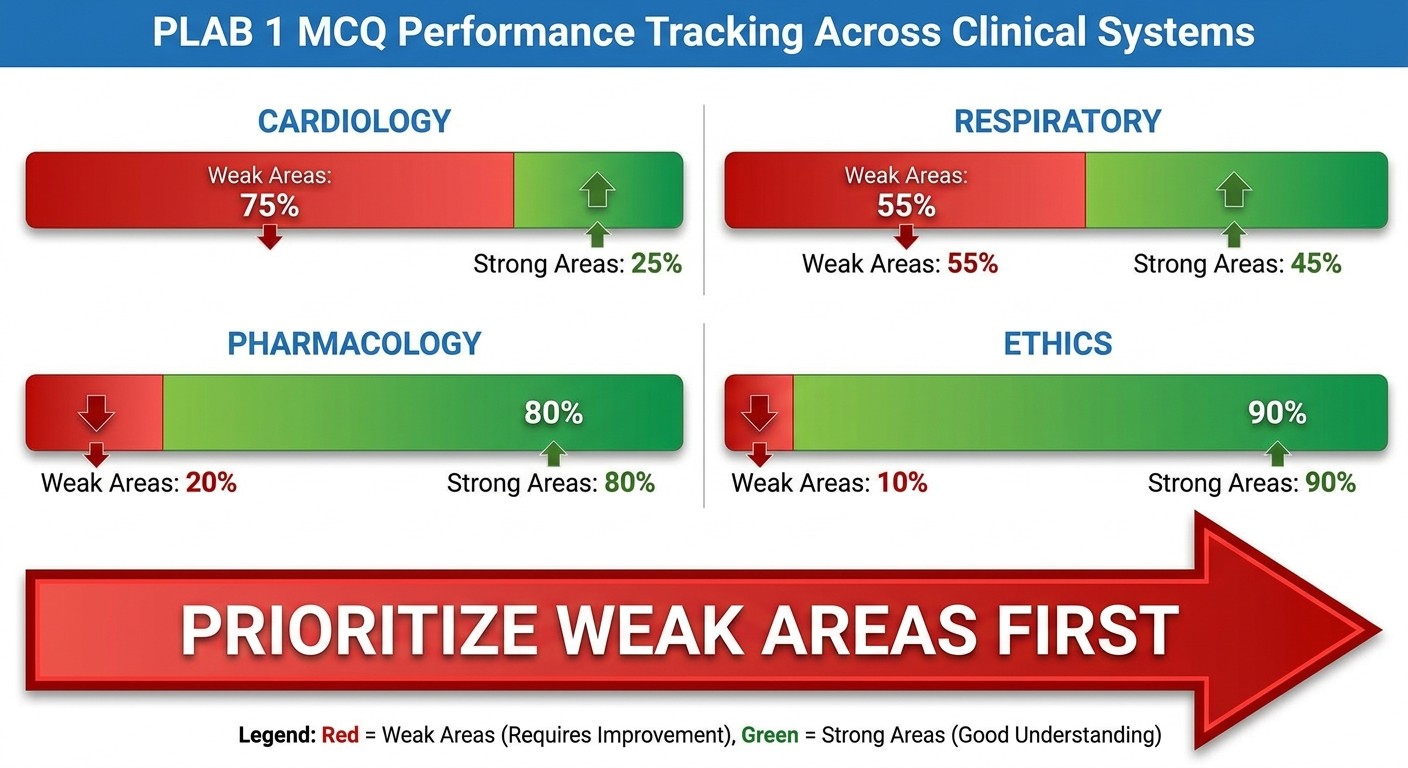
PLAB 1 covers an enormous breadth — from acute medicine to chronic disease management, from pharmacology to medical ethics. Most candidates try to study everything equally, which guarantees they wont have time to master their weak areas.
Track your performance by clinical system, not just overall percentage. Create a simple spreadsheet or use your question bank's analytics (if available) to monitor:
Cardiology: ACS management, heart failure, arrhythmias
Respiratory: COPD exacerbations, pneumonia, asthma
Pharmacology: UK drug names, dosing, interactions, contraindications
Ethics: GMC guidelines, consent, confidentiality scenarios
Paediatrics: Development milestones, vaccination schedules, safeguarding
Psychiatry: Mental Health Act, capacity assessment, risk management
Primary Care: NICE screening guidelines, chronic disease monitoring
If you are scoring 85% in cardiology but 55% in pharmacology, your next two weeks should be pharmacology-heavy, not a balanced review of everything. This seems obvious, but most candidates continue practicing their strong areas because it feels good to get questions right.
The Synapses spaced repetition system can automatically surface your weak UK drug names and NICE guideline thresholds at optimal review intervals, ensuring you see your problem areas exactly when you are about to forget them.
Spaced Repetition Integration: The Science of Forgetting
Getting a question wrong once doesnt mean you have learned it. Memory research shows that without deliberate review, you will forget 50% of new information within 24 hours and 80% within a week. For PLAB 1, this means wrong answers need structured follow-up, not just a mental note to "remember that."
Here is the evidence-based review schedule:
Day 1: Attempt question cold, get it wrong, understand explanation thoroughly Day 2: Review the same question — can you get it right without looking at options? Day 4: Test yourself again — if correct, move to 1-week interval Day 11: Final review — if still correct, consider it learned If wrong at any stage: Reset to Day 1 interval
This approach transforms every PLAB 1 mistake into a long-term memory asset. Instead of hoping you wont see similar questions on exam day, you systematically ensure that you will recognize the pattern and get it right.
For questions involving UK-specific content (NICE guidelines, BNF drug interactions, GMC ethical frameworks), convert the key facts into flashcards for daily review. For instance, if you missed a question about hypertension management in diabetes, create separate cards for the blood pressure thresholds, ACE inhibitor choice, and monitoring frequency.
The Synapses platform handles this scheduling automatically — every wrong PLAB 1 MCQ becomes a personalized flashcard that resurfaces based on your forgetting curve, not arbitrary calendar dates.
Building Your 2-Month Question Bank Plan
PLAB 1 preparation requires strategic escalation, not random practice. Here is how to structure your question bank usage across 8 weeks:
Weeks 1-2: Foundation Phase
30 questions/day, completely untimed
Focus on understanding UK clinical guidelines and pharmacology
Create flashcards for every wrong answer
Target areas: NICE guidelines, BNF drug names, basic clinical reasoning
Weeks 3-4: Integration Phase
50 questions/day, still untimed
Mix different clinical systems in single sessions
Begin tracking performance by specialty
Identify your 2-3 weakest areas for focused review
Weeks 5-6: Application Phase
60 questions/day, introduce 1-hour timed blocks
Concentrate 70% of practice on your identified weak areas
Practice clinical reasoning under mild time pressure
Begin full-system integration questions
Weeks 7-8: Simulation Phase
4-5 full 180-question mock exams per week
Strict 3-hour time limits
Analyze mistakes immediately after each mock
Focus on exam endurance and concentration maintenance
Throughout this progression, use question bank analytics to verify that your weak areas are actually improving. If your pharmacology scores plateau at 65% despite focused practice, you need a different approach — perhaps more BNF review or different question sources.
The adaptive daily plan system automatically adjusts your daily question distribution based on this performance data, ensuring you spend proportionally more time on underperforming areas without manual tracking.
Common PLAB 1 Question Themes: What to Expect
PLAB 1 questions follow predictable patterns that reflect UK clinical practice. Understanding these themes helps you recognize what each question is actually testing.
Clinical Reasoning Questions
These present a clinical scenario and ask for the "most appropriate next step." The key is understanding UK healthcare pathways — when to refer to secondary care, when to manage in primary care, and what investigations to prioritize. For example, a chest pain question might test whether you know the NICE pathway: ECG first, then troponin timing, then risk stratification tools.
NICE Guideline Applications PLAB 1 loves testing specific thresholds and recommendations from NICE guidelines. Common topics include hypertension targets in different patient groups, diabetes management algorithms, and antibiotic prescribing for common infections. These questions reward precise knowledge of UK-specific recommendations, not general medical principles. BNF Drug Knowledge UK drug names, dosing schedules, and contraindications feature heavily. Many international candidates struggle because UK formulations and naming conventions differ from their home countries. For instance, UK guidelines might specify "co-amoxiclav" while other countries use "amoxicillin-clavulanate." The BNF online is essential for familiarizing yourself with UK-specific drug information. Ethical Scenarios
GMC guidelines on consent, confidentiality, and professional boundaries appear in 10-15% of questions. These test your understanding of UK medical law and professional standards. Common scenarios include capacity assessment, breaking bad news, and managing conflicts of interest. The correct answers always prioritize patient autonomy and informed consent.
Primary Care Integration
Many questions test knowledge of UK primary care systems — referral pathways, screening programs, and chronic disease monitoring. You need to understand what GPs handle independently versus when they refer to specialists. This reflects the integrated nature of UK healthcare delivery.
When you encounter these question types during practice, use Explanation Chat to explore follow-up questions about UK-specific guidelines. For instance, if you get a NICE hypertension question wrong, you can immediately ask about diabetes-specific blood pressure targets or ACE inhibitor contraindications without leaving your study session.
Advanced Strategies: Beyond Right and Wrong
Once you have mastered basic question bank usage, these advanced techniques separate high scorers from average performers:
Distractor Analysis
Dont just learn why the correct answer is right — understand why each wrong option was included. PLAB 1 distractors are carefully chosen to represent common clinical misconceptions or alternative guidelines from other countries. By understanding the logic behind wrong answers, you develop stronger clinical reasoning.
Pattern Recognition Training
After completing 500+ questions, you will start noticing question patterns. PLAB 1 writers use specific phrases to signal certain concepts: "most appropriate initial investigation" versus "gold standard diagnostic test," or "immediate management" versus "long-term treatment plan." Learning these linguistic cues helps you decode what each question is actually asking.
Cross-System Integration
Advanced practice involves questions that combine multiple clinical systems — for instance, a cardiac patient with diabetes and chronic kidney disease. These questions test your ability to prioritize competing clinical concerns using UK guidelines. Practice these integration scenarios extensively in your final weeks.
Timing Strategy Development
During timed practice, develop systematic approaches to different question types. Simple recall questions (drug dosages, normal values) should take 30-40 seconds. Complex clinical scenarios might need 90 seconds. Learn to quickly categorize questions and allocate time accordingly.
For candidates using UK-focused practice questions, these advanced strategies become second nature through exposure to authentic PLAB 1-style scenarios that mirror the actual exam experience.
Common Mistakes to Avoid
Even with perfect strategy, these common errors can undermine your question bank practice:
Mistake 1: Reviewing Too Soon
Checking the answer immediately after making a choice prevents true active recall. Force yourself to commit to an answer before looking at explanations.
Mistake 2: Ignoring Confidence Ratings
If you consistently guess correctly, you might think you know more than you do. Track confidence alongside accuracy to identify lucky guesses that need more study.
Mistake 3: Neglecting Wrong Answer Follow-Up
Getting a question right after getting it wrong yesterday doesnt mean you have learned it. Use spaced repetition to ensure long-term retention.
Mistake 4: Studying Only High-Yield Topics
PLAB 1 can test any topic from the MLA content map. While prioritizing common themes makes sense, completely ignoring low-yield areas can cost you points on questions that others get right.
Mistake 5: Skipping Mock Exam Analysis
Simply taking mock exams isnt enough — you must analyze your mistakes systematically and adjust your study plan accordingly.
Creating Your Personal Question Bank System
Your question bank strategy should reflect your learning preferences and time constraints. Here is how to customize the approach:
For Visual Learners: Create mind maps connecting wrong answers to broader clinical concepts. Use the question bank analytics to identify patterns visually. For Systematic Learners: Build detailed spreadsheets tracking performance by topic, question type, and confidence level. Set numerical targets for each clinical system. For Social Learners: Form study groups that review difficult questions together. Explain incorrect answers to peers to reinforce your own understanding. For Time-Constrained Candidates: Focus on high-yield areas first, but ensure you still review low-performing topics. Use spaced repetition to maximize retention with minimal time investment.
The key is consistency rather than perfection. A simple system followed daily beats a complex system used sporadically.
When reviewing challenging UK pharmacology questions, use the Synapses spaced repetition system to ensure BNF drug names and NICE thresholds resurface at optimal intervals, building long-term recall rather than short-term recognition.
Performance Tracking and Analytics
Successful PLAB 1 candidates treat their preparation like a performance improvement project, not random studying. Track these key metrics weekly:
Overall Accuracy: Your percentage correct across all questions attempted System-Specific Performance: Scores broken down by clinical specialty Confidence Calibration: How often your confidence level matches your actual performance Timing Efficiency: Average seconds per question in timed practice Improvement Trajectory: Week-over-week score changes in weak areas
Set realistic targets based on your timeline. If you are consistently scoring 75%+ across all systems with good timing, you are likely ready for PLAB 1. If any clinical system is below 65%, prioritize that area until it improves.
Use question bank analytics to identify not just what you got wrong, but when you got it wrong. Questions missed due to time pressure require different interventions than questions missed due to knowledge gaps.
For candidates starting 6-8 weeks before their exam date, the adaptive daily plan automatically adjusts your study schedule based on these performance metrics, ensuring you spend optimal time on areas that need improvement.
Integration with Other Study Resources
Question banks work best when integrated with complementary study methods, not used in isolation. Here is how to coordinate your approach:
Textbook Review: When you consistently miss questions in a specific area, return to primary resources for that topic. Use question bank performance to guide your textbook reading priorities. Video Learning: For complex topics that you repeatedly get wrong, seek out UK-focused video explanations that clarify the clinical reasoning. Flashcard Review: Convert every wrong answer into targeted flashcards for spaced repetition. Focus on UK-specific facts (drug names, thresholds, guidelines) that differ from international standards. Practice with UK Guidelines: When questions reference NICE or GMC guidelines, read the actual source documents, not just question explanations. This builds deeper understanding of the reasoning behind UK-specific recommendations.
For topics like chronic disease management and screening protocols, combining question practice with UK-specific lesson content ensures you understand both the facts and the clinical reasoning behind PLAB 1 scenarios.
Final Week Strategy: Mock Exams and Review
Your final week should simulate exam conditions while reinforcing your strongest knowledge areas. Here is the day-by-day approach:
Days 1-2: Complete two full 180-question mock exams under strict time conditions. Analyze mistakes immediately but dont attempt major learning of new concepts. Days 3-4: Review your highest-frequency mistake patterns. Focus on UK-specific content where you consistently struggle. Days 5-6: Complete one more mock exam, then review only your absolute weakest areas. Avoid learning completely new material. Day 7 (Exam Day): Light review of your personal summary notes. Trust your preparation and focus on exam logistics.
During final week reviews, resist the urge to cram new information. Instead, consolidate what you already know and ensure your strongest areas remain strong while shoring up glaring weaknesses.
Frequently Asked Questions
How Many Questions Should I Complete Before PLAB 1?
Most successful candidates complete 2,000-3,500 practice questions over 6-8 weeks of preparation. Quality matters more than quantity — 1,500 questions with thorough review and spaced repetition beats 4,000 questions attempted passively. Focus on question banks that mirror PLAB 1 style and include detailed explanations with UK-specific guidelines.
Should I Repeat Questions I Got Right the First Time?
Generally no, unless they were lucky guesses or you had low confidence in your answer. Focus your limited time on questions you got wrong or answered correctly but with uncertainty. However, during final week review, briefly revisiting challenging questions you eventually mastered can boost confidence.
What Should I Do When I Consistently Miss Questions in One Area?
First, identify the root cause: knowledge gap, UK guideline unfamiliarity, or clinical reasoning issues. Then pause question practice in that area temporarily and return to foundational learning — textbook review, UK-specific guidelines, or focused video content. Resume questions only after addressing the underlying problem.
Is 60% Accuracy in Practice Questions Good Enough?
PLAB 1 typically requires 65-70% to pass, but practice question difficulty varies between providers. Aim for 75%+ consistency across all clinical systems in your practice questions, with particular attention to timing. If you are consistently scoring 60%, you likely need more foundational review before increasing question volume.
How Do I Handle Questions About Drugs I've Never Heard Of?
UK drug names and formulations often differ from international standards. Create systematic flashcards for every unfamiliar medication you encounter, including generic names, common UK brand names, and key clinical uses. The BNF online is essential for familiarizing yourself with UK pharmaceutical conventions that PLAB 1 assumes you know.
Should I Focus on High-Yield Topics or Study Everything Equally?
Start with high-yield areas (cardiology, respiratory, pharmacology, ethics) but ensure you dont completely neglect any clinical system. PLAB 1 can test any topic from the MLA content map, and questions you find "easy" might be what separates you from candidates who focused too narrowly. Use performance tracking to identify your weakest areas and prioritize those for focused review.
---
PLAB 1 success comes down to strategic preparation, not just hard work. Use question banks as diagnostic tools that reveal your knowledge gaps, not just practice tests that make you feel busy. Build spaced repetition into every wrong answer, track your performance systematically, and focus your limited time on areas where improvement will have the biggest impact on your score.
Prepare smarter with Oncourse AI — adaptive MCQs, spaced repetition, and AI explanations built for PLAB 1. Download free on Android and iOS.