Back
INICET Preparation 2026: Complete Guide — Exam Pattern, High-Yield Subjects, 90-Day Study Plan and Topper Strategy
Complete INICET 2026 preparation guide with exam pattern, subject weightage, high-yield topics, 90-day study plan, and proven topper strategies for AIIMS PG admission success.

INICET Preparation 2026: Complete Guide — Exam Pattern, High-Yield Subjects, 90-Day Study Plan and Topper Strategy
You are probably staring at your MBBS degree, wondering if INICET preparation is actually doable in 90 days. Here's the reality: it absolutely is — if you know exactly what INICET asks and prepare accordingly.
INICET 2026 has 200 MCQs. Three and a half hours. Plus one mark for correct answers, minus one-third for wrong ones. But here's what most students miss: INICET isnt just another entrance exam. It's AIIMS-specific, which means the questions think like AIIMS faculty — more integrated clinical scenarios, fewer isolated fact recalls.
The 2025 INICET data shows the truth. Medicine and Surgery together contribute 29% of all questions. Add Pathology, Pharmacology, OB-GYN, and Pediatrics, and you have covered 65% of the entire paper. That's your target zone right there.
What is INICET? Your Gateway to AIIMS Excellence
INICET (Institute of National Importance Combined Entrance Test) is your exclusive route into postgraduate medical programs at all AIIMS institutes across India. Unlike NEET-PG that feeds into multiple institutions, INICET serves only AIIMS — making it focused but intensely competitive.
The exam targets MBBS graduates from any recognized Indian medical college who want MD/MS/MDS courses at AIIMS Delhi, AIIMS Jodhpur, AIIMS Bhopal, AIIMS Patna, AIIMS Raipur, AIIMS Bhubaneswar, AIIMS Rishikesh, AIIMS Mangalagiri, and AIIMS Nagpur.
What makes INICET different:
Institute-specific focus: Questions reflect AIIMS teaching methodology and case presentation style
Smaller candidate pool: Around 40,000-50,000 aspirants compared to NEET-PG's 2+ lakh candidates
Clinical integration: 60% weightage on clinical subjects with case-based scenarios
Higher stakes per question: With only 200 MCQs, each question carries more weight than NEET-PG's 200 questions
The competition intensity becomes clear when you see the numbers. AIIMS Delhi Internal Medicine had a cutoff of 114 marks in 2024. Surgery crossed 120. These scores dont happen by accident.
INICET 2026 Exam Pattern and Structure
INICET follows a standardized computer-based format. Here's the complete breakdown:
Component | Details |
|---|---|
Total Questions | 200 MCQs |
Duration | 3 hours 30 minutes |
Marking Scheme | +1 for correct, -0.33 for incorrect |
Question Type | Single best response |
Language | English only |
Mode | Computer-based test |
Sessions per year | 2 (June and November) |
Marking Strategy Impact
The negative marking of 0.33 marks creates a specific threshold. You need to be more than 25% confident to attempt a question (since random guessing gives -0.08 expected value). This isnt NEET-PG where you can afford more aggressive guessing.
Target accuracy: 75-80% of attempted questions should be correct for optimal scoring. If you are getting 65% accuracy in mocks, you need to either improve knowledge or become more selective in attempts.
Subject-Wise Weightage and Distribution
The 200 INICET questions distribute across subjects with this approximate pattern:
High-Weightage Subjects (65% of paper)
General Medicine: 25-30 questions (12.5-15%)
General Surgery: 20-25 questions (10-12.5%)
Pathology: 20-25 questions (10-12.5%)
Pharmacology: 18-22 questions (9-11%)
Obstetrics & Gynecology: 15-20 questions (7.5-10%)
Pediatrics: 15-18 questions (7.5-9%)
Medium-Weightage Subjects (25% of paper)
Anatomy: 15-18 questions (7.5-9%)
Physiology: 15-18 questions (7.5-9%)
Microbiology: 15-18 questions (7.5-9%)
Biochemistry: 12-15 questions (6-7.5%)
Lower-Weightage Subjects (10% of paper)
Forensic Medicine: 6-8 questions (3-4%)
Community Medicine: 6-8 questions (3-4%)
Radiology: 4-6 questions (2-3%)
Anesthesia: 3-4 questions (1.5-2%)
Ophthalmology: 3-4 questions (1.5-2%)
ENT: 3-4 questions (1.5-2%)
Dermatology: 2-3 questions (1-1.5%)
Psychiatry: 2-3 questions (1-1.5%)
Orthopedics: 2-3 questions (1-1.5%)
This distribution hasnt changed significantly over the past 3 years, making it reliable for preparation planning.
High-Yield Topics by Subject
Medicine (Must-Know Topics)
Cardiology (40% of Medicine questions)
ECG interpretation and arrhythmias
Heart failure classification and management
Acute coronary syndrome protocols
Valvular heart disease presentations
Pulmonology (25% of Medicine questions)
COPD and asthma management guidelines
Pneumonia classification and antibiotics
Pleural effusion analysis
When studying cardiology, Oncourse's Adaptive Practice automatically identifies your weak areas — if you consistently miss arrhythmia questions, the system delivers targeted ECG interpretation MCQs until you master the pattern recognition that INICET demands.
Gastroenterology (20% of Medicine questions)
Inflammatory bowel disease differentials
Liver function tests interpretation
Upper GI bleeding management
Nephrology (15% of Medicine questions)
Acute kidney injury classification
Electrolyte disorders
Glomerulonephritis patterns
Surgery (High-Impact Areas)
General Surgery (60% of Surgery questions)
Acute abdomen evaluation
Trauma management protocols
Wound healing and complications
GI tract surgeries indications
Orthopedics (25% of Surgery questions)
Fracture classifications
Joint disorders
Spine pathology
ENT + Ophthalmology (15% of Surgery questions)
CSOM management
Cataract types
Glaucoma diagnosis
Pathology (Core Concepts)
Histopathology (50% of Pathology questions)
Neoplasia classification
Inflammatory patterns
Staining techniques and applications
Clinical Pathology (30% of Pathology questions)
Laboratory value interpretations
Tumor markers significance
Genetic disorders
Systemic Pathology (20% of Pathology questions)
CVS pathology
Respiratory pathology patterns
Practice pathology lessons and test comprehension with pathology MCQs to build the pattern recognition INICET expects.
Pharmacology (Strategic Focus)
Autonomic Nervous System (25% of Pharmacology questions)
Receptor classifications
Drug interactions and contraindications
Adverse effects patterns
CNS Pharmacology (25% of Pharmacology questions)
Anticonvulsants mechanisms
Antidepressants classifications
Anesthetic agents
Cardiovascular Drugs (20% of Pharmacology questions)
Antihypertensive combinations
Anticoagulants monitoring
Heart failure drug protocols
Strengthen pharmacology fundamentals with clinical pharmacology lessons and apply knowledge through clinical pharmacology practice questions. Antimicrobials (20% of Pharmacology questions)
Antibiotic spectrum and resistance
Antifungals and antivirals
Drug combination rationales
Endocrine Pharmacology (10% of Pharmacology questions)
Diabetes management protocols
Thyroid drugs
Steroid therapy guidelines
Drug mechanisms stick better with spaced repetition — Oncourse's system surfaces high-yield pharmacology facts through intelligent intervals, so you never let crucial drug interactions go cold before the exam.
OB-GYN (Essential Topics)
Obstetrics (60% of OB-GYN questions)
Antenatal care protocols
Labor complications management
High-risk pregnancy monitoring
Gynecology (40% of OB-GYN questions)
Menstrual disorders evaluation
Contraception methods and failure rates
Gynecological oncology basics
Pediatrics (Core Areas)
Growth and Development (30% of Pediatrics questions)
Immunization schedules
Developmental milestones
Growth chart interpretations
Pediatric Medicine (40% of Pediatrics questions)
Respiratory tract infections
GI disorders in children
Congenital heart diseases
Neonatology (30% of Pediatrics questions)
Birth asphyxia management
Neonatal sepsis
Feeding problems
90-Day INICET Study Plan: Phase-Wise Strategy
Phase 1 (Days 1-30): Foundation Building
Target: Master the Big Six subjects (Medicine, Surgery, Pathology, Pharmacology, OB-GYN, Pediatrics) Week 1-2 Structure:
Monday, Wednesday, Friday: Surgery concepts (3 hours) + Surgery MCQs (1 hour)
Tuesday, Thursday, Saturday: Medicine concepts (3 hours) + Medicine MCQs (1 hour)
Sunday: Mixed Surgery/Medicine revision + image-based questions
Week 3-4 Structure:
Monday, Thursday: Surgery (focused clinical scenarios)
Tuesday, Friday: Medicine (system-wise approach)
Wednesday: OB-GYN (obstetrics focus)
Saturday: Pediatrics (development + immunization)
Sunday: Pharmacology + Pathology basics
Foundation Phase Goals:
Complete 70% of high-yield topics in Big Six subjects
Solve 2,000+ MCQs across these subjects
Identify and list weak areas for Phase 2 targeting
Oncourse's Performance Analytics tracks your subject-wise accuracy and time per question, giving you concrete data on where marks are leaking — turning your 30-day foundation into a targeted weak-area elimination strategy.
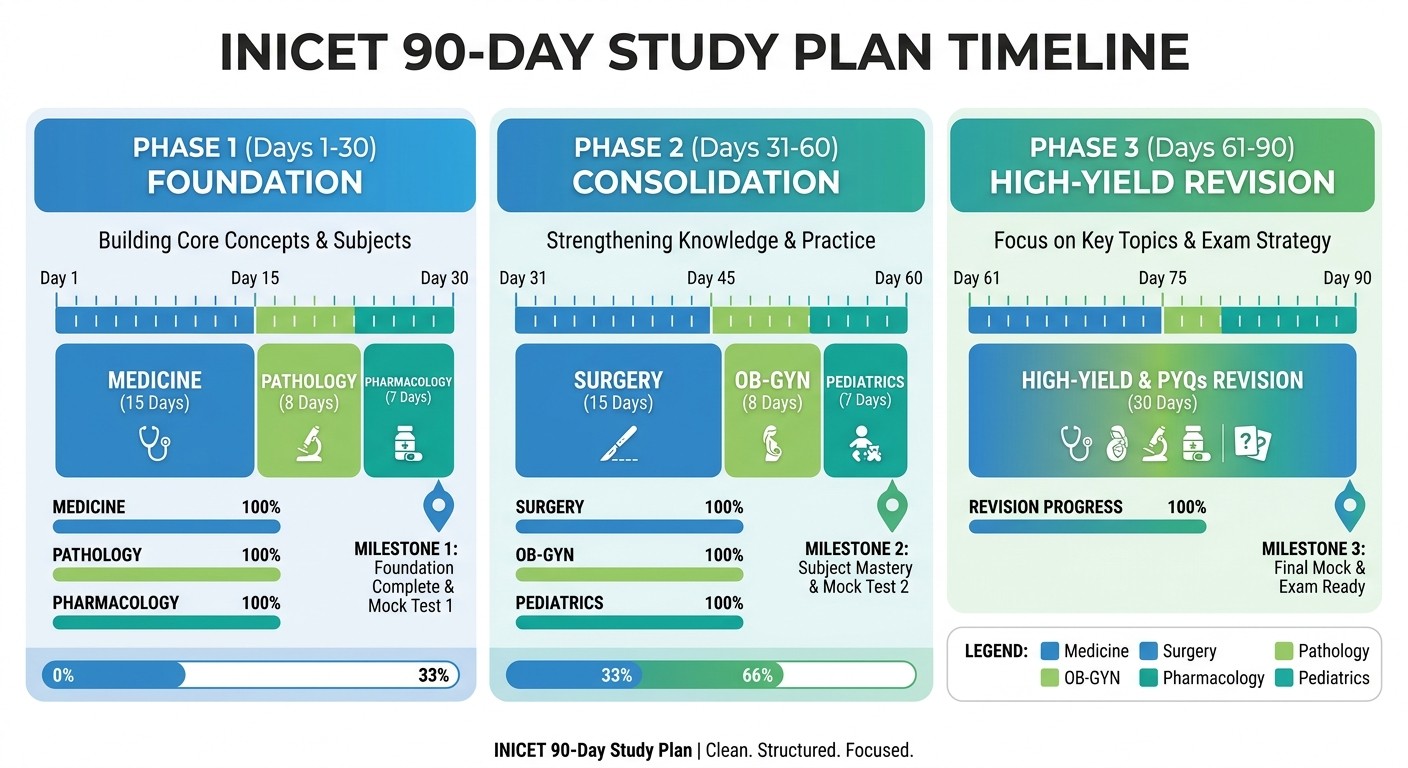
Phase 2 (Days 31-60): Consolidation and Coverage
Target: Complete remaining subjects while strengthening Big Six through revision cycles Week 5-6 Structure:
Daily 4-hour blocks: 2 hours Big Six revision + 2 hours new subjects (Anatomy, Physiology, Microbiology, Biochemistry)
Subject rotation: Anatomy (Monday), Physiology (Tuesday), Biochemistry (Wednesday), Microbiology (Thursday)
Weekends: Integrated case-based practice mixing all covered subjects
Week 7-8 Structure:
Morning block (3 hours): High-yield revision of Medicine/Surgery
Afternoon block (2 hours): Complete Forensic Medicine, Community Medicine, and remaining low-weightage subjects
Evening block (1 hour): Image-based questions and radiology basics
Consolidation Phase Goals:
Cover 100% syllabus across all 19 subjects
Maintain 75%+ accuracy in Big Six subjects
Complete PYQ analysis for last 3 years
During consolidation, use forensic pathology lessons to quickly cover medicolegal essentials, and reinforce with forensic pathology flashcards for rapid recall.
Phase 3 (Days 61-90): High-Yield Revision and Mock Testing
Target: Peak performance through spaced revision and mock test analysis Week 9-10 Structure:
Daily mock tests: Full 200-question INICET simulation
Post-mock analysis: 2 hours identifying and resolving wrong answers
Targeted revision: Focus study time only on areas where mock scores dropped
Week 11-12 Structure:
Rapid revision cycles: 2-day cycles covering all Big Six subjects
Grand tests: Weekly full-length tests under exact exam conditions
Formula consolidation: High-yield calculations, normal values, cut-off scores
Week 13 (Final Sprint):
Days 85-87: Light revision of most frequently missed topics
Days 88-89: Formula sheets and image-based question practice
Day 90: Rest day with confidence-building activities
High-Yield Phase Goals:
Complete 15+ full-length mock tests
Achieve consistent 140+ scores in final 5 mocks
Master time management (105 seconds per question average)
The final phase leverages spaced repetition algorithms — key INICET facts (drug doses, normal lab values, surgical indications) surface automatically through revision cycles, ensuring nothing critical gets forgotten in the final sprint.
Topper Strategy: What High Scorers Actually Do
Revision Cycle Mastery
INICET toppers dont study linearly. They run parallel revision cycles:
Weekly Cycle: Big Six subjects get touched every week, no exceptions Monthly Cycle: Complete syllabus gets one full pass monthly Daily Cycle: Previous day's wrong MCQs get revisited every morning
This prevents the common mistake of finishing Surgery completely, then starting Medicine, then realizing you forgot Surgery basics by Week 8.
PYQ Analysis Framework
Toppers approach previous year questions systematically:
1. Topic frequency mapping: Which Medicine subtopics appeared in all 3 sessions of 2024?
2. Question pattern analysis: How does INICET ask Pharmacology differently than NEET-PG?
3. Error pattern identification: What type of mistakes do you make consistently?
Create a PYQ tracking sheet with columns: Subject, Topic, Question Type, Your Answer, Correct Answer, Concept Gap. Review this monthly.
Mock Test Strategy
Frequency: One mock every 3 days during final 30 days Timing: Take mocks at the same time your actual exam is scheduled Analysis depth: Spend 90 minutes analyzing every mock, focusing on:
Time per subject (Medicine should take <45 minutes)
Accuracy patterns (which subjects drop under pressure?)
Confidence correlation (are you overconfident in weak areas?)
Memory Palace for High-Yield Facts
Build subject-specific memory palaces for facts that appear repeatedly:
Pharmacology Palace: Drug doses, contraindications, interactions Pathology Palace: Staining patterns, tumor markers, diagnostic criteria Pediatrics Palace: Immunization schedules, growth percentiles, developmental milestones
Use the Probe game to gamify these memory palaces — turning boring recall into competitive pattern matching that sticks long-term.
Common INICET Preparation Mistakes and How to Avoid Them
Mistake 1: Equal Time Allocation
Wrong approach: Spending equal time on all 19 subjects Right approach: 65% time on Big Six, 25% on medium-weightage, 10% on remaining
Students who clear INICET with 130+ scores spend 40% of their time on just Medicine and Surgery. Students who struggle spend equal time on Dermatology and Medicine.
Mistake 2: Passive Reading Addiction
Wrong approach: Reading textbooks for hours without active recall Right approach: MCQ-driven learning with concept gaps filled through targeted reading
If you cant solve 70% of Medicine MCQs after reading Harrison's, you were reading passively. Switch to solving MCQs first, then reading only the concepts you got wrong.
Mistake 3: Mock Test Hoarding
Wrong approach: Taking 50+ mocks without analysis Right approach: 15-20 thoroughly analyzed mocks with error pattern tracking
Quality beats quantity. One deeply analyzed mock teaches more than five rushed attempts.
Mistake 4: Last-Minute Image Practice
Wrong approach: Starting image-based questions in final month Right approach: 30% image practice throughout preparation
INICET has 40-50 image-based questions. Students who start image practice late score 10-15 marks lower than those who practice images daily.
Mistake 5: Neglecting Negative Marking Impact
Wrong approach: Attempting all 200 questions regardless of confidence Right approach: Strategic attempts based on confidence levels
Toppers attempt 160-180 questions with 80% accuracy. Strugglers attempt all 200 with 60% accuracy and score lower due to negative marking.
How Oncourse AI Accelerates Your INICET Success
Adaptive MCQ Targeting
Instead of generic question banks, Oncourse identifies your specific weak areas and delivers targeted practice. If you consistently miss cardiovascular pharmacology or pediatric immunization questions, the system automatically increases exposure to these exact topic clusters.
The adaptive engine tracks 47 different performance metrics — time per question, topic accuracy, confidence correlation, revision frequency — and adjusts your study plan in real-time.
Performance Analytics Dashboard
Your dashboard shows exactly where marks are leaking:
Subject-wise accuracy trends: See which subjects drop under time pressure
Topic heat maps: Visual representation of your strong vs weak areas
Revision scheduling: Intelligent spacing of high-yield facts and formulas
Mock test analytics: Detailed breakdowns of each practice session
This data-driven approach removes guesswork from your 90-day plan and focuses effort where improvement creates maximum score impact.
AI-Powered Explanations
Every MCQ comes with detailed explanations that go beyond correct answers. The AI connects concepts across subjects, showing how a Pharmacology question relates to Pathology knowledge you already have.
When you get a heart failure drug question wrong, the explanation doesnt just tell you the answer — it builds connections to cardiac physiology, pathological mechanisms, and clinical presentations, strengthening your overall understanding.
Spaced Repetition for Long-Term Retention
High-yield INICET facts (normal values, drug doses, diagnostic criteria) get surfaced through intelligent intervals. You never let a critical concept go cold, and you never waste time reviewing things you already know perfectly.
The system learns your forgetting curve and surfaces facts just as you are about to forget them — maximizing retention efficiency during your 90-day preparation window.
Explore comprehensive INICET preparation resources across all subjects, practice with subject-specific MCQ banks, and reinforce learning through spaced repetition flashcards.
Frequently Asked Questions
Is 90 days enough for INICET preparation?
90 days is optimal for focused INICET preparation. The exam has 19 subjects but 65% weightage comes from just 6 subjects. This concentration allows intensive coverage of high-yield areas while maintaining revision cycles for comprehensive topics.
What is the minimum score needed for AIIMS Delhi?
AIIMS Delhi cutoffs vary by specialty: General Medicine (110-115 marks), Surgery (115-120 marks), Pediatrics (110-115 marks), Radiology (120-125 marks). Aim for 130+ to have multiple specialty options across different AIIMS institutes.
Should I attempt all 200 questions in INICET?
No. With -0.33 negative marking, attempt questions only when you are 70%+ confident. Toppers typically attempt 160-180 questions with 78-82% accuracy, scoring higher than those who attempt all 200 with 65% accuracy.
How many mocks should I take for INICET preparation?
Take 15-20 full-length mocks during your final 6 weeks. Focus on thorough analysis rather than quantity — spend 90 minutes analyzing each mock, tracking error patterns and time management issues.
What subjects should I prioritize in the last 15 days?
Focus 70% of final-week time on Medicine, Surgery, and Pharmacology. These three subjects contribute 35% of total questions and have the highest revision-to-score conversion rate in the final sprint.
Is coaching necessary for INICET preparation?
INICET success depends more on structured self-study and targeted practice than classroom coaching. Focus on high-quality MCQ practice, systematic PYQ analysis, and consistent mock testing. Digital platforms with adaptive learning can replace traditional coaching effectively.
---
Ready to start your INICET journey? Prepare smarter with Oncourse AI — adaptive MCQs, spaced repetition, and AI explanations built for INICET success. Download free on Android and iOS.